Norman E. Alexander Family M Foundation Forum on Science and Foreign Policy: U.S. Science and Research in a Changing Landscape
Panelists discuss recent trends in federal science investment, how a range of organizations are helping bridge funding gaps, and what is needed to keep the United States at the forefront of global innovation.
Established in 2024, the Norman E. Alexander Family M Foundation Forum on Science and Foreign Policy is an endowed annual event that explores the interconnections among the natural sciences, emerging technologies, and foreign policy and national security. It was made possible through the generosity of the Norman E. Alexander Family M Foundation in recognition of Mr. Alexander’s lifelong engagement in all manner of discourse for the betterment of humanity. The forum provides a unique platform for interdisciplinary knowledge-sharing among scientists and foreign policy experts.
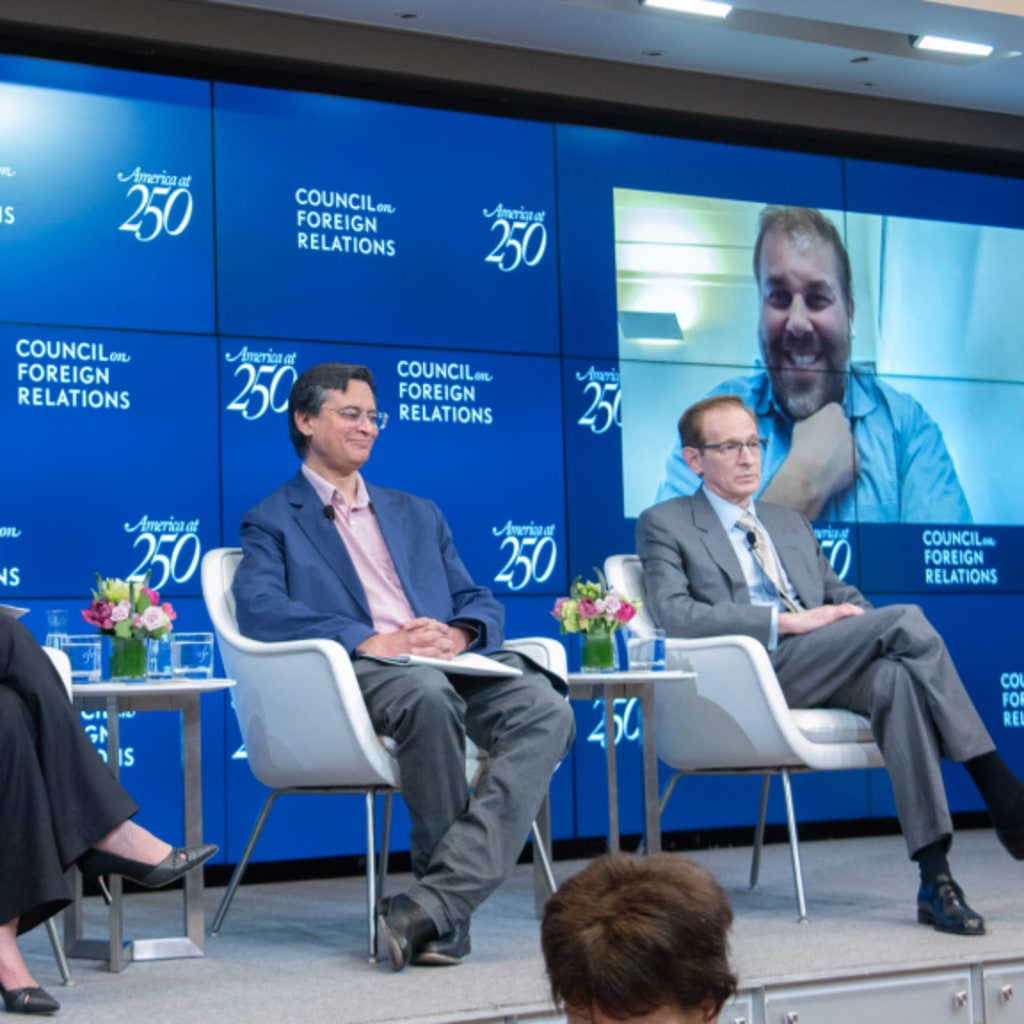
PARIKH: OK. Good evening, everybody. It’s so nice to see everybody. I can’t believe you all came out on a—on a snowy winter’s day. Thank you for being here. I’m Sudip Parikh, and I have the privilege of serving as the chief executive officer of the American Association for the Advancement of Science and executive publisher of Science and the Science Family of Journals.
I want to welcome you to the Council’s second convening of the Norman E. Alexander Family Foundation Forum on Science and Foreign Policy. This Forum was established specifically to explore the interconnections amongst the natural sciences, emerging technologies, foreign policy, and national security—and it is more timely than ever. On behalf of the Council, I want to thank Mark Alexander for the generosity of the Norman E. Alexander Family Foundation in recognition of Norman Alexander’s lifelong engagement in all manner of discourse for the betterment of humanity. Thank you, Mark. The Forum—(applause)—yes. Thank you. (Inaudible.)
Now, the Forum provides a unique platform for interdisciplinary knowledge-sharing among scientists and foreign policy experts. In leveraging the Council’s convening power, we look forward to hosting significant discussions in the years to come with the generous support provided by the Norman E. Alexander Family Foundation.
Now, there is no question that science and technology will play a critical role in tackling global policy challenges from climate change, to food security, to global health, and beyond. And so to talk about that we are really excited—I’m excited—to be a conversation with three people that I respect greatly, and so let me introduce them now very quickly. I’m going to encourage you all to look online and in your packets for the biographies in detail. Everybody here has a very long set of accomplishments; I’m going to just read off one.
So, first let me note Mandë Holford, the professor of organismic and evolutionary biology and curator of malacology at the Museum of Comparative Zoology at Harvard University, and a CFR member. Thanks for being here.
HOLFORD: Hi, everyone.
PARIKH: And then I’m going to go to Robert Millard, or Bob Millard, chairman emeritus of the Massachusetts Institute of Technology Corporation—MIT—and a CFR member as well. Bob.
And then, last and certainly not least, David Spergel, the president of the Simons Foundation, based here in New York.
And so, with that, I want to get started just by setting a little bit of a scene for you. We’re going to do three things in this conversation for the next thirty minutes and then we’re going to open it up to questions. The three things that we’re going to do is: First, we’re going to talk about the federal investment in science—how it came about, why it exists, and why it’s important. Then we’re going to talk about science’s annus horribilis—I’m not very good at Latin—but the horrible year that was 2025 in science. We’re going to talk about the challenges that were—that were—that were faced by the scientific enterprise, how we have addressed them, how we’ve tried to overcome them, and what damage has been done. And then, finally, in act three we’re going to talk about what comes next—what battles are yet to come, what can we do about it, and what does the future look like for American science and technology.
And so, to start the first piece, which is talk about the federal investment in science, then we have to go back in history a bit. And I’ll do that just by setting a scene of where we are today.
We live in wondrous times. Forget about thinking about—don’t think about the paper today, but you think about the life that you’re living. I want you to think about what we know as humans. We know right now that there are two-kilometer-high mountains of water ice on Pluto with methane covers—methane dust sitting on top of them. That is wild to me that we know this. It’s amazing to me that there are grandmothers alive who have cystic fibrosis. That blows me away. That’s a miracle. That is an absolute miracle. It’s a miracle that it happened—it’s God’s work through a scientist—through a scientist like that. And then we live in a time when artificial intelligence has changed everything and that’s all we can talk about. And it’s fed by mastery of mathematics and physics, machine learning.
So we live in this extraordinary time. And every bit of it—every bit of it—I can point back to comes from the fact that the American people made a decision in the last ’40s and early ’50s. And so I’m going to talk just a—we’re going to talk just a little bit about that.
So let me turn to Bob first on this. Tell us about the—that history and how we got here. Who is Vannevar Bush?
MILLARD: OK. Vannevar Bush got his Ph.D. at MIT, but he went to work—he went and ran the Carnegie Institute in Washington. And then he was tapped by FDR to create the National Defense Research Corporation, which was a new entity. And prior to that, the government was not in any serious way in research. There was some research done at the—at the national labs, really for weapons, but they were not in the business of funding scientific basic research. But it was—it was recognized that to win World War II you needed science, and there were a whole host of programs that he very quickly got FDR to fund. And as is said in retrospect, World War II was really won by science. I mean, we’ve been living in an increasingly scientific world.
So coming out of—so there—so there was a great debate at the time as to whether or not universities could actually execute on any sort of science that would be meaningful to the war effort. And Vannevar Bush, who was an academic, really convinced the administration to take that risk. I mean, previously people thought that—Congress thought that the scientists at universities were eggheads and they couldn’t do anything practical. Well, it turns out that a huge amount of stuff was done. Radar was developed. Well, the atomic bomb was, but that wasn’t at a university but drew from the university community. And there were dozens of other projects, from developing fuses to dealing with malaria.
And after World War II, it was recognized that science really won the war. And so he endeavored to create a structure which didn’t previously exist to fund research. He wrote a twenty-one-page paper called Science—the Endless Frontier, which I encourage you to read if you haven’t. Probably a lot—a lot of you have. And it laid out how the government really should fund scientific research, and by the early ’50s the NIH was created, the NSF was created, all as a result of that.
And I’m sorry I’m droning on here, but you asked for the history. Sorry.
PARIKH: No, we’ll be—(inaudible). Is it a—is it a good summation to say that there are two big ideas that came out of Endless Frontier? One is that the U.S. did invest in science in a time of peace just like we did in a time of war. And the second being that we should make that investment at places where you can do both higher education and research at the same time. Is that—is it fair to say those are two of the big implications?
MILLARD: Yeah, it is. And as a consequence—as a consequence, America enjoyed a real brain gain, because coming out of World War II we were—America was about 60 percent of the developed world’s GDP and so to pay for research that we’d share with the rest of the world was really not a free-rider problem, because people—more people came to America to study science. And out of that we built—we built the great research universities. We built the great industries, which were all basically based on science. Previously, science was done sporadically, as I said, in the national labs. It was also done by industry and some—and some philanthropic endeavors like the Carnegie Institute or what’s now the Simons—
PARIKH: Yeah. So this turns into—that third of the investment turns into by 2024 about $200 billion a year being invested by the U.S. federal government in science and technology. And that’s spread across national laboratories, spread across universities, spread across lots of different entities.
But over that course of time, it turns out by 2024 industry is investing almost $800 billion a year in science and technology. And then it turns out that philanthropy is also making investments. So I’m going to turn now to David to talk about, how did philanthropy step into this compact that had been created by Endless Frontier?
SPERGEL: Well, in some ways historically philanthropy was actually there quite early, right? Places like Carnegie, Rockefeller were actually major funders of science before the Second World War. And we now have I’d say a much richer and more complex system. I think of it both in terms of what gets funded—so the universities play a core role training the students, a place where a lot of the most innovative research is done. We also have an important role played by national labs, by industry, by independent labs, places like Cold Spring Harbor Labs. Rockefeller Institute down the road, which eventually becomes Rockefeller University, is set up as an independent lab. We fund at the Simons Foundation an independent lab here in New York, the Flatiron Institute.
The U.S. system is actually much richer for having all these different approaches, places operating on different timescales. When you talk about the 800 billion (dollars) in industry investment, which is really important, but you run a company, you’re investing to make money. You need to develop a product that you need immediately. If you’re investing in something like machine learning, you want something that will have commercial value. You build machine learning on thirty, forty years of academic research when machine learning was considered an obscure area of little promise, but some investors continued to do that. And that’s built, ultimately, on theories of how the neuron worked done fifty years earlier and mathematics—you know, the Kolmogorov-Arnold theorem that’s been developed in pure math, right? So all these pieces come together. So you have a system that’s very rich that way.
And then funding structure is actually quite rich. I think that’s actually one of the strengths of the U.S. system. Federal funding actually comes in the form of many different agencies with different priorities. Philanthropic funding is—I view as the venture funding. We’re doing the riskiest projects. We don’t have to report to the government or to the Congress. We can fund things that can fail a lot, which is, I think, an important piece of that whole infrastructure.
PARIKH: Thanks.
So, Mandë, as a scientist who actually has a lab at the moment, as opposed to the three of us, what does that mean in terms of—in terms of funding for science, in terms of basic research that can lead to big things, from your perspective?
HOLFORD: I think what Vannevar Bush set up was really a fantastic experiment. And just as David said, the U.S. is sort of in a very privileged position in that we don’t just depend on the federal government. The whole ecosystem comes into play when it’s funding my lab.
So my lab and my research has been funded both by NIH, NSF, and a series of foundations as well, which all bring a different perspective to the level of science you can do. When you’re doing discovery research like we are largely doing, you need people who will take the leap with you. When you’re doing applied research, that’s when industry will come and then maybe support some of the initiatives that’s going on.
So I think from what Bush built led to this kind of thriving ecosystem that allows for different angles of science to be done. And when some nations try to copy what the U.S. has done, they tend to focus on the applied aspects, right, like which science is going to lead to, you know, immediate success, so bang-for-your-buck kind of thing.
And I think what’s unique about what we have developed from what Vannevar Bush laid out is this idea that you can try and try again, as David just mentioned. You can experiment. So there are people who will fund just basic science, and not only the quick and dirty—well, not dirty, but the quick and—(laughs)—the quick applied science way, and that you can have these years and years of invested research in basic science and actually discovery science that leads to breakthroughs that no one even imagined.
So as a scientist, I thrive on the ecosystem that’s been built because it allows me to experiment with different ways to think about the questions we want to ask. Do we want something like drug discovery? Where do we go for that? Do we want to figure out why squids use venom at all—(laughs)—or why snails eat fish? Who do we go to for that? So having that broad array of opportunities to fund your work is really priceless, and I think it’s something that is quite unique to the U.S.
PARIKH: Thanks, Mandë.
So now you’ve gotten sort of a baseline of what we’ve been doing for the last seventy-five years, and it’s been extraordinarily successful. It’s the greatest engine of innovation and prosperity that the world’s even known, really is. I mean, it’s built the pyramids of our era when you look at LIGO or you look at the grand telescopes, James Webb Space Telescope. Those are the pyramids of our era, and this is what’s built it. And it’s based on an economy that’s built on the science as well.
But then comes the year of 2025, and so let’s talk about that a little bit. And so we’ve had—as I told you, we ramped up to about $200 billion of investment by the federal government a year in science. In 2025, the president’s budget request would have reduced funding for places like the National Institutes of Health by almost 45 percent, would have reduced funding for the National Science Foundation by over 55 percent. These are gigantic decreases. And I can tell you, when I testified to Congress about this what I said was: If we implement those cuts, we are no longer in a global race for science. We just aren’t. We’ve forfeited.
And so that led on the ground to big, big changes in the way that science was seen and funding was seen. So I’m going to turn to Mandë first on this one: What did that look like from the ground? When you’re—when you are at—when you’re applying for funding, when you’re looking for graduate students, what did that look like?
HOLFORD: It was brutal. (Laughs.) It was very, very brutal. It was a nightmare because you had uncertainty, right? So uncertainty was a challenge. We submitted grants that went into the ether, that you never knew what was happening. Grad schools were reneging on offers to students because they couldn’t—they didn’t know what funding scenario was coming, if these cuts were actually going to happen, if it was going to change or not.
And you know, most of my answers are anecdotal from my colleagues and where—what we experienced, but the cuts to training grants were drastic for early-career students and early-career professionals. It’s really a shame. I really think we’ve lost almost perhaps a generation of students because not everyone can afford to wait till next year to figure out what they’re going to do with their lives, right? So it was a really horrific year for science, and in those twelve months I think we did a significant amount of damage.
The shifting visas was a nightmare. People didn’t know if they were coming or going. I have a student that’s right now detained in Jamaica. Her F-1 was revoked because Jamaica’s now one of those countries that we don’t do immigration anymore with, right? So it was really not a good year.
PARIKH: Yeah. Mandë, thanks for bringing up immigration as well, as these stories all are interconnected. So this amazing investment in science we’ve done in this country has meant we’re a beacon for talent around the world. And we wanted to have talent from here in the U.S., the best talent from here, but to compete globally we recruited from all over the world. And that has really—this year might be the very first year that we have a net outflow of scientific talent from this country, first time in my lifetime, and I’m fifty-two years old.
David, what about from your perspective? What did 2025 look like?
SPERGEL: I think a lot of damage. And I think Mandë’s already talked about the damage to this current generation of students coming up; I think a real damage to U.S. international reputation in the scientific community.
We have been a beacon. This is where the best people want to go. We have been able to attract outstanding talent from Europe, from Asia, from South America, all over the world. We get the best minds to come here, and that’s had an enormous impact on our economy. If you look at the founders of most of the major companies in Silicon Valley, many of them came to the U.S. for their Ph.D. and then founded these companies. We are—we have lost those people.
A lot of people—you know, you’re a graduate student sitting in Germany or Italy, your dream was to come to MIT, to come to Stanford, to come to the top universities for your postgraduate training, and maybe to get a job here, because this is where the exciting work happened. This was a more flexible system. And people really looked to the U.S. for a lead in many ways. It was a—it’s been a piece of U.S. soft power.
You know, when I—we mentioned something like the James Webb Space Telescope. That’s a U.S.-led technological wonder, but it’s something where the Europeans partnered with us, the Canadians, the Japanese, and they all contributed. And we were the core, central nation. We have been for scientific collaborations the center. And we are losing the trust of the world. We are looking hostile to the world. We are—and when you lose trust, it takes a long time to restore.
So I think we have restored for this year the funding. That looks good. That’s a step. But we—another really important piece is to restore the vision of the U.S. as a place that people dream to go to to be great scientists.
PARIKH: And I appreciate that.
Bob, universities have a business model that has been built on this model, and 2025 just took a—basically took a sledgehammer to that. How did they react?
MILLARD: Well, let me just preface it by saying, look, if you—the greatest universities in the world are usually in America, and why is that? I think as we talked about Vannevar Bush, you know, he laid the seed corn down for what we now reap through the scientific enterprise, including the commercial ecosystem. And philanthropy’s been a big part of it.
I think the—I think the great consequences of what you’re talking about, David, are in the future, not this year. I mean, the damage is being done this year. We will reap—we will reap the damage for the next—you know, unless somehow miraculously it turns around, for the next fifty years.
How does it look from the universities’ point of view, is that what you’re—
PARIKH: Yeah. Yeah.
MILLARD: Right. Well, I think—I think the universities—this R-1—the research university enterprise was created so successfully in America from—through a combination of the government, which has a very enlightened view of it all—and arguably, there really were no great research universities in America until post-World War II—and through philanthropy, which has been an increasingly greater share of the research budget and has really enabled these universities to exist.
So what’s the future? I think the future is kind of what we all know, which is that philanthropy will take up a bigger share. It was always around, as you said, David. But I think, you know, at MIT we collect way more in philanthropic gifts than we do from the U.S. government. And that includes the payoff from the endowment, which is really prior philanthropy.
So I think that that will continue, that trend will continue. Thank goodness we have a huge—a huge accumulated wealth owing to, really—(laughs)—these tech companies that, you know, came out of this university ecosystem. And I—from my point of view, I see an increasing share of that going to—going to replace the government. I mean, the government is—you know, all governments have competing claims, as this one does, and I’m not optimistic that we’re going to grow the budget.
And you should really talk about this, because Sudip probably more than anybody else in America had a lot to do with—has as much to do with as anyone else that sort of turning around the congressional pressure on the—on the administration for the science agencies. I don’t know if—I can interview you for a moment.
PARIKH: I’ll quickly hit on that, which is I’ve started this part by saying that the president proposed cutting these science agencies by large amounts of money, almost half. And over the course of the last year, the Congress has really—they’ve found their sanity. And these bills, these appropriations bills that fund the federal government, they’ve just been finished actually this week. There’s one still not quite finished, Homeland Security. And what they have shown, these Republican-written bills have restored the funding for the National Institutes of Health, mostly restored the funding for the National Science Foundation, and mostly restored the funding for NASA. These agencies are flat funded.
Now, the problem is, is that all these agencies in the runup to this—to January and February thought they were being cut, and so they went ahead and made a lot of decisions based on that. And so damage has been done. I mean, there are less fellowships, less graduate students, less basic research being funded. If this had happened thirty years ago, Geoff Hinton might not have gotten the funding that was required to create the basis for AI today. If this had happened forty years ago—not forty; thirty-five years ago, Sergey Brin might not have gotten the funding that eventually became Google. These came from the National Science Foundation. Jennifer Doudna might not have been funded to understand gene editing. These are the kinds of research that would not have been funded if you cut those things in half.
And we’re not alone in the world. Our friends in China have been investing at a greater rate every year. So if you look at the trendlines, we’re going this way and China’s going this way. And if you look at the consequences of that around the world, we have real challenges.
But for the moment, we’ve protected topline funding. The challenge is that there’s more to come. And that’s, I think, what we’re going to spend our time on here in this next section of the conversation.
So, Mandë, I’m going to come back to you. So now that we’ve sort of made it through that horrible year of 2025, what’s the damage that’s been done at your university? You’re at Harvard, which is one of our—one of our nation’s best universities, one of our best research universities. What’s the damage done there?
HOLFORD: I think the damage has been significant across the board, right? So starting again with the early careers and grad students, those programs have cut the amount of students that they admit. So we’ve cut out, you know, the lifeline for some people to do science—the Jennifer Doudnas and the other people you mentioned. They also—we’ve also had grants cut, but the grants have now come back because of judges and all of these things. But it does—the pace at which you do science changes when you’re not sure where you’re going to get your next funding for the projects that you want to do. You don’t know how many people to admit into your lab. Should you hire postdocs? Should you not? But Harvard has, as you all probably know, a really nice, very good endowment. (Laughs.) And they were very, very keen on making sure to support faculty that had grants removed. So they set up funds to help people at least for that year of 2025 to be able to conduct sort of business as usual, or as close to usual as possible. But not every institution could do that, right?
So I left Hunter of City University of New York to come to Harvard. If City University got the same kind of cuts that Harvard had to deal with in 2025, I don’t think they would have survived because it would not be possible for them to be able to support the faculty at the rate that Harvard was able to do.
And so it was—it was an experiment, but I like to look for maybe the silver lining. And the silver lining is perhaps what we do moving forward in the way that we train grad students, in the way that we fund science—more kind of team science kind of building opportunities, and the partnership between philanthropic organizations and universities, similar to what Simons proposed with these Empire State faculty members. And maybe David will talk a little bit more about that Empire State program that he built. But I think it was a good example of how philanthropic institutions can help to support continual hiring of faculty, because there’s a faculty freeze currently. There’s a hiring freeze. So you’re also losing people not just at the very beginning, but also sort of in the middle of their careers as well if you’re not hiring people.
And initiatives like the Empire State—I don’t know what you call them—awards, where Simons is funding—providing funding for faculty throughout different kind of fields and sectors, and then the university can match some of that funding so that we can continue to keep hiring people. I think the hiring freeze at Harvard is still in effect. It might be lifted; I’m not completely sure. But we’ve had really good, visionary people like Dean Hopi Hoekstra, who’s been able to set up these funds to allow grants to continue to flow to existing people. But it has not been easy. I think it takes a lot from the leadership to think creatively about how are we going to maneuver such a beast, right, that everyone sort of thought was grinding along and doing well until it came to a screeching halt, and then you have to sort of pivot midstream.
But I think things like figuring out how we can fund graduate education more effectively. Not everyone’s going to end up in academia, so should we make inroads to internships in industry and other fields would be great. Figure out how we can engage more with policy members so that we can have these discussions about funding not just in times of crisis, but in times of when things are well to plan ahead more, perhaps.
And I think one of the biggest things was that compliance is dangerous. As you mentioned, Sudip, the institutions started to plan for having cuts that didn’t come, and that led to issues. And then you had private foundations as well who cut out training programs, who did a lot of things because they were worried about being a target. And I think that’s a little bit dangerous.
PARIKH: Yeah. I think that’s so true.
Mandë, you hit on something that I want David to follow up on, which is thinking through what does that next model of this look like? We’ve had this model of Vannevar Bush for seventy-five years and it’s done wonders for us, but we’re—we’ve had—you know, as Mark Carney (sp) said, we have had this disruption, not a transition. And the Simons Foundation has been thinking through what are some of the ways that philanthropy can help, but also what are the structures that might be changing in the mix of funding, in the mix of incentive that might—that might get us through this. David?
SPERGEL: I think it’s really a time to rethink a lot of the things we do. I think the response of academia in 2025 was defensive. That’s what we had to do. That’s what people tried to keep things going.
I want to be clear on the role of philanthropy. Philanthropy is not going to be able to significantly increase what it does. Most of our major philanthropies are spending at a prescribed rate, just like the university endowments. In order to do something new like fund these faculty positions, which we did in New York, you have to stop doing things. So we didn’t fund any major new science projects. We basically prioritized junior people and hiring over funding any new project. And so we made that choice. Other places made other choices. But that was really meant as a—as a stopgap.
I think we have to think very differently in 2026. This is, I would say, an incredible moment of opportunity for scientific research. On one hand we have new tools from AI that are letting us do work in ways we hadn’t imagined. You know, I, you know, actually have kept up my publications. I had a PNAS paper accepted today and a PRL paper—Physics (sic; Physical) Review Letters, publication of the National Academy of Sciences—last week. How am I able to do that? Because I have been using generative AI to write my codes. I have been using this in new and innovative ways to enable to me to do research in new areas. It’s really empowering. I think we can have these tools that will transform how we do science.
I think at the same time we also have to think about the way we have done our scientific research. The Vannevar Bush model has been a wonderful model, but we need to think about how we have been structuring things. How do we do graduate education? You know, do we train people in individual labs or do we train them more broadly to cross boundaries? Do we train them where we can let them have rotations through industry? Do we—you know, I think some of the ways universities operate, where every university is sort of for itself and very rarely collaborates with its partners—I mean, there’s amazing things in Boston where you have Broad, and MIT, and Harvard work together, and have created one of the most innovative centers I know and have investments in infrastructure.
But, you know, we don’t need in New York City five nanotechnology labs. You need to be able to think in new ways. We need to be able to think in kind of new structures. We have to build new partnerships.
Even in our international model, it’s sort of built around the idea that the U.S. is the lead nation. Right now in terms of scientific productivity, the U.S., China, and Europe are all kind of comparable in terms of what comes out, and we need to be adjusting for that world.
So I think this is a moment where institutions have an opportunity to really rethink some of the things we’ve been doing, I think, to look at the programs we have at an institution and really emphasize excellence, put our resources into our strongest programs, and maybe make some cuts. Not everyone needs to have the same program at every institution. We are better off having, you know, more leading places in different areas.
I also think we need to rethink how we support science nationally. I think one of the problems we have as a country is we have centers of excellence in a handful of parts of the country, right, and we need to make sure that there are top programs in particular fields all across the U.S. so that they are—we have economic engines that are creating jobs not only in Boston and San Francisco and New York, but in Nebraska and in Texas. Well, Texas actually does fine with Austin. You know, in Oklahoma, right? That there are—we make sure that we are changing some of the ways we do things. And I think this is really a moment where we should use this crisis to really rethink where we are, and rethink how we can do things differently and better.
PARIKH: Yeah. And we’ve got to do that because we have a little bit of runway because of appropriations and because there’s still a fight on immigration. And I can tell you that I know that there’s going to be an executive order that is going to—that is going to constrict the laboratories that’ll be funded based on whether or not there are any people from countries of concern in them. That is—that would be devastating to American leadership in the sciences. And we would not feel it until ten years from now when we wonder where the innovation is, when we wonder where the next great thing is.
So, Bob, you’ve been thinking about the future of universities. I’m going to give you the last—the last question about the future: What’s the future of the universities? I know you’ve been thinking about this, in addition to MIT but elsewhere.
MILLARD: Who knows? I think, yeah, what Sudip is referring to, I’ve been—I’ve been working on a—on a—on a new teaching university, teaching only. I think, you know, for places like the universities that a lot of us went to, teaching and research are an integrated mission. But in—for most of the rest of the country, research and teaching are quite a bit more separated. And the value system in higher education is—points toward research. You get tenure at whatever university it is based on your research, not your teaching, generally.
Some—in David’s future, you’ll probably agree that not every institution of higher education should be doing research in every field. I think that we’re not providing the workforce out of our higher education system that the country needs. Half the kids that graduate from college—the half that do graduate—half of them can’t get jobs because they didn’t study anything relevant. So what Sudip is referring to is we’re working on, with MIT’s collaboration, a new university model to do just undergraduate STEM education, largely through a co-op program. And we think we can bring the cost of an education down to $20,000 a year and train maybe another hundred thousand engineers a year. We produce 140,000 now. China produces, like, a million.
So I think—I think there’s a change afoot, and there’s a change afoot because the majority of Americans now don’t think that a college education is worth it. We’re not talking about Harvard, and Princeton, and MIT; we’re talking about these colleges that are closing weekly because the costs are too high, the job prospects are too low. We’re just—they’re just not delivering the value that everybody thought they were delivering when they were delivering twenty or thirty years ago.
PARIKH: Yeah. It’s a model that’s going to have to be rethought. It’s a model that’s going to have to be rethought. And this moment of—this moment of disruption, this moment of breaking, is also a moment of opportunity.
So that’s where we’re going to leave it, open it up for questions. I hope that—I hope that you dig into us about what is—what is the reason why science matters to foreign policy as well.
Do I just pick? OK. I think this hand was first. Please.
Q: Thank you. I’m Robert Klitzman from Columbia University. Oh. (Comes on mic.) Robert Klitzman from Columbia University.
It seems to me that increasingly Americans distrust science and expertise more broadly. And I’m wondering, how much do you think that affects or contributes to some of the pushback that’s been occurring? And if so, what do we do about that? And should we use some of the limited resources we have now for science to sort of educate the public, which I think doesn’t understand science well? I’d be interested in your thoughts. Thank you.
PARIKH: Who wants to take this one?
SPERGEL: Sure. You know, I think it’s certainly true we need to articulate better the impact of science on people’s lives. We need to train people better about what science is. Some of that’s investment in education at different stages. Some of it is listening to people. And some of, I think, the responsibility is on the scientific community. We too often talk at people; we don’t listen. We too often feel we have the answers.
I think there’s been a problem where we confuse facts and values. And you know, to take a political issue that has been, you know, I think behind some of this, which was during COVID we had to make some real tradeoffs: Do we keep schools open? Do we close them? How long do we do this? There’s a tradeoff between, you know, health threats to the elderly versus threats to—you keep schools closed, we know there’s educational loss; we know that there’s more children being beaten at home if people are stuck at home. These are political tradeoffs. Those are value judgments.
As scientists, we can tell you the facts about the risks of children being home. We can tell you the risks of exposure to disease. Those are facts. And I think we’ve confused facts and values sometimes in the way we engage our public, and I think that’s been a problem in science communication.
PARIKH: Whose hand is up? The black sweater.
Q: Thank you. Hi. Yvonne Ploder. I used to work for a science funder.
My question is around prioritization. So we’re talking a lot about science. Is there an implicit set of priorities that the science community is holding on to as we face cuts and oscillations in the budget?
MILLARD: You should answer that.
PARIKH: I can start, and I can—maybe I’ll turn to Mandë as well. So I’ll start by saying that the administration has definitely chosen. So if you read the plans that come from the administration you’ll hear “AI” over and over and over again, you’ll hear “quantum” over and over and over again, and you’ll hear “applied” over and over again—what I think is a use inspired basic science, which I’m still trying to figure out what that means. All that said, it’s really hard. The level of science that the federal government invests in, you have to have a portfolio.
It’s like your 401(k), right? You need to have some things that are T-bills, that are just incremental science because we need to do that. Then you have to have to have some things that are high risk, high reward, that if it pays off it’s big. And sometimes that can lead to some things that sound silly. And so we pay the price for that. But we have to be willing to have a set of legislators who understand that well enough, they’re willing to say, yes, we will fund that thing that probably won’t work because it’s also going to fund this thing that will work. And I don’t know which one is which.
And so, Mandë, I want to turn to you, because, you know, you have to make the case to funders all the time right now. How do you—how do you tell them that your work is a priority?
HOLFORD: Right. It’s difficult to pick a priority, I would say, in the ecosystem that we have in the U.S., because unlike certain nations where clean water is important, or, you know, vaccines are—well, used to be not this nation—(laughs)—but vaccines are important. And it’s easy for them to focus and say, we’re going to prioritize and do these few things. But in the U.S., we really do have the luxury of having a large expanse of things that we can study. So it’s hard to say that scientists are going to prioritize one thing or another. Some people might be biased and say space. I would say the oceans. And so it’s hard to say what you’re going to do.
But when you make your case, like the case that—for my research we do a lot of basic science, discovery sort of driven science, it’s about the future. It is about the long the long game. It is about the fact that we don’t know these bacteria, or we don’t know these species that exist, and we find them, and we learn new things from them, and we’re able to do bigger and greater things. And so in some sense you need the belief of the politicians that better things are to come. But we can’t get there by leapfrogging. We kind of have to go through the journey of knowledge and really invest in the long game. And so the idea is that the promise is there, but you have to do the hard work.
PARIKH: And if Bob wants to chime in, then we’re going to go the virtual question.
MILLARD: Well, just to answer another facet of that is, look, the great strength of doing science in a liberal democracy is that the underlying mechanism is curiosity. We do curiosity-driven research at the basic level in this country, better than anyone else has in the history of the world. And you don’t know where that’s going to lead. It may lead to dead ends. But it’s sort of a market signal. Everybody who’s tried to command it from the top has not done as well. It’s a bottoms-up evolutionary process. And that’s because no one can predict the future.
PARIKH: And it’s a lesson that has to be learned every generation.
Virtual, please.
OPERATOR: We’ll take our next question from Patricia Rosenfield.
Q: Thank you very much. And great thanks to the Alexander family for this wonderful forum. I hope there’ll be many different avenues for follow up. I have a—I’m from the Herbert and Audrey Rosenfield Fund. But my question—my comment and question are based more from my work at a U.N. agency, the World Health Organization, and a private foundation, Carnegie Corporation.
I have a comment and then a question. My comment is, I’m not sure that we need a new model in higher education. We have the community college system in this country, which it sounds to me is doing much of what you’re—what I heard today. And I think supporting community colleges, many of which including one I know well, Borough of Manhattan Community College, is prioritizing science and technology along with the humanities. So I would suggest that in this era instead of new funding to look at existing institutions that are important in every community around the country, and to support them.
But my question is related to something that David said in his really thoughtful comments about international cooperation. I haven’t heard much discussion about that. And I’d be really interested in each of the speakers commenting about the damage to international cooperation, both through the cuts in funding to U.N. agencies, what we had in the U.N. thinking about closing. This is in the articles in today’s paper. But also just in various mechanisms, the hydrological year, around the pandemic, and many, many different areas which have benefited so much from international cooperation, many of which had received support from NSF and NIH, and including—and other agencies, including AID, and the State Department, and the Defense Department. So I’d really appreciate understanding what do you see the costs are, both in science and in just human—and all the developmental aspects of science.
PARIKH: Thanks. I know all the panel members have just recently been traveling internationally. So, David, do you want to start, then we’ll go to Mandë and Bob?
SPERGEL: So let me talk about what are the costs? There are many different ones. And one of the many ways in which we have led the world is we have been the source of scientific data—whether that’s climate data, medical data. A lot of—the world has looked to us for collecting, disseminating data. And because of our tradition of openness we’ve been kind of the intellectual center. And with some of these cuts, the data has become vulnerable. And many of our foreign colleagues are somewhat panicked, because they relied on us. And what we’re seeing is in some ways healthy. They’re trying to make sure that they can reproduce it in their own countries.
But it’s sort of—it’s a case of loss of U.S. leadership. That we were where everyone turned. And, you know, it is one of my worries about one of the impacts of this. We have been the lead nation in science. We have been the place that everyone looks to in so many different ways. And we have benefited from that leadership. Whether you think about it in terms of soft power or think about it in terms of our ability to track talent. And we have put that at risk.
PARIKH: Mandë, you were just in Madrid.
HOLFORD: Absolutely. I would agree 100 percent with what Dave said. This is the first time I’ve traveled to Europe, I was at a conference, and no one came to me to ask, oh, how do we come to your lab or how do we visit? The loss of 2025 I think we’re feeling immediately. We don’t have to wait ten years to see the effect. No one wanted to come. They were all worried about visa issues. They were all sort of in disbelief that, as Dave said U.S. science is always put on a pedestal. It’s where you go to do the kind of science where you want to dream big and think crazy thoughts, and someone will fund it, right? Not every society is willing to fund curiosity-driven science. Not every society is willing to fund discovery research. But they knew the U.S. could do that and would do that.
But I think we’ve lost a great deal of hope in the idea of science in the U.S. because, as a lot of young people in Europe, especially, would come to the U.S., to do even a short stay to sort of boost their CVs, then return and get a position in their own country, they’re not doing that anymore. At least, this is anecdotal from my experience, they’re going to other EU countries. They’re not necessarily wanting to come to the U.S. after just this one year. And a lot of people are sitting it out because the visa process still remains to be very tricky. Getting an appointment even for a visa remains to be very tricky. And so I think the damage we’ve done on an international scale can’t be quantified necessarily right now, but it can certainly be felt in the human side of the loss. It’s like, you know, you’ve lost a good friend, or a cousin, or someone that you used to have faith in is no longer there. And the response has been to recoil and to not engage for at least a while, perhaps.
PARIKH: Bob.
MILLARD: I think they’ve said it well. I mean, it’s—I don’t think anybody thinks that that science is unimportant. I don’t think anybody thinks that science has been helped by the hostility that we’ve seen from the political.
PARIKH: The one thing I’ll add is that there are now multinational projects where the U.S. is not even invited. And that is extraordinary to me. I mean, usually it’s been, oh my gosh, the U.S. won’t participate, what are we going to do? We have been actually left out of potential international collaborations. And that is a turning point. That has never—I’ve not seen that before, not since the days of the Soviet Union. So we are entering a new phase.
In the corner here.
Q: I’m glad you mentioned the Soviet Union. So we wanted to kind of go back to that era. Ben Schmitt, University of Pennsylvania.
I think that it’s interesting that in that era there was still great-power competition, but we didn’t see the Soviet Union engaging and taking these sort of malign activities, or establishing infrastructure at scale abroad, like we do now both looking at things—for example, the Russian Federation searching for oil and gas inside of the Antarctic Treaty System, which is, of course, against the Antarctic Treaty System. People’s Republic of China establishing six maybe seven bases in Antarctica. At the same time that the United States has mothballed our only Antarctic-class research icebreaker.
And, you know, China is establishing research stations, actual physical footprint and presence, around the world, including in the Arctic where the last time the United States has established a base was the Greenland Summit Station in 1989. So I guess this clearly has not only a soft power, but a hard power aspect of this as well. There’s clear national security implications. So my question is, in all of your engagement with policymakers, including those that have restored this funding, is the national security argument and that global competition argument ringing through? And if so, is it also going to eventually ring through to the White House?
PARIKH: Yeah. I might be the person who’s into politics more deeply than anybody up here, so I can maybe respond to that. You know, those arguments—we’ve been making those arguments for a long time, right? National security, prosperity, and health. That’s actually—if you look at Endless Frontier, it’s those exact same arguments. It turns out that politics matters as well. And so it turns out that there are Republican chairs of appropriations committees that really were worried more about a primary than they were about whether or not we had icebreakers in the Arctic. And so you have to talk about how do you protect a chair of a committee on appropriations from the right, because they’re going to get a primary if they are pushing back on the president’s budget request?
And so being political without being partisan is something that science has not been good at. But we’ve had to—we’ve had to learn this year, because if we don’t we’ll realize that, because we do live—we live in this liberal democracy that Bob talks about—we have to participate in that liberal democracy. If we don’t, we can’t expect that our leadership will just come to the right answers because they’ve read the books in the Library of Congress. That was the original idea, by the way, of the Library of Congress is that folks were going to get wisdom from reading those books. It turns out that there’s a political process.
And so what I’ve found, this year in particular, is that the politics matter. They know the argument about the Arctic. They know the argument about rare earth minerals. They know the arguments about climate. What they have—what they have not seen is a political pathway to get to support for the sciences. I don’t know if folks want to add to that.
HOLFORD: I would agree with that 100 percent. I was a AAAS science and technology policy fellow. And that was the first time that I really saw science from the other side, right? I’d always been the practitioner at the bench and the student, and the lab head. But it wasn’t until you’re talking with the politicians and engaging with them that you see that they think of it in a very different way. It’s not at all the long game that we see when we’re working on big projects. It’s much more driven by turnout, driven by is it an election cycle, is it not an election cycle? And I think it’s important for scientists to realize that these discussions have to happen continually, and not just in moments of crises.
But we have to continually talk to them and impact on them that science is a global endeavor. And when you mess around with visas, and when you mess around with funding, pulling us out of multinational projects like the Paris accord, or whatever is happening, it has implications to the kind of science that we do in the kind of place that the U.S. is seen, for welcoming other scientists to come here and engage. And these discussions have to continually happen with policymakers, and not just one-on-one when there’s a crisis moment.
PARIKH: Thank you. We just have a couple minutes left. I’m going to take three more questions, maybe here in the front and then the two there. And we’ll—let’s just hear them all at once, then we’ll try and answer as much as we can.
Q: Amar Bhide. I’m a hiring mistake at Columbia. I represent the reactionary element. (Laughter.)
So there’s a macroeconomist at Northwestern called Robert Gordon who has made the argument, which I don’t necessarily agree with, that productivity has slowed down—slowed down considerably. Roughly starting with the period that Vannevar Bush wrote his famous report. That notwithstanding the huge investments that have been made in science and technology, according to Gordon productivity—we’re simply feasting off the advances that were made before this huge investment was made. I’m a sort of amateurish historian of science and technology. And I look at the great advances in modern physics. And I see that Einstein was a patent clerk in 1905 when he did his major work in relativity. I see Heisenberg and Bohr all doing fundamental breakthrough work before huge investments were made. I see the decoding of the DNA taking place by Watson and Crick, again, before huge investments by the NIH.
And finally, I guess we have completely different views about the origins of the research university in the United States. In my reading, there is great research universities of the United States were catalyzed by the German research universities, which, in turn, were catalyzed by the German chemical industry. So if I look at Stanford, MIT, Johns Hopkins, the Carnegie Institutes, they all came into being before NIH funding. If I look at what caused Harvard to turn itself into a research university, it was Conant, a chemist in the 1930s. So are we giving excessive credit to this cornucopia of federal funding that has been poured in the direction of elite universities? And might not the public interest be served by a more honest debate about where this money has gone and what the alternatives to this kind of funding might have been?
PARIKH: I’d love to talk about that with you over a drink. Let’s go to the two over here and we’ll have—and we’ll finish this conversation. There were two, one there and one there. Yeah, they’re right next to each other. Yeah.
Q: All right. Hi. My name is Hall. I was a C-student in physics back in high school.
But I want to ask about commercialization. You know, a lot of great U.S. research innovation in batteries, solar panels, and even the iRobot from MIT, are now being successfully commercialized by the Chinese. Are we doing something wrong with commercializing our own research, instead of giving it to someone else to eat our lunch, figuratively, sometimes literally, speaking?
PARIKH: That’s a great question. And the last.
Q: Yes. Daniel Gilmer, pharmaceutical sector. So hello, Mandë. Good to see you.
So I have a question really on this emerging sentiment around the new model and where some of this funding may go. What are some of the risks associated with perhaps having the U.S. government receive equity in exchange for this funding? Imagine the 200 billion (dollars) not going out as just grants, but something more like the Intel model that we’ve seen more recently. What would that look like, if it was invested based on equity? Especially if the U.S. government is also regulating companies within those sectors where it has an equity position.
PARIKH: Sounds like we’re taking that experiment to heart. All right, we have thirty seconds each to answer any of that that you heard. Bob, I’ll let you go first.
MILLARD: Well, there were diverse questions so I could—basically can answer whatever I want, right?
PARIKH: Right, exactly.
MILLARD: So I think—one of the things I think you touched on was the so-called declining productivity of the science enterprise. And I’ve heard that before. But I think science is harder. You know, when Tycho Brahe, you know, he didn’t even have a telescope and he figured out a lot of stuff. You need big science now. It’s just more expensive because the problems are harder. And we’re getting to the point where we actually can redesign—I mean, we—it’s just harder.
PARIKH: I’m going to ask you to leave it there and turn to David. David, go ahead.
SPERGEL: Tycho Brahe actually was funded by the Danish government at a funding level, as a fraction of the Danish economy, that’s much higher than our current science funding by the federal government. And if it wasn’t for Brahe’s observatory he would not have made those discoveries. I’m a physicist. And if you look at the work that Einstein did, you know, it was only through government funding, with the LIGO Laboratory, and funding that was a multiyear investment, that we were able to detect gravitational waves from the early universe. That funding has been—could only have happened at that level. It’s curiosity driven.
We actually now understand where all of the gold and platinum, all the metals in the universe, are created. If you have any gold on you, it was created when two neutron stars collided at high speeds and merged and formed an enormous explosion. We’ve detected the signal from that. MIT faculty spent—devoted his career to this and won the Nobel Prize for it. And it’s one of those areas where, as we went to develop that technology, we basically came up with differential GPS. And every time you land at an airport in bad weather, it’s because of the technology you developed for black holes.
PARIKH: That’s a great place to leave it, David. I’m sorry. Thirty seconds. I’m going to turn to Mandë for the last—the last set of answers.
HOLFORD: Great. I would say that we can’t replace the federal government for investing in science. It is a key partner. It has to continue to do so at a scale that is the scale that we want to do to be able to make breakthroughs and to have—you know, answer complex questions. I think David is right. Philanthropy can only do so much. And it certainly cannot replace the federal government. And the advantage of having the federal government at the scale that we have it is that we can build things like the space station, and that we can have CERN, and all of these other investments that just aren’t possible at an individual university level, or an individual company level, or an individual collaborator level.
Having the engagement—the full engagement of the federal government in science means that we can be a symbol for international scientists and have multinational corporations that really advance how science is going to go. And so I would—I would hope that going forward in 2026 we don’t decide to not engage because of what happened in 2025, but we step boldly towards politicians and make the argument that science has to be funded, and funded really well, at a federal level for us to continue to lead.
PARIKH: Thank you, Mandë. And with that, we’re going to reach the conclusion of our meeting. I will say, as far as the argument whether or not science is doing anything for us, it reminds me of this argument that I heard one time about the weather app. And somebody said, hey, what’s the weather outside? And I pulled up the app, and it said sunny outside. And then he said, look out a window. Look out the window. Look out the window for what science has delivered for the country and for the world. And that can give you some of the answers. So with that, let’s argue about that over a glass of wine. Thank you, everyone, for joining us.
(END)
This is an uncorrected transcript.
Speakers
- Mandë N. HolfordProfessor of Organismic and Evolutionary Biology and Curator of Malacology, Museum of Comparative Zoology, Harvard University; CFR Member (speaking virtually)
- Robert MillardChairman Emeritus, Massachusetts Institute of Technology; CFR Member
- David SpergelPresident, Simons Foundation
Presider
- Sudip ParikhChief Executive Officer and Executive Publisher of the Science Family of Journals, American Association for the Advancement of Science; CFR Member





 Symposium