Five Revolutions that Shaped the Modern World
Explore some of the revolutions that have shaped history since the end of World War II.
By experts and staff
- Updated
Revolutions have influenced the course of history throughout the ages, upending , sparking wars, and reshaping countries’ foreign policies. This list looks at five of the most significant revolutions that took place in the decades following World War II, examining what caused each, how they unfolded, and what they meant for the world.
Chinese Communist Revolution (1949)

Background: In the early 1900s, most Chinese citizens lived in poverty. A few powerful landlords controlled the vast majority of the country’s wealth, and foreign countries exerted significant influence over the economy. In the years following the collapse of the Qing Dynasty in 1912, the ruling Chinese Nationalist Party (KMT) attempted to unify China and rebuild its economy, often in an uneasy alliance with the Chinese Communist Party (CCP). But disagreements over policy and ideology eventually sparked a .
Outcome: The CCP prevailed in 1949, establishing the People’s Republic of China (PRC). Meanwhile, the defeated KMT fled to Taiwan, from which it continued to claim legitimate over all of China under the name the Republic of China (ROC).
Factors that influenced the revolution’s outcome: Japan’s invasion of China in 1931 caused the KMT to lose support among the public and made governing the country difficult. crushed the Chinese economy. In addition, students and laborers organized mass strikes in opposition to the KMT’s corruption and theft of public property, among other issues. Many citizens also viewed the KMT as unable to defend the country from Japanese occupation. Such shortcomings were flaring when compared to the highly organized armed forces of the CCP. At the same time, the CCP gained popular support from the peasant masses for its proposed land reforms. The CCP also promised desperately needed political and material support from the for their shared ideology.
Foreign policy implications: The charge that the United States had “lost” China to fueled anti-communist sentiment in the United States. It also made the United States sensitive to any further communist revolutions in Asia and drove U.S. interventions elsewhere. Mao Zedong encouraged North Korea to attack South Korea and intervened on the North’s behalf to fight U.S. soldiers. Mao’s China tried to spread revolution throughout the world, while the United States withheld diplomatic recognition for three decades. Instead, the United States maintained ties with the ROC (Taiwan). The CCP believes that until Taiwan becomes integrated into the PRC the Chinese civil war is incomplete. The dispute over Taiwan is an ongoing source of geopolitical tension in the region.
South Africa’s Negotiated Revolution (1948-94)

Background: Afrikaners–South African descendants of Dutch settlers–systemized three hundred years of racial segregation after they came to power in white-only elections in 1948. During their reign, Afrikaners implemented a policy known as apartheid, meaning “apartness.” Black South Africans could only live in specific Black-only townships, could work only in certain segregated and low-paying industries, and could not vote. The government banned Black political organizations like the African National Congress (ANC). Additionally, law enforcement arrested and executed some Black activists.
Outcome: After decades of armed struggle, the ANC and the South African government began a series of negotiations in 1990. The negotiations gave the majority Black South African population control over the government. In exchange, white South Africans retained their wealth and control over the economy. In 1994 South Africa held its first free and fair elections. Nelson Mandela, the leader of the ANC, became the country’s first Black president.
Factors that influenced the revolution’s outcome: White South Africans concluded that apartheid did not work. Starting in the 1970s, countries imposed and embargoes on the South African government because of its apartheid policies. Meanwhile, the ANC established ties to foreign governments and lobbied for its cause. The ANC began a slow transition, which is still underway, from a revolutionary movement to a political party.
Foreign policy implications: Since the end of apartheid, South Africa has participated in negotiation efforts to end conflicts in other African countries. In addition, South Africa’s anti-apartheid movement has served as a model for human rights movements around the world.
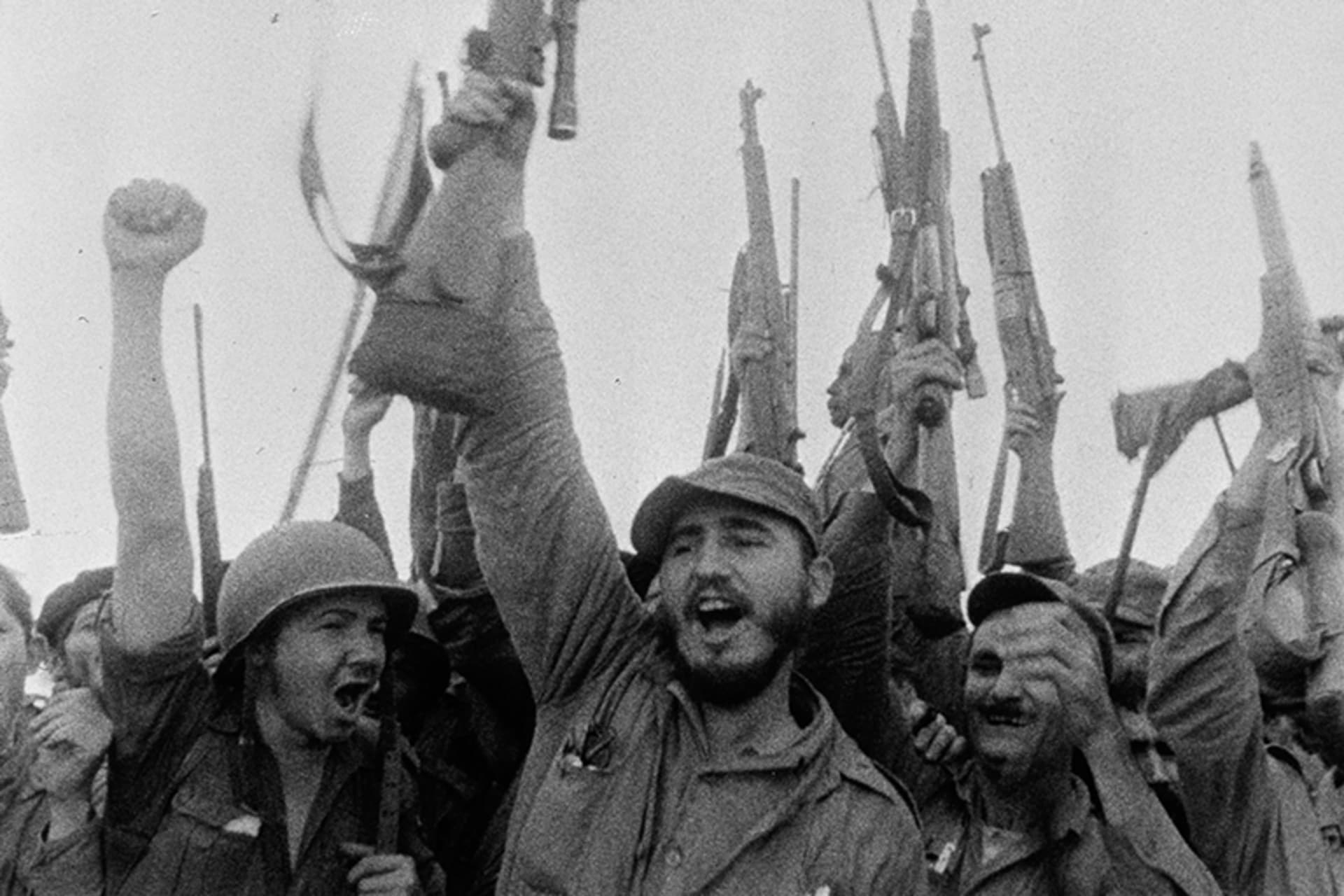
Cuban Revolution (1953-1959)

Background: Cuba experienced high levels of corruption, unemployment, and inequality in the early 1950s. The country’s economy was lagging and largely depended on the United States. In 1952, General Fulgencio Batista staged a coup with the support of the army and suspended the constitution. Batista established a regime notorious for its arrests, torture, assassinations, and criminality.
Outcome: Revolutionaries ousted Batista in 1959. Shortly thereafter, Fidel Castro took control of Havana and the Cuban government.
Factors that influenced the revolution’s outcome: Despite Batista’s military advantage, Castro mounted a successful guerrilla campaign from the Cuban mountains. Coupled with guerrilla tactics, Fidel controlled the urban underground which facilitated logistics and civic resistance. Castro built a growing through popular radio broadcasts. Meanwhile, Batista’s support fractured. The U.S. government stopped supplying arms to the Cuban government in 1958.
Foreign policy implications: Castro’s government was decisively anti-United States. The regime seized all U.S.-owned companies in Cuba and aligned itself closely with the Soviet Union. Castro also supported like-minded revolutionaries across the world, sending troops and aid to countries including Algeria, Angola, Congo, Venezuela, and Yemen. The United States tried to topple Castro’s regime during the botched Bay of Pigs operation in 1961. Castro’s ascension also shaped U.S. policy in Latin America for the duration of the . Washington was focused on preventing “another Cuba” including by backing a military coup against a left-leaning government in Chile. In 1979, the Sandinistas successfully staged a revolution in Nicaragua and imposed a socialist regime. The Sandinistas nurtured close ties to Cuba and the Soviet Union.
Hungarian Revolution (1956)

Background: Following World War II, the Soviet Union established a communist regime in Hungary. The communist reforms caused inflation to soar and the standard of living to drop. After the Soviet Union removed Imre Nagy, a reform-oriented prime minister, from power in 1955, Hungarians protested and demanded his reinstatement.
Outcome: The revolution–a potential blow to communism–failed to achieve its goals of political and economic reform. In response, the Soviet Union sent tanks into Budapest and installed a reliable ally, János Kádár, at the head of the government. With Kádár’s assistance, Soviet forces arrested and ultimately executed Nagy.
Factors that influenced the revolution’s outcome: Calls for Nagy’s reinstatement turned into demands for more radical change. Hungarians began to advocate for the reduction of Soviet influence in Hungary and the removal of Hungary from the Soviet-led alliance known as the . But faced with Soviet tanks, the revolution quickly collapsed.
Foreign policy implications: Hungary’s failed revolution demonstrated that the Soviet Union was prepared to use military force to preserve communist regimes in Eastern Europe. The revolution also showed that the United States was not prepared to intervene on behalf of democratic movements. Kádár governed Hungary from 1956 to 1988, maintaining close ties with the Soviet Union.
Iranian Revolution (1978-79)

Background: Two successive monarchs, a father-son dynasty known as the Pahlavis, ruled Iran from 1925 to 1979. The Pahlavis were modernizers who promoted and women’s rights. They were also unelected strongmen who violently suppressed political dissent. Additionally, the Pahlavis maintained close ties with the United States and Britain. The CIA backed a 1953 coup in Iran that overthrew the country’s prime minister to keep the Western-friendly monarchy in power. The Pahlavis remained deeply unpopular in much of Iran, and public discontent boiled over into mass protests beginning in 1977.
Outcome: The younger Pahlavi was ousted as (or king) in 1979. The ouster enabled the rise of the formerly exiled cleric Ayatollah Ruhollah Khomeini. Under Khomeini, Iran transformed from a secular, Western-backed monarchy into a deeply anti-Western theocracy. Following the rise of Ayatollah Khomeini an Islamic republic in which conservative religious leaders governed with near-absolute power was established.
Factors that influenced the revolution’s outcome: The shah and his foreign allies underestimated the size and strength of the revolution. Protestors came from numerous segments of society, initially united under the leadership of Khomeini. When the military refused to fire on protestors, the shah fled the country.
Foreign policy implications: Soon after the revolution, Iranian university students stormed the U.S. Embassy in Tehran, taking American staff hostage for 444 days. The crisis resulted in not only American sanctions on Iran but also the severing of diplomatic relations. They remain suspended more than four decades later. Iran also sought to extend its revolution and influence throughout the Middle East. The Iranian regime has supported politicians and armed groups that followed its sect of Islam (Shiism), often frustrating many of its Arab and Sunni neighbors.


