How Health Care Works Around the World
Experts agree that access to quality health care is the best way to improve global health. But health-care options vary greatly depending on where you are in the world.
By experts and staff
- Updated
: A Global Goal
In recent decades, more people have gained access to crucial health services such as , HIV antiretroviral treatment, and bed nets to prevent malaria. That is good news, but progress has been uneven. Wide gaps exist in the availability of services not only among countries but also within them. On any given day, half the world’s population cannot access the care it needs to stay healthy.
Experts say that the best way to improve health outcomes is actually simple: ensure that people have access to quality health care. Some call for universal health coverage (UHC), which is the ability of all people to go to a doctor for preventive care or when they are sick, and then to pay for the care they receive. International organizations such as the United Nations, the , and the are urging countries to provide UHC by 2030, going so far as to include a specific target to achieve UHC in the UN . However, even before the COVID-19 , the goal to extend UHC to an additional one billion people was not being met. The pandemic’s strain on resources and economies has further limited progress in financing universal health care.
The World Bank tracks countries’ advancement toward UHC with a measurement called the UHC service coverage index. Data from that index shows that in countries with functioning national health-care systems and higher gross national incomes, which score high on the index, health outcomes are broadly similar, with high life expectancy and low infant mortality rates; the opposite is true of those that score low on the index. In fact, twenty-five years of life expectancy separate citizens of countries at the bottom of the index from those at the top.
There is no one-size-fits-all solution.
Around the world, health-care systems differ widely. Countries adopt different systems to provide health care to their citizens, with different levels of government and private sector involvement. The crucial result is that the services exist effectively and safely—and that people can access and afford them. The spectrum of ways in which health care is delivered around the world can be gathered into four general categories, from universal coverage under fully funded national programs to no coverage at all, requiring individuals to pay for health care completely out of pocket.
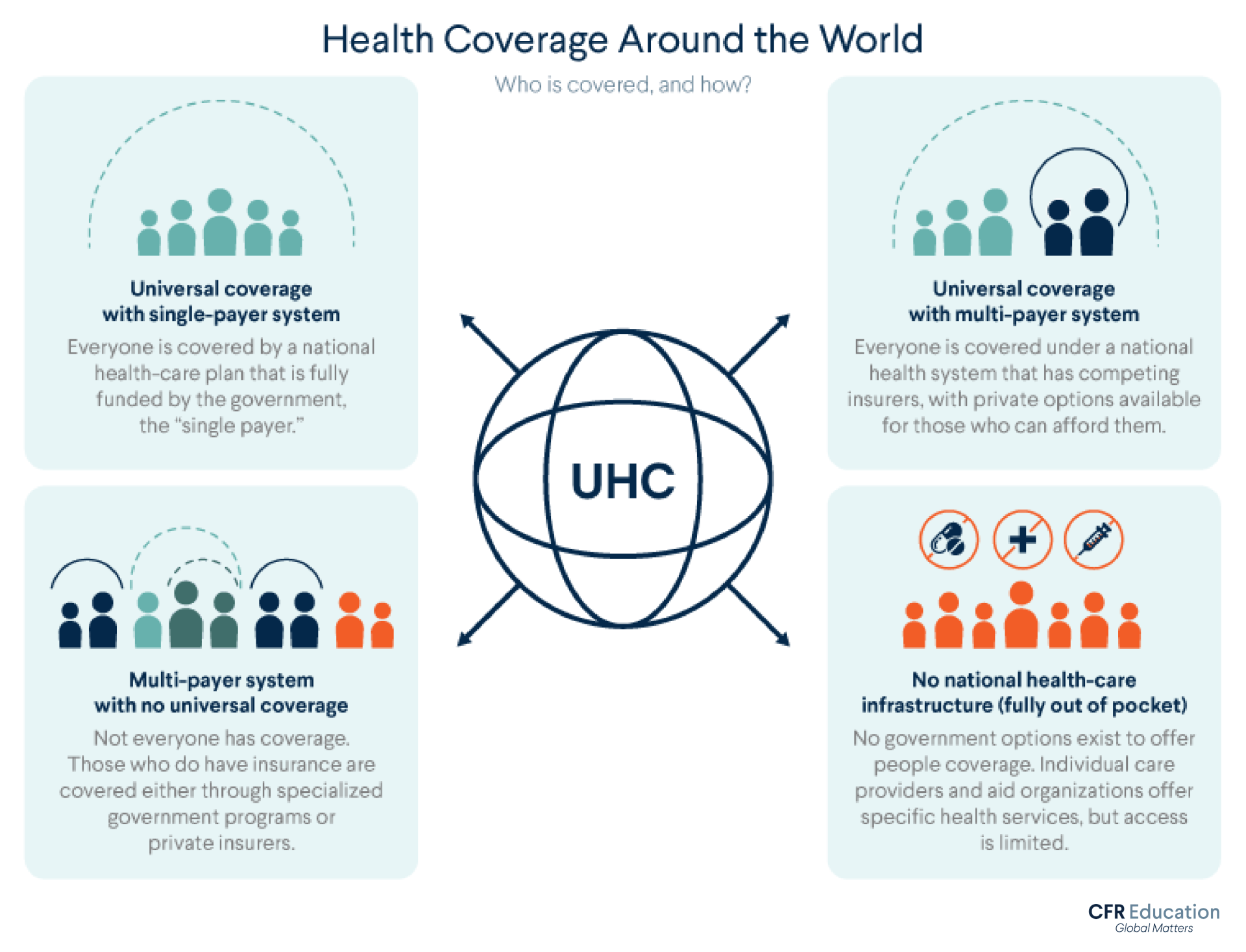
I. Universal coverage with
Everyone is covered by a national health-care plan that is fully funded by the government, the so-called single payer.
- In many countries with socialized health care, such as Cuba and the United Kingdom, the government provides care through publicly run hospitals and clinics.
- In countries with single-payer systems, many doctors are government employees, while others get compensation from the government.
II. Universal coverage with
A national health insurance system administered by competing insurers usually exists alongside a private insurance option for high-income people. Governments keep costs low through regulation and direct negotiation with pharmaceutical companies.
- In countries such as France, Germany, and Japan, people are required to have health insurance, which is mostly publicly funded.
- Those countries use greater percentages of government revenue on health care services: all three countries spend around 11 percent of their (GDP) on health care, compared to a global average of 9 percent.
- However, those countries typically have options for people to pay private insurers for premium or more specialized services. In Germany, while nearly 90 percent of the population has primary coverage through public health insurance, about 10 percent has private insurance.
III. Multi-payer system with no universal coverage
A mix of health-care programs exists, although health insurance is not required. The government allows private insurance companies more autonomy, which has given rise to advanced medical technology along with high costs and no guarantee of health coverage.
- The United States has a multi-payer system without universal coverage. People can have private insurance through their employers; be covered under single-payer Medicare if they are sixty-five or older; be covered under government-funded Medicaid if they have a disability or earn less than a certain amount; receive socialized care through the Veterans Health Administration if they have served in the military; purchase private insurance on exchanges set up by the Affordable Care Act; or simply go uninsured, as just under 8 percent of the U.S. population, or nearly twenty-five million people currently do. (In 2022, nonelderly Hispanic/Latino and American Indian or Alaska Native Americans were uninsured at higher rates—about 18 percent and 19 percent respectively—than their white counterparts [roughly 7 percent]).
IV. No national health-care infrastructure (fully out of pocket)
An important fourth reality exists in that, for most of the developing world, no national health-care infrastructure exists.
- Health care is subsidized minimally or not at all. Recent data shows that the government of an average low-income country spends less than $40 per person on health, compared to the United States, which in 2021 spent over $6,700 per person, and the United Kingdom, which spent approximately $4,800.
- Access to doctors, vaccines, and medications can be limited.
- Aid organizations sometimes fill the gap, but a significant portion of global health financing today targets specific diseases, not holistic or preventive care.
Given countries’ different economic, geographic, and political domestic situations, expecting one approach to health care to work for all of them is unrealistic. More important than one system, however, is a universal goal: to provide quality health care to the maximum number of people at an affordable price.
Used in
Global Health Policy Brief Scenarios
Activities