Climate Prompts: Fact or Fiction? Activity
Learning Objectives
Students will examine and compare their current understandings of climate change in this introductory activity to the topic.
Instructional Plan
Attach a “Yes/Agree” sign to one end of your classroom. Attach a “No/Disagree” sign to the other end of your classroom. Attach a “Maybe” sign to the front of your classroom mid-way between the two other signs.
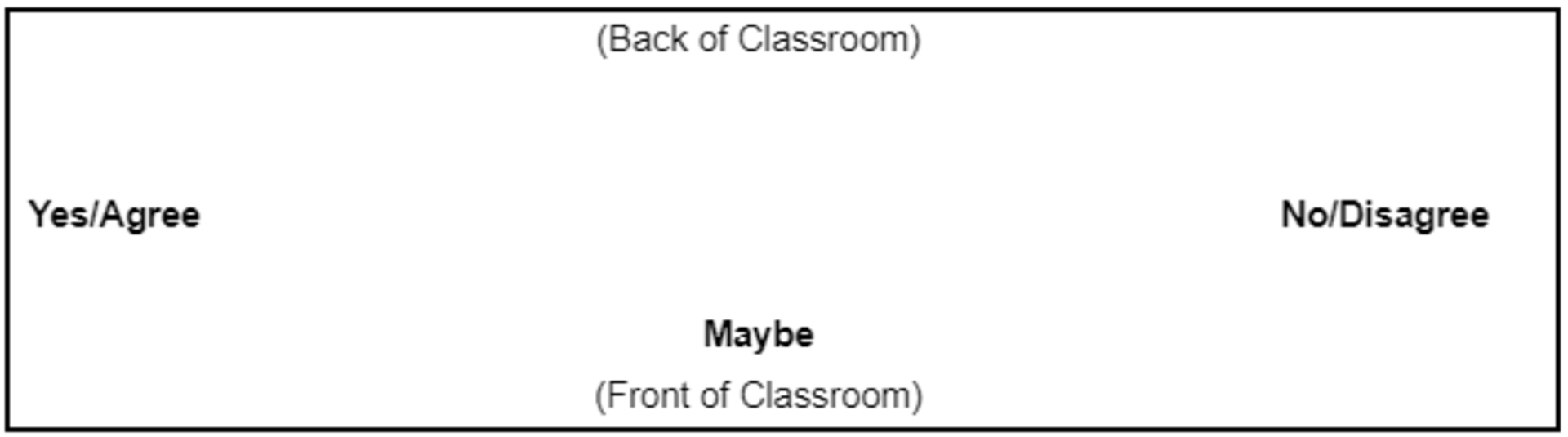
Using the list of prompts below, ask students where they stand – literally.
Read the prompts out loud to your students. For each prompt, have students come to the front of the classroom and organize themselves in a line. Students should then position themselves based on where on the spectrum of responses they find themselves in response to each prompt (agree/disagree/maybe).
During the activity, instructors may ask students to explain their reasoning to the class or to students at the opposite end of the room, thereby opening the floor for civil disagreement and balanced discussion of each prompt. Instructors might then encourage students to move to a new spot if the discussion has caused them to change their mind.
Instructors should conclude the session by asking students to reflect on what they’ve learned from this activity, either through an open class conversation or through a more private written response.
Notes:
- Instructors may choose to introduce this activity with an explanation that this and other upcoming classes will focus on climate change, a topic of global importance that involves a diverse array of opinions and understandings. This activity is designed to introduce students to key themes within climate change studies and to help them begin the work of examining and dismantling common misconceptions about climate change within the brave space of the classroom.
- In this activity, civil discourse is key. Instructors might encourage students to move to their positions quietly, invite students to share their reasoning on a voluntary basis, or work with the class to establish an agreed-upon code of conduct before beginning the activity.
Classroom Alternatives:
- Rather than asking students to move about a classroom, instructors may show prompts on a slideshow and ask students to hold up color-coded cards (Green-Yes, Yellow-Maybe, Red-No) in response to the prompts.
Prompts:
Instructors may add or edit prompts as they see fit.
- Climate change is a natural process – Earth’s temperature has always cycled, we do not need to worry about it.
- See CFR Education, “Learning Journey: Understanding the Causes of Climate Change”
- Winter and cold weather are proof that climate change is not really an issue.
- See CFR Education, “How Climate Change Worsens Extreme Weather”
- Climate change is a natural process - it has nothing to do with people.
- See CFR Education, “How Humans Cause Climate Change”
- Plants are more than capable of absorbing our carbon dioxide outputs.
- See CFR Education, “How to Lower Agriculture and Land-Use Emissions”
- Climate change only impacts weather.
- See CFR Education, “Learning Journey: How the World Can Adapt to Climate Impacts”
- Scientists disagree on the cause of climate change.
- See CFR Education, “What is Climate Change?”
- A couple degrees of warming is not really a big deal.
- See CFR Education, “How Climate Change Reduces Biodiversity” and “How Climate Change Can Get Even Worse”
- It’s impossible for people to stop greenhouse gas emissions completely, so there is no real point in trying.
- See CFR Education, “Learning Journey: How to Mitigate Climate Change”
- Industrializing countries like China and India are mostly responsible for climate change.
- See CFR Education, “Who Releases the Most Greenhouse Gases?”
- The United States is mostly responsible for climate change.
- See CFR Education, “Who Releases the Most Greenhouse Gases?”
- Humans are inventive; we can (and will) adapt to climate change.
- See CFR Education, “Learning Journey: How the World Can Adapt to Climate Impacts”
- Renewable energy is more expensive to generate than fossil fuels.
- See CFR Education, “Sources of Energy: A Comparison”
- Renewable energy is a waste of time – it only works when it is sunny or windy.
- See CFR Education, “How to Lower Energy-Sector Emissions”
- The international community will never agree on a coordinated strategy to combat climate change.
- See CFR Education, “How Are International Agreements Helping Fight Global Warming?”
- It is too late to avert a climate catastrophe.
- See CFR Education, “The Paris Agreement”
Materials
Prompts
via docs.google.com