Understanding Foreign Policy Approaches Lesson Plan
- Length
- One 60-minute class period
- Grade Level
- High School
Learning Objectives
- Students will be able to define isolationism and engagement, idealism and realism, and unilateralism and multilateralism.
- Students will be able to identify these approaches to foreign policy in real-life examples and apply them in foreign-policy scenarios.
Class Plan
- (Introduction - 5 minutes) - Show one real current headline (a conflict, a trade dispute, a human rights crisis) and prompt with the following question: “If five different world leaders (e.g. Europe, Central Asia, Latin America, North America, and Oceania) read this exact headline this morning, what is the likelihood they would all respond with the same approach to solving the problem?” Give students a moment to think, then call on two or three students to verbally share their answer and reasoning before revealing the transition below. “Here’s the thing… if five different world leaders read that exact same headline this morning, they wouldn’t all respond the same way. Same facts, completely different decisions. Today we’re going to explore why leaders choose different approaches to solve similar problems.”
- (Card Sort Activity - 30 minutes) - Break students into groups of 4-5 for a card sort activity based on the different foreign policy approaches. Groups will complete each round of the card sort at the same time.
- Round 1: Isolationism vs. Engagement
- Provide 2-4 printed copies of Approaches to Foreign Policy: Isolationism Versus Engagement Resource Page to each group, along with printed copies of the “Isolationism v. Engagement” situation cards from the slide deck (linked below). Give students 60-90 seconds to read the paragraph,, underlining definitions, circling examples, and jotting questions in the margin as they read. When students have completed reading the paragraph, have them draft working definitions of “isolation” and “engagement” together. Take 2-3 responses from the class before moving on to the card sort, as a way to ensure comprehension across all small groups.
- Once small groups have shared their working definitions with the class, ask students to sort printed versions of the “Isolationism versus Engagement” situation cards along a spectrum from Strict Isolationism to Full Engagement.
- End the round, then debrief by asking one or two groups to share where they placed a specific card. Then debrief, with any of the following questions:
- Did every group place that card in the same spot on the spectrum?
- Why might different groups have landed in different places?
- What are the costs of taking each approach?
- Round 2: Idealism vs. Realism
- Provide 2-4 printed copies of the Approaches to Foreign Policy: Idealism Versus Realism Resource Page to each group along with printed copies of the “Idealism v. Realism” situation cards from the slide deck (linked below). Give students 60-90 seconds to read the paragraph, underlining definitions, circling examples, and jotting questions in the margin as they read. When students have completed reading the paragraph, have them draft working definitions of “idealism” and “realism” together. Take 2-3 responses from the class before moving on to the card sort, as a way to ensure comprehension across all small groups.
- Next present the following scenario: “You are the Chief of Staff, and you’ve just learned that a close economic and security partner is committing human rights violations at home. You’ve asked two advisors to weigh in, and they’re presenting opposite recommendations.”
- Ask students to address the Chief of Staff’s concerns by sorting printed versions of the “Idealism versus Realism” situation cards along a spectrum from Strict Idealist to Most Realist.
- End the round, then debrief by asking one or two groups to share where they placed a specific card, as done in Round 1.
- Round 3: Unilateralism vs. Multilateralism
- Provide 2-4 printed copies of the Approaches to Foreign Policy: Unilateralism Versus Multilateralism Resource Page to each group along with printed copies of the “Unilateralism v. Multilateralism” situation cards from the slide deck (linked below). Give students 60-90 seconds to read the paragraph, underlining definitions, circling examples, and jotting questions in the margin as they read. When students have completed reading the paragraph, have them draft working definitions of ”unilateralism“ and ”multilateralism“ together. Take 2-3 responses from the class before moving on to the card sort, as a way to ensure comprehension across all small groups.
- Provide students the following prompt: “You need to respond to a transnational problem (e.g., a pandemic, a cyberattack, a climate disaster) within days. Do you act alone or try to build a coalition first? What do you gain or lose either way?”
- Ask students to address the problem by sorting printed versions of the “Unilateralism versus Multilateralism” situation cards along a spectrum from Most Unilateral to Most Multilateral.
- End the round, then debrief by asking one or two groups to share where they placed a specific card, as done in Rounds 1 and 2.
- Have one or two groups share their decision, then ask the class:
- Did every group decide the same way? What tipped your group toward acting alone or building a coalition, and what factors could change your recommendation?
- Use any visible disagreement across groups as the discussion driver, rather than settling on one “correct” choice.
- (Discussion - 10 minutes) - The class will come together and have a debriefing discussion.
- How do the approaches to foreign policy work together?
- To what extent is there a correct balance between these approaches?
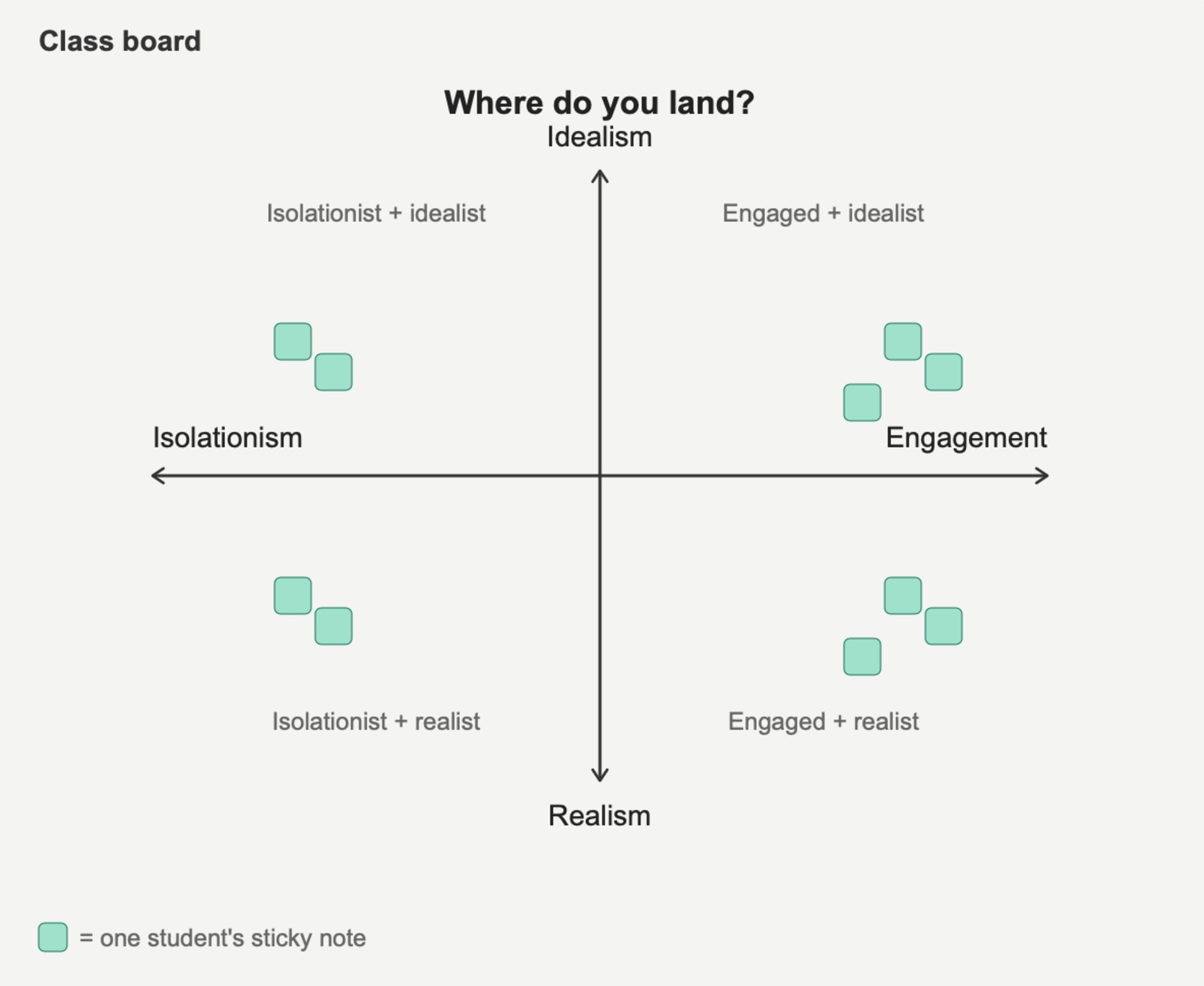
- What would this balance look like on a graph?
- (Exit Ticket - 7 mins) - Using sticky notes, have students place their Foreign Policy Approach using the 4 Quadrant Matrix drawn or projected on the board.
Materials
Approaches to Foreign Policy
Resource Collections
Card Sort Slide Deck
via docs.google.com