Unrest in Bahrain in 2014 (UNSC)
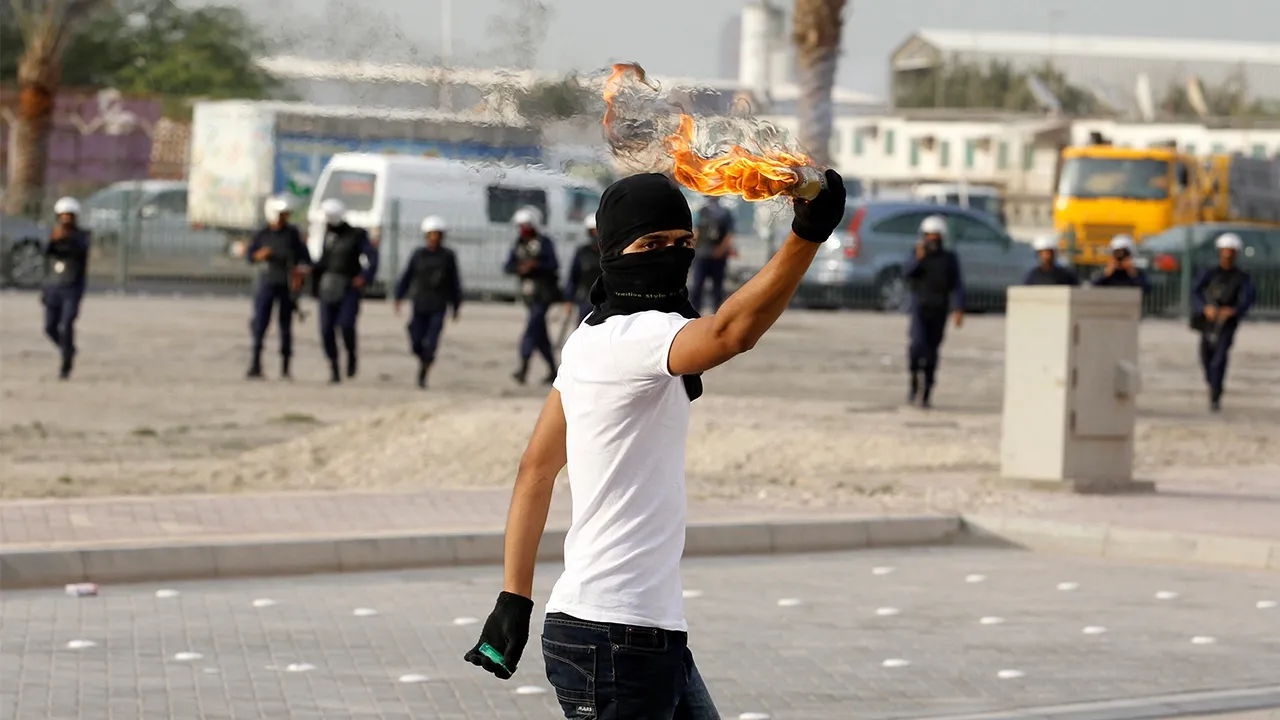
Set in August 2014. Political unrest in Bahrain has led to a government crackdown.
- Level
- High School, Higher Education
What is a simulation?
Simulations offer students the chance to role-play either the U.S. National Security Council or the UN Security Council.
How do I use them?
A simulation comprises two readings (a council guide and the case notes) of roughly 2,500 words each. They also offer detailed guidance for preparing for and running the simulation in the classroom and reflecting on the experience.
Educator Overview
Case Overview
Set in August, 2014. In the small island country of Bahrain, government and security forces have clashed with protestors seeking democratic reform. The ruling al-Khalifa family has responded to these protests with force and mass arrests. The most recent clashes between government forces and protestors are not the first but certainly the bloodiest. In February 2011, Bahraini activists, inspired by uprisings in Tunisia and Egypt, gathered in the capital to seek political reform. The fact that Bahrain’s leaders are part of the Sunni minority and the demonstrators represent the Shiite majority gives the uprising a sectarian complexion, in addition to the broader social issues of disenfranchisement and limited economic opportunity. The UN Secretary-General has called a meeting of the UN Security Council to assess whether the situation warrants a response and, if so, what kind.
Decision Point
Three years after Bahrain’s 2011 uprising, progress toward reform has stalled. In January 2014, the government suspended its “national dialogue” with opposition groups. The government blamed opposition groups for the breakdown. Soon after, renewed unrest gripped the country. On February 14—the anniversary of the initial uprising—thousands of protestors calling for King Hamad’s ouster gathered in Bahrain’s capital, Manama. The protestors met stiff resistance from security forces. This resulted in several injuries and dozens of arrests. Outside the capital, a bomb struck a police bus in a Shiite village, killing one police officer. Three more officers were killed by another bomb weeks later. Although mainstream opposition groups denied any connection to the bombings and condemned the acts, the attacks only amplified an already severe crackdown by Bahrain’s security forces. This crackdown was especially focused on predominantly Shiite areas. Activists, along with international human rights organizations, are calling for an international response. In this context, the UN Secretary-General has called a meeting of the UN Security Council. The Council will assess whether the situation warrants a response and, if so, what kind.
Learning Goals
CFR Education extended simulations use a variety of pedagogical tools to create an effective, meaningful, and memorable learning experience for students that builds their global literacy. Students will develop crucial skills such as critical thinking, communication, collaboration, and creativity. Students will complete authentic assessments that feel relevant: instead of five-paragraph essays and book reports, students will write policy memos and participate in a role-play of a meeting of a foreign policy–making body. There are no right or wrong answers in actual policy deliberations, and there are none here, either; students will walk away from this experience with an appreciation for the complexity of policy questions.
In this simulation, students will learn about the UN Security Council, as well as meeting these learning outcomes specific to this simulation:
- Students will understand potential consequences of instability in Bahrain related to international peace and security.
- Students will consider how the UN Security Council should balance a desire to support democratic reforms with a need to win the support of Security Council members who have strategic interests in Bahrain.
- Students will evaluate the options available to the UN Security Council to put meaningful pressure on Bahrain for democratic reforms.
Concepts and Issues
Concepts
- Interests versus values
- Sectarianism
- Human rights
- Political reform
- Dispute resolution
- Alliances
Issues
- Free flow of energy resources in the Middle East
- Bahrani political and religious dynamics
- International military and economic presence in the Persian Gulf region
- Promotion of Human rights and democratic governance
Policy Options
This section presents context, potential benefits and drawbacks, and other information about the policy options outlined in the case that you may find helpful as you guide the role-play and assess students.
Members of the Security Council need to assess the situation and determine whether it warrants a response. Some countries are likely to see the Bahraini government’s behavior as a crackdown that violates the human rights of its Shiite citizens. Others could see this behavior as a sovereign country’s reasonable effort to keep order. Moreover, many of the UN Security Council’s veto-wielding permanent member states have close economic ties and military interests in Bahrain. These relationships have the potential to hinder any UN Security Council action toward Bahrain. The United States, China, France, and the United Kingdom frequently trade with Bahrain and have various economic interests in the region due to its rich supply of oil. The United States and the United Kingdom both maintain naval bases in Bahrain and regard the country as an important foothold for their interests in the Middle East. Supporting aggressive measures against Bahrain to encourage democratic reforms could therefore go against council members’ economic, political, and military interests. Considering these conflicting interests, UN Security Council members will need to carefully consider whether and how they should take action to put meaningful pressure on Bahrain.
The principal policy options available in this case are discussed below. These responses are available individually, in combination, or all together.
Call for All-Inclusive National Dialogue Between the Bahraini Government and Political Opposition Groups
The UN Security Council could direct Bahraini government officials and leaders from political opposition groups, human rights organizations, and Shiite communities to conduct a peaceful dialogue to discuss implementing democratic reforms in the country and curbing the use of state force to subdue opposition. This dialogue could take place under the auspices of the UN secretary-general or be mediated by an outside organization.
This option is the least ambitious but the least likely to be controversial among permanent council members, as it likely would not damage relationships or agreements between Bahrain and member states. If successful, a national dialogue could promote peaceful conflict resolution, and allowing political opposition members a forum for discussion could potentially ease political unrest. However, there is no guarantee that either side will respond to requests for a dialogue or accept outside mediation. Even if negotiations can be arranged, this option has no way to assure or enforce any political changes in Bahrain. If either party refuses or negotiations fail, further conflict could result, and the UN Security Council could face criticism for not acting strongly enough.
Call for an Investigation of the Bahraini Government’s Suppression of the Political Opposition and Activists
The UN Security Council could pass a resolution calling on Bahrain to admit inspectors to monitor the political situation and Bahrain’s human rights practices. This option could provide legitimate, independent insight into the extent of Bahrain’s human rights abuses and undemocratic actions as well as Iran’s alleged involvement in Bahrain’s political unrest. An independent investigation could conclude with recommendations to improve Bahrain’s human rights practices, outline a timeline for reevaluation, and establish consequences, such as sanctions, should Bahrain fail to adopt reforms. International human rights organizations have previously criticized the BICI report and investigation of the events that took place in Bahrain in 2011. Freedom of the press is limited in Bahrain, underscoring the need for an international organization to investigate claims of human rights abuses and undemocratic practices. If Bahrain allows independent inspectors into the country under the auspices of the United Nations, they could have greater access to information than previous investigations.
However, requesting access from the Bahraini government could prove challenging. Security Council members would need to secure Bahrain’s consent to allow UN inspectors into the country. Bahrain’s government has routinely refused to allow independent investigators into the country, including UN special rapporteurs (experts appointed by the UN Human Rights Council). However, a Security Council resolution calling for an investigation could bear more weight than requests from other organs of the United Nations. Council members could also consider backing up their request for an inspection with threats of sanctions should Bahrain refuse, although this could be met with resistance from Security Council members with close ties to Bahrain.
Enact Sanctions on Bahrain
The UN Security Council could enact sanctions on Bahrain in an attempt to coerce Bahrain’s government to cease its crackdown against protests and negotiate with opposition groups to implement certain reforms. These sanctions could be targeted against individuals in the Bahraini government or take the form of broader restrictions, potentially on the trade of luxury goods and manufacturing materials. Security Council members could also call for a halt on international arms sales to the country. Since 2011, Bahrain has ignored or deflected calls from the United Nations to enact democratic reforms and end the use of force to suppress the political opposition. Sanctions would ensure that Bahrain faces consequences for ignoring the international outcry against it and could put significant pressure on Bahrain to change its behavior. Sanctions could also set a forceful example to other countries that violating international human rights treaties will bear consequences.
However, garnering the support needed to pass sanctions would be difficult. Given the strategic military relationships that both the United States and the United Kingdom have with Bahrain, their support would be unlikely. Other permanent council members, such as China and Russia, could see Bahrain’s actions as a legitimate exercise of state sovereignty and be reticent to support forceful action. Due to the veto power of each of these permanent council members, the chances of gaining the required consensus to approve sanctions are low.
Do Nothing
The Security Council could decide it is unable to take meaningful action on the dispute in light of conflicting interests among council members. In this case, the UN Security Council could adopt a statement expressing concern about violent crackdowns on protests, the lack of freedom of expression and free press, and the use of torture, mass arrests, state harassment, intimidation, revocation of citizenship, disenfranchisement, executions, and the lack of due process for political opposition and activists. Such a statement could show support for Bahraini opposition groups and draw international attention to the issue. Increasing international attention could help pressure the Bahraini government into adopting reform. If the situation worsens, council members could also revisit the matter. However, inaction on this issue could draw criticism from human rights groups. Especially given the council’s willingness to approve a military intervention in Libya in 2011, remaining silent on Bahrain could be seen as upholding a double standard when council members’ interests are involved and erode confidence in future Security Council action.
Running the Simulation
CFR Education extended simulations are project-based learning activities. Project-based learning (PBL) leads to better learning outcomes and improves skills, and is more fun than traditional instructional methods. The website that students will navigate throughout the simulation is divided into several parts:
In the UNSC Guide, students will learn about the UN Security Council, the body they will be simulating. Included are details on its history, how it works, who its major players are, and more. There is also a video interview with experts who have served on the body.
In the Case Notes, students dive into the actual situation they will be trying to solve in their simulation. At the beginning is a clear decision point: the question that students will debate during the role-play. This is followed by detailed background material and a discussion of the role that the United Nations plays.
Preparation and Role-Play includes details on the various roles students could take on, guidelines for the draft resolution clauses they will write, as well as an outline of how the discussion will flow during the role-play.
The Wrap-Up is an important part of the project and includes reflection questions and guidelines for reflecting in a class discussion and in a second memorandum. For historical cases, this section also includes a short description of how the decision point was addressed by policymakers in real life.
The simulation also includes Student Resources, which include a reading list to support research, additional directions and exemplars for writing assignments, and other tips students may find helpful.
Tips for Role-Play
Once students have read the simulation and prepared their draft clauses, here is how we recommend structuring the role-play:
| Round | Timing | Objectives | Procedural Notes |
|---|---|---|---|
| One: Public Meeting | 2 to 3 minutes per participant | Receive a five-minute briefing from the secretary-general on the issue to be discussed.Present opening statements.Crystalize the central questions of debate. | During opening statements, the president of the UN Security Council will recognize country representatives in the order in which they request to speak, and no representative may speak again if others have not yet spoken. Following opening statements, country representatives are free to openly debate the statements made, evaluating the various positions on their merits. |
| Two:Informal Meeting | 30 to 60 minutes | Debate each participant’s proposed clauses.Edit, add, or drop proposed clauses and combine them into one or more draft resolutions.Draft a presidential statement using proposed clauses and/or new material if no draft resolution appears acceptable to the group. | The president will recognize country representatives in the order in which they request to speak. Representatives should limit their statements to one minute each, but if time allows the president may permit them to speak longer. The president may also invite any participant to speak as they deem it appropriate. Any participant may motion for a ten- to fifteen-minute break, during which representatives can move freely and work on their draft resolutions individually or in small groups. |
| Three:Public Meeting | 30 to 60 minutes | Hear summaries of any draft resolutions as well as arguments for and against adoption.Vote on draft resolutions in order of submission.Attempt to adopt a presidential statement by consensus if no resolutions are proposed or passed. | The president will call first on the draft resolution’s main author(s) and then on other countries that wish to make arguments for or against the resolution. To be adopted, Security Council resolutions must receive at least nine votes in favor and no dissenting votes (vetoes) from any of the five permanent members. A state may abstain, often to indicate ambivalence or mild disapproval (in contrast to strong opposition). According to the charter, abstentions are mandatory if the state is a party to the dispute in question. Abstentions by permanent members do not count as vetoes; the resolution will pass if it receives the necessary nine votes. |
Tips for the President of the UN Security Council
In Round 1, you will chair a formal session. Make absolutely sure that every country gives their opening statement before any country is allowed to speak a second time. You will also have to use your judgment about when to move into the more informal meeting of Round 2. Give enough time for students to flesh out their positions and to identify potential allies, but do not wait too long—the most productive negotiations happen in informal meetings, so you want to save time for those in Round 2.
In Round 2, you will call on speakers one at a time. The time limits on speeches are a little looser, so pay close attention to make sure everyone is included and no one dominates. Deciding whether to grant a break for negotiations is a matter of balance. Negotiations can be advanced in small-group discussions, but it is also important for the whole body to be updated on what goes on during the breaks. You will want to strike a balance between breaks for negotiating, and informal meeting time for giving updates and rounding up support for resolutions. It is often helpful to set a deadline for the end of Round 2 to encourage negotiators to come to agreements in a timely manner.
In Round 3, completed draft resolutions will be presented, discussed, and voted on. Before starting, make sure you are clear on the order in which the resolutions were submitted and who is sponsoring each one. When it comes time to vote, it will be helpful to remind everyone of the unique voting rules of the Security Council. If none of the resolutions passes, you can allow further debate and attempt to vote again, or you can move on and guide the council through debate on a presidential statement. Use your judgment about which process is more likely to be successful.
Tips for Online Classes
We suggest conducting the role-play in three rounds and that three-round structure is a helpful way to approach chunking the role-play for online learning as well. You can conduct each round synchronously or asynchronously.
In round one, participants present their positions.
- In a synchronous meeting, you can go through opening statements using videoconferencing software, allowing for live clarifying questions.
- However, this is probably the easiest round to conduct asynchronously. You could disseminate positions in writing by having participants share their position memos or write a summary for the purpose of the role-play. You could also have participants record a video of themselves delivering their opening statement and disseminate it for all to watch.
In round two, participants debate the various policy options.
- In a synchronous setting, you can simply run a full-class discussion for round two. If you need more structure or want to prod reticent participants, consider starting by randomly assigning students to breakout rooms, assigning each breakout room one policy option. After working through pros and cons, representatives from each breakout room can share out to kick off the general discussion.
- In an asynchronous setting, consider a discussion forum, with a thread for each policy option.
In round three, debate begins to coalesce around the draft resolutions that have substantial support.
- This round can be approached similarly to round two. In this round, organize breakout rooms or threads around each draft resolution.
Flashpoints
To add spice or challenge to the role-play, partway through the discussion throw in one of the following flashpoints—additional hypothetical developments that fit within the case’s existing decision point—or create your own.
- In response to international and domestic outcries against excessive use of force, harsh sentencing and reports of abuse in prison against members of the opposition, King Hamad bin Isa al-Khalifa announces plans for an independent commission to investigate the Bahraini criminal justice system and recommend potential reforms. Details on the organizers of the independent investigation have not been released. Leaders of the Bahraini opposition have expressed their concerns about the legitimacy and transparency of this independent commission.
- Reports emerge that a Bahrani court has overturned Bahrain’s previous decision to dissolve al Wefaq. King Hamad claims this decision to be “a step towards unification and reform.” The opposition claims his decision as a tool to divert international criticism. Some analysts have raised concerns that the decision could spark violent backlash from the opposition.
- In a blistering speech, a prominent Iranian cleric castigates the Bahraini monarchy for what he calls its “long-standing subjugation and cold-blooded murder of our Shia brothers and sisters.” According to Iranian media, the cleric is speaking with the support of Iran’s senior leadership. He calls for the Iranian government to take action in support of Bahraini Shias, using force if necessary. Bahraini leaders quickly condemn the speech and raise the alert status of their security forces. The principal Bahraini opposition figures do not immediately react.
After introducing a flashpoint, you might want to help students refocus their discussion by considering critical questions such as these:
- Who is affected by this event or development, and how?
- Is there any uncertainty about what has taken place? How credible is the report?
- Does this event or development affect the feasibility of any policy options? If so, how?
- Does this event or development affect the desirability of any policy options? If so, how?
UNSC Assessment
Case Assessment
- What is the situation in Bahrain as presented in this case, how could it threaten international peace and stability?
- Why are the Bahraini activists dissatisfied with the al-Khalifa regime and what are their demands?
- How has the Bahraini government responded to popular unrest? What have been the consequences of the government’s actions?
- What are the permanent members of the UN Security Council’s interests in Bahrain that could deter UN Security Council intervention? How can the individual interests of permanent members lead to UN Security Council inaction?
Writing Assignments — Overview
- What are the six organs of the United Nations system? What are their responsibilities?
- How is the UN Security Council structured? How are Security Council decisions made?
- What are the two categories of tools that the UN Security Council has at its disposal to implement its decisions, and what are the range of specific tools available in each?
- What is the difference between a Chapter VI peacekeeping mission and a Chapter VII peace enforcement mission?
- What are the main challenges and limitations that the UN Security Council faces as it carries out its work? What solutions have been proposed to address these challenges?
Each CFR Education extended simulation involves writing assignments that help students think through policy options and reflect on their learning experience.
In UNSC cases, there are two types of writing assignments.
- Before the role-play, everyone writes draft clauses for a Security Council resolution.
- As part of the wrap-up, everyone writes a written reflection.
Simulations have instructions for written assignments (found under the Student Facing Simulation), rubrics, and samples for each of these writing exercises.
Samples:
Below are sample rubrics for your use in assessing the writing students will do as part of this extended simulation.
These are single-point rubrics. Jennifer Gonzalez, who writes the blog Cult of Pedagogy, has a great explainer, but the bottom line is that single-point rubrics are relatively easy for students to digest but still have all the advantages of giving structure to instructors’ feedback.
UN Security Council Draft Clauses Rubric
| CONCERNS What needs improvement | CRITERIA What is expected | ADVANCED What is excellent |
| Purpose - There are two to three preambular and three to four operative clauses - Clauses are properly formatted and styled | ||
| Preambular clauses - Accurately identify relevant prior agreements and existing organizations | ||
| Operative clauses - Are practical and within the UN Security Council’s powers - Address who - Address what - Address when - Address where - Address why - Address how - Address funding |
UN Security Council Written Reflection Rubric
| CONCERNS What needs improvement | CRITERIA What is expected | ADVANCED What is excellent |
| Subject paragraph - Is brief - Places the issue in the larger context of U.S. foreign policy - Clearly states whether the writer agrees or disagrees with the president’s decision | ||
| Options and Analysis paragraph - Discusses each option that came up during the role-play in discrete paragraphs - Weighs the advantages and disadvantages of each option - If options from the position memo are discussed, those options contain additional analysis | ||
| Recommendation and Justification paragraph - Makes a clear recommendation based on the writer’s personal position - Supports the recommendation effectively | ||
| Reflection paragraph or paragraphs - Reflects on and critiques the Security Council’s decision - Is written from a personal point of view, not that of the assigned role |
Downloadable rubrics are available here: