Climate Change Inequality
In this free resource, explore how climate change disproportionately affects certain communities and could drastically increase global inequality.

By experts and staff
- Updated
Income Inequality and Spatial Inequality
Climate change is a global problem, but its consequences are not evenly distributed around the world. For example, although average global temperatures are projected to rise by 3°C (5.4°F) by 2100, some places along the equator have already warmed twice as much, leading to increased rates of drought and extreme heat.
Location is not all that determines a community’s vulnerability. Income levels also dictate whether populations can afford costly —such as air conditioning and fire insurance—that would minimize the consequences of climate change.
In many instances, those two factors—location and income—work in tandem. Some of the most climate-affected communities are also the least financially equipped to adapt. As a result, climate change is projected to dramatically increase global inequality, with one study estimating that average incomes in the poorest countries will decline by 75 percent by 2100, while incomes in some of the richest countries will continue to grow.
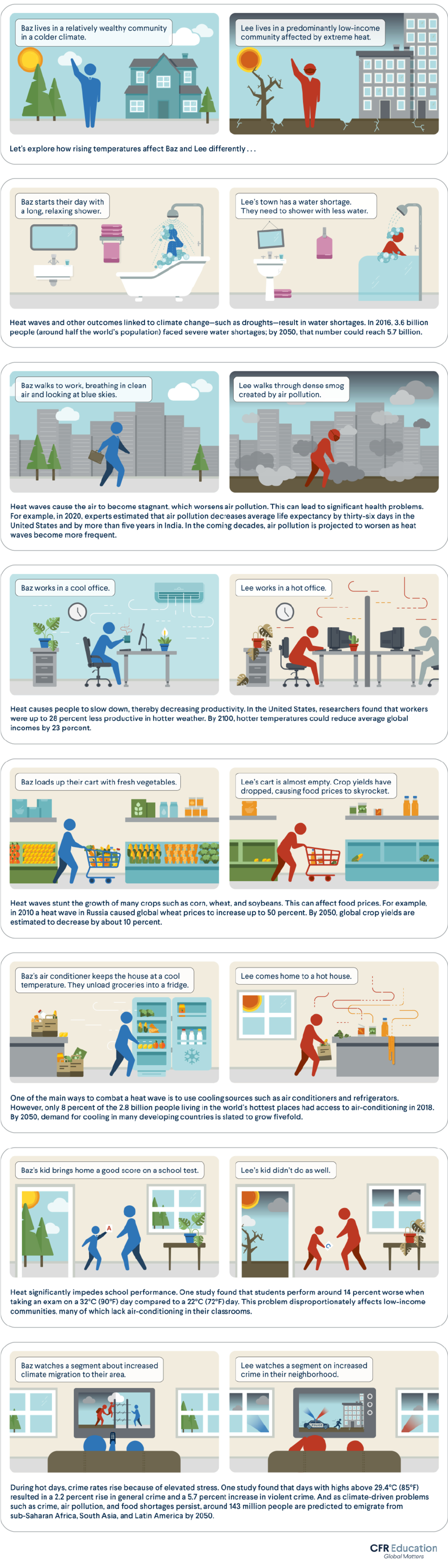
Climate Change Inequality Cartoon: Heatwaves
Climate change inequality manifests in many forms; certain communities are particularly susceptible to rising sea levels, while others face heightened risks from severe storms. This cartoon explores just one consequence of climate change—heat waves—following how two people living in separate communities experience the effects of rising temperatures in strikingly different ways.
Used in

Effects of Climate Change Lesson Plan
Lesson Plans

Revolutions Around the World Lesson Plan
Lesson Plans