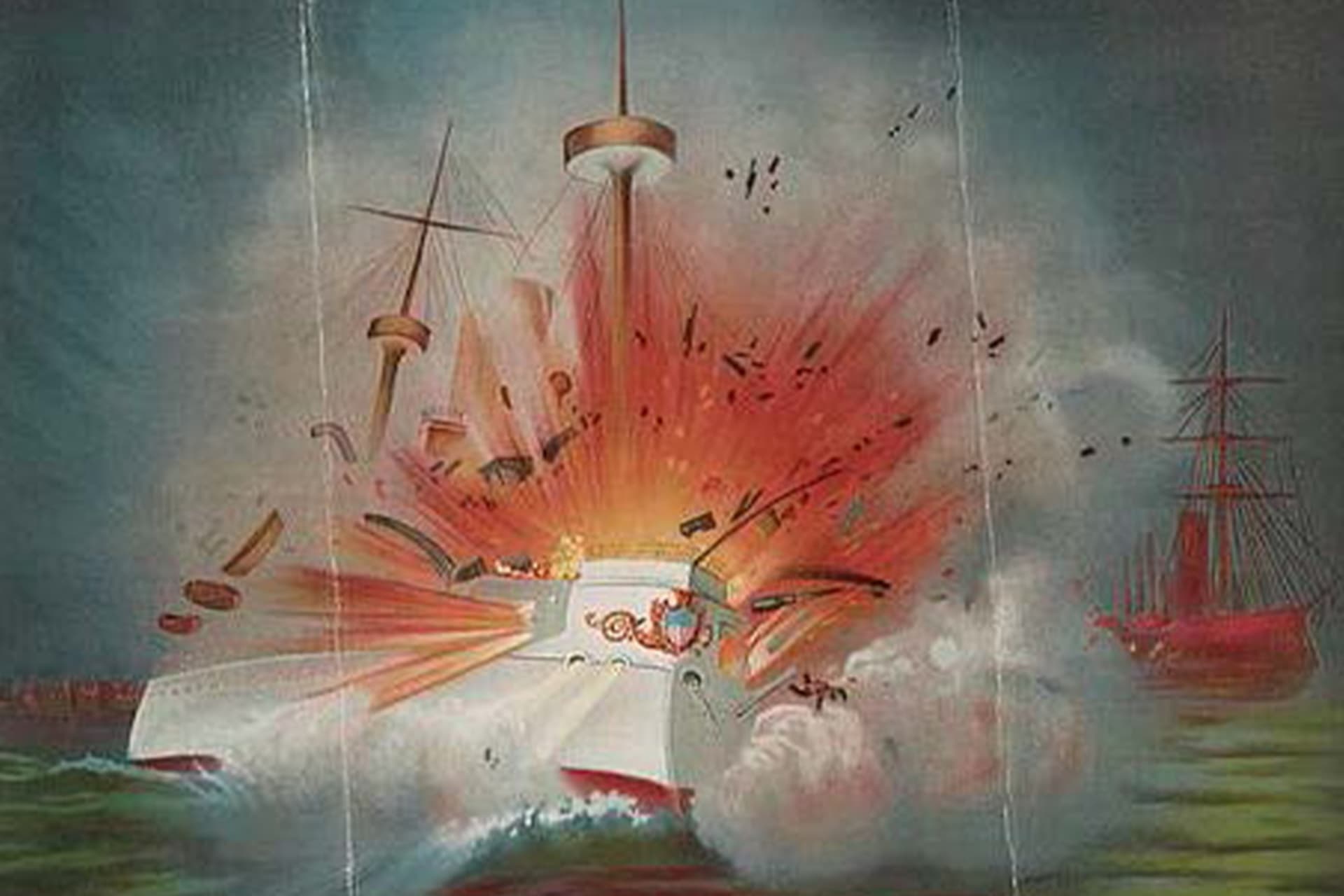
Explosion of the USS Maine in 1898
How should the United States intervene against Spanish colonial rule in Cuba? Explore this historical simulation set in 1898.
- Level
- High School, Higher Education
Need guidance for how to run your mini simulation?
Overview
After the mysterious explosion of the USS Maine in Havana, Cuba, the United States has decided to go to war with Spain. President William McKinley and his advisors now need to decide how to intervene against Spanish colonial rule in Cuba and what U.S. war aims should be.
Students will understand that war strategy stems in part from war aims.
Students will understand that intervention inevitably shapes future relations with a country
The Situation
By the 1870s, tensions between the United States and Spain were growing. Once a vast empire, Spain had lost much of its overseas territory over the nineteenth century. The decline of the Spanish Empire left Cuba as one of its last remaining footholds in the Western Hemisphere. But Madrid’s grasp had begun to slip there as well. Starting in 1868, Cubans waged three successive liberation wars, culminating in the 1895 Cuban War of Independence. To quell the rebellion, Spanish forces acted harshly to suppress the revolutionary fervor on the island. The Spanish forcibly relocated hundreds of thousands of Cuban civilians to concentration camps and practiced scorched-earth tactics to starve the rebels of supplies. More than two hundred thousand Cuban civilians died as a result of this policy. Back on the mainland, U.S. journalists were quick to bring the story of Cuban liberation to American readers. The American media stoked widespread sympathy for the Cuban cause and anger toward the Spanish empire. As the war dragged on, public outrage began to spur calls for U.S intervention on behalf of the Cubans.
Although public interest in Cuba was mainly humanitarian, the United States had economic interests in the island as well. In the wake of a major depression in 1873, the United States sought economic opportunities to aid recovery. Spain’s waning power in Cuba gave U.S. businesses a chance to invest in the island’s lucrative sugar and tobacco industries. Consequently, the U.S. and Cuban economies grew increasingly interconnected. By the 1890s, U.S. investments in Cuba amounted to roughly $50 million. At that time, nearly 95 percent of Cuban sugar exports went to the United States. Some Americans feared that continued Cuban imports would hurt certain domestic producers. However, most U.S. policymakers were more concerned that instability in Cuba would endanger U.S. investments and harm the overall U.S. economy. Intervention, therefore, offered an opportunity to protect U.S. economic interests. Moreover, the United States would also benefit from strengthened ties with a newly independent Cuba by aiding in the defeat of Spanish forces.
Policymakers also had strategic interests in Cuba. Specifically, the United States was eager to expand its in the Western Hemisphere. Cuba presented a strategically valuable location for a naval outpost. An expanded U.S. naval presence in the Caribbean could protect regional trade. Moreover, a military presence in Cuba would aid U.S. efforts to develop a canal through Nicaragua or Panama to connect trade routes in the Atlantic and Pacific oceans. Spanish domination over the island, though, curtailed the United States’ ability to advance its political and strategic ties with Cuba. Some policymakers hoped that the removal of Spanish control in Cuba could enable a long-term U.S. presence in the region. Others, however, worried that intervention in Cuba was not worthwhile. In addition to the immense cost of a war, the United States had no way to ensure that intervention would lead to an independent Cuba friendly to U.S. interests. Policymakers, therefore, needed to consider how to prioritize various U.S. interests to determine how Washington’s relationship with a newly independent Havana would look.
Decision Point
Set in April 1898
The USS Maine—an American battleship sent to protect U.S. interests in Cuba—has exploded in Havana Harbor. The explosion killed 260 American sailors. Although the source of the explosion is unknown, the blast has sparked a media frenzy in the United States. Many in the American public are accusing Spain of orchestrating the incident and demand retribution. Diplomatic efforts with Spain following the explosion have failed, and public fury is growing. As a result, President William McKinley’s administration has concluded intervention in Cuba is now inevitable. Congress has approved the intervention, with an amendment forbidding any U.S. attempt to annex Cuba. With the United States on the path to war, President McKinley has convened his cabinet to determine what the United States’ aims should be and how best to pursue them. Policymakers will need to consider and prioritize the varying U.S. interests in Cuba and weigh the costs and benefits of pursuing those interests.
Cabinet members should consider any combination of the following policy options:
- Intervene for humanitarian purposes by aiding the Cuban resistance unconditionally to force Spanish withdrawal. This option most directly appeals to U.S. public sentiment and would be favorable to the Cuban resistance. However, this policy decision forgoes opportunities to secure advantageous economic arrangements. Humanitarian intervention also fails to advance strategic naval expansion in the region.
- Intervene for economic purposes by deploying forces to protect U.S. investments. This policy decision would also aid Cuban forces in the hope of cultivating a favorable postwar trade relationship. The goal of this intervention is to promote continued U.S. investment in Cuba. This option would protect U.S. economic interests in Cuba but could face opposition from competing U.S. industries. Additionally, the United States cannot guarantee that Cuban independence leaders will desire economic ties with the United States.
- Intervene for strategic purposes by strongly supporting Cuban forces. The purpose of this policy decision is to influence Cuban leaders to support the development of a U.S. naval base on the island. Control of a Cuban harbor would allow the United States to project power throughout the Caribbean. Moreover, a U.S. naval outpost would help facilitate the construction of a canal through Central America to expand trade. However, garnering the goodwill necessary to achieve this outcome is not guaranteed. This policy option could therefore require more robust involvement in the war than other options.
- Take limited action in retaliation for Spain’s suspected involvement in the USS Maine explosion by launching one or more isolated attacks on Spanish forces. This option would fail to aid Cuba or expand U.S. economic or strategic interests. However, this policy option would signal U.S. focus on preserving domestic interests and appease public desire for retribution against Spain.