The Zimmermann Telegram in 1917
Should the United States take action against Germany? Explore this historical simulation set in 1917.
- Level
- High School, Higher Education
Need guidance for how to run your mini simulation?
Overview
British intelligence has decoded a secret German telegram to Mexico that proposes an against the United States. The telegram also shares Germany’s plans to resume submarine warfare against U.S. shipping in the coming month. How should the United States respond?
Students will understand that the decision to enter World War I involved prioritizing short- and long-term threats at home and abroad.
Students will understand that the increasingly global nature of World War I made it difficult for the United States to remain neutral as the war went on.
The Situation
By its third year, World War I had taken millions of lives in Europe and throughout the world. However, with the entire European continent engulfed in conflict, the United States adopted a policy of neutrality because it was unwilling to commit its resources or personnel to a foreign war. Even so, it maintained trade with the Allies (France, Russia, and the United Kingdom), supporting them with arms and food exports. War-time trade with Allied nations occurred to the great advantage of U.S. industries. Between 1914 and 1916, U.S. trade with the Allies tripled to $3 billion annually. However, as U.S. ships overwhelmingly composed Allied supply lines, they became a target. The German navy adopted a policy of unrestricted submarine warfare. Germany used U-boats to sink any ships found approaching British waters, including neutral vessels. This policy was widely considered a violation of and resulted in the deaths of hundreds of Americans. Most notably, 128 Americans were killed in the 1915 sinking of the passenger liner Lusitania at the hands of German submarines. As a result of international condemnation, Germany halted attacks on U.S. ships after this incident. However, the carnage left the American public enraged. The debate over the merits of neutrality grew louder.
On one hand, neutrality allowed the United States to trade while reserving its own resources and keeping personnel out of harm’s way. Entry into the war would require a massive mobilization of both people and industries. Moreover, the United States lacked the military resources and personnel needed to commit ground troops on the European continent. Some Americans saw the war in Europe as too remote to pose sufficient threat to the United States to justify the costs of war. Though they found the shipping attacks egregious, many observers doubted that Germany could launch a significant attack on the U.S. mainland. However, there were some Americans who contended that Germany’s aggression could not be ignored. After the sinking of the Lusitania, many policymakers argued that German attacks constituted violations of American neutrality and necessitated war. Other supporters of U.S. involvement saw the war as offering opportunities to promote democracy worldwide and prevent future wars. U.S. businesses and banks also had a vested interest in the outcome of the conflict. Financial institutions in the United States loaned vast sums to the Allies and risked enormous loss if the Allies were defeated.
With the war expanding, policymakers began to wonder how much longer neutrality would remain an option. Growing tensions with Mexico, also a neutral country, underscored this danger. Sporadic border clashes and persistent U.S. meddling in the Mexican revolution left the neighbors with a mistrustful relationship. An ocean separated the United States from the war in Europe, but U.S. policymakers feared the possibility that Mexico could ally with Germany and the other Central Powers to bring the war to U.S. soil. The United States feared that the Central Powers could try to leverage Mexico to tie down American troops and equipment that otherwise would have been sent to Europe. Moreover, the Central Powers could use Mexico to trigger a conflict directly threatening the U.S. mainland.
Decision Point
Set in January 1917
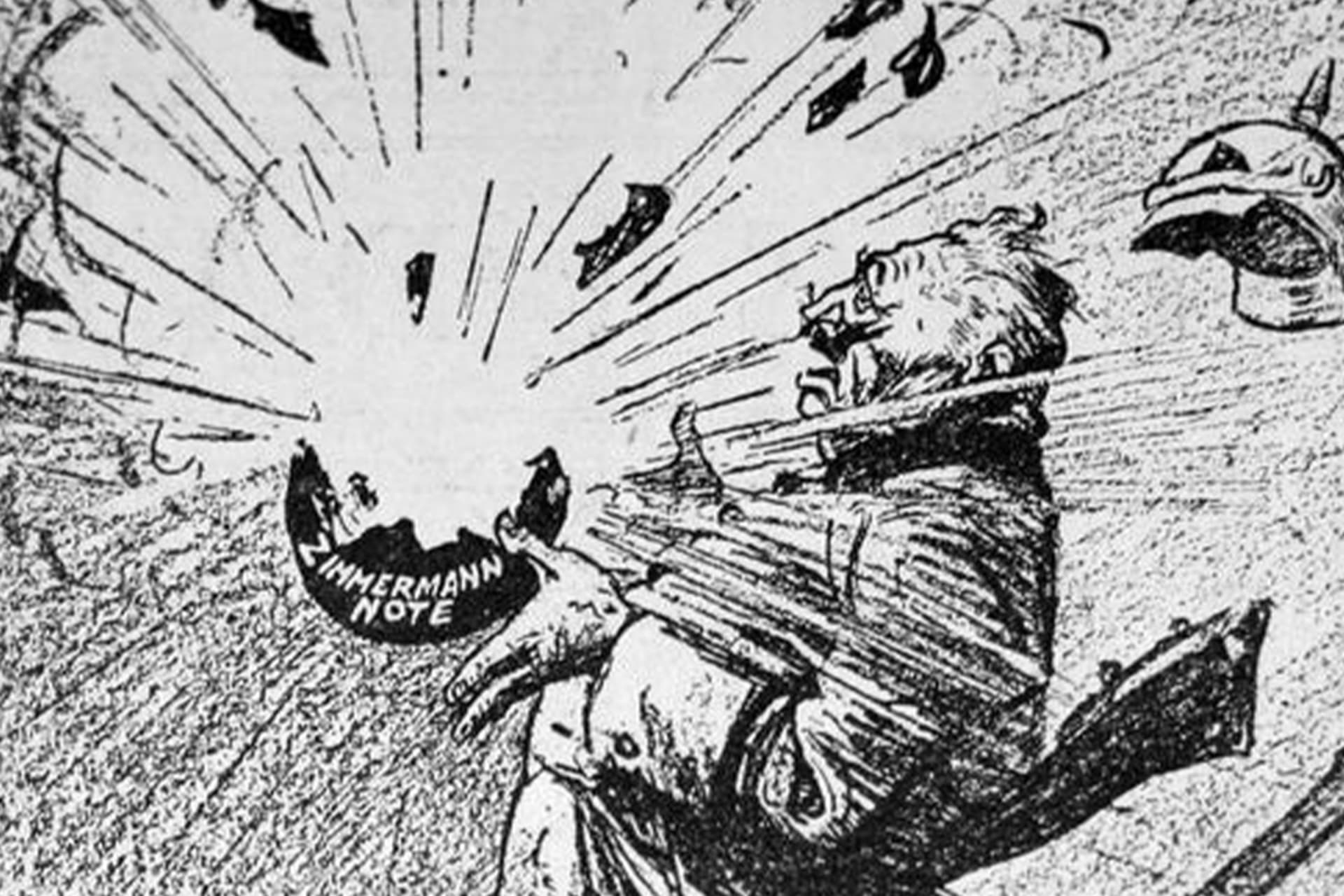
British intelligence has just shared an intercepted telegram, written by German Foreign Minister Arthur Zimmermann. The communication to the Mexican government reveals that Germany intends to resume unrestricted submarine warfare on the United States starting February 1. The telegram further proposes an alliance with Mexico, promising that, if the United States enters the war, Germany will support a Mexican campaign to reclaim the territory it lost to the United States in the 1830s and 1840s. President Woodrow Wilson has convened his cabinet to decide whether and how to maintain neutrality. Wilson’s cabinet must advise the president on whether it is time to enter the war. Cabinet members will need to evaluate the threat posed by the telegram to U.S. shipping and the risks of hostility with Mexico. Policymakers must weigh these domestic factors against the considerable risks and costs of entering the war.
Cabinet members should consider the following policy options:
- Strengthen defensive measures but remain neutral. This policy option includes reinforcing the U.S.-Mexico border and arming U.S. merchant ships crossing the Atlantic. This option could temporarily protect U.S. interests at home and abroad but would not altogether deter aggression. Defense measures also leave the United States exposed to future attacks. This option requires the fewest resources, focuses primarily on domestic U.S. interests and maintains lucrative U.S. shipping. Moreover, President Wilson would do nothing to incite an attack from Mexico.
- Take offensive actions short of war by launching small-scale retaliations at German submarines or calculated acts of sabotage in Mexico. This option allows the United States to seek retribution for German aggression and protect U.S. investments without requiring full mobilization for war. It does not guarantee U.S. entry into the war but risks escalating tensions that could draw the United States into a more costly exchange.
- Declare war on Germany and enter the war on the side of the Allied powers. Committing troops to Europe would require full military mobilization: diverting industries to wartime production and boosting U.S. military capacity through a draft. It would put U.S. personnel at risk and require significant resources. However, if the Allied powers are successful in the war, the United States could diminish Germany’s threat and expand democracy worldwide. U.S. involvement could also shorten the duration of this costly global conflict. This option could risk inciting an attack from Mexico, although mass mobilization could also deter potential Mexican aggression.
Additional Resources
- Telegram with a Translation of the Zimmermann Telegram (February 24, 1917)National Archives
- Letter by Theodore Roosevelt on the Sinking of the Lusitania (June 23, 1915)Gilder Lehrman
- Anti-war resolution passed by the 1916 convention of the Industrial Workers of the World (1916)Industrial Workers of the World