Nonstate Warfare: The Military Methods of Guerillas, Warlords, and Militias
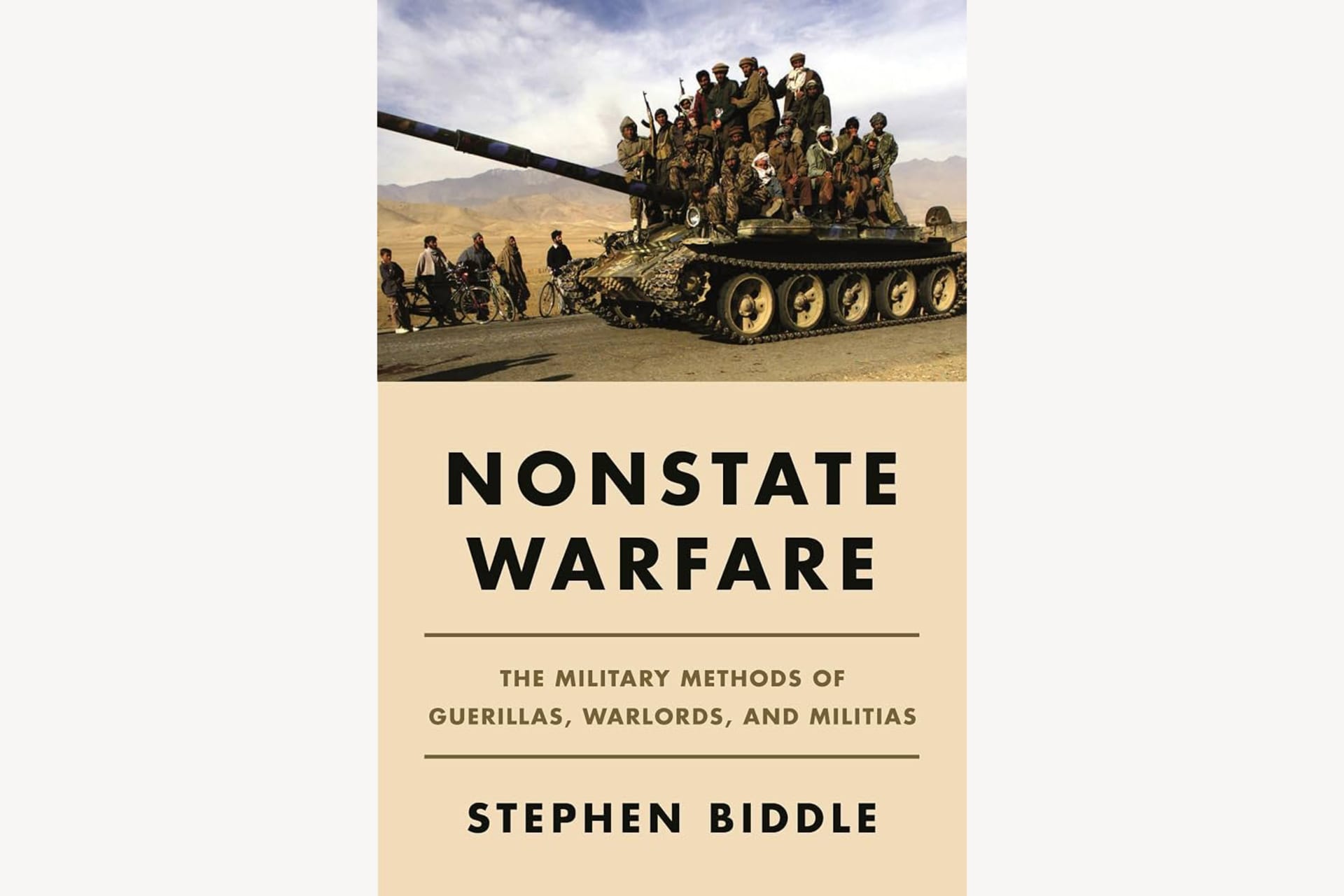
In Nonstate Warfare: The Military Methods of Guerillas, Warlords, and Militias, CFR Adjunct Senior Fellow Stephen Biddle explains how nonstate military strategies overturn traditional perspectives on warfare.
By experts and staff
- Published
SUMMARY
In Nonstate Warfare: The Military Methods of Guerillas, Warlords, and Militias, Stephen Biddle examines how nonstate military strategies overturn traditional perspectives on warfare. Among the most common assumptions in security studies is that state and nonstate actors fight very differently. Interstate warfare is usually seen as high intensity, conventional combat wherein uniformed, heavily armored formations employ massed firepower to destroy one another as a means to take and hold ground. By contrast, nonstate actors are widely expected to intermingle indistinguishably with civilians, using roadside bombs, snipers, ambushes, and suicide vests to coerce state enemies rather than taking and holding ground or seeking decisive battle. These assumptions underlie major debates in defense policy, military strategy, and international relations scholarship. Yet neither assumption is a sound description of real warfare. Some nonstate actors use methods that resemble the stereotype, but many do not, and neither state nor nonstate actors’ actual methods fit either assumption very closely.
In fact, as Stephen Biddle argues in Nonstate Warfare, there is nothing intrinsic to state or nonstate status in military behavior. Almost all real differences are matters of degree on a heavily interpenetrated continuum in which some nonstate actors already fight more “conventionally” than many states, and in which the material inferiority usually assumed to underlie the nonstate military stereotype is less and less relevant to real actors’ choices every year. Nonstate actors’ internal politics, rather than their weapons or equipment, are increasingly the most important determinant of their tactics and strategies – and misunderstandings of nonstate warfighting based solely on nonstate material inferiority can lead to serious errors in both policy and scholarship.
This book is suitable for the following types of undergraduate, graduate, and professional military education (PME) course disciplines:
- Civil War in Political Science
- History
- Public Policy
- International Affairs
- Military Affairs
- International Security Studies
- Strategic Studies
DISCUSSION QUESTIONS
For Advanced Undergraduate Seminars
- How different are state and nonstate military methods?
- Why aren’t they actually as different as so many people seem to expect?
- Do all nonstate actors use the same methods? Why not? What accounts for the differences within this category?
- Why should we care? What difference does all this make? What, if any, implications does the book’s argument hold for government policy or for our understanding of the world?
- Why should we believe Biddle’s findings (or not)? How is evidence used here, and is the evidence persuasive?
- The book advances a particular theory, from which it derives its recommendations. What is a theory? What does a theory comprise? How does the theory here fit the requirements of theory in general? Do all policy arguments have theories? What are the advantages and disadvantages of such an explicit use of theory? How else might one advance an argument, and what strengths and weaknesses would these other approaches have?
For Master’s Courses
- How different are state and nonstate military methods?
- Why aren’t they actually as different as so many people seem to expect?
- Do all nonstate actors use the same methods? Why not? What accounts for the differences within this category?
- Why should we care? What difference does all this make? What, if any, implications does the book’s argument hold for government policy or for our understanding of the world?
- What mistakes does Biddle think governments might make if they fail to understand his argument? What are the stakes here for policymakers?
- If governments have gotten this wrong, why? If new ideas are going to improve policy in the way Biddle clearly hopes, how will this happen? What pathologies in policymaking practice is the book trying to overcome?
- Whose policy choices is Biddle trying to influence? Will they read the book? Will their staff? In which agencies? How does research affect public policies?
For PhD Courses in Political Science and Public Policy
- What’s the dependent variable here? What are the independent variables? What is the unit of analysis and explanatory domain?
- How are these variables operationalized?
- What’s the causal mechanism that interrelates the dependent and independent variables?
- Why were these cases selected? How does Biddle address the risk of selection bias? Is his strategy successful? What would be the pros and cons of more or different cases?
- How are the case studies structured? Why are they organized this way?
- Biddle chose case method as an empirical testing strategy rather than large-n. Why? What are the pros and cons of that choice in this context? If he had opted for a large-n design, what would that have required, and would that choice have required him to adapt his theoretical work? If so, how?
- What literatures do the findings address? What gap does the book try to fill? What puzzle does it try to answer?
- The book hints at a larger theoretical claim than it advances. Why is the claim delimited as it is? What would be needed to establish the “unified theory” it sketches but does not defend?
- What further research does the book suggest?
For PhD Courses in History
- There is very little historical narrative in Nonstate Warfare. Yet it presents five detailed case studies of past conflicts, and presents a sustained argument to explain the outcomes of these past events. Is this historical scholarship? Why or why not?
- The book advances an interpretation to explain patterns of historical outcomes. How does it defend this interpretation? How is this approach different from other work we have read this semester? What are its strengths and weaknesses?
- The explanatory story here is very explicit and detailed. Is it less nuanced than other work we have read this semester? What is nuance, and what does it contribute to our understanding?
- The book deals with cases where archival documentation is often limited. What kind of evidence and documentation takes its place here? What are its strengths and weaknesses?
- How would you place Nonstate Warfare in the broad trends of recent military historiography? In what ways is it distinct? In what ways is it not?
For PME Courses
(The questions above are appropriate for PME at the undergraduate and master’s levels – the questions below are meant as supplements for the uniquely military student bodies at PME schools at any level).
- How, if at all, should tactics and doctrine change given Biddle’s findings?
- How, if at all, should force design and acquisition policies change?
- What implications does the book hold for intelligence analysis?
- If theater commanders had read Biddle’s book, how, if at all, would the conduct of American operations in Iraq and Afghanistan have been different?
- How easy or difficult will it be to implement Biddle’s policy recommendations?
- How does Biddle make his case here? How does he use evidence? Is this the way you’ve seen policy arguments advanced in your career experience to date? If not, why not? Should it be?
- Was the book easy to read? If not, why not? Is Biddle just a lousy writer? Or, is there something about the strategy for the use of evidence here that makes the writing different than you’ve seen elsewhere? Is this necessary?
ESSAY QUESTIONS
For Advanced Undergraduate Seminars
- Assume you are an advocate of one of the views Biddle rejects. Rebut his argument. As you do this, be sure to anticipate Biddle’s likely response to your rebuttal. Are you persuaded by your argument? Should others be?
- The People’s Liberation Army of Krasnovia is at war with the Krasnovian government in 2024. The PLAK’s materiel is inferior to their government rival. The PLAK has a tribal culture, mature natural order institutions, and limited stakes. What would an orthodox materialist predict for their military behavior? What would Biddle predict? Would they agree? Why or why not? What rationale would they give for their predictions?
For Master’s Courses
- What policies would Biddle recommend for the U.S. government in the next ten years and why? What policies would an orthodox materialist recommend? Would they agree? Why or why not?
- What policies would Biddle recommend for a nonstate actor with materiel that is inferior to their government foe, a tribal culture, fragile natural order institutions, and limited stakes? How would Biddle justify this recommendation to the nonstate actor’s leadership?
For PhD Courses in Political Science and Public Policy
- Propose a follow-on research project that would build on the analysis in Nonstate Warfare to advance knowledge in security studies. What would the research question be, and what gap would its answer fill in the literature? What method and evidence would you use to answer it, and how would the answer relate to the findings in Nonstate Warfare?
- How does Nonstate Warfare respond to the tradeoffs inherent in social science research design? What design alternatives were not chosen here, why were they not chosen, and what are the pros and cons of the respective options?
For PhD Courses in History
- Compare and contrast Nonstate Warfare with at least one of the other works we have read this semester. Evaluate their approaches, their strengths and weaknesses, and their relative contributions.
- Nonstate Warfare explains the choices of nonstate actors, but not the outcomes of wars involving nonstate actors. Does it have implications for such outcomes? If so, what are they?
For PME Courses
- Brief the Deputy Chief of Staff of the Army for Intelligence on the findings of Nonstate Warfare. What does the General need to know, and why?
- Brief the Undersecretary of Defense for Policy on the findings of Nonstate Warfare. What does the Undersecretary need to know, and why?
- Propose and justify three specific changes in U.S. acquisition programming that follow from the analysis in Nonstate Warfare.
- Is the analysis in Nonstate Warfare consistent or inconsistent with the prescriptions in Joint Publication 3-24, Counterinsurgency? Why? What implications follow from these similarities or differences?
Related Articles

Tracking Global Conflict Activity
Activities


What Is Arms Control?
Readings