- Events
- Webinar
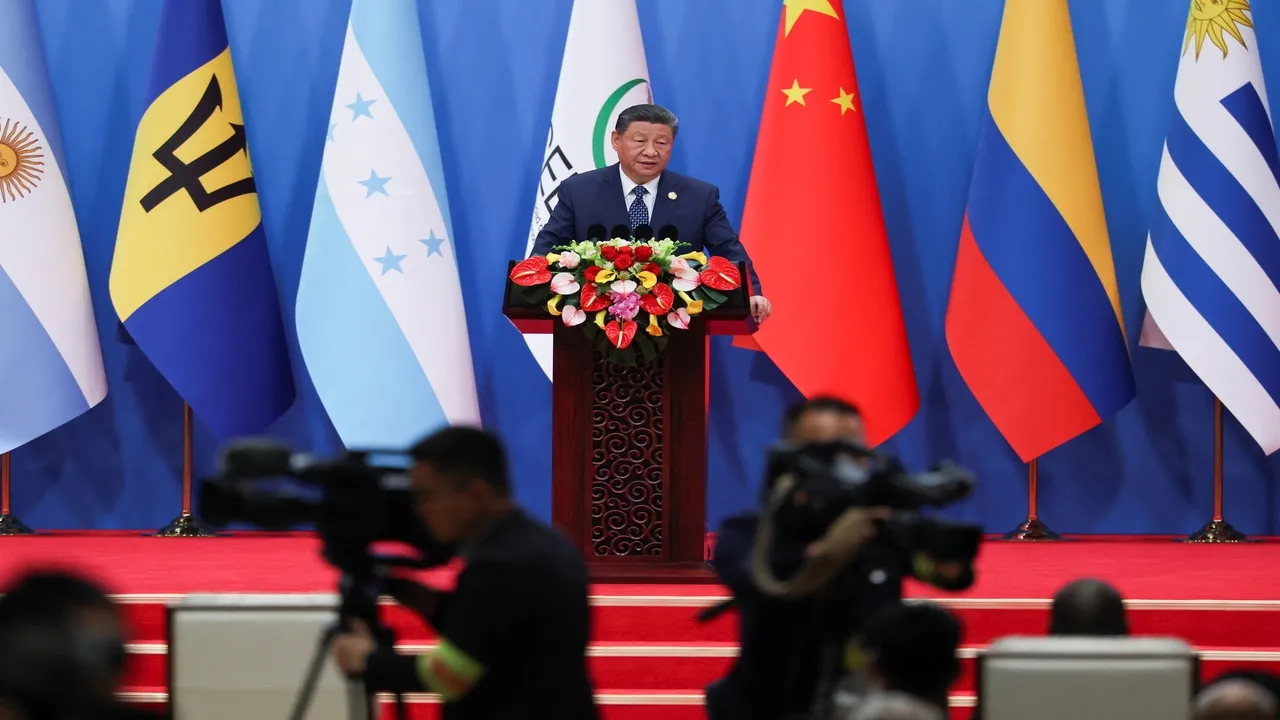
Global Affairs Expert Webinar: China’s Influence in the Americas
Watch Julio Guzmán and Margaret Myers colead a conversation on China’s influence in the Americas.
Event Date
Location
Julio Guzmán, director of international programs and clinical professor at the University of Maryland’s School of Public Policy, and Margaret Myers, senior advisor in the Asia and Latin America Program at the Inter-American Dialogue, colead a conversation on China’s influence in the Americas.
These webinars provide an opportunity for college and university educators and students to discuss global issues with CFR fellows, Foreign Affairs authors, and other leading experts. To register for future invitations, please complete this form or email [email protected] with your name, title, and academic affiliation.
Speakers
Julio Guzmán
Director of International Programs and Clinical Professor, School of Public Policy
University of Maryland
Margaret Myers
Senior Advisor, Asia and Latin America Program
Inter-American Dialogue
Presider
Irina A. Faskianos
Vice President, National Program and Outreach
Council on Foreign Relations
Transcript
FASKIANOS: Thank you, and welcome to the first session of the Fall 2026 Global Affairs Expert Webinar series. Welcome back. Happy September. I’m Irina Faskianos, vice president of the National Program and Outreach at CFR.
This webinar series provides a forum for students and educators to interact with CFR experts, and other thought leaders and experts, and participate in foreign policy discussions. Today’s discussion is on the record, and the video and transcript will be available on CFR.org/education if you would like to share the materials with your colleagues or classmates. As always, CFR takes no institutional positions on matters of policy.
We’re delighted to have Julio Guzmán and Margaret Myers with us to talk about China’s influence in the Americas.
Dr. Guzmán is the director of international programs and clinical professor at the University of Maryland’s School of Public Policy and a nonresident senior fellow at the Atlantic Council’s Adrienne Arsht Latin America Center. His research focuses on China’s influence in Latin America, including its effects on the region’s economy, democracy, and the rule of law. Dr. Guzmán is the founder and president of Partido Morado, a centrist political party in Peru, and twice ran as its candidate for the presidency, nearly elected in 2016.
Ms. Myers is a senior advisor to the Asia and Latin America program at the Inter-American Dialogue, and she is managing director for Johns Hopkins SAIS Institute for America, China, and the Future of Global Affairs. She established the Dialogue’s China and Latin America Working Group in 2011 and developed the China-Latin American Finance Database, the first publicly available source of empirical data on Chinese state lending in the region. And previously, she worked as a Latin America and China analyst for the U.S. Department of Defense and has taught at Georgetown University and George Washington University.
So thank you both for being with us today.
Julio, I thought we could begin with you to talk about China’s engagement in Latin America over the past decade, and what are the defining characteristics of its influence in the region today. And then we’ll go to Margaret.
GUZMÁN: Well, thank you very much for the invitation. One of the problems about talking China in recent years has been the lack of data. When I met with different people in Washington, DC, emotions and passions arose in both sides to talk about China, but were based on anecdotes, indeed, and personal experiences. But fortunately, over the years the data is emerging. And now we have more evidence, and we have accumulated cases, and we can start talking about China more seriously, based on objectivity and, from that point, to try to build policy and, of course, go into politics.
In my opinion, things doesn’t look very well in terms of China’s presence in Latin America. And I’m not talking about economic prospects. I would like to focus more on development, which has to do more with political institutions. I’m talking about democracy, the rule of law, and state capacity. There are—in order to understand why I believe that China could be having some effect, it’s important to understand what are the factors that sustain democracy. If we understand those factors, maybe we can identify which of them China is affecting.
Well, democracy is supported by four factors. The first one is high economic growth. And not in terms of rate, but in terms of the ability of high-quality economic growth to create new identities, new social identities—like unions, university students, the middle class, journalists—who could participate politically. That’s an important component that support democracy. The second one is social mobilization, this ability of social actors to get together and to build common platforms and ask the government for accountability and for transparency. That’s very different.
The third one is legitimacy. Is this idea—this is just an idea, but it’s very powerful—the idea that democracy is the best way that we know to be governed and to live. And finally, the fourth factor, is the ability of the state to deliver, to deliver social services. If we don’t have a state that could treat you the same way or deliver public services to all, we have a problem. Democracy erodes.
So for the four factors, I believe that China is not affecting the three first. Not high economic growth, because China is very diversified in Latin America. The quality of economic growth has to do with the structure of the regional economy in the first place. Social mobilization, no, it’s part of our history that is very unequal and discriminatory all over the centuries. And legitimacy, I don’t think so. Maybe indirectly. The idea of democracy has not been produced in Latin America. It has been imported from the Western world in the 1990s. So I don’t believe that.
But I think that China could be affecting the fourth factor, which is the ability of the state to enforce the rule of law and to provide public services. And I would like to go deep there. What are the ways of doing that? Well, the ways to weakening that ability are three. First, it’s changing the rules. (Laughs.) If I go to a region and I press to change the rules in order to be able to invest, well, that’s a problem because we are creating a discriminatory way of treating citizens and treating investors. The second one is violating laws, is to try to impose some conditions on the way I do business, I conduct business. And the last one is about getting involved in corruption cases.
So, let’s look at the data and the evidence. In terms of the data, a few years ago it was almost impossible to talk about that, because there were anecdotes, isolated cases. But now, it’s incredible, we have hundreds, hundreds—I’m not exaggerating—of cases that depict the three types of problems that we are mentioning. In front of me I have a list of eighty high-profile cases of Chinese investment to try to change regulations in terms of procuring assessments, in terms of having preferential access to natural resources, in terms of changing specific rules for some investment to get into some countries in which originally it were not allowed to do that. So eighty high-profile cases from hundreds that have already appeared. And databases have been built based on that. There is no precedent in Latin American history, in modern history at least, of those kinds of things.
In front of me, I also have high-profile cases, fifty of corruption involving Chinese investment in twelve Latin American countries, which are all of them documented. And in the case of Peru, for instance, one Peruvian president was impeached because of the informal negotiations with Chinese consortiums that led to the Peruvian president to be out of office. So and the third one, about the some kind of imposition of conditions, is very known. This study of the Peterson Institute, also with the Global Center for Sustainability, about their study of one hundred different contracts between China and developing countries, in which twenty-seven of them are Latin American. And they found two things: They found clauses in which it’s forbidden for borrower countries to make this contract public, which goes against many of the constitutions in our countries. And the second thing that they found is some conditionalities that allow China to change their policies if they are affected about any kind of conditions in those contracts.
So in terms of data, we have, like, some kind of booming cases that are telling us that something is happening. The problem with data is that you cannot prove causation, that you cannot prove that because those things are happening and because that is correlated vis-à-vis with the decline in the corruption, in the quality of government efficiency and procurement systems and also the increase in corruption, even though those behaviors you can see them, you cannot prove causation. You cannot prove that Chinese investment is causing that. Fortunately, we economists, we have tools to try to solve that problem. And that is called econometric regression analysis. What we do there—what we do is to use the scientific method to try to control for other variables and presume that everything is fixed, and then we calculate the impact of Chinese investment in those indicators of institutional quality, state efficiency, the rule of law, and the procurement system.
And that’s exactly—oh, that’s—I got my time. OK. So I was—
FASKIANOS: Right, you can wrap it up.
GUZMÁN: Thank you very much. That’s exactly what Leonel Diaz did in a forthcoming paper. And he showed significant and robust evidence that that relationship is happening. We are writing a second paper that is going to be published at the end of this year in which we are adding three more questions about more indicators comparing the Chinese situation with United States investment and investment from the European Union to see whether there is the difference there. And we believe that we can collect evidence to show what’s happening, because information is emerging but it’s still not enough to make a conclusive opinion.
FASKIANOS: Thank you. Margaret, over to you.
MYERS: Well, thank you. That was fascinating. And I’m thrilled to be able to maybe offer some additional information that can be useful, right, in understanding the evolving situation in Latin America and China’s, you know, ever-evolving role in this process. So, I mean, when I talk to my own students, I talk—I tend to talk about phases in the China-Latin America relationship. There were early phases, in there—you know, in the mid-1990s, for instance, where we saw China sort of going out with increased frequency into the region in pursuit of a number of objectives. Now we are in what I tend to call maybe a fourth, fifth, even sixth phase, where things have changed enough to suggest, and over time, right, that we are seeing perhaps, you know, a series of new motivations, new strategies, different conditions, different external forces and actors playing roles in new and important ways, that are all shaping the landscape in ways that have shifted, at least somewhat, right, from what we’ve seen in the past.
So just to give you a sense of kind of how this has evolved, if we’re talking about this new phase, right, be it fifth or sixth or otherwise, what we see still is a lot of continuity, right? We still see China pursuing many of the same objectives that it pursued in the 1990s, when Chinese state-owned enterprises, under what was called the going-out strategy, came to the region, really for three reasons. One was to pursue commodities. You know, raw materials that China needed at the time. So it could have been metals and minerals to support China’s own domestic infrastructure development. It could have been agricultural goods as China’s, you know, growing population and growing middle class was demanding more in the way of meat, which was fed by soy, right? Also oil was a very big area of focus at that point in time, and continues to be to some degree, right? And is something that China has sought to establish equity investment in, in Latin America and other parts of the world.
And so that’s still happening, right? We still see all of that driving so much of China’s engagement, and now we’re talking about a wider range of metals and minerals to include, you know, rare earths and other critical minerals that some Latin American countries have in abundance. Another thing China was pursuing back then was markets. Back in the, you know, 1990s and early 2000s, as China entered the WTO, it was producing more and it needed—it was really looking to export a lot of that capacity globally to help support this, you know, new form of economic growth that it was experiencing. And that continues to be the case, but in new and ever-more important ways. So we’re seeing more exports over time, and just continued growth in trade in general.
The third thing that China was doing was to try to internationalize its companies back then, right? These were—this was a moment, 1990s, when Latin America knew very little about China, but China also knew very little about Latin America. There were fifty total experts in all of China on Latin America in the 1990s. And many of those were focused on sort of ancient cultures and the other sort of historical dynamics in the region, but not on sort of the burgeoning relationship. And so this was a moment in which China really needed to get these companies on the ground and to help them to be successful.
And one way that it did that, and you all may have heard a lot about this, was to issue loans to governments, right, which would help them to achieve certain objectives that they had laid out, right, many of them infrastructure-related. But, as Julio mentioned, there were some conditions, right? The use of Chinese companies was one of those. So that helped Chinese companies to establish something of a footprint, the relationships that they would need to be able to navigate, and understanding they would need to be able to navigate the Latin American landscape more effectively.
All of these things are still happening, right? And they’re happening in many cases more intensively. We’re seeing more trade, but more exports from China to Latin America than the other way around, and of increasingly high value-added goods. We’re still seeing a real focus on Chinese company competitiveness, not through loans anymore. Those have really diminished. But now Chinese companies are so competitive because the prices of the items that they tend to be exporting, be they low-end or high-end, are exceedingly low. And that too will have implications for the region looking ahead. I think in ways that many in the region aren’t even anticipating to date.
What’s new, what’s shifted beyond this, is how China is approaching investment in the region. And this is—and I’ll kind of close with this, because I know I’m probably close to my end—but, you know, there is I think still in Latin America a perception, and I think still here in the U.S. a perception, of booming Chinese investment in Latin America. And indeed, things are still happening, but not nearly to the degree that we’ve seen in the past. You may have heard of the Belt and Road Initiative (BRI). We can talk about that in the Q&A if you’d like. But we’re kind of past the peak BRI moment, right, when we were seeing major, multibillion-dollar investments in big infrastructure.
Now what we’re seeing is actually a decline in the value of overall investment, foreign direct investment, and instead sort of a focusing on smaller scale projects—we’re seeing more projects, they’re tinier—that are very much aligned with China’s own priority industries and sectors, which it has set forth in its own economic planning. And specifically in the newest iteration of its five-year planning documents, which is the fifteenth five-year plan, where there’s a doubling down on a handful of industries that China thinks will carry it forward, from an economic perspective, that are going to be driving the economic engine in China. And there’s so much production in these industries that China increasingly needs to export that, right, and also invest in ways that facilitates more in the way of exportation.
So what does this mean for the region? Well, it means that some of the expectations that the region has may not be aligned with what China is actually willing to deliver. It means that we’re going to be seeing a surge in investment and also exportation in certain types of industries and sectors, some of which will have implications for Latin American industry. China is focusing right now a lot on pharmaceuticals. That’s part of these new industries that are—that are being prioritized. Latin America has its own pharmaceuticals industry. What will happen? So, I mean, all of—all of these shifts, some of them more dramatic than others, introduce a wide range of new research questions that are really worth your time, if you’re interested in this topic, but also which we can discuss in more depth today.
FASKIANOS: Wonderful. Thank you. And now we’re going to go to all of you for your questions.
(Gives queuing instructions.)
All right, so just opening up to see—we have already have raised hands. Vinay Aneja, and excuse me if I did not pronounce your name correctly. You can correct me. (Laughs.)
Q: Oh, can you hear me?
FASKIANOS: Yes.
Q: OK. Irina, it’s pronounced Vinay Aneja.
FASKIANOS: OK.
Q: OK. Thank you.
FASKIANOS: And your affiliation.
Q: I am a professor at North Carolina State University in Raleigh, North Carolina. Thank you.
My question is, why was and continues to be—China continues to be so bold as to be in the sphere of influence in the region of the world where U.S. has a huge amount of influence? And if so, what is U.S. doing about it?
FASKIANOS: Who wants to start? Margaret.
MYERS: Sure, I’ll offer some observations. We can shift back and forth. So, you know, it’s interesting. It’s a great question. And, indeed, it took a long time for this to actually happen. It really wasn’t until around 2013, 2014-15, you know, when we saw Xi Jinping assuming the chairmanship, presidency, right, head of the military positioning, that we saw a real shift in the way that China was approaching the region. There used to be a lot of writing about, you know, tread lightly, don’t do anything in Colombia, don’t do anything in any of these sort of traditional allied countries. That sort of writing sort of disappeared altogether following Xi’s—or, amid, you know, Xi’s ascendancy to the presidency, and this new view of China and its role and what sort of positioning it ought to take globally, including in the Latin American context. So a much more bold approach to Latin America in general, as you’ve noted.
Why continue to do so? I think, you know, on the one hand China has a lot of interests in the region. You know, some of these countries have a tremendous amount of—have tremendous natural resources, right? And so being able to engage with them and encourage encouraging them to diversify their partnerships beyond the United States and, you know, with China and others, is something that China has really sought to do in recent years through wide-ranging messaging campaigns but also these very attractive investment and other propositions. In other cases, there is, I think, considerable interest in trying to diminish, at least to a point, the extent to which the U.S. retains, you know, overall and supreme control or influence, right, in the region. That isn’t necessarily a suggestion that China wants to supplant the U.S. entirely, right, in Latin America, but rather that if you can diminish to a point U.S. influence then you can achieve more of these objectives that have been put forth.
And it’s my view, and that not everyone in Washington or elsewhere holds this view, that so much of this—so many of these objectives are aligned with China’s own sort of industrial and strategic planning at home, which is based on, you know, achieving even moderate rates of economic growth. And this is becoming increasingly an urgent matter, right? This is an existential matter and a real imperative in Chinese policymaking at this juncture. So finding markets, making sure they’re open, doing trade negotiations, even with the smallest countries, right, engaging in resource acquisition and securitizing those resources, ensuring that, you know, sea lines of communication and all sorts of, you know, transport infrastructure are available and open in the event of a future conflict—all of these things are a top priority at this juncture, to different, you know, portions of the Chinese government. And are, you know, in many cases advancing a lot of this activity, regardless of the perceptions of and concerns by the United States.
What is the U.S. doing? I mean, there’s been a lot of talk about this across administrations, certainly, and a real shift in thinking, obviously, between the Biden administration and the Trump administration. The Trump administration has taken a very different position, one that has sought to directly intercede in certain types of operations, right, and investment propositions, especially those kind of undefined red lines. So things like space cooperation, telecommunications infrastructure, other things that would be sort of surveillance related, certain types of critical infrastructure as well, right? I mean, a lot of this—critical minerals too, although I haven’t seen all that much intervention in that space, or at least not to the same degree, where you do see a lot of pressure not just at the government level, but even on individuals, to prevent those projects from moving forward. So it’s been a very sort of targeted approach to trying to ensure that certain types of projects are not progressing, which would be, from a sort of national security perspective, particularly threatening, by the judgment of this particular administration, and others. And certainly is a shared view on the Hill.
Whether that changes the game at all, right, whether that shifts dramatically, you know, the influence that China has, or will really alter the state of the relationship in general, is another really critical question. And my sense is that most of China’s influence is derived from trade, right? I mean, if you are in a country and you’re exporting 90 percent of your top commodities to China, then inevitably you’re going to be making decisions that take that top trade partner into consideration. And so there are a lot of factors here. And I think it’s worth asking whether the approach that the U.S. is taking at this juncture is sufficient.
FASKIANOS: Julio, do you want to add anything, or should we go on to the next question?
GUZMÁN: Well, just thank you, Vinay, for the question. I believe that from China’s point of view, we need to remember that in 2001 China joined the WTO. And China was in a phase of growing, of economic growth, that Latin America looked very appealing for them. First, natural resources to fuel economic growth in China, but on the other hand Chinese middle class were start increasing. And that means that demand for food was increasing significantly. Latin America brought those things at the very beginning. But the other factor is that Chinese presence in Latin America has been quick and has been silent. Quick, from, you know, from 2005 to 2008, and then start growing really, really fast. And silent in the sense that we didn’t have the data in order to really understand what was going on.
Chinese presence in Latin America, so quick, has been going from hardware control, which is natural resources, to software control, which is the systems, telecommunications, high-level technology. And from the United States side, I believe that was a misunderstanding. Really, I believe that the United States took for granted Latin America for many, many years. But at the same time, it was distracted at that time with other geopolitical problems in the world that made Latin America not the priority, politically speaking. Now the United States are taking some measures. I’m not going to judge on those measures. I believe that diplomacy, negotiation, and goodwill could solve everything. But I believe that was the reason why this is—this is happening, and where we are now.
FASKIANOS: Thank you.
I’m going to go next to Emily Parra-Diaz. If you can unmute yourself and tell us who you are.
Q: Hello.
FASKIANOS: Yes.
Q: All right. Hi. Good afternoon. My name is Emily. I’m a current senior at Stanford University in Southern California.
The question I have is for Professor Myers. I just wanted to ask that I know that you had mentioned pharmaceuticals and how you, I believe, mentioned that they are expected to increase. That being said, for any other industries, are there any that you would say that over the time of your, like, work or analyzing that you expect to go down perhaps? So I’m not too sure if you highlighted any of them, but yeah. Thank you.
MYERS: Thank you, Emily. Yeah, I mean, it’s a critical question. And so if—I mean, this can be a great study for you. And I encourage you to just go ahead and read the—you know, the fifteenth five-year plan. It’s a long document, but it’s translated into English. Or you can do that yourself through—you know, through translation software. Because a lot of that is laid out. You may want to read previous documents too, just so you can do something of a comparison. But let me give you a kind of rundown of how I see it all playing out, right?
So there was something called over the past, gosh, maybe four years, something called the new three. Xīn sānyàng. And so it was the new three industries, right? And a lot of these were being developed and promoted domestically in China, but these new three were really—were really critically important. So that was batteries, EVs, and solar. And so we have seen the implications of the promotion and, you know, incentives that have been given to those industries over time, not just within China—where there’s this dramatic competition among these industries to the point where it’s called involution, right, where certain top champions have ascended and are able to produce at, basically, you know, the lowest—the lowest value possible, right, in terms of exports.
And then now we’ve seen an explosion in the exportation of all of these things globally, to include in the Latin American context. Which has had some consequences. Some positive, right? You have maybe more solar fields and things like that, advancing certain development objectives in that respect, or environmental objectives. And then others—you know, there’s a sort of dumping consideration underway, where a lot of countries are feeling—I mean, the term that you hear in Spanish is inundación, right? Like, a flooding of goods, not just these but other things, into the region.
So the question now—there is now a new-new three, right? And then there are a handful of other industries that are being prioritized within this new planning moment. And they have been identified. They’ve been outlined, right? So pharmaceuticals is one of them. Machinery, but increasingly sort of high-tech machinery that includes—you know, that incorporates AI and other high-tech functions. Seed technologies and things—so biotech, right, is a very big part of that. And, of course, Brazil has, you know, major capacity in that sort of area. Aerospace, that’s another intersection with Brazil, right? So there are some where it’s not going to be across the board everything China is doing is intersecting with Latin American industry, but a lot of this will have some implication, right, for the competitiveness of certain businesses and industries in the region.
And beyond that, you know, I think what we’re seeing in some countries—Brazil, Mexico, and a handful of others, right, Peru, too, I believe, right—there are certain development strategies that put forth certain industrial objectives, and even outline areas where, you know, development—they’re looking to promote development or industrial competitiveness or, you know, productivity. And, I mean, in Mexico—in Plan México, for instance, which isn’t talked about with as much frequency these days, batteries, you know, was a big part of that discussion. So we’re EVs. So we’re a handful of other things. And when you look at, you know, the competitiveness of China’s industries and how that has only increased over time, one wonders what possibilities there are, right, absent some very specific thinking about how to structure, you know, industries domestically, but also trade, and how—you know, how really that can be achieved.
And so this is going to be a moment, I think, in the coming years where Latin America is really grappling with its economic developmental future, right? Where does it see itself heading? And what can it do to achieve some degree of industrial capacity and competitiveness in the face of what is an increasingly competitive China across a wide range of industries? And this isn’t just a Latin America question, right? It’s stirred up a lot of debate here in the United States, and also policy reactions, right? And same in Europe. This is playing out in all kinds of ways in Europe. So it’s really a global consideration at this juncture.
FASKIANOS: Thank you. I’m going to take the next question, written, from Ted Vician, who’s a graduate student at Arizona State University. And maybe, Julio, you can take this one.
How has the capture of Maduro, and change in Venezuela’s oil industry affected China?
GUZMÁN: Well, indeed, the situation in Venezuela has not changed, structurally speaking. And in my opinion, Venezuela’s position in the oil market has been over-measured. Venezuela, it’s true, it has like 20 percent of oil reserves in the world. But it’s only able to produce 1 percent of that. The estimates—the best estimate says that it’s going to take, like, ten years for Venezuela to invest—and not only to invest money, but also to create the institutional framework and the institutional arrangement for that to happen. So I really don’t think that that is going to change the market globally. And it’s going not going to have a big impact in oil prices.
Indeed, when Maduro was captured if you take a look at the data, you look online, oil prices almost didn’t change. They increased very slightly. In terms of China, my understanding is that China has debt contracts tied with oil production in Venezuela. And those contracts are formal, are pretty explicit. And I don’t think, as far as I know, that there will be some kind of disruption with that. So I don’t think, again, that, as far as the information that we have right now, that this is going to have a huge impact in oil markets and oil production around the world.
FASKIANOS: Thank you. I’m going to go next to Earl Carr.
Q: Hi. Thank you, Irina. And great to see you, Margaret.
We understand that China has incentivized many countries in Latin America to use the renminbi. How do you quantify the influence and impact of the internationalization of the renminbi in Latin America?
MYERS: Shall I start with that one, Irina?
FASKIANOS: Sure.
MYERS: OK. That’s a—Earl, that’s a wonderful question. (Laughs.) I bet you have a better answer to it than I do. And great to see you, too. You know, so, I mean, just in terms of the types of usage, right, of how much—certainly we’ve seen growth in the use of renminbi, right? It’s not necessarily been something that all countries have embraced wholeheartedly. And there’s been something of a process in terms of introducing this idea and, you know, achieving some degree of buy-in in different places. But it’s been done, in some cases through lending, right? And we can go through the sort of—you know, Julio mentioned the loan contracts that—and we have a handful of those thanks to, you know, William & Mary, and Peterson, and others that have put together, you know, these contracts, and analyzed them. And some of them have these conditions, or are denominated, rather, in both dollars and renminbi. And so that to the extent that the renminbi are used, you know, that introduces that currency into those markets.
Currency swaps are another mechanism through which we see, you know, the introduction of and use of Chinese renminbi—also known as yuan, for those who are—I mean, it’s sort of interchangeable, right? Both. And so we’ve seen those in Brazil and Argentina. It’s been really critical sort of source of liquidity for Argentina in recent years across several administrations, and so that too has happened. And then another—you know, there are other mechanisms too. And certainly, you know, I think the introduction of clearing houses, right, and other things in in different countries—Chile has a major clearinghouse. And it’s the Agricultural Bank of China that has been managing those most extensively. So it’s something that’s taken shape, right? And there is a degree of interest.
And certainly it makes sense, you know, if we’re talking about the exportation of commodities, right, to some degree. That said, it’s been difficult, I think, you know, for the renminbi, or frankly any other of these sort of emerging currencies, to supplant the dollar, right, and to become a reserve currency in the way that the dollar has managed to do over time. And so I think certainly China is still working on that. And the weaponization of the U.S. dollar is something that has really, you know, attracted a lot of attention of late, and has incentivized those BRICS countries and many others, right, to take positions suggesting that, you know, dependence on the dollar is—there’s too much dependence on the U.S. dollar, and that something ought to be done to change that overall dynamic. Making the prospect of use of other currencies, to include the renminbi, more palatable and interesting, right, to a wider range of countries.
So we’ll see what happens. A lot will depend, I think, in the future on how much finance potentially comes from China, right, and whether, again, that is denominated in renminbi, rather than dollars, or any other BRICS currency, for instance.
FASKIANOS: Julio.
GUZMÁN: Yes. Thank you. I’d like to agree with Margaret in two things. It’s small. It’s increasing. But I see very difficult, at least in the short term, the renminbi to be important in Latin America. Not only for the reasons that Margaret mentioned, which is trade, but particularly for monetary policy. We need to understand that currency is not only used in transactions, in international transactions, but also currency is used in order to manage exchange rate the domestic economy. Particularly in countries like Latin America, that we need to have—we need to manage the price of the dollar very quickly, because we have a long story of inflation. What it means? That in order to manage the price of the dollar central banks needs to have a lot of local currencies and a lot of currency in U.S. dollars in order to intervene in the market to make the prices to float in a very specific range.
That means that the provision of dollars is extremely important for that reason too. If we include the renminbi in the equation, it’s getting the situation much more complex. And on the other hand, how the governments get those dollars to manage monetary policy, not only from trade and from international transactions, but also for the issuing of bonds, national bonds. In both, in local currency and also in dollars. And international markets and financial markets is mostly composed by U.S. dollars. So it’s another reason, a third reason, why it’s the dependency of the developing world and Latin America on the dollar is extreme—is very strong still. Nobody knows what is going to happen in the future, but for now that’s the situation.
FASKIANOS: Thank you. I’m going to go next to Davida Osei-Appiah.
Q: Hi, everyone. My name is Davida. I’m a student at NYU. And I want to give a quick shoutout to my professor, Professor Zindar, for letting me know about this very informative and great webinar. So, thank you, Professor Myers and Mr. Guzmán, for your time. And thank you, Ms. Irina, for moderating.
You might have answered this earlier, but you mentioned that China has decreased investment in large projects across Latin America, in infrastructure projects specifically. Though it seems like in African countries China seems to still have very large investments when it comes to infrastructure in that region, especially regarding, like, outside of oil and minerals. So do you think that China’s new investment plans to align with their five-year plan is being implemented all at once across all the regions, or just certain regions at a time? Thank you.
MYERS: That’s a terrific question. I haven’t done the data, run the data, for Africa. My sense, you know, is that a lot of this is happening globally, though. You still hear about—for a couple of reasons, right? So there’s still a sense in Latin America that China is investing heavily in large-scale infrastructure. But I think we need to remember that a lot of these projects began to be negotiated and developed during peak BRI, right? So 2014, 2015, 2016 was when we saw a lot of the ideas, the conceptualization, and also the initial execution taking place. And then you see some of these things coming online a little bit later. So the perception is, oh, you know, big infrastructure is still the name of the game. This is exactly what’s happening and this is the top priority. And I think the same is happening in Africa, right? It takes a little while to actually get these things going and operational.
In general, I mean, there has been, there are a handful—there are a couple of trends, you know, demand side and supply side, right, that are affecting kind of what China is willing to do and is—and able to do in the Global South in general, and just more broadly, right? So one is that there is just less capital. There is less capital. And there is—you know, so that means that Chinese companies in general have been more risk adverse. And so a smaller project in a, you know, high-priority sector that is being incentivized by the Chinese government or the Ministry of Commerce, for instance, and has preferential financing, and all of these other things, right, and will end quickly. It’s not a big infrastructure thing. It’s not going to cause, you know, problems in a country, and there won’t be a lot of resistance. And then revenue will begin to be produced pretty much immediately. Those are the preferences, right, when those are the conditions in China and that Chinese companies are facing.
So for that reason, regardless of where they’re investing, right, there is, I think, a real preference for a different kind of investment. That doesn’t mean there’s no infrastructure happening. You still see a port here and there, right? You still see things happening. So in the Latin American context, about 60 percent whether, in terms of value or number of projects of investment over the—still. We just reran the numbers, right? Is in these sort of new infrastructure, high-tech sectors, which often tend to be kind of smaller scale projects. That may vary across different regions, but my sense is that because of, you know, what it is that China is able to offer at this juncture, the overall dynamic has changed.
The other really important thing—and I’ll stop with this, the other really important thing that has changed is that we don’t see the policy banks—so those are the China Development Bank, right, and China Ex-Im Bank, which were the major suppliers of finance for this big infrastructure—providing the same kinds of loans, these big sovereign loans, to governments, right, that were responsible for really developing and advancing so much of this big infrastructure in the first place. They have been brought back home, right, to deal with a number of development questions at home. Their overall—the capital that they’re working with has been dramatically decreased, right? And they are being held on a much tighter rope these days than what we’ve seen in the past. And so that too has an effect on what kinds of projects will be executable, right, and which will not. But this is a wonderful, wonderful comparative exercise. And I hope you’ll undertake it.
FASKIANOS: Julio.
GUZMÁN: Thank you. And thank you for the question. I think it’s very difficult to answer because everything is a supposition. If there is a plan, a specific plan from different regions, nobody knows. But the things that we know is that Chinese presence in Africa was first, and then Latin America went after that. One of the reasons for that was, obviously, geographical distance. Geographical distance makes, of course, trade and investment much easier at the very beginning. And also it created, like, a way of learning, try to learn how to engage with the developing world from that.
The second thing is that one of the things that we learn from trade theory is that even though trade is good for both sides at the very beginning, there are a lot of distributed effects in each country when that engagement happens in terms of employment, in terms of the industries that are that are affected, in terms of social actors, et cetera. So instead of comparing Africa and Latin America as a region, I will take a look at very specific countries and what is going—what is happening in each of those countries. Because the context and the initial condition of each country is completely different than another, even though they could be neighbors or in different regions. So I will be very careful of looking at regional patterns. And I will be more interested in looking at specific cases.
The point that I would like to make here is that I am an economist. I’ve been trained as an economist. And because I am an economist, I know the limitations of economics. And economic growth is not development. Ask Latin America. We have been growing for twenty years, and the social conditions are pretty the same. Ask other countries that have been growing a lot, and the same condition is happening. So my point is, economic growth and trade and technology, they are good, but it’s only one input of development. And I would rather focus my concerns and my research on development, what it means, with what this means for people, rather to take a look of what is happening on the economy itself.
And again, I go back to the issue of democracy and the rule of law, because the information that is emerging, not solid yet. Because I said I need to be very objective, it’s not solid yet. We need to do research. We need to keep looking at the data and do regression analysis and using other quantitative methods. But the information that is emerging from Africa, in that sense, it’s similar to Latin America. The deterioration of the rule of law and the changes in rules all the time, because they need to accommodate China investment in the region.
There is even a theory about when two—when two powers that have different cultures, different political cultures, and the way of doing business, they get together. When they have the same political power, they have the incentives to accommodate, and to talk, and to negotiate. But when you have this huge asymmetry in which we have different cultures, different political cultures, but power asymmetry, the result is that the weaker actor used to get adapted to the conditions. I’m not saying that this is force. I’m not saying that, because we don’t have the evidence. But we have the results. And the results is that there is an adaption in the rules and the way we can do business and we do politics in our countries, because of the huge power asymmetry from China.
FASKIANOS: Thank you.
I’m going to take the next question from—sorry, I’m getting it—Craig Miller. It’s from his students. He’s associate professor of history and political science at Pennsylvania College of Technology. And his students have written this question: Historically, China has thought in long-term cycles while we tend to think in four-year cycles. How do we negate that disadvantage? I don’t know who wants to start.
GUZMÁN: Could you repeat the question, please? I did not understand.
FASKIANOS: Yes. China has thought in long-term cycles, while we tend to think in four-year cycles. How do we negate that disadvantage?
GUZMÁN: Well, let me start here as a Latin American. We Latin Americans, we don’t even work in four-year cycles. (Laughs.) Not even formally or informally, because even presidencies that last four years or five years, they don’t have any plan. And I’m not talking only about Peru. It’s very hard to find a Latin American country with a plan even for four years, because politics has become so short-term, and because of the particular challenges that we Latin Americans face. But there is here one insight that I could share, is the fact that we are comparing authoritarian regime, China, which has the ability and the space to make those decisions in the long term—good or bad, but they have this ability. And on the other hand, we have electoral democracies, that are very weak in Latin America, that have spans of four or five years that even within that period is very complicated to do things.
So, again, political institutions are very important when you analyze these economic processes. And that’s one of the advantages. When you compare, for instance, just for putting an example, how loans and investments from the World Bank or from the Inter-American Development Bank are designed and implemented in Latin America, they took around three or four years. I worked at the Inter-American Development Bank for ten years, so I know this. It takes three, four years from the idea to the money to get into the country. In the case of China, it takes months to sign a debt contract. Why? Well, because we have a Latin American country with executive, and you have an authoritarian regime that could make a decision pretty quick. And you cannot compete with that. For the good or for the bad, I’m not—I’m not putting that. You cannot compete.
That’s why it’s much—you see that in the case of China, and other countries that has tradition of authoritarian political regimes, they have this space to make these plans for ten years, twenty years. In our case, is much more complicated with—because we need to consult, we need to negotiate, and because we are politically weak within our own countries.
FASKIANOS: Margaret, maybe you can talk about from the U.S. four-year political cycle.
MYERS: I mean, yeah. I mean, this is—this is essentially—I mean, this is a real challenge. It’s not as though there’s no continuity at all, right, in thinking about how we ought to be addressing, you know, various aspects of our foreign policy, and whether certain things remain of concern or not, right? I mean, in many ways many of the policies that the Biden administration adopted on China, and even on China in Latin America, right, were similar to those that Trump one, right, had put into place or sort of advanced. And so others differed, right, obviously, considerably. But there was some continuity there.
That said, I mean, this would be an exercise to achieve, you know, real continuity, and long-term thinking, and carrying out, you know, certain policies over more than four years, ideally for decades at a time, right, it requires a consensus, right, on what’s in the American interest and how our foreign policy best articulates that. And we’re certainly very far from that at this juncture. And I know there are many organizations that are working very hard to achieve more in the way of consensus and understand—bring folks to the table of different minds to make that happen. But we are in a moment where that is perhaps harder than it’s been for a very long time.
So I don’t have a good solution, but I mean it’s a great question. And indeed, it’s been one of the issues that’s been most difficult and most striking, even to Latin Americans and wide-ranging other partners, right? Is they say, look, China is always giving us the same message. We always—we know they’re going to be doing these things. Yes, it does shift somewhat. The priorities change, you know, year from year, but it’s the same general message. We’re here. We’re interested in investing. We’re going to be doing these things, right? And the U.S. priorities and, indeed, forms of engagement, and the rhetoric that’s employed changes dramatically, even, you know, within administrations.
FASKIANOS: Thank you.
I’m going to take the next question from Ludmila Gonzalez Curulli.
Q: So it’s my pleasure to have this opportunity to listen to you. I really appreciate that you bring all these dynamics about the region.
And I’d like to ask you a question regarding the Chinese influence in Latin America within the U.S. and China competition, specifically about the AI competition. As you already know, the U.S. has already extended the critical mineral lease by the beginning of the year. So it has incorporated new critical minerals. And in these AI competitions, I would like to know what do you think are the most critical factors that we should look closely, especially in upcoming elections in Brazil, Argentina, U.S., within the context of the AI race. Following up on the commentaries that you have mentioned, Julio Guzmán, about this adaptation that Latin American countries may have to the Chinese economic coercion. So what do you think about this from the Latin American perspective and the U.S., how we can understand better this Chinese influence in the AI? Thank you.
FASKIANOS: Who wants to start?
MYERS: I’m happy to just very quickly. I think Julio’s best position to address a number of these things. But, one, I mean, I would say, look, so long as this is conceptualized as a race, right? And my organization works very hard to sort of challenge that overall framing and thinking, right, because what truly are we racing toward? There are so many safety and other considerations, right, that everyone needs to take into account. And so long as we think of this as a race, we risk maybe ignoring those things just to get to a sort of endpoint that is not well defined, and where we don’t know really where any of this will stand and what the implications will be from a social, economic, environmental, and other perspective, right?
But so long as it is conceptualized as a race, right, and indeed there is competition in these areas. And we see companies really looking to establish positions, standards, you know, contracts that will use certain equipment and other technologies that employ U.S. or Chinese AI models, right, or would have the capacity to do so. A lot of this is being discussed right now. One option for Latin American countries, especially those with, you know, critical minerals or other manufacturing capacity, right, is to try to insert themselves more effectively in these supply chains.
So if we’re talking chips, right, it’s really advocating for—you know, if it’s not manufacturing of the chips themselves, then it’s packaging or some other element, you know of the value chain. If we’re talking, you know, critical minerals development, it’s really advocating for the processing to the extent that it’s environmentally feasible, right, of these—of these critical minerals in-country. So just having that value-add component would be something that I think has been articulated to be of interest, right, and would be valuable to Argentina and others.
That is something that Chinese companies have promised to bring when they have bid on certain contracts or, you know, certain tranches—or land with minerals. But it’s yet to happen, either in Chile or in Argentina. So it presents an opportunity. Whether that’s achievable or not, I mean, is something that these countries will need to consider very carefully and really push for.
FASKIANOS: Julio.
GUZMÁN: Thank you, Margaret, for saying that I could add more things, because I can’t. (Laughter.) You know, I know a little. I know a few things, but I don’t have the big picture, partly because nobody has it, but partly because I’m not an expert on that. But I know a couple of things. That, first of all, that we have potentially stakes on this, Latin America can have. Because we have a number of countries that all of them in a group, they are very big producers of critical minerals. So there is a potential stake that we can take about our advantage. That’s true.
But the second thing is that we need to understand first the value chains of artificial intelligence. And we don’t. Indeed, we are in a very early stage to even understand what is the chain of production, all the inputs, and the value chains, in each Latin American country that supports AI in the future. And we don’t have any analysis. We don’t have evidence. And I know that because of a couple of projects that we are trying to participate in our school of public policy. And part of the diagnostic was that that there is no information in Latin America about that. So if we don’t know, if we know that we have critical minerals and we potentially do something, if we get together, but if we don’t understand the production function of that, it’s going to be very difficult for us to take advantage economically, but also politically.
FASKIANOS: Thank you.
I’m going to take the last question from Mark Whitman, professor at Alfred State College: By putting so much concentration on China, what critical components in other countries might the U.S. be taking its eye off of? What is the significance of ignoring other countries for China? So I’ll let each of you take—
GUZMÁN: Again, please, sorry.
FASKIANOS: Sorry. So the question was: By putting so much concentration on China, what critical components in other countries might the U.S. be taking its eye off of?
MYERS: I mean, as a final point I would make probably the first one—of the first points that Julio made, which is that, you know, there has tended to be for so many years now, right, a sort of deprioritization of hemispheric affairs. Of course, you know, the new the renewed Monroe Doctrine, or Donroe Doctrine, or whatever we want to call it, right, sort of suggests more attention toward the region. But in reality, we’re in a very similar position that we’ve been in for many, many years. And what is missing is a conceptualization or understanding of the importance of the region from an economic perspective. I mean, never mind all of the other, you know, personal and other—and, you know, social linkages that that exist. But, you know, and from a national security perspective, right, very critically important as well.
But economically speaking, I mean, this is—this region is fundamental. And there’s so much that can be done to partner more effectively. There are ideas out there. There are ideas being floated right now, right, that would potentially generate new critical linkages. And those that would not only be, you know, growing economies, but also ideally incentivizing development within them, to Julio’s point. But, you know, it’s—so, yes, I’m sure there are other—many other countries we could point to.
It’s a great question. And overemphasis on China, and I would say more importantly kind of using China to achieve certain objectives that should or should not be—you know, the sort of China as the foil, China as the—(laughs)—you know, always using—playing the China card is something that I—in my view, you know, folks even on the Hill are tiring of that a bit. And so we’ll see how much—how much that’s being carried forward in future conversations about all of these issues. But yeah, I mean, it’s a critical question. And I’ll just say, you know, Latin America is fundamental. And there’s been for a very long time not enough attention paid.
FASKIANOS: Julio.
GUZMÁN: Yes. Well, I will add to what Margaret says that there are two areas in which I believe there are potentialities. The first one is trade. I know that, politically speaking, it’s very hard now to try to enforce or to promote free trade agreements with Latin America. That time just passed. But it’s interesting the potential gains that the United States and Latin America together could get working on non-trade barriers. Like, for instance, facilitation in infrastructure. I remember a study that the Inter-American Development Bank did a few years ago. And they released this amazing figure that only if we take advantage of non-trade tariffs, and infrastructure related with trade, and customs, and logistics, and all those things, the gains are ten times the gains in comparison to the gains of keep reducing tariffs in the region vis-à-vis with the United States.
So the agenda is not a political agenda in trade. Indeed, it’s a management agenda, in which we can start doing things that are already in place. And we have—the legislation has been already signed for years. So we need to start working on the field and start taking out these knots that make trade difficult. That’s a big agenda. And you don’t need political capital to do that; you need only willingness and management, as I said, to do this, because this is a technical issue.
And the second one is a closeness between the United States and Latin America. I believe many of the things that I believe, in which I truly believe—which is democracy, the respect of the rule of law, equal treatment for everyone, because I think that’s progress—are things that that we share with American tradition. And the way I’m thinking is because I came to the United States and I have this great opportunity of study here, or being here, and to see the world, because the world is bigger than you really believe it is. So this interchange of Latin Americans coming to the United States, and vice versa, and try to understand and to know each other better, could contribute to cultivate that culture, that culture of, as I said, the values that I believe are important for us.
Instead, one time I said that instead of investing in mining, we should be investing in minds, in people’s minds, to change the way, to be aware of the things that are important to us. That having a good job is a good thing, but having freedom or being treated equally to everyone is as important as that. To have the power to mobilize and to say, I need this, I want this to our government and to ask for accountability, is as important of have an additional income. And I think that—we’ll get that if we get a closer relationship between our cultures, American culture and Latin American culture.
FASKIANOS: Wonderful. That is a great way to end this webinar. And I apologize to all the questions, there were so many raised hands and written questions that we did not get to, but we only have an hour. So, Julio Guzmán and Margaret Myers, thank you both for taking the time to be with us today and share your expertise and analysis. And to all of you for your questions and comments.
The next Global Affairs Expert Webinar will be on Wednesday, September 16, at 1:00 p.m. Eastern Time. Samuel Charap, who’s at RAND, and Kori Schake, who’s at the American Enterprise Institute, will lead a conversation on U.S. policy in Ukraine. In the meantime, I encourage you to learn about CFR paid internships for students and fellowships for professors at CFR.org/careers, and visit CFR.org, ForeignAffairs.com, and ThinkGlobalHealth.org for research and analysis on global issues.
So, again, thank you both for being with us, and to all of you as well. Hope you enjoy the rest of your day. And we look forward to your continued participation.
GUZMÁN: Thank you very much.
(END)