- Guest writers
From Morocco to the Classroom: Building Soft Skills Through Simulations
After seeing Moroccan students’ exemplary soft skills, a CFR Education Ambassador and Fulbright Teachers for Global Classrooms Fellow is using CFR mini simulations to strengthen those skills in his own students.
By experts and staff
- Published
- By
- Zack Ritland, Braintree High School
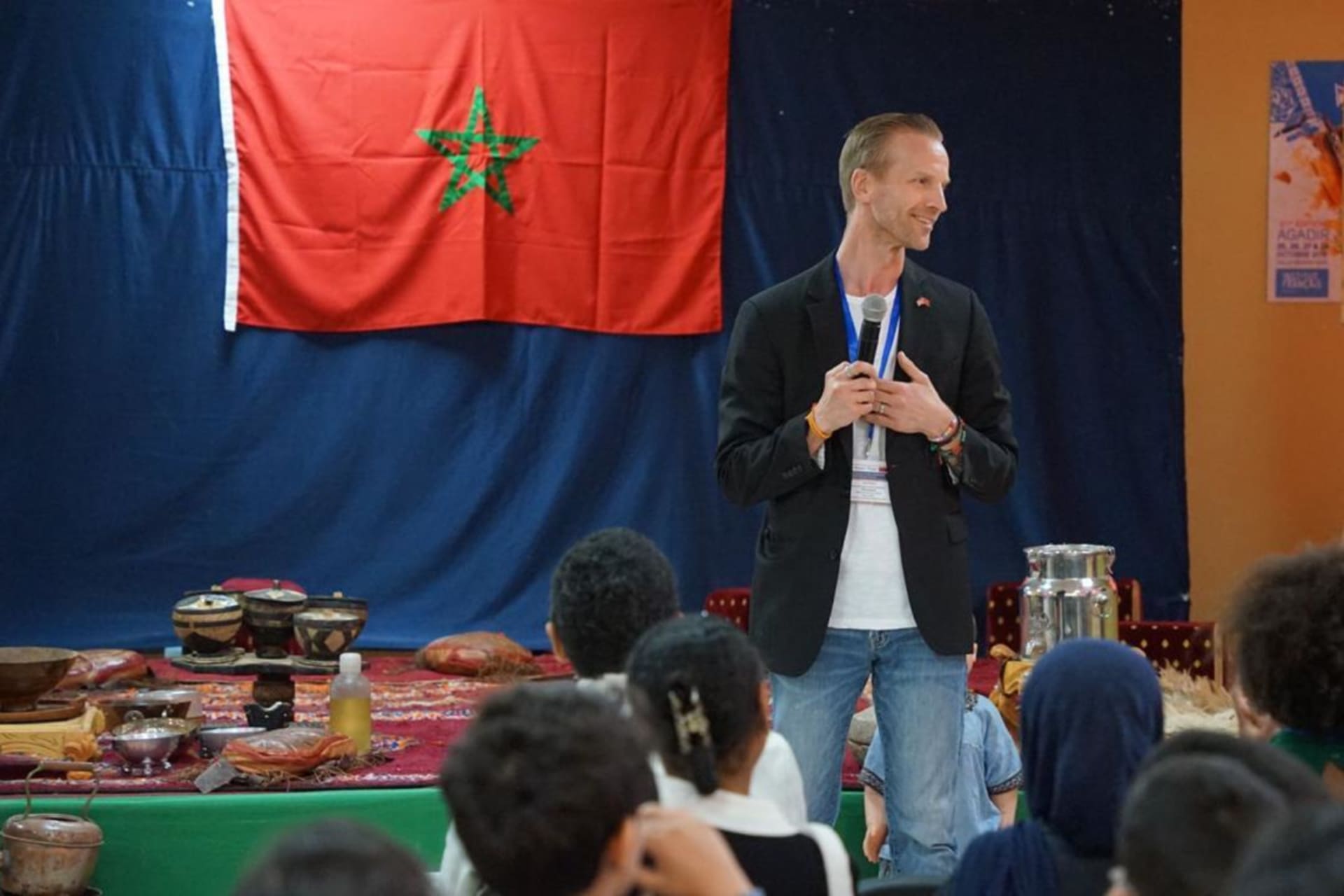
For years, I’d use my classic icebreakers to get to know my classes and often felt like I had accomplished doing so. However, since the COVID-19 pandemic, I have noticed that students are increasingly hesitant or even resistant to sharing ideas, engaging in discussion, or presenting to their peers, even on topics beyond social studies. This past year, I participated in the CFR Education Ambassador program and the Fulbright Teachers for Global Classrooms (TGC) Program, which included a two-and-a-half-week placement in the Kingdom of Morocco. There, I observed classrooms and met with educators and students whose remarkable soft skills left a lasting impression on me.
What I Discovered Observing Moroccan Classes
During my Fulbright TGC fellowship in Morocco, I had the privilege of visiting classrooms and meeting students. What left the deepest impression was not only their academic engagement but also their remarkable soft skills. These soft skills are interpersonal skills that allow students to communicate effectively, engage in teamwork, collaborate, solve problems, and build positive relationships. These skills are not specific to one subject or even one profession and can be applied in many situations, making them essential twenty-first century skills.
The students, ages fourteen to nineteen, interacted with peers, teachers, and administrators with a confidence and maturity that reminded me of college students or young professionals. Hands shot into the air with the sound of “Teacher, teacher!” and students eagerly approached us to ask thoughtful questions about American schools and our personal lives. Most striking were the presentations delivered by middle school students on community issues, conservation, and educational technology. They spoke before a packed audience that included the Consul-Honoraire of Côte d’Ivoire, which would have probably intimidated many adults, but they presented with poise, enthusiasm, and conviction.
Their example prompted me to reflect on my own teaching. Too often, pressed for time, I fall back on teacher-centered instruction to cover content entirely. Yet we all know that doing so can deprive students of opportunities to develop the communication, collaboration, and confidence they will need beyond the classroom.
While I believe my American students’ academic skills are comparable to those of their Moroccan peers, they often have fewer chances to cultivate these essential soft skills (at least, mine do). Again and again, employers emphasize that the ability to communicate, work well with others, and build relationships determines who thrives in the workplace. Having participated in hiring interviews myself, I have seen candidates with exceptional credentials surpassed by those who demonstrated warmth, confidence, and genuine interpersonal skills. Teaching and practicing these abilities is therefore not optional; it is indispensable for our students’ futures.
How I Found CFR Education Could Help
My work with the CFR Education Ambassador program uncovered opportunities to strengthen my students’ soft skills. The timing of the CFR Education Ambassador program and my Fulbright TGC fellowship did not feel like a mere coincidence. During our Zoom meetings, I was first introduced to CFR Education simulations such as The Future of NATO, A Threat to Taiwan, and Response to 9/11, each of which aligned naturally with my Modern World History curriculum. “The Future of NATO” was relevant in light of our unit on modern Russia. “A Threat to Taiwan” was an obvious choice because we spent nearly three weeks studying modern China, and Taiwan is its most significant geopolitical issue. Finally, “Response to 9/11” interested me because of our twenty-year invasion and occupation of Afghanistan, the difficult withdrawal, and the trillions of dollars spent. This mini simulation encouraged students to consider whether it was all worth it and whether another response might have been possible.
Although students gained valuable historical and geopolitical knowledge during the simulations, I realized that stronger preparation was needed to encourage the rich discussion and collaboration I hoped to see. I thought the simulations I chose would spark interest and encourage my students to exercise the soft skills I observed in Morocco, but there was not as much discussion and debate as I had hoped for. What happened? We all know the answer. You cannot simply drop a complex issue into an already quiet class and expect a lively debate. My students already didn’t feel comfortable sharing small details about themselves, let alone discussing a complex issue they knew little to nothing about. Before tackling difficult global topics, I first needed to build a classroom culture that was both congenial and convivial.
In addition to the soft skills, proper planning and preparation were also lacking. Next year, I plan to make greater use of CFR Education’s support materials, particularly the How to Run a Role-Play video and the accompanying preparation and reflection documents. These activities will help students understand the simulation process and build confidence before stepping into their roles. Early in the year, I also intend to use the Alternative Options for Using Mini Simulations to introduce concepts such as perspective-taking, roles, and positions in a less stressful setting. Asking my students to familiarize themselves with the Mini Simulation Roles & Goals resources will further ensure that each experience is purposeful and well structured.
CFR Education simulations are ideal for cultivating soft skills because they place students in decision-making situations that demand communication, empathy, critical thinking, and problem solving. As students grapple with complex global issues and multiple perspectives, they practice the human skills essential for informed citizenship and future careers while deepening their understanding of modern history and current events. We, as educators, just need to make sure our students are set up for success.
Final Remarks from a Fulbrighter Using CFR Resources
As both my CFR Education Ambassador and Fulbright Teachers for Global Classroom programs come to an end, I am left with a renewed appreciation for the power of global learning. The curiosity, empathy, and communication skills I witnessed among Moroccan students reinforced my belief that these qualities are essential for our students. For my students, cultivating such soft skills is preparation for thoughtful citizenship and success in an increasingly interconnected world. Bringing these lessons back to my own classroom is both a privilege and a responsibility. My students who have participated in globally focused activities in year one have responded positively. One said, “The simulation made history feel more relevant. I like how they made all the historical facts we learn connect with what’s going on in the world.”
Their excitement is a reminder that meaningful engagement leaves students wanting more. For educators seeking additional ideas and classroom resources to improve student discourse, Generation Global’s resource library is an excellent starting point. I am also building a webpage for my Fulbright Teachers for Global Classrooms final project that features lessons and activities designed to help students develop their soft skills. (Please note that the website is still under construction, as the final project is not due until August 31.) Ultimately, the lessons we teach today can inspire student curiosity, understanding, and collaboration across borders, something we so desperately need in today’s world.
Zack Ritland is a social studies teacher at Braintree High School in Braintree, Massachusetts. He is a recent Fulbright Teachers for Global Classrooms participant and CFR Education Ambassador.
The author of this blog was a participant in Fulbright Teacher Exchanges, programs of the United States Department of State, administered by IREX. The views and information presented are the grantee’s own and do not represent the views of the U.S. Department of State, the Fulbright Program, or IREX.