How a Single Phrase Shaped the War on Terror
What is the 2001 AUMF and what does it have to do with 9/11? From the invasion of Afghanistan to the campaign against the self-proclaimed Islamic State, and more, learn how the United States has legally authorized its counterterrorism policy for more than two decades.
By experts and staff
- Updated
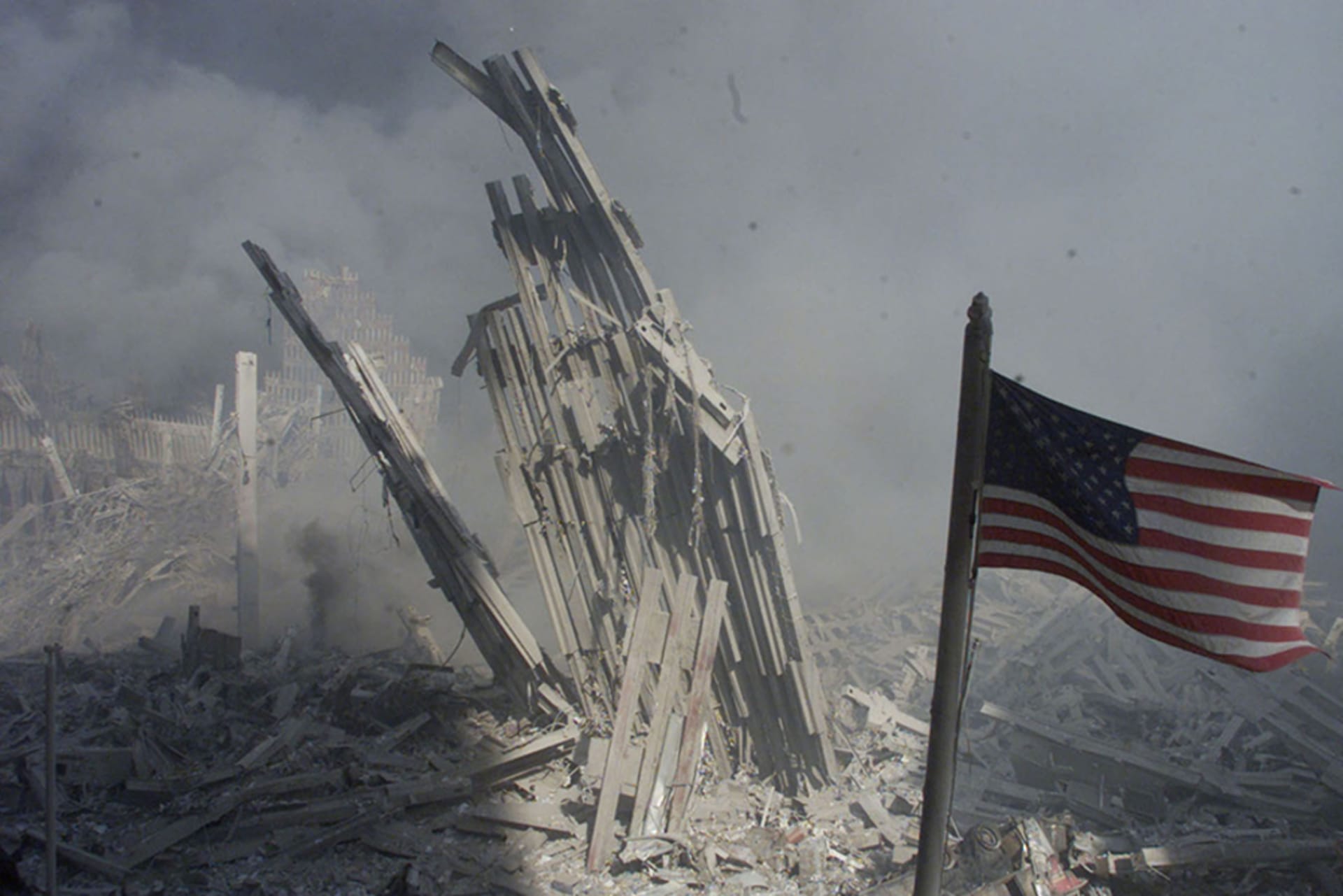
On the morning of September 11, 2001, two hijacked planes crashed into the twin towers of the World Trade Center, a third struck the Pentagon, and a fourth was headed for Washington, DC, when passengers overtook the hijackers and brought the plane down in Pennsylvania.
The 9/11 attacks targeted the symbolic centers of U.S. business and security. The plane hijackings resulted in the deaths of nearly three thousand people. Following 9/11, Americans’ perceptions of security, privacy, extremism, and geopolitics fundamentally changed. Post-9/11 policies touched the most mundane and most profound aspects of American lives—from boarding an airplane to grappling with the ramifications of warfare.
In the aftermath of the deadliest incident on record, Congress passed a series of laws reorganizing and empowering U.S. intelligence agencies and the military to combat the threat from terrorism. Many of those measures have served as the foundation of U.S. foreign and domestic policy for more than twenty years.
Among the most consequential of those post-9/11 laws was the 2001 Authorization for Use of Military Force (AUMF). Drafted in the hours after the 9/11 attacks and passed three days later with only one opposing vote, the sixty-word resolution authorized the president to take action against those responsible for the attacks on September 11:
That the President is authorized to use all necessary and appropriate force against those nations, organizations, or persons he determines planned, authorized, committed, or aided the terrorist attacks that occurred on September 11, 2001, or harbored such organizations or persons, in order to prevent any future acts of international terrorism against the United States by such nations, organizations or persons.
That authorization clearly outlined a military response against those responsible for the 9/11 attacks. But in the more than two decades since then, presidential administrations cited the 2001 AUMF to justify a broad range of military and actions. Some of those operations, experts have argued, went well beyond the AUMF’s intended scope.
What is an AUMF?
U.S. presidents are the commanders in chief of the armed forces. That means they have the power to direct U.S. military strategy, operations, and deployments abroad. However, the Constitution requires Congress to authorize the president to use military force. It can do so by formally declaring war against another country, but that practice is effectively obsolete; Congress issued its last official declaration of war during World War II. Alternatively, Congress can pass a law authorizing military force. AUMFs, as they are called, essentially serve the same purpose: they allow the president to use the military.
AUMF laws can place limits on how the president can use force, such as by defining a time frame, objective, or geographic location for the operation. But they do not have to do so. The 2001 AUMF authorized a sweeping scope of operations. It did not name a specific group or nation as its target, nor did it confine U.S. military activities to any specific location or time frame. Its open-ended nature has meant that the 2001 law has been used as the legal basis for some of the most significant national security policies and military operations since 9/11.
How the 2001 AUMF Has Been Used
The Invasion of Afghanistan: 2001
The first major policy step based on the 2001 AUMF was the invasion of Afghanistan on October 7, 2001. Launched with support from the United Kingdom and local Afghan militias, targeted (which planned and committed the attacks) and Afghanistan’s ruling regime, the Taliban (which harbored al-Qaeda). U.S.-led forces quickly toppled the Taliban, destroyed al-Qaeda’s training camps, and drove its surviving members into hiding. , the founder of al-Qaeda who claimed responsibility for directing the attacks, was ultimately killed in Pakistan by U.S. forces in 2011. The United States remained in Afghanistan combating a Taliban until 2021, when U.S. forces withdrew and the Taliban regained control.

Detaining Enemy Combatants at : 2001–Present
One month into the Afghanistan War, President George W. Bush, citing his authority under the AUMF, issued a military order outlining his administration’s plans for the detention, treatment, and trial of enemy combatants in the . His order led to hundreds of alleged al-Qaeda members being detained, mostly at Guantanamo Bay, Cuba. The detentions faced legal challenges. However, in 2004, the Supreme Court upheld the president’s authority to detain enemy combatants, calling it a “fundamental incident” of the use of military force. In other words, preventing a fighter on the other side from returning to the battlefield is a natural part of war: by authorizing the war itself, the Supreme Court held, Congress had authorized the logical next step of detention. The AUMF became the main source of presidential authority to detain enemy combatants at Guantanamo Bay. Over more than two decades, Guantanamo Bay held nearly eight hundred detainees. As of July 2026, fifteen men remain at the facility, including the alleged architect of the 9/11 attacks, who is still awaiting trial.

The Terrorist Program: 2002–2007
According to the Bush administration, the 2001 AUMF not only authorized military action abroad but also permitted intelligence operations within the United States. In 2005, a New York Times story revealed that the National Security Agency (NSA) had been wiretapping U.S. citizens without warrants since 2002. The monitoring captured international communications that were potentially linked to terrorist activity. The Bush administration pointed to the AUMF as legal justification for the so-called Terrorist Surveillance Program. Using the Supreme Court’s 2004 ruling on the AUMF, the Bush administration equated the necessity of gathering intelligence with the need for detaining enemy combatants. Like the detention of suspected terrorists, the Terrorist Surveillance Program was deemed a “fundamental incident” of using military force. In response to the ensuing public outcry over privacy concerns, Congress enacted separate, though still broad, legal constraints on the program.

Targeting al-Qaeda’s “Associated Forces”: 2004–Present
In addition to al-Qaeda and the Taliban (clear targets of the 2001 AUMF), the United States has also taken military action against the “associated forces” of those organizations. The phrase “associated forces” is not included in the 2001 AUMF; instead, the Bush administration began using it to justify detaining members of groups fighting alongside al-Qaeda or the Taliban against the United States or U.S. partners. After Bush, the Obama administration used the concept of associated forces as the basis for expanding counterterrorism operations, using the 2001 AUMF to authorize air strikes, targeted killings, and ground operations against groups it deemed to be fighting the United States alongside al-Qaeda, including al-Shabaab in Somalia and al-Qaeda in the Arabian Peninsula in Yemen.
The White House also prominently used the 2001 AUMF to launch a military campaign against the self-proclaimed Islamic State in Iraq and Syria. Officials argued that the group was covered under the AUMF because it had once been part of al-Qaeda, even though the two had split in 2014 and were in open conflict with one another. The subsequent Trump and Biden administrations both continued to apply the same logic, targeting the Islamic State, its offshoot in Afghanistan known as the Islamic State in Khorasan, and several other groups deemed to fall under the 2001 AUMF.

Air Strikes in Syria: 2017–2020
The first Trump administration stretched the AUMF further by articulating a concept some analysts call ancillary self-defense. Since 2014, U.S. forces had sought to combat the Islamic State in Syria, which was simultaneously engulfed in a . The two conflicts increasingly overlapped, however. When Syrian government forces and allied militias threatened U.S. troops stationed in the country, the United States responded with repeated air strikes in 2017 and early 2018. Although those groups had no connection to the 9/11 attacks or the Islamic State, the Trump administration cited [PDF] the 2001 AUMF as its legal rationale for the air strikes. It argued that the law authorized force not only against those responsible for the 9/11 attacks but also to protect U.S. troops and partner forces deployed under that authorization, regardless of who was attacking them. The Trump administration applied that reasoning again to justify further strikes against Iran-backed militias in Iraq and Syria in 2019 and 2020.

Will the 2001 AUMF Be Repealed?
For more than two decades, the 2001 AUMF has underpinned military action against terrorist groups in more than twenty countries, many with increasingly distant connections to the 9/11 attackers that the law was designed to address. As the law has aged and its interpretation has broadened, critics have called for its repeal or revision to better define the evolving terrorist threats facing the United States. Doing so would not be the first time Congress has repealed an AUMF. Indeed, in 2026, Congress repealed two AUMFs that authorized the 1991 Gulf War and the 2003 Iraq War. Both the Obama and Biden administrations endorsed the idea of updated legislation, even while continuing to use the 2001 AUMF to authorize military action. Several lawmakers have introduced legislation to repeal or amend the law, but no bill has passed.
At the same time, the threats facing the United States are evolving, and so are the legal approaches that presidents use to address them. Although terrorism remains a major issue on the U.S. foreign policy agenda, other issues, such as confronting Iran, have come to the foreground in recent years. U.S. military actions under both the Biden and Trump administrations in the past decade have relied less on the 2001 AUMF than on other legal strategies. After launching a war on Iran in February 2026, for example, the Trump administration did not invoke any AUMF; rather, it has repeatedly cited the president’s constitutional authority as commander in chief as the main legal basis for its military actions and used various legal strategies to argue it does not need congressional authorization. That approach underscores a broader debate among lawmakers and legal scholars over the limits of a president’s authority to use force. The 2001 AUMF is just one part of that debate. But even if the law is repealed or fades from use, the underlying question over who gets to decide when the United States goes to war will remain.
Used in
U.S Foreign Policy After 9/11 Lesson Plan
Lesson Plans
9/11 Reflection Activity
Activities
