The Nuclear World
Where are the world’s nuclear weapons today and whom do they protect? Explore maps, charts, and graphs to learn about current and future nuclear weapons states.

By experts and staff
- Updated
Think of the nuclear world as a map of where all the nuclear weapons in existence are located. The map looks the way it does because of two powerful yet competing goals. On the one hand, most countries support a nuclear weapons–free world; that support has resulted in a universal ban on nuclear weapons. On the other hand, because of the security, prestige, and power associated with the possession of nuclear weapons, a small number of countries still possess nuclear arsenals, and that number has increased over the past seventy years.
Which countries have nuclear weapons?
Although the number of nuclear weapons in the world has shrunk since its peak in the 1980s, more countries now have nuclear weapons. Nine countries are known or believed to possess nuclear weapons: the United States, China, France, India, Israel, North Korea, Pakistan, Russia, and the United Kingdom. Those countries are called nuclear weapons states. Several other countries started nuclear weapons programs but gave them up, either voluntarily or because of external pressure. A few have had nuclear weapons and later destroyed them or turned them over to another nuclear state.
Because countries do not reveal their military secrets, knowing exactly how many nuclear weapons each country possesses is difficult. However, all countries experience some level of security leaks, and a few decades of careful research has produced a generally accurate picture of nuclear arsenals globally.
Russia and the United States have the biggest nuclear arsenals
Approximately 87 percent of all nuclear warheads, or individual weapons, belong to the United States and Russia combined, each having roughly four thousand in its stockpiles.
During the , the United States and the together amassed some sixty thousand weapons. Nuclear annihilation was a persistent threat, because each country possessed enough nuclear weapons to destroy the other several times over. Though the threat of a nuclear war is less immediate now than it was during the Cold War, it has not disappeared and is rising once again. As the number of countries that possess nuclear weapons grows along with the tension between nuclear weapons states, so does the potential for catastrophic conflict.
Which countries are a nuclear threat today?
Nuclear conflict involving any of the five original nuclear powers—the United States, China, France, Russia, and the United Kingdom—is unlikely but remains a possibility. Although the number of weapons held by these countries has declined, most are reluctant to pursue complete because they see nuclear weapons as important components of their security posture. After all, nuclear weapons are the most powerful weapons ever created and few countries want to give them up.
In 1968, a historic binding agreement was signed by several major world powers, including the United States and Soviet Union, in an effort to stem the spread of nuclear technology: the Nuclear Non-Proliferation Treaty (NPT). In addition to the five original nuclear powers, four other countries have acquired nuclear weapons since the NPT went into effect.
Israel: believed to have nuclear weapons
Though Israel has never confirmed its status as a nuclear weapons state, it is believed to possess a considerable number of nuclear weapons. It never joined the NPT, but it has taken action to stop nearby countries from building a nuclear arsenal. Israel bombed suspected sites in Iraq (1981), and Syria (2007). Israel also targeted nuclear facilities in Iran in 2025, and has signaled that it would mount further attacks if it felt threatened by the country’s nuclear program.
India and Pakistan: rival neighbors and nuclear powers
Sharing an 1,800-mile border, India and Pakistan have fought several conventional wars over 100,000 square miles of disputed territory. Both countries possess nuclear weapons. Neither joined the NPT, and both appear to be modernizing and adding to their stockpiles. Many policymakers and experts fear that nuclear war could break out between the two countries—or, even more concerning, that Pakistan could lose control of a nuclear weapon to .
North Korea: the world’s biggest nuclear threat
Although North Korea is believed to have a small arsenal, its continued nuclear tests have raised widespread concerns over possible nuclear conflict. It withdrew from the NPT in 2003 and conducted its first nuclear test in 2006. Since then, it has threatened to use its nuclear weapons against the United States, Japan, and South Korea.

Which countries ban nuclear weapons?
Some countries and regions have developed nuclear weapon-free zones.
Since the 1960s, some countries have come together to create nuclear weapon-free zones (NWFZs), specified areas where countries pledge not to build, receive, test, or store nuclear weapons. NWFZs do not prevent peaceful nuclear technology use.
The idea of setting up an area where nuclear weapons are banned was introduced in 1958, when Poland suggested a plan to create an NWFZ in Central Europe. But NWFZs officially got their start through the NPT, which recognized the right of countries to make those zones (as twenty-one Latin American countries did in the Treaty of Tlatelolco in 1967).
Five treaties have created NWFZs in Africa, Central Asia, Latin America, Southeast Asia, and the South Pacific. Together, those zones span the entire Southern Hemisphere and parts of the Northern Hemisphere.
Additionally, three treaties create a nuclear weapons–free global common space for research, exploration, and the general advancement of humankind:
- The Seabed Treaty bans weapons of mass destruction on the ocean floor.
- The Antarctic Treaty bans any military activity in Antarctica, including the testing of nuclear weapons.
- The bans weapons of mass destruction from the earth’s orbit, the moon, or any other object in outer space.

Which countries have security guarantees to help protect them against nuclear weapons?
The global divide isn’t as simple as nuclear and nuclear free.
Many countries without nuclear weapons want to protect themselves against nuclear threats without developing nuclear weapons themselves. One way to do that is through a security guarantee—a pledge from a country to protect an ally using military means. A security guarantee extends the perceived security a nuclear arsenal provides to allied countries that do not possess nuclear weapons. Because of that provision, a security guarantee provided by a nuclear-armed country is also called a . The U.S. nuclear umbrella covers several countries.
- Australia: Since 1951, the United States and Australia have been part of a collective security , but the related treaty is nonbinding and its language not as strong as that in the North Atlantic Treaty: whether the alliance requires the U.S. military to actually come to Australia’s defense is unclear. Still, most experts consider Australia to be protected by the U.S. nuclear umbrella.
- Japan: In 1951, at the end of the Allied occupation, the United States and Japan signed a security treaty that provisionally allowed the United States to maintain armed forces in and around Japan. In 1960, the two countries revised that agreement, which then allowed the United States to set up military bases in Japanese territories in exchange for U.S. protection and security, including nuclear weapons.
- South Korea: Two months after fighting stopped in the Korean War in 1953, the United States and South Korea signed a mutual defense treaty creating a military alliance that continues to this day.
- members: NATO member countries that do not have nuclear weapons (i.e., all except France and the United Kingdom) are protected by the umbrella.
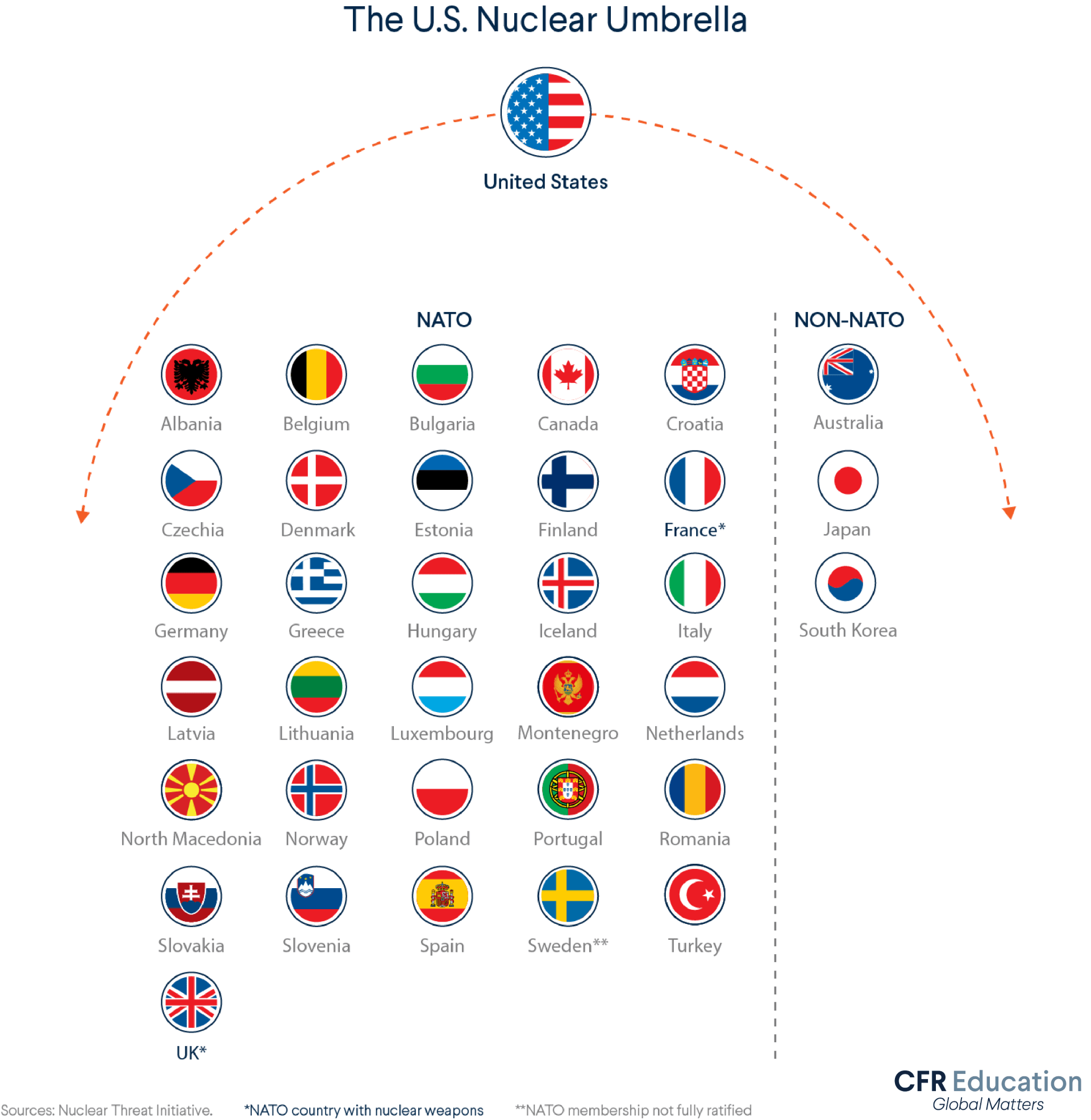
A nuclear umbrella is also meant to be a tool of nonproliferation: if countries without nuclear weapons are protected under a security guarantee from a nuclear-armed country, then those countries will be less inclined to start nuclear weapons programs of their own.
Security guarantees and nuclear umbrellas both illustrate an important point: even countries that have committed to nonproliferation understand that they live in a nuclear world. The different ways countries deal with that reality—acquiring nuclear weapons, declaring NWFZs, or seeking security guarantees—reflect the paradoxical goal of most countries: a peaceful future secured by weapons.
