Sustainable Development Goals Lesson Plan
- Length
- One 60-minute class period
- Grade Level
- High School
- Course
- AP Environmental Science, AP World History, IB Global Politics, U.S. Government and Civics, U.S. Government and Foreign Policy
Learning Objectives
- Students will identify and describe 17 UN Sustainable Development Goals (SDGs) and be able to evaluate the relative feasibility of the goals.
Instructional Plan
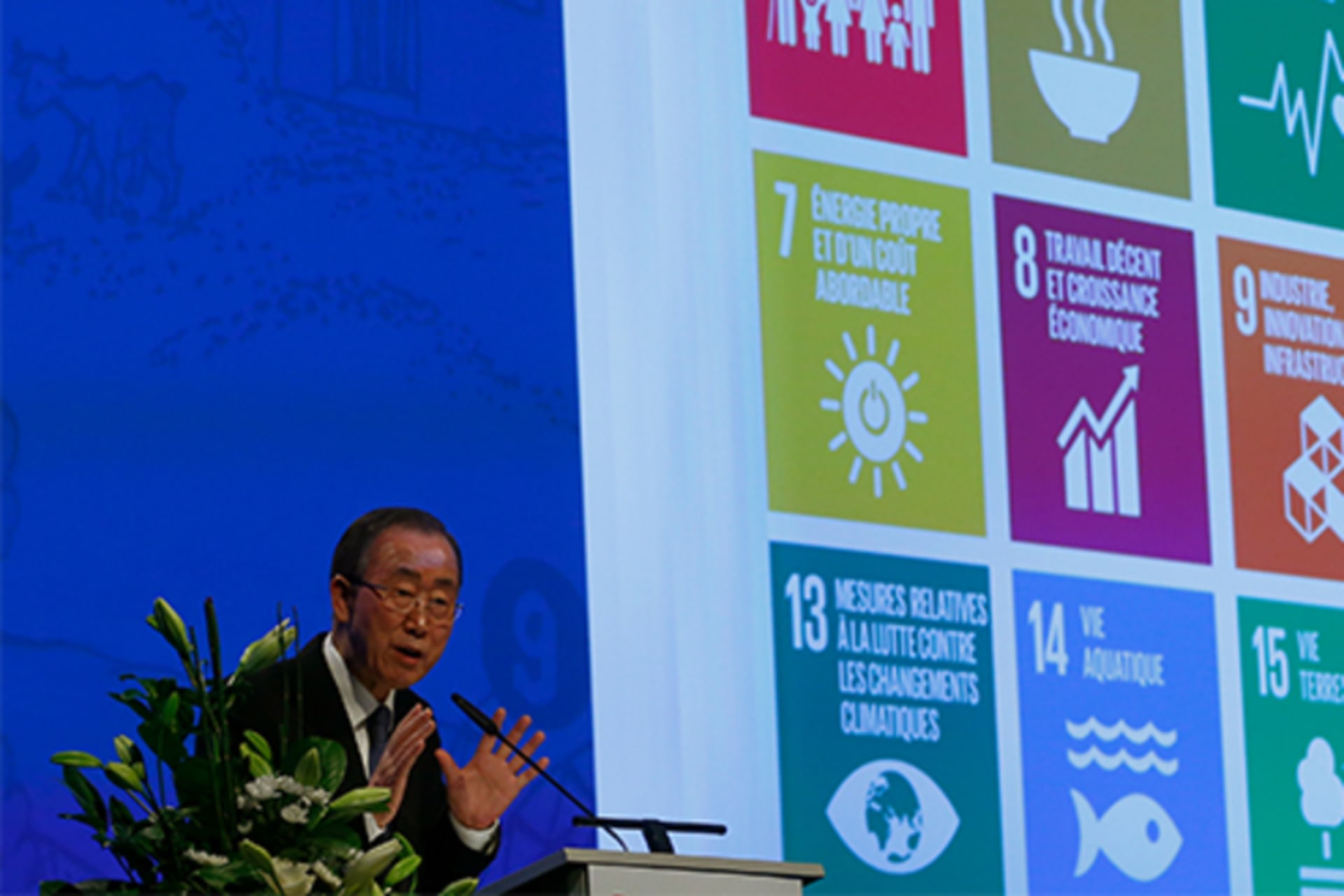
- (Introduction: 5 minutes) - Begin the class by projecting an image of the 17 Sustainable Development Goals and the following prompt on the board: “If you could only focus on 5 of these 17 global goals, which would you target, and why?”
- Give students 3 minutes to read through the goals and reflect privately on the prompt. If time allows, ask 2-3 students to volunteer their responses; however, it is enough for students to use this opening prompt as an individual warm-up for the session ahead.
- Briefly explain the structure of today’s session to students: Working in small groups, students will rank the 17 Sustainable Development Goals, complete a gallery walk of each other’s rankings, then discuss the similarities and differences they observe across the groups
- Note: Do not explain what the SDGs are yet - let curiosity build; the ranking activity will surface prior knowledge (or lack of it). This introductory activity sets up the “What are the SDGs?” discussion later on in the session.
- (Group Ranking: 15 minutes) - Break out students into groups of 4-5. Distribute the 17 SDGs as individual cards or a list to each group.
- Task: Rank all 17 goals from most likely to be achievable (1) to least likely to be achievable (17) by the target year (2030).
- Groups will write their final ranking on the bottom of the paper, with 1-2 sentences justifying their #1 (most achievable) and #17 (least achievable) choices.
- Circulate while groups work - prompt reluctant groups with: “What would ‘achievable’ even mean - cheapest? Fastest? Most politically popular?
- (Galley Walk: 20 minutes) - Post each group’s ranked paper around the room.
- Students then walk in their groups and note on their own graphic organizer:
- One ranking they strongly agree with
- One ranking they’d argue against
- Reconvene as a whole class and quickly poll which goal most groups ranked as most achievable and which as least achievable. Ask 2-3 groups to defend outlier rankings.
- (Bridge to content: 20 minutes) - Use this moment to formally introduce “What are the SDGs?” - Key points to cover include:
- 17 goals adopted by all UN member states in 2015, meant to be achieved by 2030, covering:
- No poverty
- Zero hunger
- Good health and well-being
- Quality education
- Gender equality
- Clean water and sanitation
- Affordable and clean energy
- Decent work and economic growth
- Industry, innovation, and infrastructure
- Reduced inequalities
- Sustainable cities and communities
- Responsible consumption and production
- Climate action
- Life below water
- Life on land
- Peace, justice, and strong institutions
- Partnerships for these goals
- Frame the compare/contrast activity that just happened as evidence that “achievability” is contested and value-laden.
- It is no longer considered enough to improve people’s livelihoods regardless of the environmental cost.
- The SDGs are interconnected. Rather than look at poverty in isolation, the SDGs focus on how improvements in one area can help others.
- Encourage the class to consider why interconnectedness is a feature of the SDGs.
- Extend this with support from CFR Education Reading: “The Sustainable Development Goals” as needed
- (Closing/Student Reflection: 5 min)
- Quick individual reflection (can be verbal share-out or turned in on paper): “Pick one goal your group ranked as ‘least achievable.’ Name one real-world obstacle discussed today that explains why.”
- Optional homework extension: Have students read CFR Education’s “The Sustainable Development Goals” and reflect on how the reading compliments the collaborative work done in class.
Materials
SDG Worksheet
via docs.google.com