Best Decision

7

Creation of the Bretton Woods System

Scroll to begin

Introduction

As the United States fought World War II, President Franklin D. Roosevelt was looking to lay the foundation for the world that would follow the fighting. He believed that the war had started in part because countries had pursued wrong-headed trade and monetary policies in the 1930s that intensified the Great Depression and fueled nationalism. FDR also knew that American firms and farmers would want to export to foreign markets once the war ended. Intent on correcting the mistakes of the past and hoping to spur future prosperity, Roosevelt convened a meeting of forty-four countries in July 1944 in Bretton Woods, New Hampshire. For three weeks, the delegates to the conference—known formally as the United Nations Monetary and Financial Conference—hammered out the rules for a new international monetary system. At its heart lay two new multilateral institutions, the International Monetary Fund (IMF) and the International Bank for Reconstruction and Development (most commonly known as the World Bank), which became the pillars of the postwar global economic order. SHAFR historians ranked the creation of the Bretton Woods System as the seventh-best U.S. foreign policy decision.
The Lessons of the 1930s

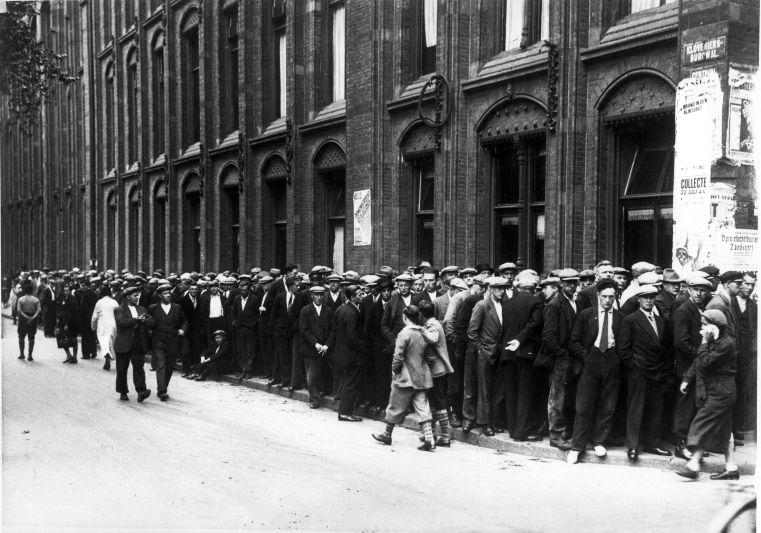
Roosevelt and some of his senior advisors, particularly Secretary of State Cordell Hull, believed that trade promoted peace as well as prosperity. In their view, the 1930s showed the perils of restricting commerce across borders. To combat the Great Depression, countries had imposed high tariffs, formed discriminatory trading blocs, and manipulated the value of their currencies. But by seeking to gain an advantage over their rivals with these beggar-thy-neighbor policies, everyone ended up worse off. The resulting tough economic times in turn fueled the nationalism that ignited World War II.

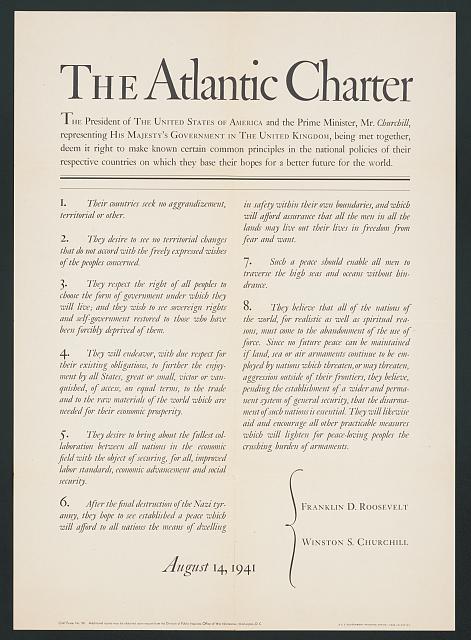
Roosevelt looked to act on these views even before Pearl Harbor brought the United States into the war. In August 1941, he met British Prime Minister Winston Churchill in Placentia Bay, Newfoundland. Their meeting produced the Atlantic Charter. It promised, among other things, that Great Britain and the United States would seek, “with due respect for their existing obligations, to further the enjoyment by all States, great or small, victor or vanquished, of access, on equal terms, to the trade and to the raw materials of the world which are needed for their economic prosperity.”

Unemployed men in the Netherlands, August 1933. Courtesy of the National Archive of the Netherlands.

Clashing Interests

Although the Atlantic Charter was a joint British-American effort, Churchill did not share Roosevelt’s enthusiasm for removing trade barriers. The British prime minister wanted to preserve the British imperial preference system, which sought to promote trade within the British empire while limiting trade outside it. The inclusion of the words “with due respect for their existing obligations” were inserted in the Atlantic Charter at Churchill’s behest to protect imperial preferences. Even with the revision, London would continue to feel pressure from Washington to end its discriminatory trade practices. Indeed, in accepting Lend-Lease aid in 1942, Churchill agreed to cooperate with U.S. efforts to eliminate trade barriers.

Roosevelt and Churchill left the details of what a new international economic system might look like to their subordinates. For the next two years, British and U.S. officials swapped proposals on a postwar monetary system without ever coming to agreement. The conflicting British and U.S. views and interests would shape the discussions at the Bretton Woods Conference.

Text of the Atlantic Charter, 1943. U.S. Government Printing Office.

The Bretton Woods Conference

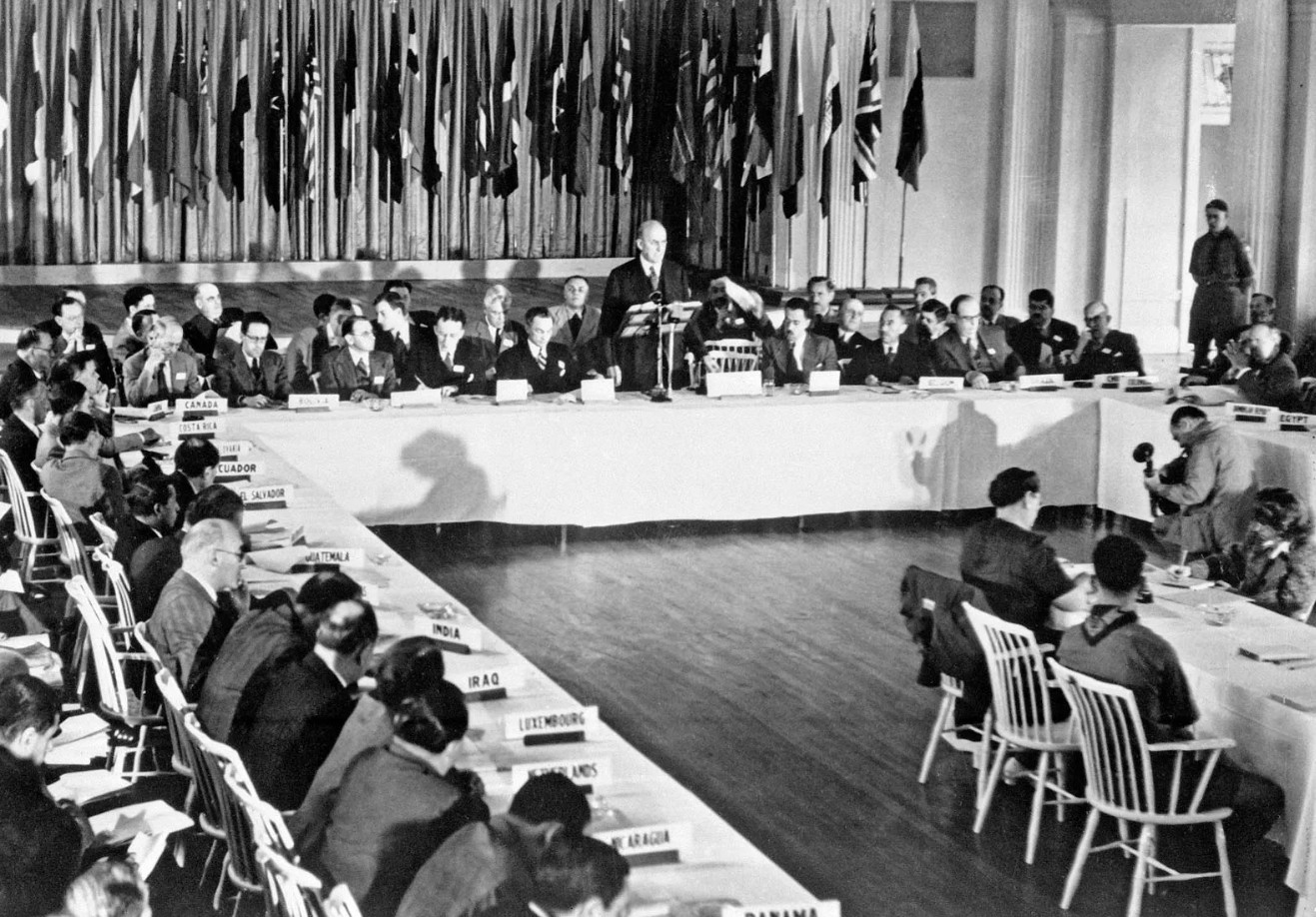
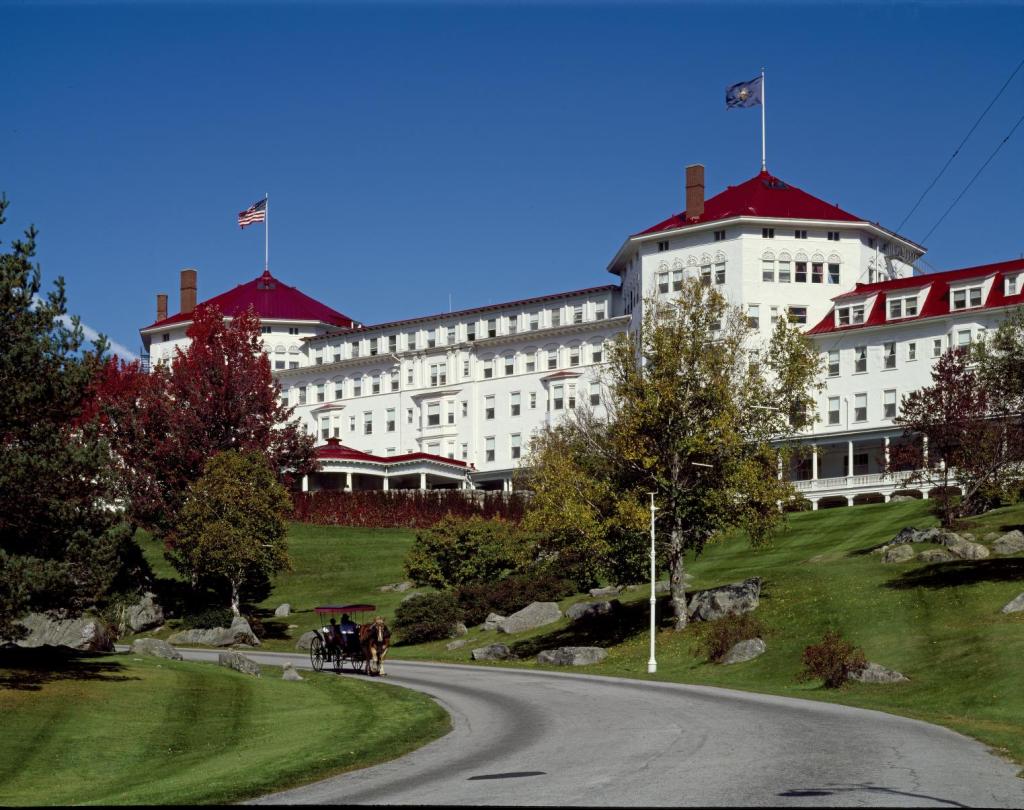
Some seven hundred delegates and technical experts descended upon the Mount Washington Hotel in Bretton Woods on July 1, 1944. The hotel was in disrepair. It had been closed for two years, and staff were rushed in at the last moment to make beds and serve meals. Denied the opulence of many conference settings but blessed with lovely views of New Hampshire’s White Mountains, the participants set out to create a new global economic order.

The conference opened with a message from Roosevelt stating that their task was to “see to it that the arteries” of commerce “are not clogged again, as they have been in the past, by artificial barriers created through senseless economic rivalries.” How to accomplish these lofty goals was a matter of dispute and would consume the conference delegates for three weeks.

The Bretton Woods Conference, July, 1944. Curtesy of the Encyclopædia Britannica.

Economic diseases are highly communicable. It follows, therefore, that the economic health of every country is a proper matter of concern to all its neighbors, near and distant. Only through a dynamic and a soundly expanding world economy can the living standards of individual nations be advanced to levels which will permit a full realization of our hopes for the future.

President Franklin D. Roosevelt, Message to the Delegates of the Bretton Woods Conference, June 29, 1944

Dueling American and British Visions

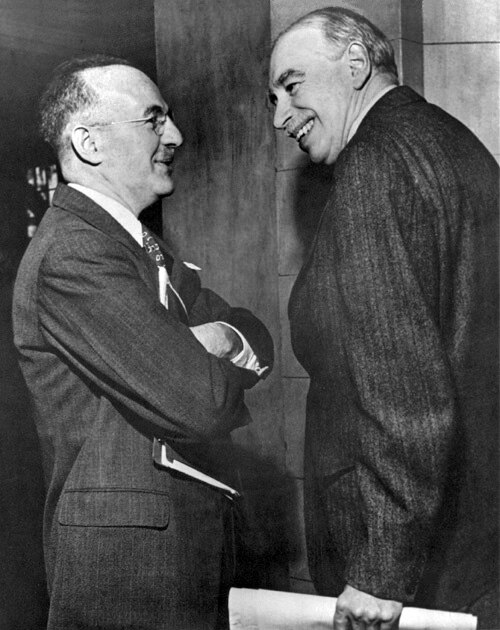
Nearly four dozen countries, including China and the Soviet Union, sent delegates to Bretton Woods. The main battles, however, were fought by the British and U.S. delegations. Because their two years of discussion had not settled many of the most important issues to be decided, they presented competing visions to the conference. The author of the British blueprint was the famed economist Lord John Maynard Keynes, the child of elite English academics. The architect of the U.S. plan was Treasury official Harry Dexter White, the son of Jewish immigrants from Lithuania. Their visions for the future global order were as different as their biographies.

The fundamental question Keynes and White debated was how to structure the international monetary system so that it would be stable and promote trade. The 1930s had shown the dangers of the gold-exchange standard that emerged in the aftermath of World War I. In that system, countries agreed to exchange their currency for a fixed amount of gold. Countries that ran trade deficits had to reduce their money supply to keep their gold reserves from being depleted, which in turn deflated prices and hurt employment. For that reason, many countries abandoned the gold-exchange standard before World War II began.

Keynes Versus White

Keynes’s answer to the problem was to create a global central bank he called the International Clearing Union. It would stand above national governments, enforcing a strict exchange-rate mechanism designed to keep currencies in balance and supplying the financial liquidity needed to finance international trade. White’s proposal was more modest and respectful of national, and particularly U.S., sovereignty. Each member country would contribute dollars and gold to a stabilization fund that it could draw on in the event it faced a balance-of-payments crisis that prevented it from paying for its imports. White also proposed creating a European Reconstruction Bank that would help lower-income countries unable to borrow money on commercial markets. Delegates from Latin America pushed to broaden the range of countries such a bank could help.

Keynes’s and White’s plans differed on other issues, including how much flexibility the new system would have and the voting rights that member countries would exercise. Whatever the intellectual merits of Keynes’s arguments, White had a trump card to play: the United States had replaced Britain as the world’s dominant economic and financial power. The United States held more than 60 percent of the world’s gold reserves. Any agreement would have to reflect Washington’s preferences.

Harry Dexter White (left) and Lord John Maynard Keynes (right) at the Bretton Woods Monetary Conference, 1944. Courtesy of the World Bank Group Archives.

Agreement Is Reached

The agreement that emerged from three weeks of negotiations leaned heavily in favor of White’s plan. The delegates agreed to create two new international institutions: the IMF and the World Bank. The IMF was tasked with overseeing the new global monetary system and providing short-term financial assistance to countries having trouble paying for imports. That monetary system provided for a fixed-exchange rate system based on a U.S. promise to redeem foreign currencies for gold. The World Bank was charged with assisting the reconstruction of war-ravaged countries and promoting economic development in poor countries.

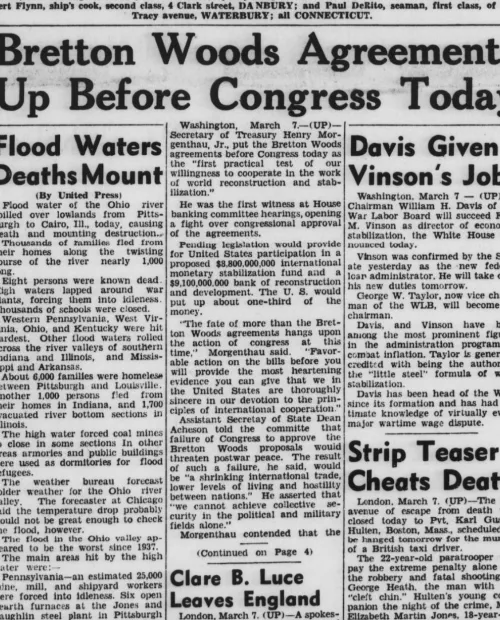
Given the central role the United States would play in the new monetary system, congressional consent was needed. Roosevelt chose to treat the agreement as ordinary legislation rather than as a treaty, necessitating approval by both the House and Senate. The IMF was the more controversial of the two new institutions. The need to help war-torn countries was easy to grasp; the intricacies of exchange-rate mechanisms were not. IMF skeptics, however, did not have the votes. In July 1945, Congress passed the Bretton Woods Agreements Act, authorizing U.S. membership in the IMF and World Bank. Other countries quickly followed, though the Soviet Union and its satellite countries never joined.

Front page announcing pending Bretton Woods legislation. The Waterbury Democrat, March 07, 1945. Library of Congress, Chronicling America

The front page of the Waterbury (Connecticut) Democrat reports on the pending Bretton Woods legislation, March 7, 1945. Courtesy of the Library of Congress.

The Legacy of the Bretton Woods Agreement

The Bretton Woods Agreement established a new financial order with the United States at its core. The system’s design gave a privileged role to the U.S. dollar, facilitated international trade, and encouraged economic growth. The new system did not solve all the problems buffeting the international economic system. It did not, for instance, establish the rules governing trade. The agreement’s success was also aided by the passage of the Marshall Plan and the creation of NATO, both of which helped Western Europe recover economically from World War II. Nonetheless, Bretton Woods showed the benefits of multilateral cooperation, provided the economic underpinnings of U.S. Cold War alliances, and validated U.S. global leadership. Those results outlasted the specifics of the Bretton Woods Agreement itself. In 1971, in recognition that the United States could no longer make good on its pledge to exchange dollars for gold, Richard Nixon closed the so-called gold window and ended the system of fixed-exchange rates. By then, U.S. dominance had been firmly embedded in the international financial system, which continues to today.

National Security Archive, GWU

Learn More

Primary documents, books, articles, and more on creation of the Bretton Woods System.

Primary Documents

Books

Articles

Documentaries and Short Videos

Lectures and Podcasts