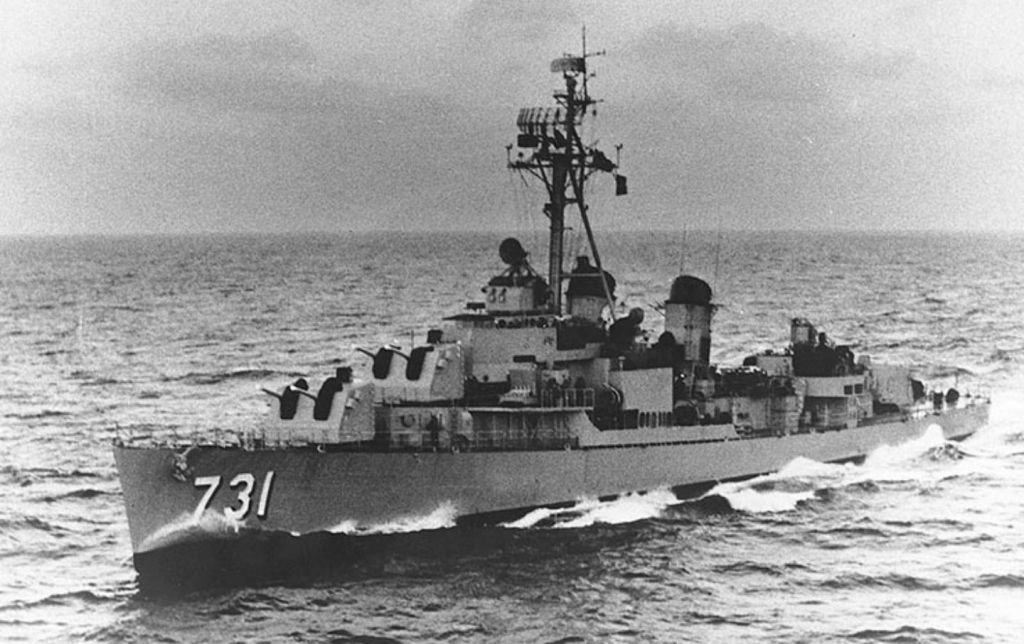
USS Maddox was a ship involved in the Gulf of Tonkin incident.

Worst Decision

9

Gulf of Tonkin Resolution

Scroll to begin

Introduction

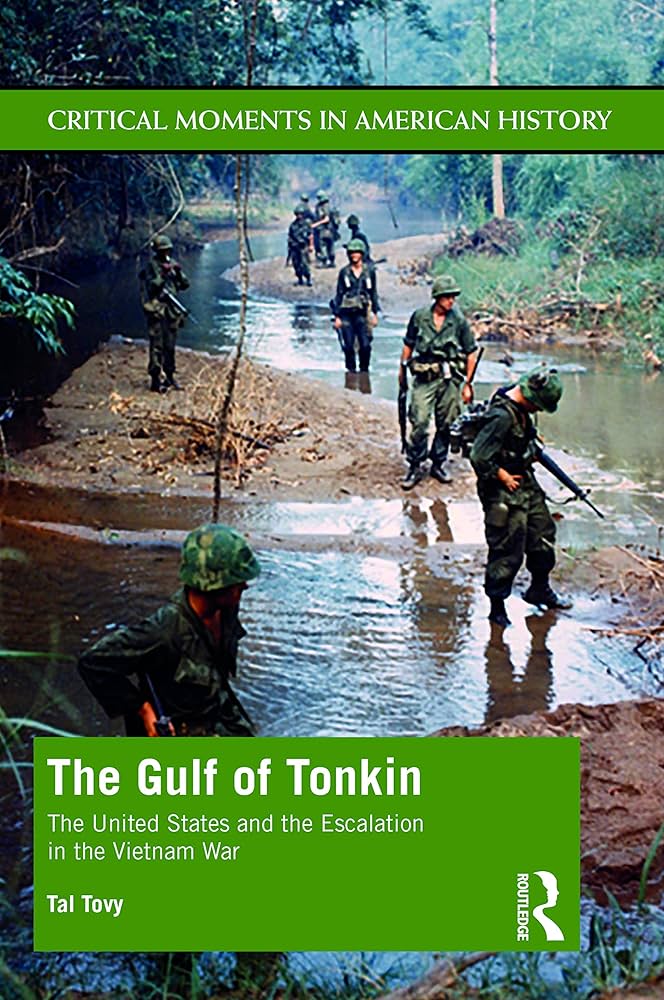
On August 2, 1964, North Vietnamese patrol boats attacked the USS Maddox, a destroyer operating in international waters in the Gulf of Tonkin off the coast of North Vietnam. Two nights later, the Maddox reported that it had come under fire again. President Lyndon B. Johnson responded to the news by ordering airstrikes on North Vietnam—the first overt U.S. attack on the country. Johnson also asked Congress to endorse his decision to confront North Vietnamese aggression. Congress complied in less than seventy-two hours by passing the Gulf of Tonkin Resolution. What members of Congress did not know was that much of what the Johnson administration told them about why the Maddox was in the Gulf of Tonkin was untrue and that the second attack likely never occurred. Acting in haste and with bad information, Congress approved deepening U.S. involvement in what would become the Vietnam War. SHAFR historians ranked the Gulf of Tonkin Resolution as the ninth-worst U.S. foreign-policy decision.
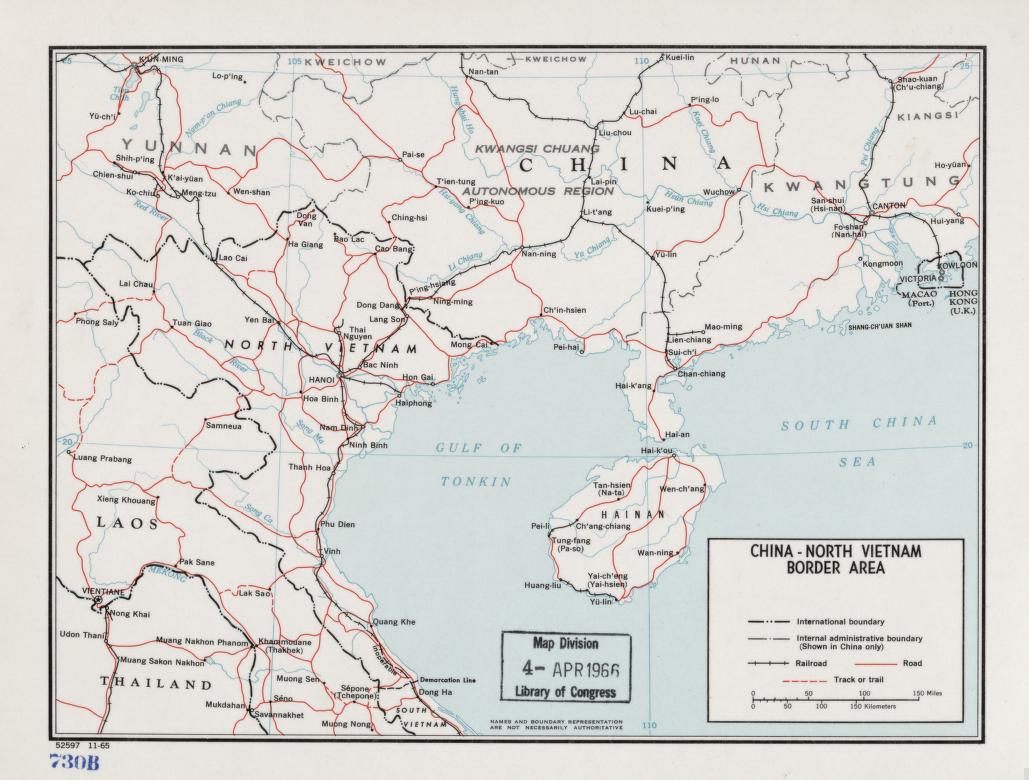
The Gulf of Tonkin, 1966. Courtesy of the Library of Congress.

The Gulf of Tonkin, 1966. Courtesy of the Library of Congress.

The Road to the Gulf of Tonkin

The 1954 Geneva Conference ended French control of Indochina and proposed elections to create a unified Vietnamese state. Those elections were never held, and South Vietnam and North Vietnam became independent countries. In 1959, Communist-controlled North Vietnam launched an insurgency in South Vietnam led by the self-proclaimed National Liberation Force, which was better known to Americans by the pejorative name, “Viet Cong.” The fighting exposed the ineffectiveness and unpopularity of the South Vietnamese government. Convinced it was essential to stop the spread of communism, the United States increased its commitment to South Vietnam. By the time of President John F. Kennedy’s assassination in November 1963, the United States had sixteen thousand troops in South Vietnam.

The mission of the U.S. forces was to train the South Vietnamese army to fight and not to fight themselves. But the U.S. military also supported a range of clandestine operations by the south against the north, including Operation Plan 34A (OPLAN), which sought to harass North Vietnam’s coastal facilities to learn about North Vietnamese military operations and readiness. On the night of July 30, 1964, South Vietnamese commandos attacked two North Vietnamese islands near where the Maddox was patrolling.

Shots Fired (or Not)

On August 2, the Maddox was operating in international waters in the Gulf of Tonkin, collecting signals intelligence on North Vietnam, when three North Vietnamese torpedo boats approached it. The Maddox fired warning shots, and a firefight ensued. The Maddox drove off its attackers without suffering any significant damage.

The USS Turner Joy joined the Maddox on August 4. That night, the Maddox detected unidentified ships approaching its position. The crew then reported incoming gunfire and torpedo attacks. For the next three hours, the Maddox and the Turner Joy fired at their attackers. But the Maddox’s captain began to doubt his ship was under attack. Enemy vessels would appear on sonar, vanish, and then materialize elsewhere, suggesting that either the ship’s equipment was malfunctioning or that sonar operators were misreading what they were seeing. A U.S. Navy jet flying overhead saw no signs of North Vietnamese ships.

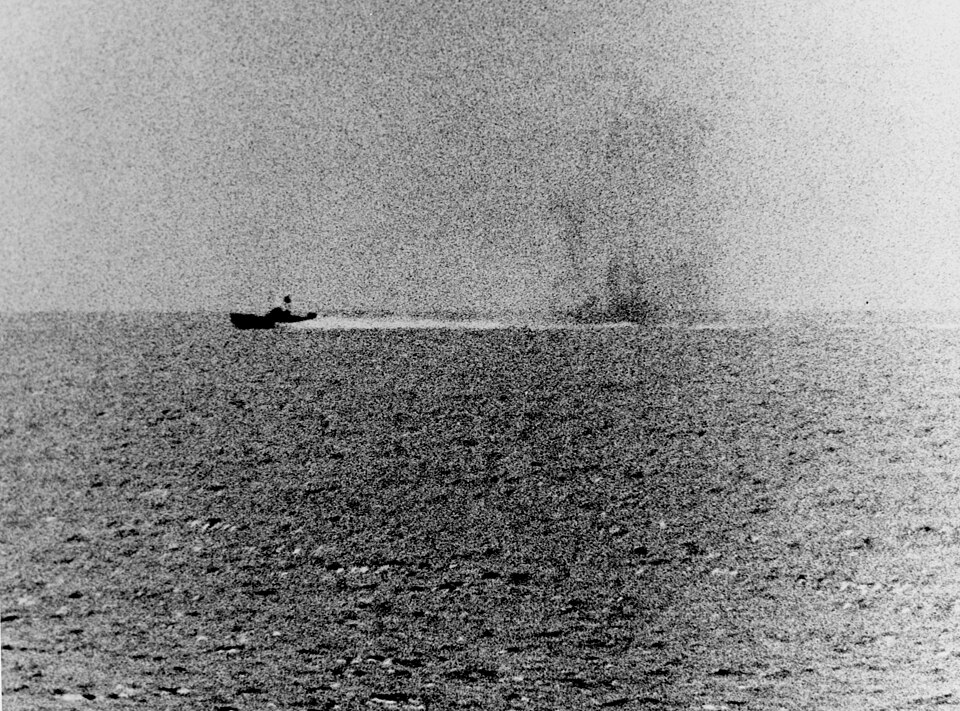
A photograph taken from the USS Maddox on August 2, 1964, showing a North Vietnamese torpedo boat racing by with what appears to be smoke from the Maddox’s shells in its wake. Courtesy of the U.S. Navy Naval History and Heritage Command.

A photograph taken from the USS Maddox on August 2, 1964, showing a North Vietnamese torpedo boat racing by with what appears to be smoke from the Maddox’s shells in its wake. Courtesy of the U.S. Navy Naval History and Heritage Command.

LBJ Responds

Johnson learned that the Maddox had reported coming under attack for a second time while he was at a National Security Council meeting on another matter. He spent several hours consulting with his advisors. They highlighted an intelligence intercept of a North Vietnamese patrol reporting the results of the attack to higher officials. Determined to act, LBJ conferred with congressional leaders, including his Republican opponent in the upcoming presidential election, Senator Barry Goldwater of Arizona. The election influenced LBJ’s thinking about what to do. He told some advisors that a forceful response would deny Goldwater the opportunity to paint him as soft on communism.

At 11:30 p.m. Washington, DC, time, Johnson went on national television. He said that North Vietnam had launched an unprovoked attack on U.S. Navy ships operating in international waters. In retaliation, he had ordered air strikes against North Vietnamese ships and support facilities. It was the first overt attack by U.S. forces against North Vietnam. Johnson added that he would ask “Congress to pass a resolution making it clear that our Government is united in its determination to take all necessary measures in support of freedom and in defense of peace in southeast Asia.”

President Lyndon B. Johnson’s Address to the Nation, August 4, 1964

Johnson Goes to Congress

Johnson wanted Congress to move swiftly. To speed things up and ensure he got the result he wanted, he submitted to Congress on August 5 the text of a resolution his advisors had drafted months earlier. The draft did not declare war; instead, it approved LBJ’s determination “to take all necessary measures” to repel any further North Vietnamese “aggression,” not just in Vietnam but anywhere in Southeast Asia and beyond. Johnson feared that declaring war would generate public pressure to invade North Vietnam. That might prompt China to intervene in the fighting, as it had during the Korean War.

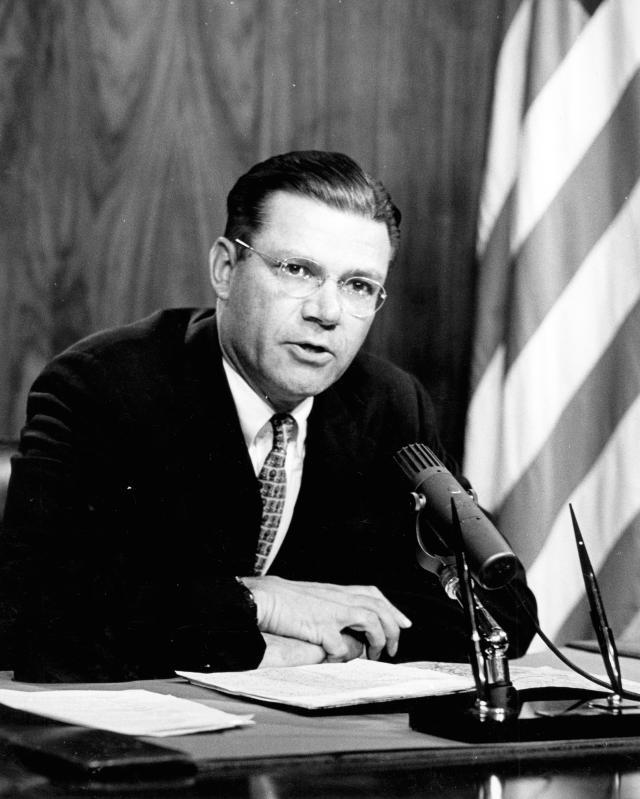
The House of Representatives declined to hold hearings on the attacks and the draft resolution. The Senate, however, convened an emergency hearing on the morning of August 6 under the joint auspices of the Senate Armed Services and the Senate Foreign Relations committees. Secretary of Defense Robert McNamara testified that the Maddox had been conducting routine operations when it was attacked and accused North Vietnam of committing an “unprovoked attack.” A senator who had been tipped off about OPLAN 34 asked whether those operations had led to the attack on the Maddox. McNamara denied that U.S. forces had participated in any South Vietnamese military operations against North Vietnam.

Secretary of Defense Robert testifying before the Senate on August 6, 1964. U.S. Naval Institute Photo archive.

Secretary of Defense Robert testifying before the Senate on August 6, 1964. U.S. Naval Institute Photo archive.

“It Covers Everything”

The full Senate began debating the Gulf of Tonkin Resolution on the afternoon of August 6. Senators spent little time discussing what had happened to the Maddox. They focused instead on whether the resolution empowered Johnson to use military force in Southeast Asia as he saw fit. Senator J. William Fulbright of Arkansas, the chair of the Foreign Relations Committee and an ally of LBJ, assured his colleagues that Johnson was not contemplating sending more U.S. troops to South Vietnam. Fulbright acknowledged, however, that “the language of the resolution would not prevent it.” He was more emphatic in private, telling one Democratic colleague that the resolution was simply intended “to pull the rug out from under Goldwater” in the presidential race.

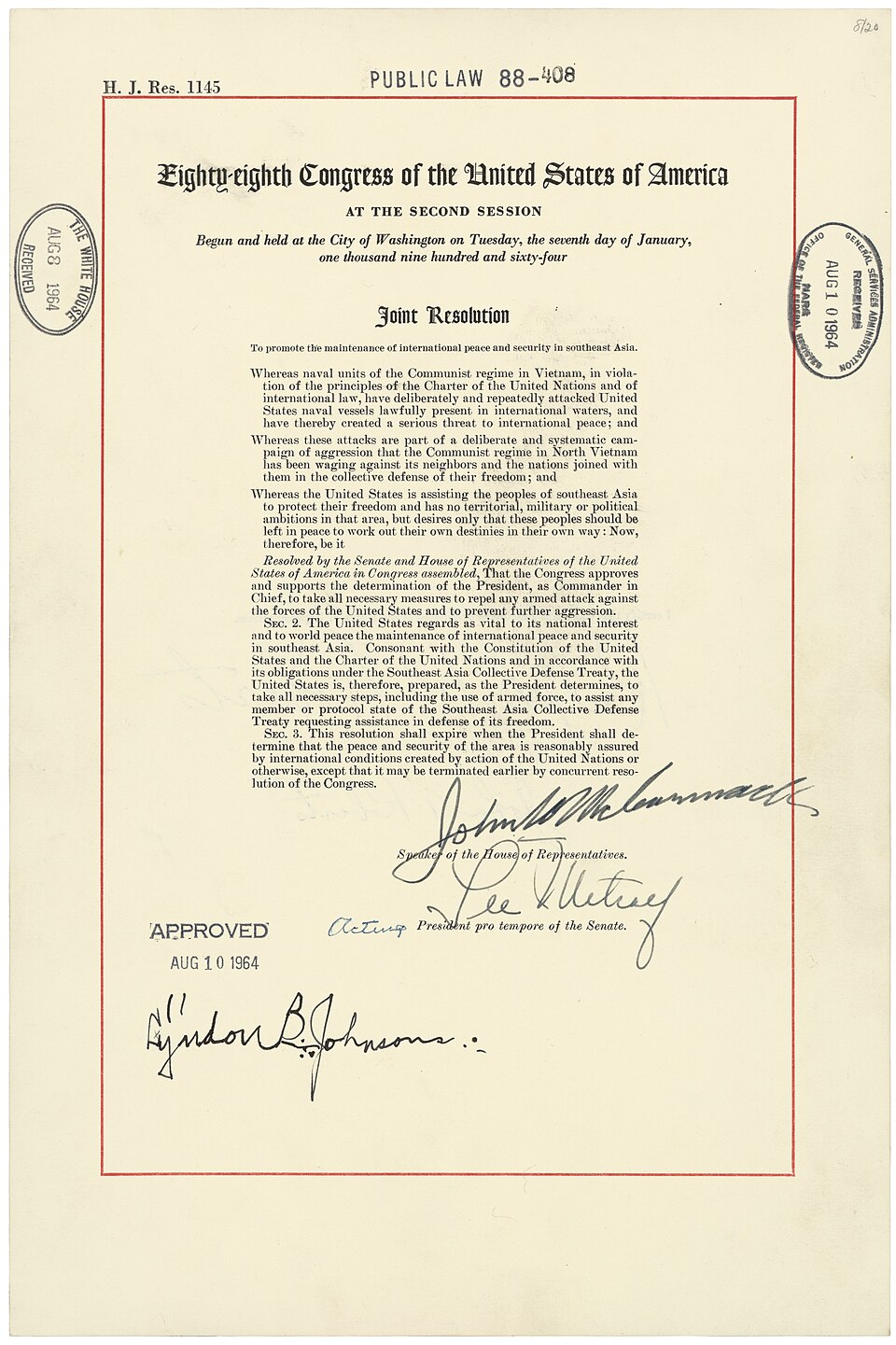
As the Senate resumed debate on August 7, the House took up the Gulf of Tonkin Resolution. After just forty minutes of consideration, House members approved the resolution by a vote of 416 to 0. Shortly afterward, the Senate voted 88 to 2 to adopt the resolution. The Senate’s debate had lasted for 8 hours and forty minutes. Congress’s swift and overwhelming passage of the Gulf of Tonkin Resolution delighted Johnson, who likened it to “a grandmother’s nightshirt: It covers everything.” Johnson now had a free hand to deal with North Vietnam.

The signed version of the Gulf of Tonkin Resolution, August 10, 1964. Courtesy of Wikimedia Commons.

The signed version of the Gulf of Tonkin Resolution, August 10, 1964. Courtesy of Wikimedia Commons.

What We Know Now

Johnson and his advisors told Congress and the nation that the attack on the Maddox was clear and unprovoked. Both claims were false. They knew that the captain of the Maddox doubted whether any attack had occurred at all. McNamara lied in his Senate testimony on August 6 when he denied knowing of any actions by the South Vietnamese navy that might have provoked North Vietnam. The captain of the Maddox was pressed to retract his reservations about the attack and some intelligence analysts were told to keep their doubts about the incident to themselves. The intelligence intercept that was seen as a smoking gun turned out to have been about the attack on August 2.

Johnson knew that the United States was not blameless. Both McNamara and CIA Director John McCone told him they believed that North Vietnam attacked the Maddox because they suspected it was supporting the South Vietnamese commando attack. LBJ also suspected, if he did not outright know, that the second attack did not occur. Shortly after the Gulf of Tonkin Resolution passed, he told an advisor, “Hell, those damn, stupid sailors were just shooting at flying fish.” But Johnson said nothing about that to the American public.

The Legacy of the Gulf of Tonkin Resolution

The Gulf of Tonkin Resolution embroiled the United States deeper in the Vietnam conflict. For the first time, the United States used force openly against North Vietnam. Despite having good reason to doubt whether the August 4 attack occurred, Johnson rushed to retaliate and to use the news as a pretext to push Congress into giving him open-ended authorization to use force. He won that congressional support by misrepresenting the circumstances surrounding the operations of the Maddox and by suppressing questions about the supposed attack. The truth came out several years later, fueling public distrust of the government and spurring talk of a “credibility gap.” Congress repealed the Gulf of Tonkin Resolution in January 1971. By then, forty thousand U.S. servicemen and women, and hundreds of thousands of Vietnamese, had died. U.S. combat operations continued for two more years.

National Security Archive, GWU

Learn More

Primary documents, books, articles, and more on the Gulf of Tonkin Resolution.

Primary Documents

Books

Articles

Documentaries and Short Videos

Lectures and Podcasts