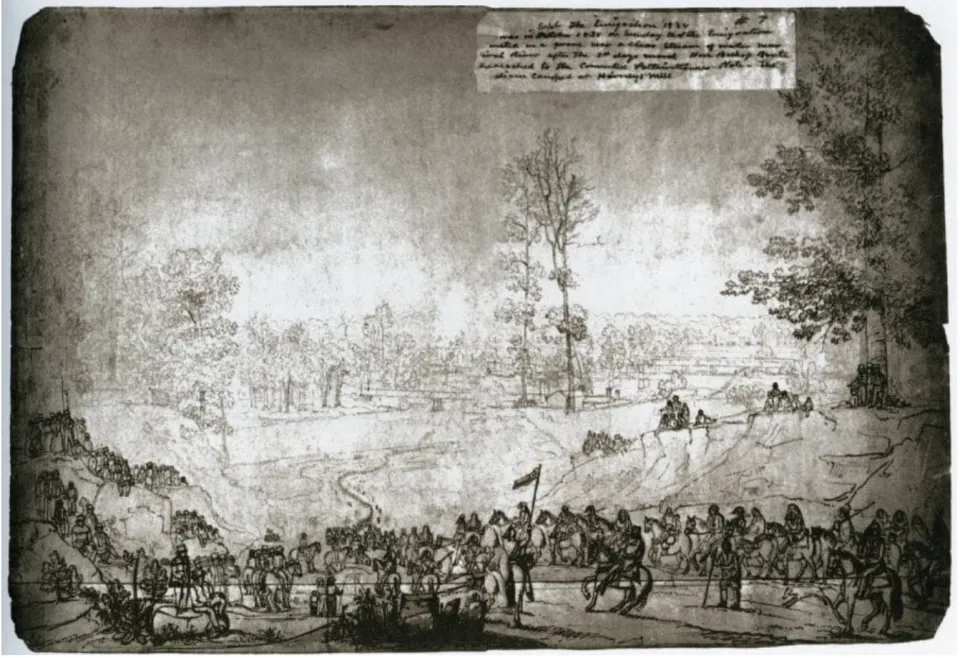
representation of the hardships the Potawatomi faced along the Trail of Death.

Worst Decision

3

Indian Removal Act

Scroll to begin

Introduction

White settlers in the United States in the early nineteenth century coveted the land held by Native Americans. The U.S. government initially sought to limit the resulting conflict by treating Native American tribes as sovereign nations and negotiating treaties that established the boundaries of their lands. The U.S. government generally did little, however, to force settlers to respect the terms of treaties. Instead, Washington frequently imposed new treaties on Native Americans with even less favorable terms. With tensions between the two communities increasing, enthusiasm grew in the United States for expelling Native Americans from their ancestral lands. In 1830, Congress passed, at President Andrew Jackson’s request, the Indian Removal Act. Over the next two decades, the U.S. government repudiated its solemn treaty obligations and forced as many as one hundred thousand Native Americans living east of the Mississippi to relocate to smaller lands west of the Mississippi. SHAFR historians ranked the Indian Removal Act as the third-worst U.S. foreign policy decision.
Treaties and Native Americans

At its founding, the United States treated Native American tribes as sovereign nations. It signed treaties with tribal leaders that were reviewed and approved by the Senate as any other treaty would be. That treaty-making had two major objectives. First and foremost, it sought to solidify white land claims and wrap them in the cloak of legality. It also sought to defuse tensions between Native Americans and white settlers by establishing borders and regulating commercial exchanges.

The treaty-making achieved the first objective and failed to achieve the second. Settlers hungered for land, and the U.S. government seldom acted to stop them. Instead, it pressed Native American tribes to renegotiate treaties and accept even less. As with the original treaties, the revised agreements were often reached through bribery and coercion. With the Louisiana Purchase in 1803, President Thomas Jefferson proposed a different solution to end conflict between the settlers and Native Americans: encouraging Native Americans living east of the Mississippi River to settle in lands in the west. Jefferson never acted on his proposal, but it resonated with many Americans, especially in the South.

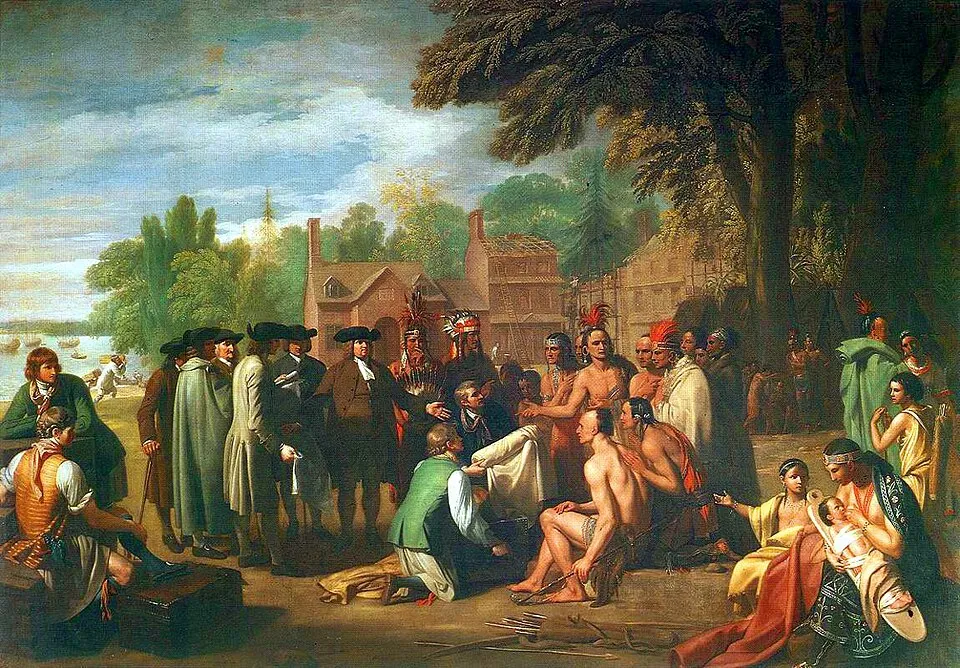
The Treaty of Penn with the Indians. William Penn's 1682 treaty with the Lenape depicted in Penn's Treaty with the Indians, a 1771 portrait by Benjamin West. State Museum of Pennsylvania

"The Treaty of Penn with the Indians,” by Benjamin West, depicts William Penn signing a treaty with the Lenape people in 1682.

Andrew Jackson

Andrew Jackson took office in March 1829. He had gained fame by defeating the Upper Creek (Red Stick) Indians in 1814 at the Battle of Horseshoe Bend in present-day Alabama, forcing them to cede nearly half their lands to the United States. He added to his fame by leading campaigns against the Seminoles in Florida. Like many Americans of his time, he dismissed Native Americans as “savages” who should give way to settlers who would develop the vast riches of the land. It did not matter to him or most of his supporters that many Native Americans had adopted white customs and practices.

Jackson vigorously opposed treating Native American tribes as sovereign nations and negotiating treaties with them. He argued it was unconstitutional because it allowed sovereign entities to exist within the United States. In his view, Native Americans held no special status and should be subject to the laws of the states in which they resided. He also noted that treaties with Native Americans placed a disproportionate burden on the South. Few such treaties had been struck with Native American tribes in the Northeast—their lands had already been overrun.

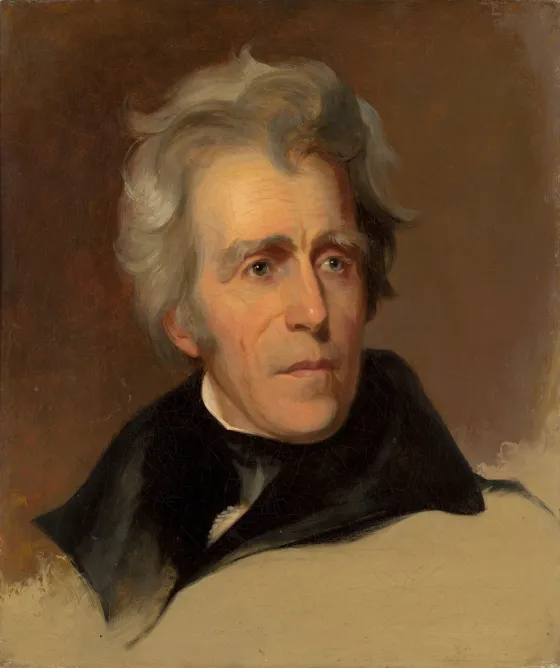
Andrew Jackson National Portrait Gallery Smithsonian

President Andrew Jackson. Courtesy of the National Gallery of Art/Thomas Sully.

Jackson’s Call for Removal

Jackson made relocating Native Americans west of the Mississippi one of his campaign promises in the 1828 election. Upon taking office, he informed Native American leaders that he would not countenance independent governments within the confines of the United States. In December 1829, he asked Congress to consider “the propriety of setting apart an ample district west of the Mississippi” for Native Americans, with “each tribe having a distinct control over the portion designated for its use.” He added that “this emigration should be voluntary, for it would be as cruel as unjust to compel the aborigines to abandon the graves of their fathers and seek a home in a distant land.”

Jackson argued that relocating Native Americans would benefit the United States by placing “a dense and civilized population in large tracts of country now occupied by a few savage hunters” and “strengthen” the southwestern frontier against foreign invasion. But he also saw relocating Native Americans as the only just and humane option the United States had. He believed that the expulsion, assimilation, or annihilation of Native Americans was inevitable, as their demise in northern states had demonstrated. “Humanity has often wept over the fate of the aborigines of this country and philanthropy has long been busily employed in devising means to avert it, but its progress has never for a moment been arrested.” Relocation, he insisted, offered Native Americans the chance to preserve their ways of life.

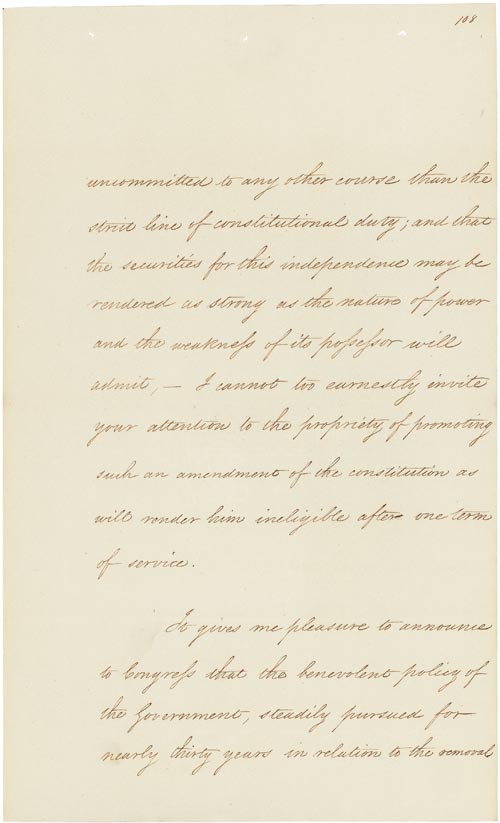
President Andrew Jackson's message to Congress "On Indian Removal," December 6, 1830. Courtesy of the National Archives and Records Administration.

Congress Debates

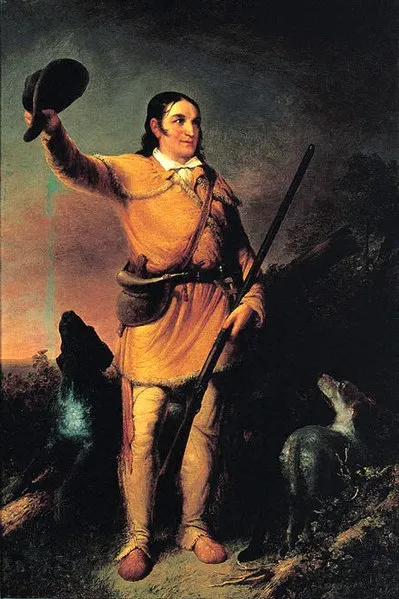
Opposition to Jackson’s proposal came mostly from northern lawmakers and Christian missionaries. Notable opposition outside of the North came from former Speaker of the House Henry Clay, who was still a formidable political figure despite being out of office, and legendary frontiersman and Tennessee Congressman Davy Crockett. Jackson’s opponents argued that removing Native Americans violated both the treaties the United States had signed and the basic laws of morality. Crockett declared that his opposition to the Indian Removal Act would “not make me ashamed in the Day of Judgment.”

Jackson’s proposal was popular in the South, where white settlers stood to be the biggest beneficiaries. Georgia had argued since it relinquished lands west of its present-day borders to the U.S. government in 1802 that it was not obligated to observe the sovereignty of Native American nations. Georgia had a particular dispute with the Cherokee nation. That animosity grew when gold was discovered on Cherokee land in 1828. Many southerners viewed northern opposition to removal plans as hypocrisy, given that they had overrun the Native American peoples living among them.

Portrait of David Crockett, by John Gadsby Chapman, oil on canvas. 1834.

Portrait of David Crockett, by John Gadsby Chapman, 1834. Courtesy of Harry Ransom Humanities Research Center.

Congressional Passage

The Senate passed the Indian Removal Act on April 24, 1830 by a vote of 28 to 19. The House of Representatives followed suit on May 26, though by the narrower vote of 101 to 97. Jackson signed the bill two days later. The seven-hundred-word law authorized him to give federal land west of the Mississippi to Native American tribes willing to relinquish their lands east of the Mississippi. The law also authorized him to provide “such aid and assistance” as Native Americans might need “to enable them to remove to, and settle in, the country for which they may have exchanged.”

The Indian Removal Act did not authorize Jackson or anyone else to force Native Americans from their lands. However, contrary to Jackson’s claims, Native Americans were not free to choose as they wished. Emboldened by passage of the act, settler encroachment on their lands intensified. The tribes knew that neither the federal government nor state governments would intervene on their behalf, especially in the South, and their situation would likely only get worse.

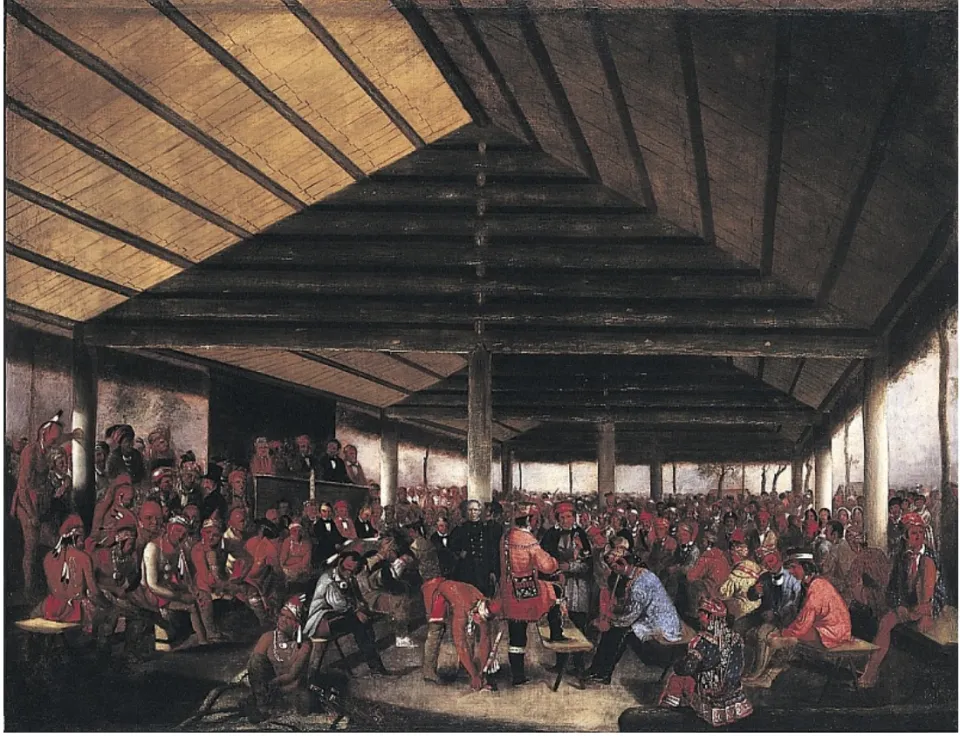
meeting

"International Indian Council" (Held at Tallequah, Indian Territory, in 1843) by John Mix Stanley depicts a tribes meeting in response to the Indian removal. Courtesy of the Smithsonian American Art Museum, Gift of the Misses Henry.

Implementation

As many as one hundred thousand Native Americans from eighteen tribes were relocated under the Indian Removal Act. Some northern tribes such as the Kickapoo, Potawatomi, and Wyandot traded their homelands for land in Kansas. Members of other tribes, including the Delaware, Shawnee, and Miami, were forcibly moved to what was then called Indian Territory and is now Oklahoma.

The primary impact of the Indian Removal Act, however, fell on the Cherokee, Chickasaw, Choctaw, Creek, and Seminole living in the southeastern United States. Known as the Five Civilized Tribes because of their willingness to adopt many European-American practices, their land was coveted by white settlers looking to grow profitable crops such as cotton. Under pressure from encroaching settlers and coerced by hostile state governments, the Choctaw, Creek, and Chickasaw agreed in 1831 and 1832 to relocate to Oklahoma. The Seminoles fought a seven-year war that ended with most tribal members being expelled to Oklahoma. The Cherokee were forcibly moved to Oklahoma starting in 1838, with four thousand of the sixteen thousand who began walking what became known as the Trail of Tears dying before reaching their new home.

In the whole scene there was an air of ruin and destruction, something which betrayed a final and irrevocable adieu; one couldn’t watch without feeling one’s heart wrung. The Indians were tranquil but somber and taciturn. There was one who could speak English and of whom I asked why the Chactas were leaving their country. “To be free,” he answered, could never get any other reason out of him. We ... watch the expulsion ... of one of the most celebrated and ancient American peoples.

Alexis de Tocqueville, Democracy in America

The Legacy of the Indian Removal Act

The Indian Removal Act repudiated solemn treaty obligations that the United States had extended to Native American tribes and sanctified in law the forced displacement and suffering of Native American tribes. The law’s supporters argued that it was just because it authorized the voluntary exchange of land. However, the land transfers were voluntary in name only. U.S. negotiators used bribery and coercion to secure agreements from tribes that faced the threat of violence from settlers, often with the blessing of state and local officials. The U.S. government frequently failed to provide promised aid and assistance to tribes forced to relocate, most notably with the Cherokee who walked the Trail of Tears. By pushing Native Americans off vast swaths of land in the South, the Indian Removal Act also enabled the practice of chattel slavery to spread, furthering a second horrific abuse of human rights.

National Security Archive, GWU

Learn More

Primary documents, books, articles, and more on the Indian Removal Act of 1830 below.

Primary Documents

Books

Articles

Documentaries and Short Videos

Lectures and Podcasts