Methodology
The rankings of the best and worst decisions in the history of U.S. foreign policy are based on a survey conducted with members of the Society for Historians of American Foreign Relations (SHAFR), the world’s foremost professional association dedicated to the scholarly study of the history of American foreign relations. The survey ran from October 5, 2023, through November 5, 2023.
The survey consisted of two substantive questions. First, SHAFR members were asked to select ten decisions from a list of 120 foreign policy decisions that in their “judgment did the most to advance U.S. national interests and values.” Respondents had the option of reviewing the complete set of decisions before making their decisions. Second, SHAFR members were asked to review the same 120 foreign policy decisions and select the ten decisions that in their “judgment did the most to harm U.S. national interests and values.” Respondents similarly had the opportunity to review the list of decisions before making their selections. The list of decisions was the same for both questions.

THE SURVEY
1. What decisions did the most to advance U.S. national interests and values?
2. What decisions did the most to harm U.S. national interests and values?
View All Decisions Considered
Decision Selection
The survey sought to solicit expert historical assessments of U.S. diplomatic and foreign policy decisions since the start of the American Revolution through the end of the first Donald J. Trump administration. The survey did not seek to assess the quality of military decisions made during wartime or to evaluate decisions about organizational arrangements within the U.S. diplomatic or military establishments. The decisions the survey assessed could have been made by the president, the Senate, Congress, or the president and Congress (or Senate) acting together.
The survey considered U.S. relations with Native Americans in the first century after the signing of the Declaration of Independence as foreign policy decisions because until the signing of the Indian Appropriations Act of 1871 the U.S. government considered them to be sovereign nations. The survey considered tariff decisions as foreign policy decisions starting with the end of World War I because tariffs had until that point in U.S. history been considered by presidents and members of Congress as primarily domestic decisions.
The 120 cases that appeared in the survey were generated in three steps. First, a review of ten major textbooks on the history of U.S. foreign policy generated an initial list of 543 decisions from the signing of the Declaration of Independence through the end of the first Trump administration that met the selection criteria. Second, that initial list was reduced to 164 cases based on judgments about the overall significance of each possible decision. Third, an advisory committee composed of twelve SHAFR members representing expertise across the range of historical eras in U.S. foreign relations winnowed and revised the list to final 120 cases included in the two survey questions.
Results
Three hundred and sixty verified SHAFR members completed the survey. Of those, 346 members provided ranked lists of what they considered the ten best decisions, and 331 verified respondents provided ranked lists of what they considered the ten worst decisions. In all, 111 of the 120 listed decisions received at least one vote as a best decision, and 101 of the 120 decisions received at least one for vote as a worst decision.
The rankings presented in this website are a weighted tabulation of the raw results. A decision with a ranking of one received ten points, a decision with a ranking of two received nine points, and so forth, with a decision ranked ten receiving one point.
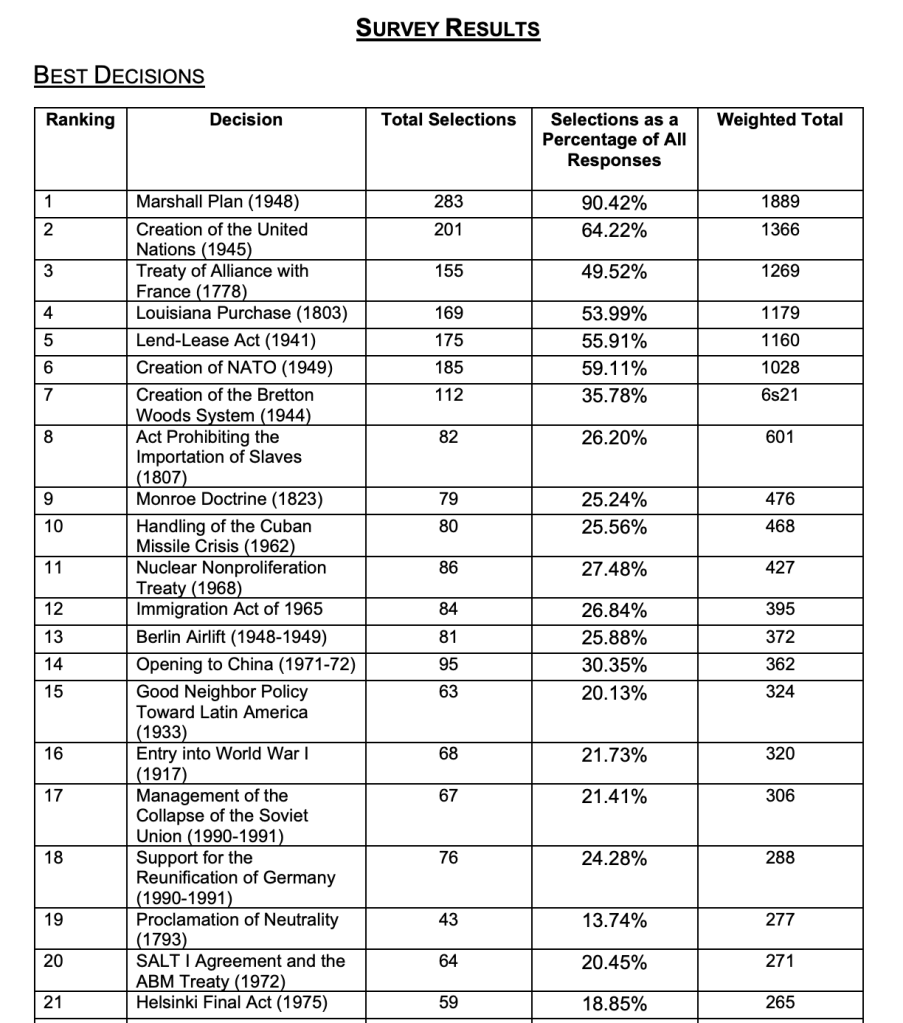
SURVEY RESULTS
See the Full Survey Results
The Advisory Committee
The survey was developed in consultation with an advisory committee composed of twelve SHAFR members. The committee members and their affiliations at the time the survey was conducted were:
- Laura Belmonte, Virginia Tech
- Mary Dudziak, Emory University
- Charles Edel
- Jeffrey Engel, Southern Methodist University
- Kristin Hoganson, University of Illinois
- Adriane Lentz-Smith, Duke University
- Fredrik Logevall, Harvard University
- Lien-Hang Nguyen, Columbia University
- Christopher McKnight Nichols, The Ohio State University (chair)
- Andrew Preston, University of Cambridge
- Sarah Snyder, American University
- Jeremi Suri, The University of Texas at Austin
The members of the advisory committee are not responsible for the contents of this website or for any interpretation of the survey results. Member affiliations are noted as of the date the survey was conducted.
Feedback
You can report broken links and suggest materials such as books, articles, videos, or podcasts to be added to the website by writing to [email protected].