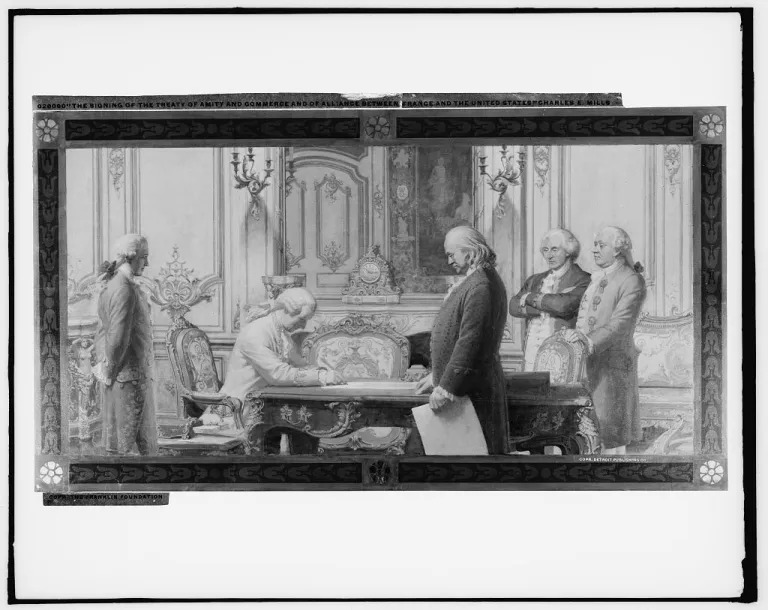
Signing of the Treaty of Alliance between France and America

Best Decision

3

Treaty of Alliance With France

Scroll to begin

Introduction

When the thirteen colonies declared independence in 1776, they turned to Great Britain’s rival France for aid. At first, France provided only clandestine support. It feared that publicly siding with rebels who were likely to lose would risk a war with Great Britain that had few benefits. But adept U.S. diplomacy and a critical American battlefield victory changed that calculation. On February 6, 1778, France recognized the independence of the thirteen American colonies and pledged to support their war with Great Britain. The agreement, which was codified in two separate treaties, was a turning point in the American Revolutionary War. France subsequently provided the colonies not only with military supplies and financial support, but also with land and naval forces. France’s entry into the war also forced Great Britain to divide its forces to guard against threats to its interests in Europe and the Caribbean as well as in the thirteen colonies. A war that the colonists seemed destined to lose became a war that they won—and that changed the course of history. SHAFR historians ranked the Treaty of Alliance with France as the third-best U.S. foreign policy decision.
Backdrop to a Revolution

American independence was partly the byproduct of the epic rivalry between Great Britain and France. The two European powers fought three wars over the course of the eighteenth century as each sought to become the dominant political and military power in Europe. Their rivalry spilled into North America during the Seven Years’ War, or what the British colonists in North America called the French and Indian War. France won several battles early in the war, but the momentum eventually shifted in favor of Britain. When the fighting ended in 1763, France ceded its claims to Canada and a large area west of the Appalachian Mountains to Britain.

Looking to pay off the debt it had incurred to fight the war, the British Parliament imposed new taxes on the American colonies. The colonists balked at paying. They argued that they had already helped finance the war with both men and money, and complained that they were the victims of taxation without representation because they had no say in Parliament’s decision. They also objected that the revenues being raised would not be used for their benefit. Britain’s efforts to compel compliance fueled more resistance. British attempts to minimize conflict with Indigenous tribes by barring settlement west of the Appalachian Mountains added to the colonists’ grievances. Neither side backed down. A once unthinkable rebellion became a reality when the Continental Congress declared the independence of the United States of America on July 4, 1776.

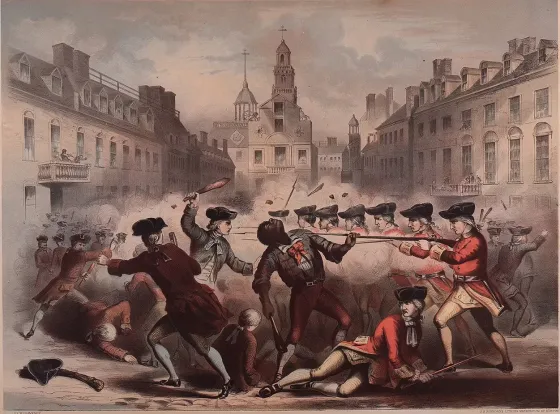
“Boston Massacre, March 5th, 1770,” by John H. Bufford based on a drawing by William L. Champney, ca.1856 Boston Athenaeum

“Boston Massacre, March 5th, 1770,” by John H. Bufford based on a drawing by William L. Champney. Boston Athenaeum

The Search for Allies

The colonists knew they needed help to overthrow British rule. Indeed, four months before declaring independence, the Continental Congress appointed Silas Deane as a secret envoy to France. His mission was to persuade the French government to provide financial and military aid. The Continental Congress knew that France resented the loss of its North American possessions, wanted to weaken its rival, and feared that a British victory would increase the threat to its possessions in the Caribbean. The colonists also hoped that the trading opportunities that would materialize if America won its independence would entice France to provide aid.

Deane’s initial negotiations led the French to secretly authorize the sale of arms and ammunition to the Americans. The weapons reached the colonies through the Dutch West Indies and helped sustain the American war effort. France also provided loans and gifts to finance the war, and it allowed American ships that were preying on British merchant vessels to use French ports in the Caribbean. France was unwilling, however, to openly support the colonists. Publicly siding with the rebels risked a war with Britain. That risk seemed too great given that the ragtag American army seemed likely to lose to Britain’s superior forces.

In late 1776, the Continental Congress sent Benjamin Franklin and Arthur Lee to join Deane in Paris.  The seventy-year-old Franklin became a celebrity in Paris. He was already well known for his writings and scientific experiments; what he added in person was his charm, which he used to cultivate ties with leading French thinkers and to appeal to their Enlightenment ideals of liberty and self-determination. Public support for the American cause surged. But France still refused to join the war.

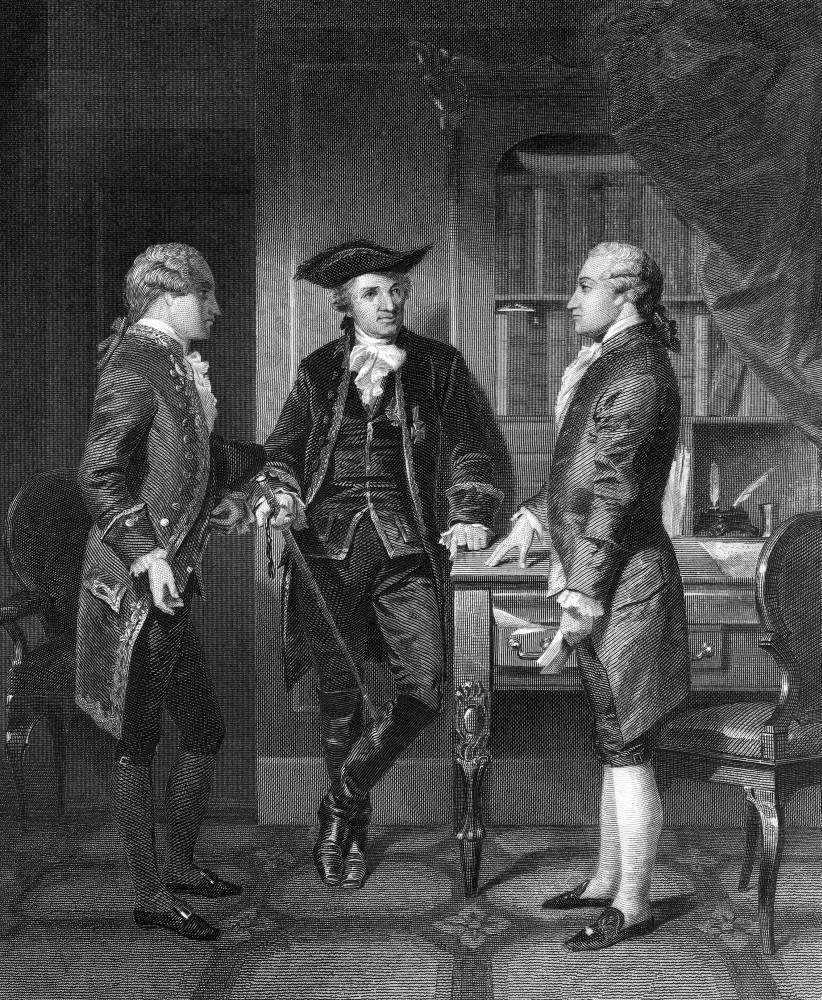
Baron de Kalb, center, introducing the Marquis de Lafayette to Silas Deane.

Baron de Kalb, center, introducing the Marquis de Lafayette to Silas Deane. New York Public Library

The Battle of Saratoga

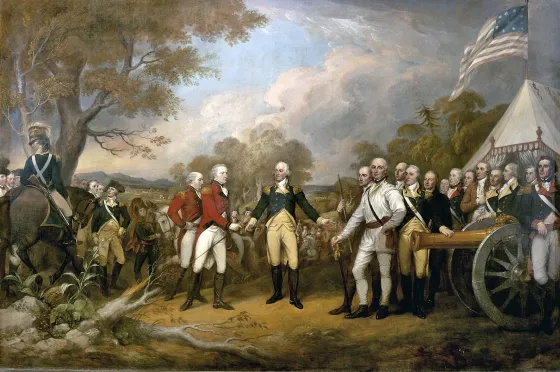
What changed French policy was American success on the battlefield. In June 1777, Britain sent a large army south from Canada in a bid to split New England, which had been a hotbed of revolutionary sentiment, from the rest of the colonies. In mid-September, a smaller and less experienced colonial army stopped the British advance near Saratoga, New York. After the Americans won a second battle in early October, the British forces surrendered.

The American victory at the Battle of Saratoga dealt a major setback to Britain’s war effort and scrambled political calculations in Paris. France now worried less about joining a doomed war and more about missing the opportunity to weaken Britain. London might respond to its devastating defeat at Saratoga by offering concessions to entice the colonies to abandon independence. If France remained on the sidelines, the Americans might find such an offer more appealing than continuing a war they could still lose.

Surrender of General Burgoyne

"The Surrender of General Burgoyne” at Saratoga, by John Trumbull. Courtesy of the Architect of the Capitol.

A Franco-American Alliance

The talks between the American and French negotiators moved quickly. On February 6, 1778, Deane, Franklin, and Lee signed two treaties with France. The Treaty of Amity and Commerce recognized the United States as an independent nation. The agreement also sought to promote trade between France and the United States by stipulating that neither country would provide better commercial opportunities to any third country and by assuring that each country’s ships would have access to the other’s ports.

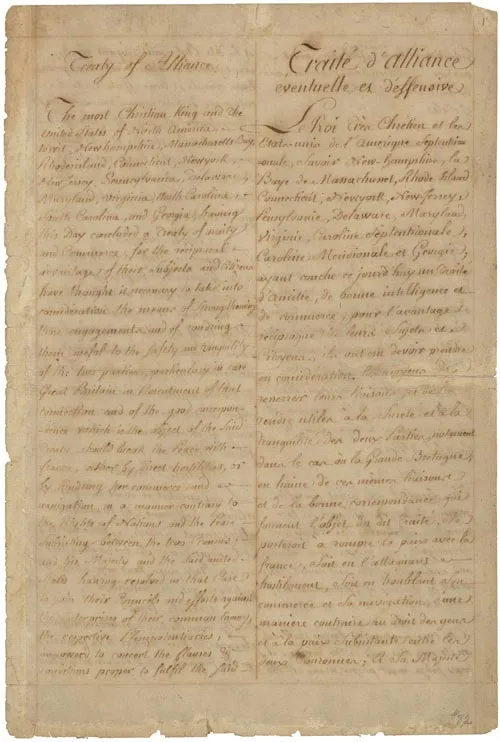
The Treaty of Alliance established a military alliance between France and the United States. It obligated the two countries to make “common cause and aid each other” in the event that Great Britain expanded its war on the thirteen colonies to France. The treaty also stipulated that neither country would make peace with Great Britain “until the Independence of the United States shall have been formally or tacitly assured by the Treaty or Treaties that shall terminate the War.”

France informed Britain on March 13, 1778, that it had recognized the United States as an independent country. Four days later, Britain declared war on France. Actual hostilities between the two countries began three months later when a British naval squadron fired on two French ships. The texts of the two treaties reached the Continental Congress on May 2, 1778. The Continental Congress ratified the treaties two days later.

Treaty of Alliance with France (1778)

Treaty of Alliance with France, 1778. Courtesy of the National Archives and Records Administration.

Victory Together

France’s entry into the war turned what had been a colonial rebellion into a global struggle. Spain and the Dutch Republic subsequently entered the war on France’s side. That forced Britain to divert troops and naval forces from the colonies to the Caribbean and Europe, which relieved pressure on American forces and helped turn the tide on the battlefield in their favor.

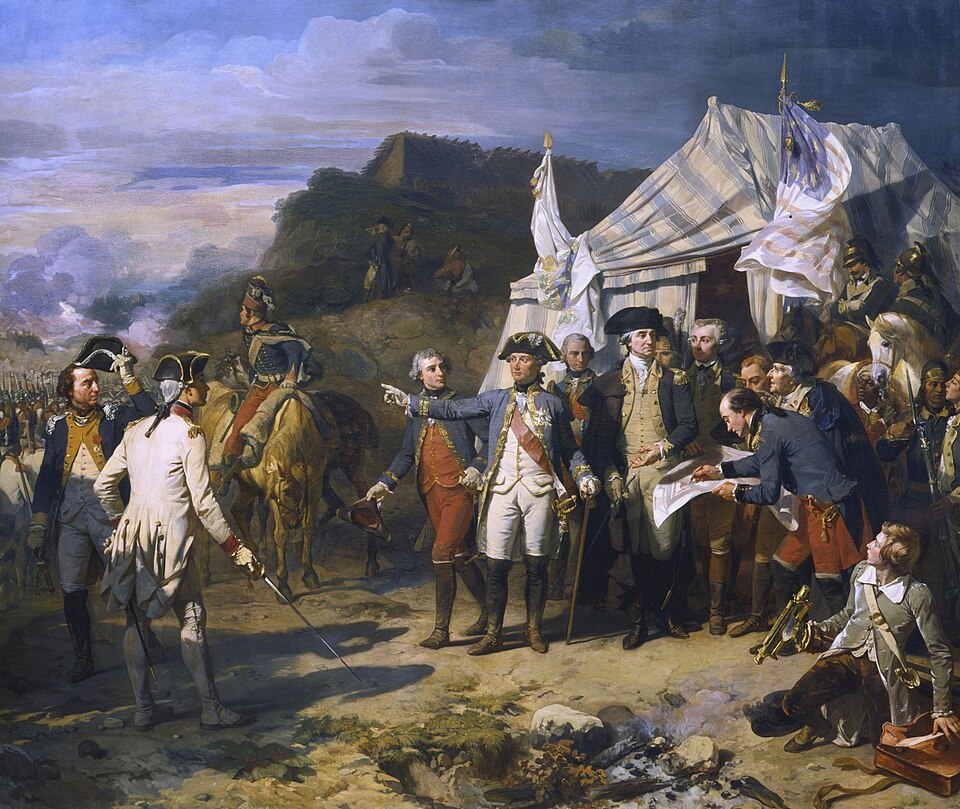
But it was France’s direct military involvement that played the decisive role in securing American independence, most notably at the Battle of Yorktown in October 1781. French troops, led by General Jean-Baptiste Ponton de Rochambeau, worked closely with General George Washington’s Continental Army to surround a British army led by General Lord Charles Cornwallis at Yorktown, Virginia. Meanwhile, a French naval squadron, led by Admiral François Joseph Paul de Grasse, defeated a British naval force and cut off Cornwallis’s resupply by sea. After a twenty-two-day siege, Cornwallis surrendered. It was the last major battle of the American Revolution. Two years later, Britain signed the Treaty of Paris, formally recognizing U.S. independence.

“Siege of Yorktown, 1791” by Louis Charles-Auguste Couder in 1836. Courtesy of the Museum of the American Revolution.

The Legacy of the Treaty of Alliance With France

The Treaty of Alliance with France was pivotal to the success of the American Revolution. France’s substantial military, financial, and diplomatic assistance enabled the thirteen colonies to take advantage of their success at the Battle of Saratoga. France’s entry into the war helped the fledgling United States gain additional support from Spain and the Dutch Republic. Both developments forced Britain to disperse its forces to protect its many flanks. Most importantly, the direct involvement of French troops and the French navy expanded the colonists’ military capabilities, enabling them to defeat British forces on land and at sea, thereby compelling Britain to acknowledge America’s independence.

National Security Archive, GWU

Learn More

Primary documents, books, articles, and more on the Treaty of Alliance with France.

Primary Documents

Books

Articles

Documentaries and Short Videos

Lectures and Podcasts