A Dovish Market Has History on Its Side in Tuning Out the Fed
By experts and staff
- Published
 Benn SteilCFR ExpertSenior Fellow and Director of International Economics
- Dinah WalkerAnalyst, Geoeconomics
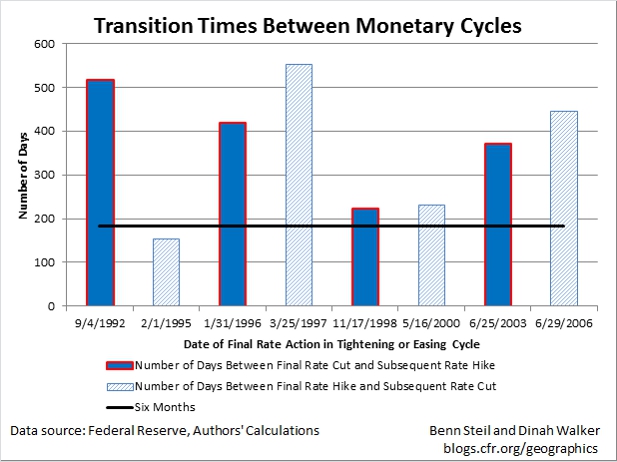
Market expectations for Fed policy have been decidedly more dovish than the Fed itself, a conundrum that is concerning San Francisco Fed economists. As the Fed debates its rate-liftoff forward guidance this week, however, it is worth asking how much it really matters.
We have long argued that the market has been perfectly rational in tuning out elements of central-bank forward guidance that aren’t credible. Today’s Geo-Graphic shows why the market may well have it right again.
As the figure above shows, going back to 1992 the Fed has never raised rates less than 225 days after the end of a policy-easing cycle. In 1992, the gap was 518 days. In 1996 and 2003 the gap was also over a year.
So with QE3 set to wind down in October, the market has history on its side in expecting a later transition to tightening (beginning this time next year), and a slower one, than Fed forecasts and statements suggest.
Read about Benn’s latest award-winning book, The Battle of Bretton Woods: John Maynard Keynes, Harry Dexter White, and the Making of a New World Order, which the Financial Times has called “a triumph of economic and diplomatic history.”