Haiti’s Reconstruction Struggles
Five years after a devastating earthquake, Haiti remains plagued by a weak political system and flawed reconstruction process, says former correspondent Jonathan M. Katz.
By experts and staff
- Published
- Jonathan M. Katz
- Danielle Renwick
On January 12, 2010, a 7.0-magnitude earthquake struck near Haiti’s capital, Port-au-Prince, killing as many as 316,000 people and destroying much of the city. Relief and reconstruction in Haiti, the poorest country in the Western Hemisphere, continues to move slowly and has been marked by major setbacks, including a cholera outbreak some experts have linked to UN peacekeepers. (While the UN has led anti-cholera efforts, it claims immunity from legal action.) Despite donors’ best intentions, foreign assistance has failed to strengthen Haiti’s political institutions, says Jonathan M. Katz, who reported from Port-au-Prince during the earthquake for the Associated Press and is the author of The Big Truck That Went By. Five years later, Katz says, the state remains weak.
The earthquake left an estimated 1.5 million people homeless, spurring the development of sprawling tent camps, some of which remain open. How are conditions today?
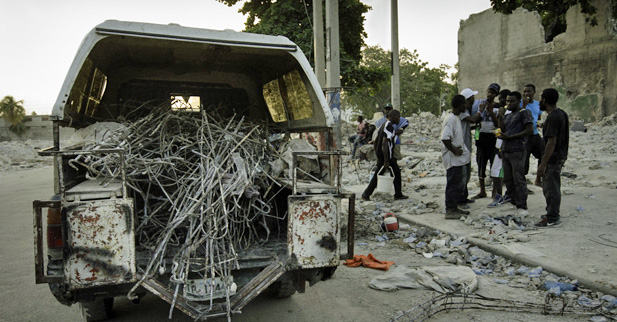
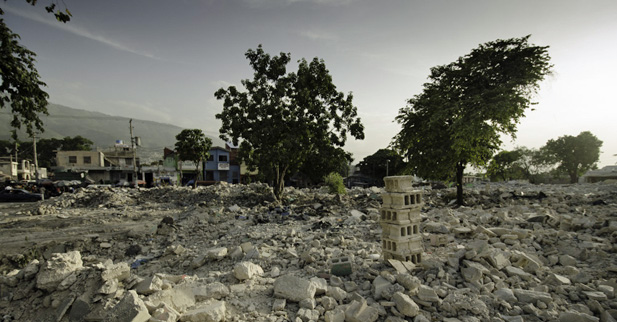
Most of the rubble has been cleared—mostly by Haitians, who used it to rebuild their homes. General services and infrastructure weren’t there to recover in the first place. The situation before the earthquake was untenable, and it still is untenable.
The camps became the most visible symbol of the destruction caused by the earthquake, so a lot of pressure was put on the various responders to reduce the number of people living in the camps.
But within a month of the earthquake the camps were simply becoming new parts of the housing stock of Port-au-Prince. If you were to go into one of the major camps and then to Cite Soleil, a shantytown that had been there for about thirty years, you couldn’t really tell them apart. They look the same, they’re made of the same materials, and a lot of the same families had family members living in both.You’d have the same kinds of boutiques, the same guys selling lottery tickets.
That’s not to say people didn’t want to move back somewhere else. In many cases people had lived in nicer concrete houses before the earthquake and wanted to get out of the camps. The vast majority of people who were registered as living in earthquake camps have now left. Some have gotten rental subsidies, some have been violently pushed out, and some were able to get back to work and could rent another place.
Haiti is embroiled in a political crisis that has blocked parliamentary and municipal elections. Is this a legacy of damages wrought by the quake, or another chapter in the country’s chronic political instability?
The cause of this crisis goes back to the wake of the Duvalier dictatorship. In 1986, Jean-Claude [“Baby Doc”] Duvalier fled, and the Haitian people created a new constitution whose main goal was to prevent a dictatorship from reestablishing itself in the place of the Duvaliers. That constitution created a very severe set of checks and balances that allowed, for example, parliament to dismiss the prime minister with a simple majority in either chamber.
Recognizing the extreme power that the legislature has over its branch, the executive—and this includes all presidents from all parties—has consistently exploited a loophole to prevent elections from being held, to keep parliament weak and allow presidents to rule by decree.
If another earthquake were to happen today on the exact same fault, the result would be more or less the same.
What’s specific to the current conflict is the presidential election that was held in the year after the earthquake, which was about how Haiti would be reconstructed. The United States supported [the challenger, current President] Michel Martelly, who saw reconstruction the same way Washington did—based on foreign investment—over then-President Rene Preval’s party’s candidate, Jude Celestin. Celestin looked like he was gong to be a continuation of Preval, [whose relationship with Washington was sometimes confronational].
The Organization of the American States (OAS)—and really the United States—came in and all but decided the results of the election. [Editor’s note: The OAS, which oversaw Haiti’s election, found strong evidence of fraud and recommended that enough ballots be invalidated to drop Celestin from first place to third, eliminating him from the runoff.]
The effect was to have the president that the United States wanted, but also to allow what became the opposition to remain in power in parliament. Given the proclivities of the 1987 constitution, that created a conflict in which the executive and legislature would be in gridlock.