Innovation, Tech, and Policy Leaders Focus on Rebuilding America and Outcompeting China
By experts and staff
- Published
Last week marked the second edition of Endless Frontiers, a new convening in Austin, Texas, where many of America’s top leaders from across technology, science, venture capital, government, industry, and media gathered to discuss how to rebuild the foundations of American strength and prosperity.
- This year’s theme focused on “The Return of American Moonshots.” Over three days, participants considered how America can leapfrog its competitors to win five key interlocking races over defense, AI and technology, industrial capacity, governance and institutional renewal, and national cohesion.
- Endless Frontiers is a bipartisan, invite-only conference co-hosted by the Council on Foreign Relations and four leading Texas universities: the University of Texas at Austin, Texas A&M, Baylor University, and Rice University.
- Read about the start of the conference in Axios Austin.
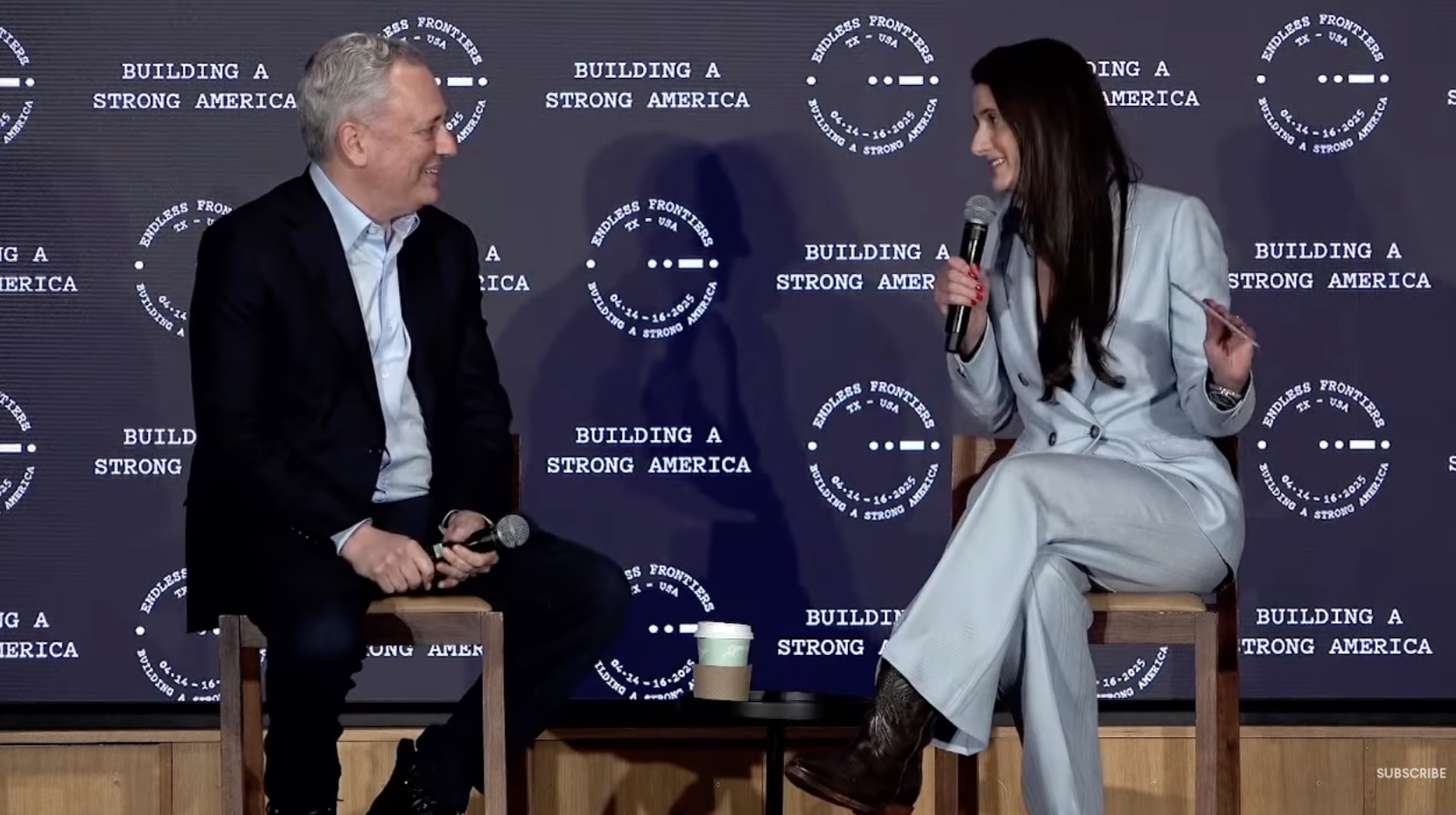
Alongside a wide range of intimate, small group discussions on the ground, Endless Frontiers featured key conversations on the record. Links and highlights are below.
- “A real advantage of the United States that we have this vibrant risk capital ecosystem. I would start by looking at that and asking what that’s not doing well enough that we need the government to get involved in. . . . One of the ways that we ended up with all the rare earths being processed in China is that we just kind of let that industry go to wherever the lowest cost manufacturing was or processing. And it may not even have been completely lowest cost in China. They I think strategically targeted it and may have subsidized it.”
- “There’s a very strong NIMBY backlash happening with respect to data center construction right now. And in fact, even some members of Congress have introduced a ban on more data center construction. I think the president has a different approach. I think it makes a lot more sense, which is he introduced what he called the rate payer protection pledge, where we got all the big hyperscalers and AI companies to pledge that if they built a new data center, it would not cause residential electricity prices to increase. But in exchange for that, the quid pro quo is we’d make it easier to do permitting and make it easier for them to basically stand up their own power generation. The idea is bring your own power and in exchange, you can set up data centers.”
- “If you poll AI, it polls really poorly. The popularity of AI is slightly worse than Congress and slightly better than Iran. That’s because of just all the fear that’s been kind of pumped into the market and the media. Our popular entertainment usually portrays AI in a dystopian way. And then again, I think some of our leading founders haven’t necessarily been incredibly reassuring on this point. AI has a popularity problem.”
- “We’re just trying to say to folks is, look, ‘Our market is the market you’re going to make profit in. Our education system is the one where your engineers go to study. Our technology licensing is the one that built your telecommunications industry if you really look at that piece. If you actually want to have your own firms who can build telecommunications equipment in your country, it’s Qualcomm who’s going to license you that technology. It’s not going to be Huawei.’”
- “They [China] have demonstrated that they are, as Secretary Bessent has said, an unreliable partner. They’re an unreliable trading partner, particularly on critical minerals and a whole bunch of other things. And so of course, the United States has no interest in purchasing critical inputs from an unreliable partner on these things. So we are working through this problem. There’s just no easy way out of this. The dependencies actually go both ways. We have an enormous amount of tools. I think there’s a lot of focus on what China could do. And clearly, to be honest with you, if they wanted to put a full stop on it, large industries would stop producing. . . . Suffice to say, we have technology tools, industrial tools, input tools, financial tools. We could shut down the Chinese economy if we needed to.”
- “We’re doing [trade] agreements bilaterally. While we’re not doing sort of plurilateral discussions on trade for this very reason, what we are locking in is U.S. access. I like to tell people, I’m the United States trade representative, not the trade representative for the world trading system or the rules-based trading order, right?”
- “Chinese investments have no independent private-sector participation and lack the price signals and risk discipline that make projects truly commercially viable. State capital acting alone can never build dynamic markets the way that private capital can. Our global partners want to work with us because our model is better. When we mobilize private capital, we build enduring markets. When we invest, we are investing in our partner countries’ economic future and their people. If in the future, DFC exits an investment and private-sector capital endures, that’s how we know we’ve succeeded. The U.S.’s greatest export is the American free market system and its legacy of success.”
- “How are we addressing these global challenges? Simply doing more deals is not a solution. A data center without adequate grid support is useless, as is a mine without infrastructure to move the ore. One-off investments build isolated assets that become targets and are easy to outcompete. Instead, DFC investments will mobilize private capital to build holistic economic ecosystems anchored to U.S. capital markets, insulated against adversary control, and structured to generate strong returns for the American taxpayer, with economic development that moves the needle.”
Janet Petro
- “This time we’re not just going back to put footprints there. We’re going back to stay and we’re going to do a whole bunch of science while we’re there. So, these initial missions, and that’s the second pillar was building a moon base, which again creates a whole bunch of energy and excitement. I think across the world, across the United States and people who are involved in the space community, building a moon base is pretty exciting. We’re going to send a whole bunch of robotics. We have a commercial lunar payload services contract, so commercial. We have a whole bunch of commercial providers that we are really trying to incubate and get a whole bunch of people to be able to land on the moon.”
- “Beating China is a thing. It is a thing. My boss is very emphatic that we’re going to beat them and we should all think about how’s it going to feel if they get there first. So, we’re trying to do everything possible. And then to Blue and SpaceX, we’ve all had accidents, explosions, bad things that happened. Space is hard. If space wasn’t hard, every country in the world would do it and it would be easy to be an everyday thing, but space is really, really hard to get everything just right.”
Chris Cassidy
- “I think when you see the flags that are on the shoulders of the four spacesuits walking on Mars, they’re not going to all be American. And when you see the four flags of the spacesuits walking on probably the, what, Artemis four crew, I doubt they’re all going to be for American flags. So by definition, there’s international cooperation, international partnership that is going to be happening from the very beginning of this program.”
About Endless Frontiers:
- Endless Frontiers is an annual, invite-only retreat in Austin, Texas, that brings together two hundred of America’s top leaders from across technology, science, finance, government, industry, and media for a single purpose: to renew national strength at a moment of geopolitical upheaval and intensifying competition with China. Founded in 2024 by cochairs Jordan Blashek, Rush Doshi, Marshall Kosloff, and Evan Loomis, the retreat is co-hosted by the Council on Foreign Relations and four leading Texas universities—the University of Texas at Austin, Texas A&M, Rice University, and Baylor University.
- Endless Frontiers is a nonprofit effort. Nearly all of its funding comes from its university and nonprofit co-hosts, as well as foundations like the Hewlett Foundation, Griffin Catalyst, and the Sloan Foundation. It also receives private support from local Austin venture capital firms Overmatch and 8VC.
For more information, please email [email protected].