Oregon Boundary Dispute in 1845
How should the United States respond to British naval buildup near the Oregon Country? Explore this historical simulation.
- Level
- High School, Higher Education
Need guidance for how to run your mini simulation?
Overview
Thousands of American settlers are migrating west to the contested Oregon Country. Increased migration is putting significant political pressure on President James K. Polk to fulfill a campaign promise and annex the entire territory. How should the United States respond to British naval buildup in the region and a deteriorating U.S.-British relationship?
Students will understand that, in negotiations, presidents often have to manage foreign policy risks while satisfying public opinion.
Use the following historical case to spark discussion and help students think through what they would do if they were decision-makers.
The Situation
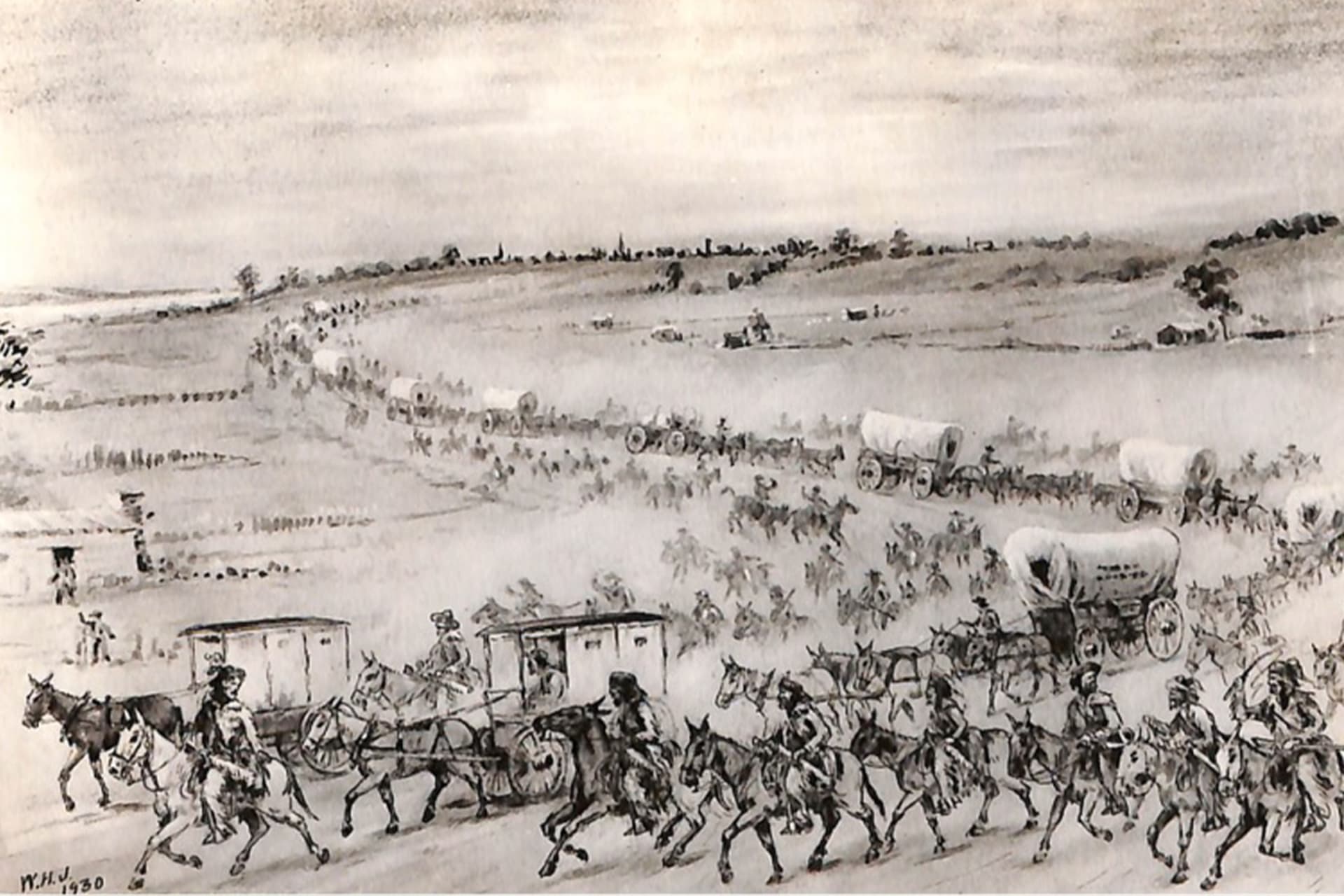
In the early nineteenth century, the United States and several European powers competed to wrest control over the Pacific coast of North America from American Indians. By the 1820s, Russia occupied the northern portion of the coast, while Spain (and later Mexico) claimed the southern portion. The struggle for the remaining territory between the latitudes of 42° and 54°40′ North, which the United States called the Oregon Country, fell between the United States and the British Empire. Both sought this territory to advance commercial interests such as the fur trade. Oregon Country was also the only remaining area on the west coast where either country could build Pacific Ocean ports to access burgeoning trade routes. Despite long negotiations, the United States and the British Empire could not agree on a boundary to divide the territory. Neither was willing to relinquish the critical area between the Columbia River and the forty-ninth parallel. This swath of land contains Puget Sound—the region’s best natural harbor. In 1818, the two countries settled for a stalemate, establishing a treaty of joint occupation over the Oregon Country. By the 1840s, however, this agreement grew strained. The United States and British Empire initially used the territory mainly for trapping and trade. However, driven by economic depression in 1837 and the expansionist ideology of manifest destiny, thousands of U.S. had begun to settle permanently in Oregon. Between 1840 and 1845, five thousand settlers journeyed west and began establishing a permanent presence. Migrants even created provisional governments to administer the region. With more settlers arriving each year, public pressure to cement U.S. control over Oregon grew.
In 1844, amid fierce public debate about the limits of United States expansion, Democrat James K. Polk was elected president. Polk’s campaign centered on manifest destiny and relied on supporters of Oregon , to whom he promised to claim the entire Oregon Country. Polk reiterated his promise at his inauguration, claiming, “Our title to the country of the Oregon is ‘clear and unquestionable,’ and already are our people preparing to perfect that title by occupying it.” Democratic newspapers began pressing for immediate annexation. Opposition to annexation and proponents for compromise were denounced and accused of harboring British sympathies. Slogans such as “Fifty-Four Forty or Fight” emerged, promoting the hard line. The British saw Polk’s stance as a challenge to the empire’s honor and a threat to British economic interests. As a result, London responded with their own threats. Officials declared the Royal Navy was prepared to commission a force in defense of Oregon that would overwhelm the U.S. Navy. As tensions mounted, both countries prepared for the possibility of war. In the summer of 1845 Washington offered a compromise. Polk put forward again the initial U.S. proposal to divide Oregon along the forty-ninth parallel. This placed Puget Sound on the American side of the border. The British rejected this offer, however, and Polk ceased negotiations.
Decision Point
Set in December 1845
A British warship has been spotted near the Columbia River. Reports indicate several more British vessels have been deployed to the Oregon territory. Considering the recent failure of negotiations with Britain, this mobilization suggests the British Empire’s claims of readiness to protect its interests by force are credible. As tensions rise, President Polk has called on Congress to terminate the joint occupation treaty in one year. Polk has convened his cabinet to determine what territorial claim to negotiate for—or perhaps fight for. Cabinet members will need to weigh the risk of war against preserving U.S. interests in the region and protecting U.S. citizens already in the area. Polk’s promise to voters to claim the entire territory must also be taken into account.
Cabinet members should consider the following options:
- Reassert the U.S. claim on the entire territory up to 54°40′ North. Fulfilling Polk’s campaign promise would be politically popular. However, this option has the highest likelihood of sparking a war that the United States could lose. British resolve to fight a war for so remote a territory could be weak. That said, the British Empire is still a militarily superior power.
- Maintain the original U.S. proposal to divide the border at the forty-ninth parallel. Although less extensive than his campaign promise, this division, which includes Puget Sound, would still be broadly favorable to U.S. interests. This option still poses a risk of war. However, given the remote nature of the territory, the current British military posturing does not guarantee willingness to fight.
- Accept the British proposal to divide the land at the Columbia River. This option averts a war but would result in the United States losing valuable port access in Puget Sound. This policy option would likely result in public anger over a perceived retreat from Polk’s initial position.
- Forgo claims on the Oregon territory. This option would avoid war but would be immensely unpopular. The United States would cede access to vital ports, and fail to protect U.S. interests and settlers already in the region.
Additional Resources
- Inaugural Address of President James K. Polk (March 4, 1845)Yale Law School
- "British Occupation of Oregon," Article in the Yazoo Democrat (December 24, 1844)Library of Congress
- Letter from U.S. Secretary of State James Buchanan to British Diplomat Richard Pakenham (August 30, 1845)U.S. Department of State