Sovereignty and Neutrality in 1807
Should the United States remain neutral during the war between France and England? Explore this simulation set in 1807.
- Level
- High School, Higher Education
Need guidance for how to run your mini simulation?
Overview
The newly independent United States sought to stay neutral during the Napoleonic Wars between France and the United Kingdom. However, harsh constraints on trade and incessant British attacks on American shipping have left the United States questioning how it can exercise its freedom from European entanglements.
Students will understand that although the United States won the American Revolutionary War, it was not fully free from Europe. Even in the newly independent United States, unrestricted trade and liberation from European infringements on American independence could not be guaranteed.
Use the following historical case to spark discussion and help students think through what they would do if they were decision-makers.
The Situation
At the outbreak of the Napoleonic Wars between France and a Britain-led in 1803, the United States was still in its first decades of independence. The priority for the fledgling nation was to protect its newly gained . This was no simple task; the new country remained militarily and economically weak compared to the European powers. At the time, the British navy comprised over five hundred warships. The United States, for comparison, had fewer than twenty. Unprepared and unwilling to be drawn into a European conflict, the United States sought to protect its interests by remaining neutral in the war in Europe. Simultaneously, the United States relied on trade with both France and the United Kingdom as a vital driver of economic growth. Previous conflicts between France and the United Kingdom had proven advantageous to the U.S. economy, as both countries depended on imports of U.S. raw materials to fuel their war efforts. American exports grew nearly tenfold between 1793 and 1806. By 1806, however, maintaining both neutrality and trade grew difficult. France and the United Kingdom imposed to strangle each other’s economies and to deprive access to critical materials.
In theory, international maritime laws at the time protected a neutral country’s right to trade. This did not stop British ships from harassing American shipping and seizing U.S. cargo, however. Critically, the British navy also began forcing American sailors into British military service, a practice known as impressment. The British claimed impressed sailors were deserters from the Royal Navy. However, the British paid little attention in practice to whether impressed sailors were British or U.S. citizens. By 1807, more than six thousand U.S. citizens had been impressed into the Royal Navy.
British practices were met with outrage in the United States. With the capacity to conduct trade severely limited, the U.S. economy suffered. Moreover, Americans saw British practices as a violation of American sovereignty. Moreover, policies like impressment expressed blatant disregard for the United States’ hard-won independence. Despite growing outrage, the Thomas Jefferson administration remained wary of drawing the United States back into a war with a superior force. Even with the bulk of British forces occupied fighting France, such a war could be devastating. Conflict with Britain could ravage the U.S. economy, threaten the lives of thousands of U.S. citizens, and risk ending in reoccupation by the United States’ former colonial ruler. With the European war showing no sign of letting up and British aggression on the seas mounting, the United States feared even a small escalation or miscalculation could draw it into a position that would require action or become a flash point igniting war.
Decision Point
Set on June 25, 1807
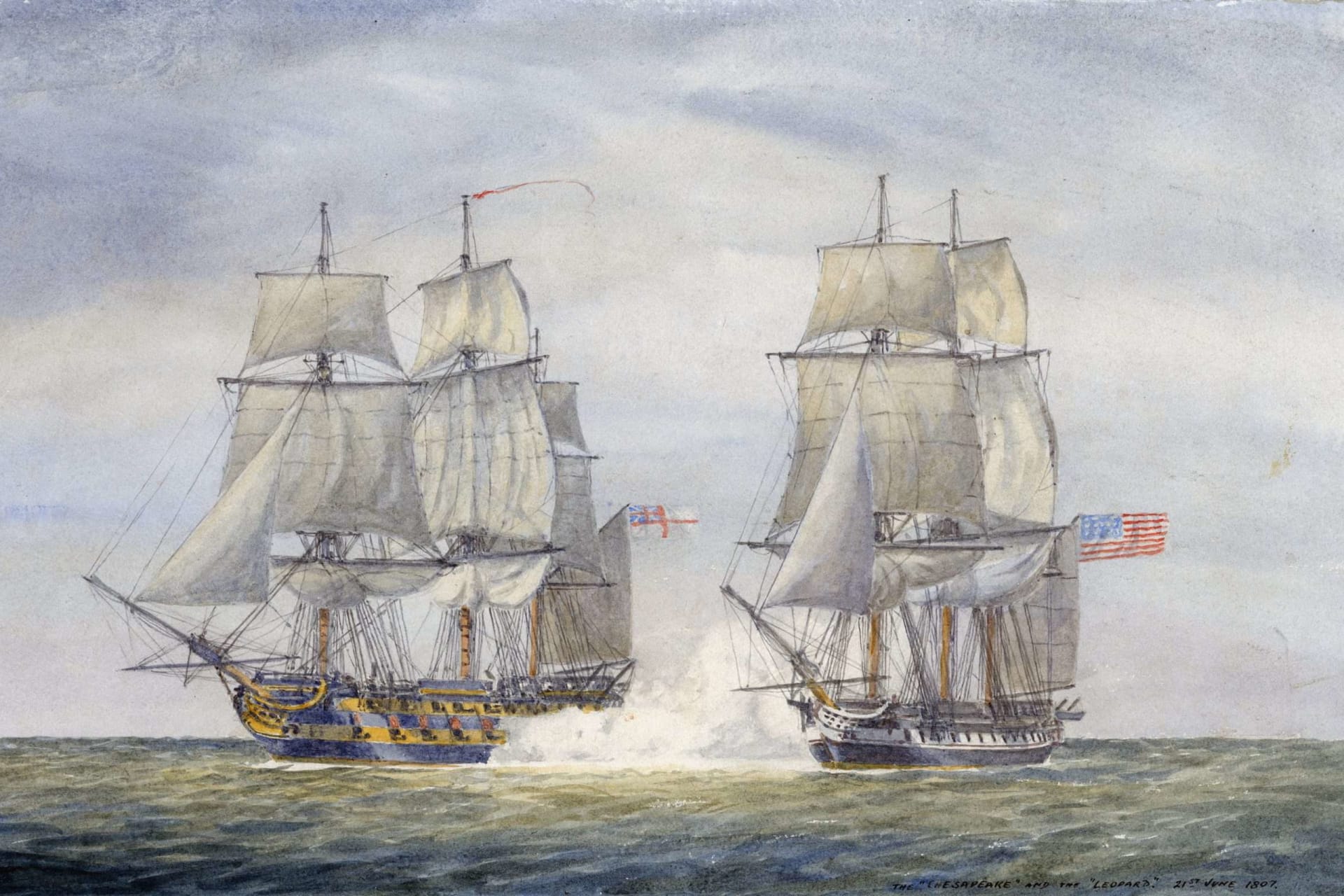
Off the coast of Virginia, the British HMS Leopard fired upon and boarded the USS Chesapeake, an American warship. Three Americans were killed in the assault, eighteen were injured, and several others were impressed into British naval service. News of the incident has brought already simmering tensions over British shipping practices to a boil. As a result, many Americans are openly calling for war with the United Kingdom. U.S. forces have begun to plan the defense of critical positions should the incident prove to be the first clash of a larger war. President Jefferson has called a cabinet meeting to decide how to respond to this latest in a series of British affronts. As they deliberate, advisors will need to consider how to protect U.S. interests and assert U.S. sovereignty. Meanwhile, cabinet members must also take into account the risks of entering a war with a stronger power.
Cabinet members should consider any combination of the following policy options:
- Economic measures, including increased or an outright on trade with European countries. Ceasing trade could coerce the United Kingdom into allowing unrestricted trade between the United States and Europe. This policy option could halt the impressment of Americans and keep American vessels out of harm’s way. However, such an embargo is not guaranteed to work. Moreover, tariffs or embargoes would deepen economic hardship in the United States before forcing British action.
- Diplomatic measures, including negotiations with the British pursuing either an apology or reparations for the incident. Ideally, this policy option would include a broader agreement easing British restrictions on trade and abolishing impressment. This option could protect U.S. trade, assert U.S. sovereignty, and avert a war. Without any leverage, however, a favorable agreement would be unlikely given previous British indifference toward American sovereignty. Negotiations could also take time, during which British practices could continue and public outrage could grow over the lack of a forceful response.
- Military action, including building up U.S. military and naval forces to defend against further attacks or immediately declaring war against the United Kingdom. This option would most forcefully assert U.S. sovereignty but has the most risks. Even with the bulk of British forces occupied fighting France, the U.S. military is underprepared for a war with the United Kingdom. Swift military buildup would be costly.
Additional Resources
- Naval Anecdotes Relating to HMS Leopard Versus USS Chesapeake (June 24, 1807)Naval History and Heritage Command
- Message From Thomas Jefferson to the United States Congress regarding impressment of U.S. sailors (January 7, 1806)National Archives
- Norfolk Gazette and Publick Ledger account of the Chesapeake– Leopard incident (June 24, 1807)Library of Congress