Leslie H. Gelb Memorial Event: Common Sense and Strategy in Foreign Policy
Event date
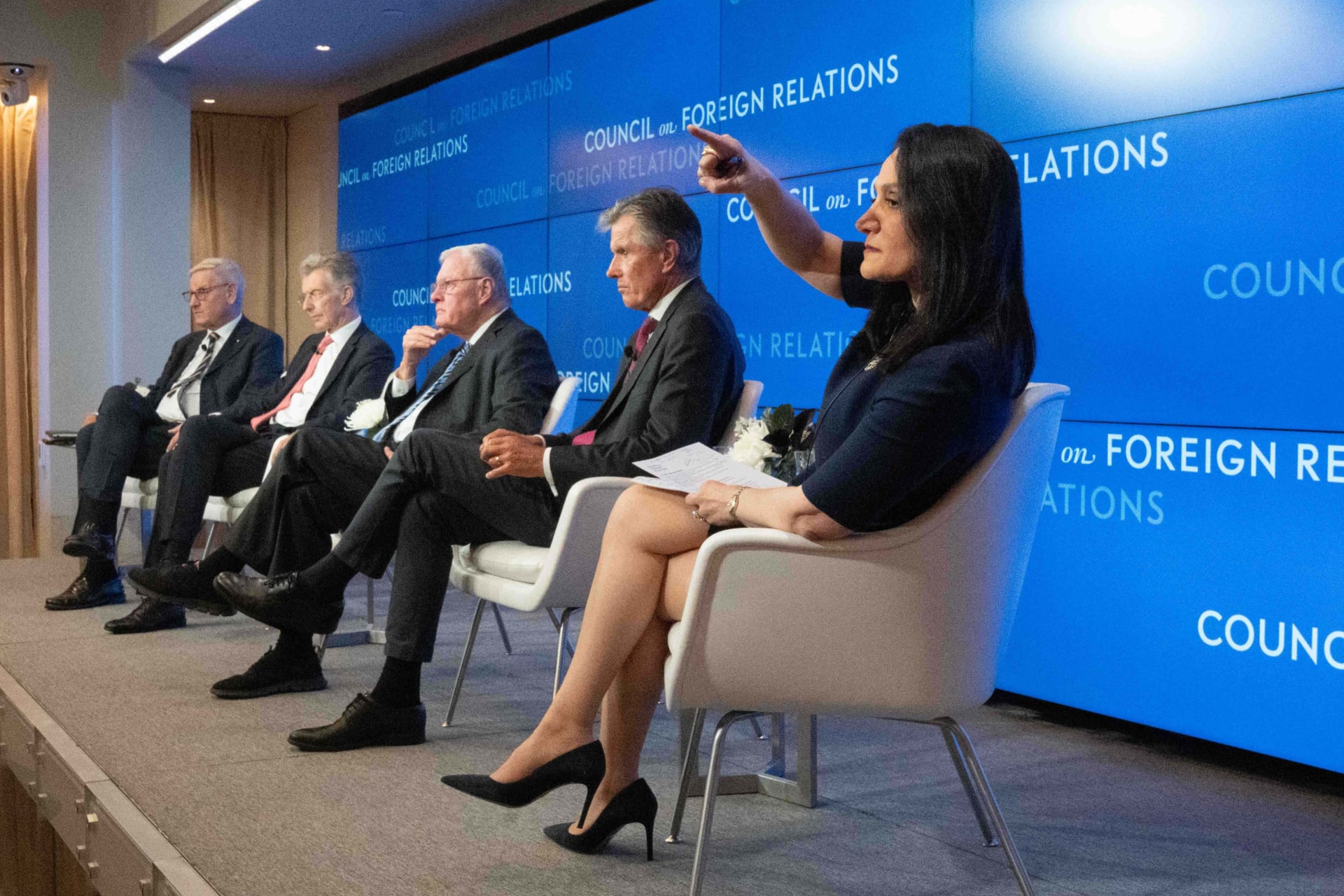
FROMAN: Well, good morning, everybody. Thank you for being here. I’m so pleased to welcome you to the Leslie H. Gelb Memorial Event, “War, Power, and Ethics: Reflection on American Engagement in the World—1776 to the Present,” with Timothy Snyder.
We’re delighted to have him here. We’re delighted to be able to do an event in Les’ honor. We’ve got a full house here in New York and we have over 400 people on Zoom.
This event is being done in honor of Les, who was CFR’s president from 1993 to 2003, and he was a dedicated member of the Council for forty-six years. I think many of us were brought into the Council or mentored by Les.
How many—just in the room, how many here sort of knew Les or were brought into the Council by Les?
Yeah, so a very significant presence. And I’d like to start by thanking the people who made this event possible, starting with the Gelb family.
Judy is on with us by Zoom, and we have Adam and Caroline here in the room. Thank you for being here.
Adam, as many of you know, has carried on the family tradition. Started a think tank about five years ago—more than five years? Five years ago, modeled on the Council, called the Council on Criminal Justice, and does fantastic work on that critically important subject. We’re honored to have them here as a permanent part of the CFR family.
I’d also like to thank Win Lord for helping put together today’s event. He and Bette Bao Lord together with Frank Wisner and Judy Cormier have been the driving force behind setting up this event. We lost Frank last year, but he—his many contributions to the Council are very much felt today.
Les closed his last book, Power Rules, with a lecture that he gave to West Point graduates, and he said the following, that restoring what is good about America, quote, “will require something that has not happened in a long time. The pragmatists, realists, and moderates will unite and fight for their America.” He wrote that more than fifteen years ago.
And he was also one of the most clearest thinkers about what democracy actually requires. In 2005, he told the American Prospect, “Elections and people on the street do not democracy make. Democracy,” he said, “is institutions and attitudes, free press, rule of law, the protection of minority rights, the confidence that losing an election doesn’t cost you everything. And those things,” he said, “take a long, long time to develop.”
That insight and what we can learn from the history of American democracy is very much at the center of today’s conversation, and this event allows us to bring together our longstanding program on democracy of which Tim Snyder is associated with CFR as a fellow, and our America at 250 program.
Tim is the inaugural Temerty chair in modern European history at the Munk School of Global Affairs and Public Policy at the University of Toronto, and I can’t think of a more appropriate legacy for Les than having Tim here to share his thoughts on this.
He will be in conversation with Anne-Marie Slaughter, president and CEO of New America. They’ll talk for about thirty minutes and then open it up to questions from all of you both here in the room and online. And as a reminder, today’s event is on the record.
And with that, let me turn it over to Anne-Marie and Tim. Please come on up. (Applause.)
SLAUGHTER: Mike, thank you.
I have to open just with—to express my pleasure to be able to do this in honor of Les, who was a mentor of mine. My first real activity with the Council was when Les asked me to chair the term membership committee when I was a professor at Harvard Law School back in the ’90s, and he was very determined that we have a really strong crop of young leaders, future Council members, and particularly—and Les was ahead of his time there—he wanted lots of women.
So I just want to salute Les Gelb, and he was a—yes. (Applause.)
So I can also say I spend way too much of my life on trains. I live in Princeton. I run New America; it’s in Washington. My husband warns people not to mention Amtrak in my presence rather than get a rant, and, really, you know, even New Jersey Transit, not my favorite.
But I would do just about anything to be in conversation with Tim Snyder right now.
SNYDER: (Laughs.) I was wondering where that was going.
SLAUGHTER: (Laughs.) Seriously, we are—what a moment in our two hundred and fiftieth year to be reflecting on who we are, where we have come from, and where we are going.
And I am a deep admirer of Tim’s academic work. He’s a true scholar of European history. His books Black Earth and Bloodlands are really staples of the historical curriculum, and he is the best of what it means to be a public intellectual, which is to take real knowledge and communicate it to a broad audience in a way that inspires action.
So it’s my honor to be here and, Tim, I’m going to kick off. When you and I were talking about this conversation, you framed a way of thinking about the United States that I found immediately persuasive, and so I’d like to just open by saying how do you think about us at this moment in our history?
SNYDER: OK. I’m going to answer that but, first, I just—I want to repeat, I was one of those term members in the term member program that Les Gelb founded, yeah, and that’s how I became a member of the Council on Foreign Relations was that program.
And I also want to mention that or just say that it was nice growing up in the America of the 1970s and ’80s to have figures like Leslie Gelb that one could look up to, and when we talk about the problems that America is having now there’s an element of that, right?
There’s an element of if you are young and you’re looking to an establishment, to whom exactly are you going to look up? And I realize that’s an odd thing to say in the Council on Foreign Relations and it’s nice that you’re all nodding along with me.
But there is that problem. A country that has a future is a country where younger people can look up to people who are not so young, and I think that’s a symptom of where we are now, which is another way of saying that it’s very important to remember people and I’m really glad that I can be part of this remembrance of Les Gelb.
So this exchange that we were having—and I’m really glad I’m able to talk to you, I’m really glad to be with you—was about how to frame this conversation. You have a slightly portentous title on the program, which—for which I’m also responsible.
But when I was communicating with Anne-Marie, I thought—the actual subject is superpower suicide. That’s where we actually are. We’re in a moment of superpower suicide, and I think—and I’ll just start with two basic reasons why I think that.
The first is that it’s something we’re doing to ourselves. I think there are structural factors that one can mention—changes in global wealth, changes in technology, and so on—but there is a—there’s a distinct sense for which I think we have to take responsibility in which we are doing this to ourselves.
We are choosing to be—putting the morals aside for a moment and we’ll come back to them, but we are choosing to be far less powerful than we could be.
We are choosing that, right, and that’s the element of choice in a suicide. And then there’s the substance of what we’re doing, which is that in domain after domain, long term, short term, ethical, strategic, we are cutting ourselves off.
We are cutting our own hamstrings, right? Achilles is cutting his own Achilles’ heel, and we’re doing it in education. We’re doing it in research. We’re doing it in the way we’re fighting war. We’re doing it in economics.
We’re doing it essentially every single place, and there’s a consistency to this which brings together all of the individual news stories about individual topics. And I think from there, you know, I’ll just pass it back to you so we can pursue some of those individual topics.
SLAUGHTER: So you can see why I thought superpower suicide was so compelling because it does pull together so many different elements of the papers we read or, in my case, curate carefully so I can get out of bed in the morning.
Talk a little bit more, though, about those different elements because I might say, yes, I certainly hear that in research, in education, in social mobility, which is not just this president that’s been happening for quite a long time.
But what about technology? Aren’t we actually increasing our power in technology?
SNYDER: So I’m going to—I want to—I’m going to start by reaffirming the premise a little bit. So, like, to be a superpower you have to be a power and to be a power you have to be a state, and I want to dwell on that for a moment.
The Council on Foreign Relations is based—you know, and Michael can jump up and correct me—but it’s based on the notion that there’s something in common between people in different political parties. There’s something in common between the government and the private sector. There’s something in common among citizens generally and it’s that something in common that I think is precisely what’s gone missing.
Like, that thing that we have in common is the American state or our vision of the American state, which has to be in some way neutral, in some way open, in some way accessible to everyone, and I think the fundamental problem is that.
You can’t be a superpower without being a power. You can’t be a power without being a state. And we’re not being run as a state. We’re being run by people who don’t see the United States of America as a state. They see it as a kind of, you know, money-making or prestige-making or something- making enterprise for a small group of people, many of whom are not Americans.
But even the ones who are Americans you can count their numbers on, you know, one hand, or maybe both hands and, you know, both feet. But it’s not very many of them, right?
And that’s not a state. We’re being run in a way which is not—we have state power. We have a lot of residual good stuff. But we’re not being run as a state and there’s no ideology of the American state present now.
What is the ideology of the American state right now? We have our own ideas. We might say democracy. We might say republic. We might say the Constitution. We might think about 250 years.
But if you follow—if you try to track the White House, in what sense are they talking about the United States of America? What is their ideology? What is their notion of the future?
I think there isn’t any, and that’s a bad sign. Or consider the elemental problem of statehood, which is succession. So how do you get from having one ruler to the next ruler? This is a thing which has been, I mean—and it’s very—I really appreciate when Anne-Marie mentions I’m a scholar because, like, that’s what I am. I’m a historian and, like, anything I have to offer comes from that.
But for thousands of years, since we’ve had a written record, the problem of succession has bedeviled states. I have power. How do we make it—how do we move on from my having power to you having power so that the whole institution still survives?
It’s a tricky problem, right? Father to son or mother to daughter is complicated. Elections are complicated. It’s all complicated.
This was the advantage that we thought we had during the Cold War over the Chinese and the Soviets. We had the succession problem solved. We had democracy. We had elections, right?
That is now being put in question, and we have a president who’s talking about how he has the right to stay in power indefinitely because, in his own mind or he would like you to believe that in his own mind, he believes that he was denied another presidential term, right?
And so that is no—and putting aside the merits of that, which are zero, that is a way of not having a succession mechanism. I mean—I mean, democracy is wonderful for many reasons, ethically among them, but it’s fundamentally a succession mechanism.
It’s a way to make sure that the actual state survives even as people come and go, and that’s being put in question.
And then I can’t help but mention one more fundamental thing, which is historical, and that is allies.
SLAUGHTER: Yeah.
SNYDER: OK. So the—like, the Roman Empire changed its allies all the time but it did it for reasons. They were cynical and calculating, and they stabbed their allies in the back and they switched them, but for reasons.
There is no history of great powers or superpowers who change their allies because they’re momentarily annoyed, right. We are pioneers in that.
I mean, somebody’s going to correct me because when you’re a historian the first thing they teach you in history school is never say that it never happened before, right? (Laughter.) Never say it’s the first time because there’s always a colleague in the back of the room who stands up, right?
But as far as I know, there are not important cases of great powers changing their allies just because they felt like it on a given day, right, and we are doing that, and that for me is a sign of the crumbling of our statehood, because you can only change your allies from day to day or mock your long-term allies if you’re not thinking in terms of the state, right?
And so that’s another sign for me. So as far as tech goes, I’m going to just say no because, look, no, I think we need—because, I mean, their—qualifications are what I’m going to say. But first of all, is the—is the rise of social media consistent with American power? Has that made us more powerful? I would say the answer is no. It’s made us less intelligent, shorter attention spans. It’s hurt education in general.
Is the rise of AI helping American power in some measurable sense? Hard for me to see it thus far. I’m sure there’s a domain where one has to compete, but I don’t see that the people who are running it are concerned with American power or the American state for that matter.
And on the battlefield, which is where we would like to boast, we can’t. The way we’re fighting the war in Iran is archaic. The moment you scramble an F-35 to shoot down a drone, you are in the wrong century. (Laughter.)
We have been fighting this war on a twentieth century model, which has been radically outdated by the experience of the Russo-Ukrainian war to which we have chosen not to pay any attention.
So yes, we do have greater capacity to marshal technology on the battlefield but we have chosen not to follow the way that tech on the battlefield is being used. That’s one of the reasons we’re losing in Iran.
So, I mean, obviously there are qualifications to what I’m saying, but I don’t think that tech in itself is riding to the rescue for us.
SLAUGHTER: OK. So remember, those of you who are online, everybody in the room, we’re going to do this half and half. You get half the time to ask questions, because I can almost hear various challenges coming back toward the stage and it’ll be a lively discussion.
I want to take it in a slightly different direction and ask whether—even accepting everything you said and accepting that we are in a—in terms of the traditional bases of power declining—we’re at a weak moment—isn’t this cyclical?
So I wrote a book in 2008 called The Idea That Is America, and at that point—and I’d really started it in the midst of the Iraq war—I wrote about, you know, we were—our allies were very upset with us. We were—we were allowing the president to imprison enemy combatants wherever, and I sort of said, look, in large parts of the world—I ended by just saying the image of America is no longer the Statue of Liberty but the image of a hooded figure standing on a box with wires trailing from him, which was the iconic image of Abu Ghraib.
Now, that was 2008 when it was published and I thought all of that was true, and I’m a Democrat so I—but I don’t actually think a lot of that was Democrat or Republican. It was a real shift in values. You could find other periods in our history where one party or the other is certainly going to say we are in total decline.
But I would have said in 2010 we got a huge Obama bounce. You know, all of that was or almost all of that was repaired. So why isn’t this just another round of periods where the United States really finds itself in very severe straits in the views of many of its own people and the rest of the world?
SNYDER: Yeah. I mean, it’s funny that you’d use the word straits. (Laughter.)
SLAUGHTER: No pun intended, but subconscious.
SNYDER: No, because—I mean, I’m going to answer that question but, like, let’s consider the specific military context in which we find ourselves. And, again, there will be discussion, you know, so I don’t—I’m not going to defend all of this. I’m just going to state it for now.
But we’re in a war we shouldn’t be in and we’re losing it, and the justifications we’re giving for it are criminal, all at the same time, right? That’s a—those are signals that you may be in decline.
But I’m going to pause there because I agree with part of at least some of the premises here. I emphasize at the beginning the voluntary character or the voluntaristic character of this for a reason. We are choosing to do this and when I say we—I mean, everybody in the room I’m sure is going to say, well, not me.
But I think we all have a part in it. There’s—I think nobody in this room is totally innocent of doing something that led us to where we are and, you know, our country voted for this and we’ve got it, but we’re choosing it. That’s what I’m trying to say. It’s a choice, and that’s—hence the suicide metaphor.
That doesn’t mean that all the fundamentals are wrong. Some of the fundamentals are really good. Going back to the tech question, I think we’re making bad choices with technology. Like, energy is another way that you would track the rise of superpowers.
How did Great Britain become a superpower? By way of hydrocarbons, the industrial revolution. That technology is now out to pasture. You can’t build yourself as a superpower on the basis of that technology. You have to be onto something else.
We are choosing not—we are choosing not to move onto that something else. We could do it, though. We have the technological basis for it. We could shift to renewable energy pretty easily. We’re choosing not to. The fundamentals are OK.
The universities are another example. Like, our universities, their fundamentals are still far better than any university system in the world or the history of the world.
But we’re choosing to attack them. We’re choosing to defund them. We’re choosing to prevent students from protesting, which is also a terrible choice. We’re making a lot of bad choices.
And so, you know, one could multiply the examples where the fundamentals are actually OK, but if these choices are sustained the fundamentals will eventually suffer, which raises the question of how do you come back.
Because as I’m sure you’d agree, there’s no automatic bounce back message—method, right? The Founders are not going to come—you know, they’re not going to rise from—just because it’s 250 years.
Like, as a historian, one gets very annoyed with these round numbers, right, because it’s, like, OK, every fifty years the rest of you are going to think about the past, right. And so, like, everybody wakes up before an anniversary and says, all right, time to hang some banners. And we’re, like, OK, but we’ve been working on this the whole time. Maybe you can listen to us.
And the funny thing about anniversaries is that nobody actually asks the historians. I mean, especially this particular anniversary in this particular country, but nobody’s asking the historians about what to say about the past.
OK, rant is over. (Laughter.)
But the question—you have to come back on the basis of something, right, and so I agree with you that we came back in some way in the—at the end of the first decade, the beginning of the second decade of the twenty-first century, on the basis of what are we going to come back this time. Because I think back then there was something that wasn’t in play, which was the centrality of what I’m calling the American state or the American republic, if you prefer, and I think that is in play now.
I think our foreign policy decisions and our domestic policy decisions have a lot more to do with personal considerations and with considerations among an international oligarchy.
And just to mention the Hungarian election, you would—you know, why is an election in a faraway country of 10 million people, right, why is that so important?
It’s important because oligarchy is international; it’s not national. MAGA is not a national movement, it’s an international movement. It’s made up of certain international nodes. Budapest played a very significant role between Moscow and Washington.
Now that node has been knocked out as a result of a democratic election and a lot of organizing before that. But I just mention that because why did J.D. Vance go to Budapest? Not because he’s an American, right, but because he’s part of an international network.
Why did Trump and Trump’s family endorse Orbán? Not because they’re Americans or concerned about the interests of the United States, but because they’re part of an international network.
I think this is in play in a way that it wasn’t in play back in the Obama period. But I want to mention one more thing—we were talking about this earlier.
You know, Anne-Marie’s reaction to Abu Ghraib is an example of the kind of thing you need to come around. It’s not the only thing, but if you don’t have a moment of ethical reflection you can’t do it, right?
So, for example, when the president of the United States says we are going to destroy an entire civilization, if that doesn’t trigger some kind of ethical response—whether or not you can do anything about it personally, but if that doesn’t—if you don’t have that ethical response to these moments, these obvious signs that things are going wrong, then it’s hard to have the practical response.
And I think—I mean, I don’t want to sound too pessimistic because there are a lot of wonderful people doing a lot of wonderful things, including New America. A lot of people are doing wonderful things.
But I think it’s in question whether we are triggered the right way by these kinds of ethical prompts that the president sees fit to give us.
SLAUGHTER: So that is the perfect segue to what will probably be my last question and, indeed, in the title that you chose it’s “War, Power and Ethics,” and I do want to then ask about that ethical response and, more broadly, because this is our two hundred and fiftieth year and I was eighteen during the bicentennial and I was sitting in Charlottesville, Virginia, at the University of Virginia in a bicentennial booth.
That doesn’t get any more Jeffersonian and red, white, and blue than that. I mean, it’s like Mr. Jefferson, which is what we call him in Charlottesville, is just going to march right down.
But, and this was an area Les Gelb and I debated because I am not a realist. I think I’m a pragmatist, but I deeply believe in the role of values in our domestic politics and our international politics.
I believe that we have those values. We constantly fall short, but that we are a nation who are free to and encouraged to point out those failings and try to do better. And those values—and actually, I mean, Les certainly recognized them, as Mike said: the rule of law, the understanding that losing an election was not everything—but even more deeply, I would have said liberty, and equality, and justice, and the Framers’ understanding of democracy as ruled by the consent of the governed—we could debate different forms of democracy. I would have added, and have, tolerance, humility and faith. I think those are part of our national values.
How—if we stand on those values in our two hundred and fiftieth year, recognizing how far short we have fallen and use that as the backbone less of the polarization of one party versus another and more, this is who we are and this is who we have to be, is that enough?
I mean, looking at Hungary, and that was not about values so much—it was about corruption, which is a value, but it wasn’t about the broader liberal pantheon of values. Is that something we can stand on?
SNYDER: All right. I’m going to start by—
SLAUGHTER: That wasn’t a question. That was a rant and then a question.
SNYDER: No, no, I got it. (Laughter.) I got it. I got it. I removed my glove. I caught it.
The—I want to start with Hungary because in the—and I think the Hungarian precedent is actually incredibly important. It’s an election of what the political scientists like Lucan Way and Steve Levitsky rightly call competitive authoritarianism where you have an election. It’s not fair. You have to run uphill.
You can run uphill, but only if you train to run uphill. You have to know that there’s a hill and you have to practice.
So Magyar in Hungary, Orbán’s opponent, he was out there for two years in the provinces. Two years. Two years of organizational work, two years of scandals covered by independent media, and one of the things they managed to do was to bring together the questions of what the Democrats call affordability—not just the Democrats, what Americans call affordability and what Americans call democracy.
And I think each of those issues is a loser on its own, honestly. I think—yeah, I think you can lose on both of them and you will, and you have. But affordability doesn’t mean anything to people. Like, yeah, they’re bothered that prices are up but, like, why does my vote matter for prices?
And, you know, and then democracy. Like, I care a lot about it. I’ve spent the last—a lot of the last decade, you know, carrying pamphlets in a backpack, talking to people in churches and synagogues and rallies about democracy.
But politically, people have to understand that democracy is about how they live their lives, and that—the connection that was made in Hungary was between what we call affordability and what we call democracy, which are the same thing because they’re connected by abuse of power.
When you have oligarchy, when you have people denying the Constitution and the rule of law, when you have the collection of wealth in few hands, that crushes social mobility. It makes people hard to live their own lives. And that’s a connection which has to be made.
I mean, it’s not just that it’s true and correct, but also politically it’s effective. So if the Democrats are just going to run on affordability, they’ll probably win, but they’ll be carried over by, like, a barrel over Niagara Falls.
They’re not going to deserve to win. They’re not going to just run on democracy because they know they don’t—it’s something that—it’s real but they don’t know how to campaign on it.
The way that they won, both in Hungary in ’26 and Poland in ’23, which is another important comparand, was by connecting corruption and daily life, was by explaining how if the country was more democratic, then your life would make more sense, and when you try to explain that to people, they understand it.
So I just wanted to note that because one of the things I think where we are in the U.S. is, like, we’ve got a bunch of strategists who are, like, yeah, life’s hard, oil prices are up, let’s just go with affordability. And then you have a bunch of activists who say, but wait, what about rights and freedom and democracy?
And, like, you have to bring those two things together if you actually want to win. OK. End of political strategy session.
On values, one thing that’s really important about values is that if you go along too far on the pragmatist or the realist train and you say values don’t matter at all, you find that it’s impossible to critique everyday reality.
What you will do is you’ll just say, well, whatever he did it’s not surprising because after all, that’s just life, right? And so by not bringing values to the center of your own conversation, you are enabling and you are normalizing yourself, right, because if life is just whatever happens and there aren’t any value judgments—and by the way, there aren’t any values as both a right-wing and a left-wing position.
I mean, as I see it, in the history of this it was a great gift of the left to the right. But however that turned out to be historically, to say that values don’t matter in politics is de facto to endorse whatever the latest outrage is because you don’t have any language to criticize it. You’ve gotten out of the habit of using the words that you would need, like “evil.”
Sounds weird, right? When I say it, you giggle. Mmm hmm. But what if some things actually are evil? What if it actually is wrong to advocate the destruction of a whole civilization, right? What if there’s right and wrong? Wouldn’t that be funny, right?
But if we—as soon as you abnegate that, then you have—you’ve given the terrain over to people who every day do something slightly worse. So values are very important for that reason too, not just to imagine a future but also to critique everyday politics. You can’t do it without it.
OK. Second thing I want to say about this is that values are connected to social mobility and the future in a very practical way. We can want Americans to care about values, but if we do not give them social mobility we cannot expect them to do so.
Those things go in train. If we want people to believe in freedom, which I believe is the value of values and the central American value, we have to give them opportunity. We can’t just say we want you to believe in opportunity anyway even though it doesn’t exist.
If people don’t—and they don’t—if people don’t see a future for themselves and their families, they tend not to believe that freedom matters, and so those two things have to go in train. And what we’ve done for the last fifty years or so is to shut down people’s social mobility and as we’ve done so we’ve insisted with an ever more hysterical strains that people have to believe in freedom.
That’s not how it works. It can’t work that way. So the final thought is—I mean, I fundamentally agree with you. I think that freedom is the value of values. I think freedom is the most important value because it’s the condition in which we can affirm all the other things that we care about.
I think it’s more important than anything else. I think it’s the only value that we can agree on in America. And so, yes, I think we have to aim towards freedom. But what we have to worry about as Americans is that we tend to treat freedom declaratively.
Like, you should believe in it and you should believe it and you should believe in it. In fact, freedom involves creating practical conditions for people. It’s hard to believe in freedom if you don’t have health care. It’s hard to believe in freedom if you don’t have vacation. It’s hard to believe in freedom if you don’t have good roads, if you can’t get anywhere, right?
There are basic conditions for freedom which are out there in the three dimensions of the world, and it’s impossible to get to freedom if you don’t talk about the other values, because freedom is fundamentally—it’s like the tent under which all the other values can thrive.
But if you don’t talk about any other values like dignity and compassion and honesty, and so on, if you remove those from the political conversation, then there’s nothing in the freedom tent, right? Just air.
SLAUGHTER: Thank you.
It’s just after 12:00 so I’m going to turn it over to everyone else. I want to invite everyone in the room and everyone watching online to join the conversation with questions. I’m going to alternate between people in the room and people online, assuming we have questions online.
I need to remind you that this meeting is on the record, so on the record, and we will take—I’m going to take our first question here in New York.
Wendy?
Q: Hi, Wendy Luers from the Foundation for a Civil Society.
Tim, do you think that the lessons that have been learned in Central and Eastern Europe so far can be used in the, hopefully, post-authoritarian and post-communist situations in Venezuela and Cuba?
SNYDER: OK. Great question.
I think that’s a wonderful question because it reminds us the extent to which or the way in which liberation often looks alike even if regimes look different.
So bracketing what I think is going to happen in Venezuela and Cuba, I’m going to agree with the premise, which is that in order to get democracy there has to be a large social movement and prior organization.
So I think one of the great mistakes that we made or a lot of Americans made, a lot of folks in the West made, after 1989 was to think that freedom, democracy, is essentially an absence. You get rid of the bad stuff, get rid of the bad guys, get rid of the bad regime, get rid of the bad economic planning, and then you’ll get the good stuff. You’ll automatically get the capitalism and with the capitalism will come the democracy.
That has proven simply not to be true. There’s no reason why we ever should have thought it, but we did think it and it’s proven not to be true. What we know about democracy is that when we get to it, it’s the result of a lot of prior effort which may not have been—which we might make invisible or for whatever reason we haven’t seen.
So an example of 1989 to which you’re referring, the most important precedent was the Polish solidarity movement, right? The idea of civil society in general, but the Polish solidarity movement in particular, which was a labor union, first of all. It’s hard to do this without labor unions.
It was a labor union which involved the Catholic Church, which involved a lot of secular intellectuals, and which ended up having, you know, nearly 50 percent of the adult population being members. So solidarity, that prior experience of cooperation and protest, even though it failed in the short run, was the most important enabling condition for democracy in Poland and the region afterwards.
And the more recent elections in Hungary and Poland, which are comeback elections, like coming back from authoritarianism, they basically tell the same story. In both cases, you have a politician, Tusk in Poland or Magyar in Hungary, who was willing to campaign in what we would now see to be a very unorthodox way—going to the people, spending a lot of time outside of the cities, trying to win in the real world and not just in social media.
You see what remained of the independent press getting across scandals, which politicians were able to communicate. Interestingly, in Hungary it was a scandal involving sex abuse of minors—I’m just going to note that—but one of many.
But what remained of the free press able to help the opposition translate scandal into a larger lesson of how corruption hurts everybody, and you have—and you have protest and local organization, right?
So for any example—I mean, whether it’s Cuba, whether it’s Venezuela, for any example, what you have to have is that prior mobilization of some kind of civil society preceding the normal business of having parties and elections. So that’s as close as I can come.
SLAUGHTER: I’ll just say, I also remember in the early 1990s after the fall and the war I was teaching at the University of Chicago Law School and there were fierce debates between our constitutional lawyers and Polish constitutional lawyers about civil and political rights and economic and social and cultural rights.
And your point about what freedom means, from the point of view of the Poles and, I think, rightly, it can’t just be civil and political.
But I’m going to now turn—we have a question from the folks watching online.
OPERATOR: We will take our next question from Sewell Chan.
Q: Hi, Tim. Sewell Chan, journalist, here.
I’m curious about the role of international organizations and international law. You know, I was—I’ve really been struck, you know, Anne-Marie’s—you know, even—I never thought that so quickly we would, you know, not talk about international law in the context of intervening in or bombing other countries.
And, you know, my general view is that probably the U.N. is only as strong as its most important member states. But what is the role of international organizations, the whole system we’ve set up, you know, in the twentieth century in both mediating conflicts but also, you know, providing a kind of set of international norms that, hopefully, transcend, you know—you know, sovereignty itself.
SNYDER: OK, thank you. Thank you, Sewell. It’s nice to hear from you.
I’ve got three answers to that. I’m going to start on the power politics realist side. So one of the important parts of Sewell’s question was we set up, and I think that gets overlooked a lot in the U.S. context.
Let me start—let me try to give you—I’ll give you an example from Davos.
So if you go to Davos and you listen to people who are not Americans, one of the things they’ll say is, it’s a little annoying the way that you guys come over here and complain constantly about how the world is against you when, like, you set up everything, right? (Laughter.)
And they have a point, right? So this—the rhetoric, especially in this administration, I mean, it’s a common American thing but and especially in this administration of claiming that, like, it’s stacked against us and it’s all unfair and so on.
I mean, come on. Like, we built the casino. You know, like, we dealt the hand. We decided how many cards were in the deck. We decided what those cards were going to be called. Like, this is our world order, and this whole effort to say, like, oh, it’s somebody else’s world order and, like, everybody’s cheating or it’s not fair, I mean, it’s petty of us but it’s also just historically wrong.
And this is a realist point because the United States created or co-created this set of institutions in order to be powerful and it worked. OK. So now we have this odd discussion, which I noticed was featured in Foreign Affairs about, like, choosing between a world of norms which holds us back and it’s annoying or, you know, a world in which nation states go it alone. No, no, no.
When you’re a great—so this is not me exactly talking. I’m just trying to explain, like, the realist side of this question. When you’re a great power or the great power, you make the rules and we, largely, made these rules, and by breaking the rules we’re not just doing—I’m going to get to the nice normative part of the question, but by breaking the rules and upsetting the order, we are losing power.
We are hugely losing power. We’re bleeding power every day because we chose the game and then we chose not to play it, right?
So we built—like, generations of American legal, political, economic effort went into building the system that put America at the center of the world order and this is why—this is—hence the suicide metaphor, and now we’re choosing to break it on the logic that somehow it favors other people, right, which is simply not true.
So this debate between, like, should we be a nation state that just pursues its own interests or should we follow these annoying rules, that’s the wrong way to set up the debate. We made the rules and they’re much more annoying for other people, and there’s a reason for that and that’s that we made them, right?
So that’s the realist answer, like, that before we even get to, like, what rules you should do to constrain us and stuff, I just want to make this point because I think this entire—like, the whole way this thing has been set up between, like, rules which are annoying or, like, a power that could break through those rules.
No. Like, if you’re on the highway, you know, you can choose to break through the rules of the highway if you want to, right. But you’re not going to end up more powerful. You’re going to end up on the side of the road dead, right?
And, like, you made the rules on the highway for a reason, so you get from point A to point B. So, like, rules can make you more, not less, powerful, especially if you’re the one who made them and our amnesia about all of this I think really leads us towards weird debates.
OK. The second point is about process, and this is not quite so cynical as this point but it’s not quite normative yet. One of the reasons why international law is a good thing is that like congressional approval for war powers, it puts a step in the process where you think about what you’re going to do before you start a war.
So law has a pragmatic purpose. Should I do this? Well, I might be punished or some people along with me might be punished, and maybe there’s a reason why I might be punished. Let me pause and think about that reason before I go ahead and do things.
And so when you just say—like, when we start from the position international law doesn’t apply to us, one of the things we’re doing to ourselves and, again, it’s something we’re choosing to do ourselves, is that we’re moving a step in a process which is helpful. It is helpful to ask is this a war of aggression, which it is, incidentally.
It is helpful to ask is this rhetoric genocidal, which it has been, not just because of the moral thing but because it’s a part of a process where you think, all right, well, when we started moving into a post-imperial world in—after the Second World War and we wrote up a convention on genocide, what were we thinking then?
Like, why did we do that? And maybe if we recall why we were doing that, it would cast some light on our own motives now and affect our own decision making.
OK. So now on to this part. I think that—you know, these two things, like, that you need a process and that, like, if you’re a great power one of the things you do is that you export rules rather than importing them. If you keep these two things in mind, then the arguments against the norms and the ethics, at least if you’re the United States, become a lot weaker.
Because even if you’re some kind of realist—even if you’re a realist you think, well, the ethics actually might help us. Or even if you’re a proceduralist, an institutionalist, you can also think, well, the ethics probably would help us.
And let’s face it, if we did have a review we would have made different decisions, but we didn’t have a review. I mean, I think there’s probably nobody—OK, correct me, I’ll wait for the person who thinks the way that we got into war in Iran without any kind of review, just sort of whimsically, that that was fine and we should do it again, right? That that was a great precedent, and hey, let’s do it again that way.
So, like, if the international law is one way of getting procedure into your decision making, that’s a good thing for you as you, even before you get into these issues, of what the right thing to do in the world is, and here I agree—I mean, at least I think I agree—that, yeah, it’s true that, you know, the power of international judicial institutions depends upon whether the U.S. funds them and joins them and so on.
But funding them and joining them is part of moving into a world where we would not only—it goes back to the renewal question. I think this is one of—like, one of the ways—one of the things we would have to do to renew ourselves is to say we’re going to go—we are going to take a step past a world where we’re making momentary wars that are self-destructive in many levels and one of the ways to get past this is to affirm actually international law.
It’s not—it serves us, it’s part of a process, but also it could get us into being a better kind of a country. So I’ll leave it at that.
SLAUGHTER: I think we have to return to a basic morality in multiple—both domestically and globally.
SNYDER: Yeah. Yeah.
SLAUGHTER: Jim?
Q: Hi. James Traub.
The nightmare that you’ve been describing is a very Donald Trump specific nightmare. But like the other illiberal populace who you’ve talked about, he was elected more or less fairly and, in his case, twice. So what do you think were the underlying failures or underlying problems that caused people to freely choose this guy whose nature they knew very well?
SNYDER: I’m going to—I’m going to question the premise only a tiny bit because I accept the thrust of what you’re saying. But did we really know Donald Trump? OK.
So is the United States at the moment in the third decade of the twenty-first century a truly pluralistic media environment in which the average consumer of news has no trouble finding out the basic facts of the world around them?
I think the answer to that is no and I think that has something to do with the answer to your question, right? So the premise that, like, we all knew what we were doing I think relates a little bit to the answer because I actually think that’s not true.
I mean, we—you know, we might think that we do. But in order to have a democracy, there’s certain prerequisites that I’ve been trying to stress and one of them is that people have access to basic facts, and having access to basic facts means having local journalism whether that’s profitable or not.
It means having—it means having public broadcasting whether that’s profitable or not. It means having, you know, science. But my point is that we—I think the prior question before we get to the question about the people is have we as a country created an infrastructure in which it’s relatively frictionless for people to answer what might seem to be simple questions.
And I think the answer to that is no. I think—and I think we’re worse at it than we were twenty years ago, and I think social media has been a problem. It’s related to the problem of the—of news deserts, news desertification.
As I’m sure many of you know that a clear majority of counties in the United States now have no reporters reporting on anything and that’s—for me, that’s where the problem starts because, like, we’re—you know, we’re in New York and we could be in D.C. or Philadelphia or Boston or whatever and we think we’re well served. There are newspapers. There are reporters and stuff.
But that’s exceptional. It’s not the norm anymore. So I want to quibble with the premise a little bit. But, I mean, in a way, it only—like, it affirms the power of your question. What has changed or what is it about us that makes it possible?
And I think the fact that we don’t—that we have basically a monopolistic media circus instead of—sorry, but instead of, like, basic fact-finding journalism at a national level, and that’s another reason why, you know—I mean, Les Gelb was, among other things, a journalist that one could read every day on foreign assignments.
And although local journalism is my personal hobby horse, we also don’t have people reporting from abroad anymore. The numbers—I mean, in 1989, and going back to Wendy’s question about, like, the big turn, in 1988 and 1989, if you were growing up in that America, man, I mean, you could read rival accounts of what was happening in Moscow from the—from Chicago Tribune reporters, Boston Globe reporters, New York reporters, Philadelphia reporters, L.A. Times reporters.
Every day you could get multiple accounts of the same event and that was marvelous, and we miss that as a country. We have much less news and it’s repeated and it’s prismed out and it’s filtered and it’s spun and it’s AI’d. So we get an impression that we’re having a bunch of news sources. But physical human beings covering the stuff that matters, right?
How clear is it, for example—I’m going off the local news now, but how clear is it, for example, that Ukraine is crushing Russia in the war right now? Why is that not clear, right? Which they are.
Why is that? And it will dawn. In six weeks everybody’s going to know this. You’re going to have a meeting in six weeks and that is—but the reason that we don’t know it—I mean, there are many reasons. We have imperial bias and so on. We think big powers win wars, which they generally don’t.
But one of the reasons is we just don’t have the personnel covering the Ukraine war. It’s the biggest conflict since 1945. Ukrainians have pioneered. They’ve just won, like, the first all-robot engagement in the history of warfare. I’m not saying that’s a great thing, you know, in ethical terms, but it happens.
You know, how was that covered in the U.S. press? Not at all, right? They’ve basically perfected a system in which they can hold off human assaults without using very many humans on their side. Kind of a breakthrough. Not covered, right?
The Russians for the last three months have lost more troops than they were able to recruit for the first time in the war. How’s that been covered?
You know, I mean, within the boundaries of the Council I realize these things have probably been made available. Michael nods yes. OK, I’m sure it’s true. (Laughter.)
But there’s a larger problem, which is that Americans—like, the average American you’re talking about is more and more separated from the world and even more and more separated from events immediately around them, which makes them more vulnerable to what Wendy was calling populism.
You’re more vulnerable to appeals to emotion. Like, we don’t want people to be vulnerable to populism. We want them to be reasonable, right?
But it’s—when we cut them off from fact-finding around them and around the world, we make it harder for them to be reasonable and that’s a big problem. And another underlying problem, which I’ve already mentioned which I’ll stress, is wealth inequality.
It is really—so the standard story in America is it doesn’t matter if a lot of people are rich and a bunch of people are poor, because let’s just take an average and, like, if we take an average everything’s OK.
OK. But let’s say that Anne-Marie and I have, you know, a billion dollars and all of you have nothing, and we take an average. No, that’s actually—sorry, this is New York. I need a bigger number. (Laughter.)
So let’s say that Anne-Marie and I have—
SLAUGHTER: A trillion, let’s say.
SNYDER: No, come on. Let’s say that we each have $50 billion and you have nothing, and we take an average. So let’s take an average of this room. Take an average. Everybody’s doing fine, right?
But in everyday practice, Anne-Marie and I dominate you because we have the money, and that’s the United States of America. You can’t take an average. You can’t take an average and we do it all the time.
The truth is that when people get past—you know, when there are too few people having too much money, it means that there isn’t social mobility and when there isn’t social mobility people look for shortcuts. And what Wendy was calling populism and what you’re calling the Trump phenomenon is a shortcut, right?
Trump is saying, yes, the game is rigged. Yes, it’s all a casino. But I built the casino. OK, I got to bracket the fact that this is a man who actually lost money on casinos. But, like, I built the casino. I can show you how it works. I know the dealer. Like, I can show you how you can get around all the rules.
That appeal works when social mobility craters, and so I think that’s part of the explanation. There are other things having to do with U.S. history and racism as well, which eventually we’ll have to address and get over.
But, I mean, those are some of the things that I see.
SLAUGHTER: OK. So we have one more question from online, and then Mike Froman gets the last question. I—(laughs)—know whom to respond to.
So go ahead.
OPERATOR: We’ll take our next question from Krishen Sud.
Q: Hi. Krishen Sud. Thank you for taking my question.
Look, I agree with a lot of what you’ve said, but I just want to challenge a couple of things as a follow-up to the last question.
So if you look at, you know, the last twenty years of our country, my humble opinion is that, you know, we’ve lacked leadership. So I will ask two questions to—not one, two examples to follow up.
One, did you, when Barack Obama interfered with the Brexit election and said we will not do a trade deal with Britain if they leave the EU, did you consider that interference in the election or not, or because you felt that that was good for the globe that, you know, it was OK?
And then the second question is when, let’s just say, Biden removed troops from Afghanistan, which cost 25 (million), 30 million people their freedom, did you think that that was something that should not have been done?
SNYDER: So I’m going to—I mean, I think we have to kind of start from a broader level. What is—I mean, first of all, what is leadership? I think your question may connect to the previous question at a deeper level.
In what conditions can you expect leadership? In what conditions can you expect leaders to arise? And I think this is a deep problem, right? It’s a problem on the Democratic side. I notice all the time when I’m talking to Democrats and they say, well, who’s going to run for president in ’28?
Like, you know what? That’s not the issue for you guys right now. The person who’s going to run for president in ’28 is the person who’s going to prove themselves in the crisis through which we’re passing now. And this whole notion that, like, somebody’s going to ride to the rescue, and it’s going to be a familiar name, and it’s going to be somebody—you know, that’s not how leadership works.
And so I’m going to get to the specifics that you talked about but I want to first say that a little bit like with having citizens voting reasonably, if you want to have leaders and leadership, think about the conditions in which that arises rather than just saying, well, we’re going to—we had a bad leader, but the tide can automatically turn and by the luck of the draw we’re going to have a good leader.
I don’t necessarily think that’s right and it connects to some of the structural problems that Anne-Marie and I were talking about, for example—for example, wealth inequality and the concentration of money in politics. Who can run for office these days in the U.S. and what price do you have to pay in order to run for office?
If you don’t get dark money out of politics, you make it too hard for people who would be good leaders to run for office. We have a huge—this goes back to the issue of, like, what we choose and what we could have.
We have an incredible elite—I mean, an unbelievable number of people who could be serving, and a lot of them don’t serve because of the money requirements involved in running for office the way we have things set up. If we changed campaign finance, we would have better leaders, right?
That’s—and you can’t—so you can’t just kind of wish for a better leader or imagine. Like, there are reasons—we can debate the Biden presidency or the Obama presidency, right, but there are reasons why certain people can run for office or do choose to run for office and other people don’t.
OK. So as far—as far as Brexit, I don’t remember Obama saying that and we did sign a trade deal with Britain. But I will say what was electoral interference in Brexit and that is, like, 10 percent or more of the traffic on Twitter during Brexit was a Russian interference campaign—I mean an actual interference campaign. Not just people saying things about what they would prefer out loud but an actual interference campaign, and that may well have turned the tide and had historical consequences.
And these—like, this is one of the reasons why, like, with technology that I think there’s a certain amount of skepticism because one of the things that the internet has enabled is for countries to interfere meaningfully in other people’s political processes without us necessarily being aware of it at the time.
And as far as—you know, as far as Biden in Afghanistan and freedom, it’s not clear to me that any amount of American intervention or anybody’s intervention over a long period of time has ever in Afghanistan led to a predictable political result ever in the history of Afghanistan.
But beyond that, I mean, the thing that Biden did was set up for him by the prior administration, as I’m sure you know very well. So I’m happy to criticize Biden and Obama. I’ll do it right now.
Obama made a huge mistake with health care by having a national debate. He should have—on the first week he should have said everybody gets what the congressmen have and that we’d all—if he did that we’d all have health insurance, right? But he didn’t do that.
Biden made a huge mistake with Ukraine in not framing the Ukraine war as a war that was to be won and instead framing it as a war where you want to be on the right side. It was a war that could have been won and should have been won and we chose not to win it.
We’re in the same position now, although we’re choosing much harder not to win it because we’re choosing to be on the aggressor side. And the Russians are going to lose. So we’re, like, the Russians are going to lose and we’re going to—it’s like Iran, really.
Like, the Russians are wrong. They’re going to lose. They’re on the wrong side, and we’re going to be on the wrong side backing the wrong side while they lose and talk about genocide, right? That’s our foreign policy currently. (Laughter.)
So, OK. I’m sorry, that was meant to be a criticism of Biden, but somehow it—like, it got turned.
But anyway, like, it’s not—like, this isn’t like the leader—I guess what I want to say is that the leadership issue like the citizenship issue it goes back to structural conditions, and to get the kind of renewal that I think we would all hope for in some form, you have to think about the structural conditions as well and not just pick at, like, the individual problem of leadership.
SLAUGHTER: Mike?
FROMAN: One of the great privileges of running a nonpartisan organization is you’re constantly pushed to think, OK, what would the other side be thinking about this.
So, you know, when you talk about freedom, Tim, and you start off by saying you don’t think this administration has an ideology, my guess is this administration would say, yeah, we believe in freedom.
We believe in freedom from overwrought government regulation. We believe in freedom from giving up our sovereignty so we have the freedom to act ourselves, and they probably agree with you that one of the big issues has been the income inequality and they would say the liberal international system that we built—as you said, we set up the rules—were created by a certain number of elites that benefited them but not the average working man or woman.
And so I guess my question is we can talk—they may well have the same set of values, but interpret them in a radically different way, and my question for you is when you look back as a historian, you know, we’re always tempted to think we’re in this unique period at the moment.
But when we look back over American history, there have been lots of periods of division and polarization, and how do you think about the capacity of the American democracy to have the kind of civil discourse necessary so that your discussion of freedom and somebody else’s discussion of freedom can actually lead to a consensus about where the country ought to go?
SNYDER: OK. I appreciate that question because I mean—and a lot of—a lot of the time I do feel like—and this is the part where, like, I’ll get canceled for, like, one set of my friends. But a lot of the time in these conversations, I do feel like a lost conservative because I believe that some things are right and some things are wrong and I also believe that the past matters and we should know about it, and those are things which I think traditional conservatives in the U.S. or otherwise would agree with.
So part of my answer to your question would have to do with an interpretation of the past, you know, which as you say, one can debate. But there’s an interpretation of the past, which—it speaks to Wendy’s question. It speaks to a lot of these questions.
What happened in 1989? Like, what happened in this last moment that we—that many of us anyway celebrated as a moment of liberation and were we, the United States, talking about freedom the right way then?
And so let me try to say something that I was trying to say to Wendy but at a slightly higher level of abstraction. I think the answer is, largely, no. I think at that time in American history we were speaking about freedom chiefly negatively.
I think much in the way that you’re characterizing the Trump administration, that freedom is a matter of big government being out the way, the government is always the problem, it’s never the solution, freedom is what I want right now, and that is one way of talking about freedom.
Oh, I forgot the other way. The other way I’m a conservative is I think that there are right and wrong answers to things, OK, and I think that there’s a right and wrong answer to what freedom is.
I actually don’t think it’s like, hey, whatever you think. I don’t think that. I think that they’re—historically, there are reasonable and less reasonable things to say and, philosophically, I think there are right and wrong things to say.
And with freedom, the negative position, although it’s the dominant American position, is incoherent and self-destructive. The reason it’s philosophically incoherent is this.
There may be barriers, right? So the negative freedom position says that freedom is just a matter of there being a barrier. There’s something in your way, for example, the government.
But that can’t work. The reason the barrier matters is because it’s stopping a human being. Barbed wire is bad if there’s a human being on the other side of it. A wall is bad if it’s keeping people from crossing but not if it’s holding up a structure, right?
If you think that the only problem is the things that are in your way, you never ask the question who am I, what am I doing, what do I value.
And so everybody—so people who are on the side of negative freedom, they don’t ask the questions about what freedom actually would be or what values are within—inside freedom. What they—they focus all of their attention on the thing which they think they’re against like the government.
And that is why—another problem. If freedom is negative it very quickly becomes an us and them, as I believe it has done under the Trump administration. If I think that freedom is about the stuff which is in my way, it’s very easy for me to shift to freedom as the people in my way, right?
All those African Americans, they’re causing me trouble. They’re in my way. All those immigrants, they’re causing me trouble. They’re in my way. And that is, in fact, how negative freedom does shift and has shifted in this country.
And then the other problem is economic. If you think freedom is just about stuff in your way and the main thing that’s in your way is the government, what do you do? You do what Musk did in the first few weeks of the Trump administration. You do what Vought’s doing now. You wreck the government and you say precisely this is all about freedom.
But when you wreck the government, do you create a wonderful anarchic state in which everybody is free and has equal opportunity? No, you do not. You create space for the already existing oligarchs who are already there and who will fill in the vacuum as they are doing right now and as Americans are observing them doing right now.
So I will just very comfortably say that there are different ideas of freedom and one of them is wrong. (Laughter.) Philosophically wrong, politically wrong.
Q: Freedom from, then to.
SNYDER: Sorry?
Q: Freedom from—
SNYDER: Yeah, that’s right. Freedom from only makes sense as the first step towards freedom to, right? The reason why you remove the barrier is to enable the human being and this is something that I observe.
So this is something—I’m going to close on this note because I think it’s important. This is something that people who were in the German concentration camps, the Americans, the doctors and the nurses—the British, the doctors and the nurses.
We didn’t liberate, you know, all the concentration camps. We liberated some of them, and you know what those doctors and nurses said? They said, this is not a liberation.
Why? Because just even the worst conditions, just removing the worst conditions doesn’t make people free. The survivors were going to need, the doctors and nurses immediately recognized and this is common sense, medical care, counseling, support for the rest of their lives.
And what’s true in the extreme cases is true in all the cases. If you want to have a society where people are free, you’ve got to recognize we’re all vulnerable. Babies are vulnerable. Old people are vulnerable. We’re all vulnerable.
And the only way you can be free is by collective action which creates some of the conditions which enable us, right? Because freedom is precisely as you say, it’s freedom to. That means that freedom has to be a collective project to create the conditions in which there can be freedom for everybody.
So I do think that freedom is the right answer. But what I don’t think is that the way I think about freedom and the way that they think about freedom is essentially the same. I think there’s such things as mistakes and errors, and I think that way of thinking about freedom is a mistake and an error from which we do have to liberate ourselves.
SLAUGHTER: So I think—yes. (Applause.)
Well, I think now you can see why it was an honor for me to be able to be here and to be in conversation with Tim.
I also so wish that Les Gelb could have been part of this debate. He would have loved it. He would have loved the very spirit of debate, and there were so many of you who had questions and I wish I could have called on all of you.
I want to also say this is really in many ways what the Council on Foreign Relations does best. You should be challenged, and I just want to underline again Tim did say, and I strongly agree, there are folks on the left who disagree with right and wrong and the idea of right and wrong just as much as the critique on the right.
This was not a partisan—that part is really not partisan at all. And also you heard superpower suicide here. You’re going to hear it again, but you heard it first from the Council on Foreign Relations, which is really what this place does best.
So thank you all. Thank you for to all the folks—to all the folks online. Thanks to Tim.
And for those of you who are here, please join us now for lunch. So thanks again. (Applause.)
(END)
This is an uncorrected transcript.