Carney’s Forward Garble
By experts and staff
- Published
Experts
![]() By Benn SteilSenior Fellow and Director of International Economics
By Benn SteilSenior Fellow and Director of International Economics

By
- Dinah WalkerAnalyst, Geoeconomics
The Bank of England’s dramatic new “forward guidance” policy, announced on August 7 with great fanfare, struck the markets like a soggy noodle – the FTSE fell, gilts fell, and sterling rose, none of which could the Bank have wanted to see.
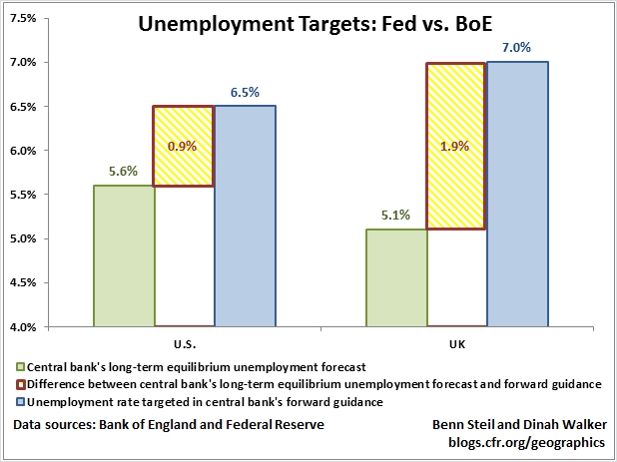
Why the disappointment? Others have pointed to the multiple caveats and exit clauses, but we would highlight something much more tangible: the pledge to keep interest rates super-low at least until unemployment fell to 7% was meaningless, as 7% is nearly two full percentage points over what the Bank considers to be the long-term equilibrium rate of UK unemployment. This is like a football coach pledging to keep throwing the football until his team is down by less than 50 points; it tells the defense nothing it didn’t already know.
Compare the BoE’s rate pledge to the Fed’s rate pledge, which has the latter committing to a near-zero policy rate until unemployment falls to less than a percentage point above what the Fed considers to be the long-term equilibrium rate of US unemployment. While hardly shocking, the Fed’s commitment was newsworthy.
If a 7% unemployment target was the best that new BoE Governor Mark Carney could deliver through his Monetary Policy Committee, he would have been better advised to skip the forward guidance and simply let the market judge his actions going forward.