Australia and United States Agree to Minerals Partnership
By experts and staff
- Published
- CFR Editors
Welcome to the Daily News Brief, CFR’s flagship morning newsletter summarizing the top global news and analysis of the day.
Subscribe to the Daily News Brief to receive it every weekday morning.
Top of the Agenda
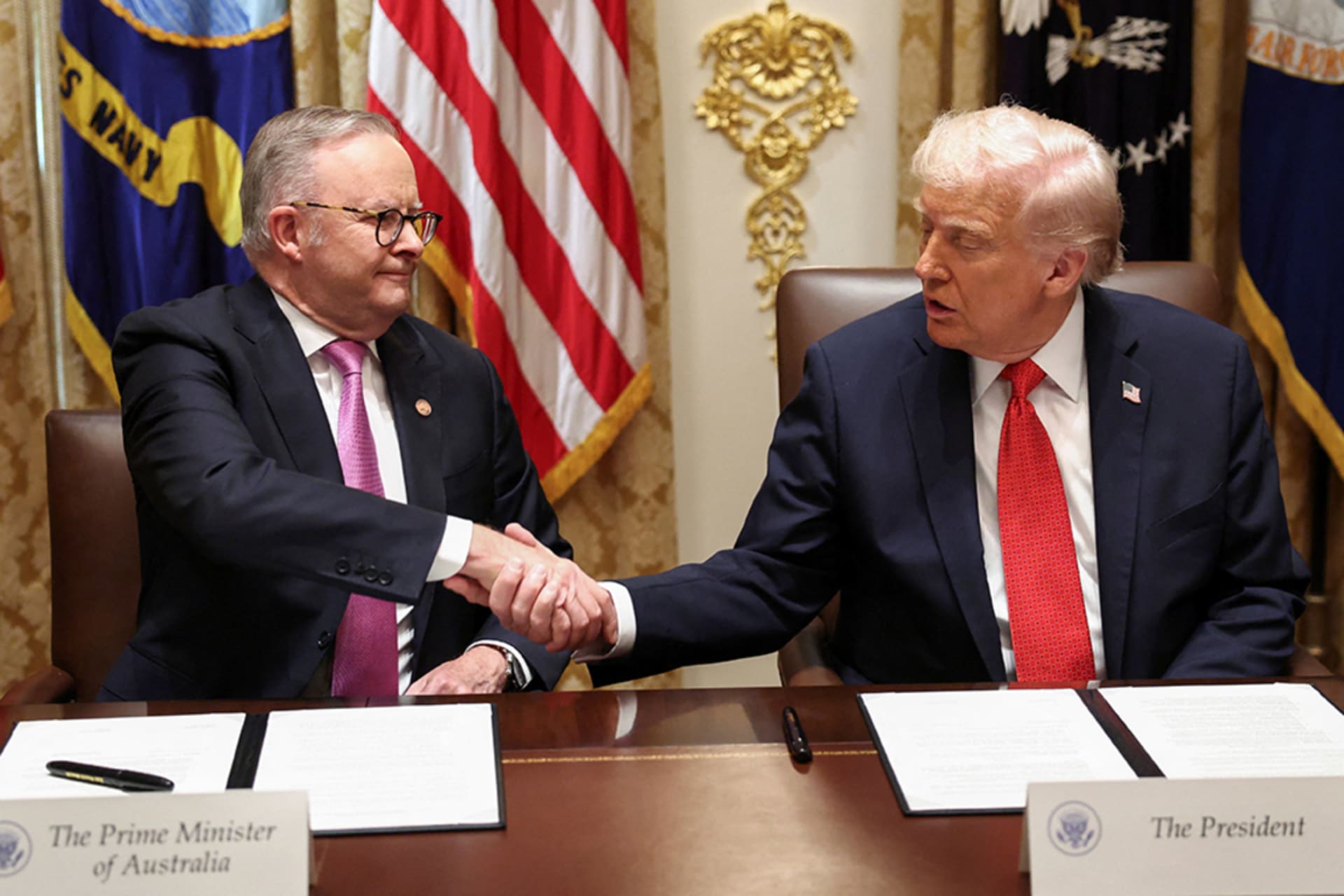
Trump committed to an Australia-U.S. critical minerals deal and to advance AUKUS and other security partnerships in yesterday’s meeting with Albanese. It was the Australian prime minister’s first White House visit since Trump took office again in January. The Trump administration threw the United States’ commitment to the AUKUS partnership with Australia and the United Kingdom (UK) into doubt earlier this year by launching a review of the pact.
Mineral cooperation. The two countries both committed to jointly investing more than $2 billion in critical mineral projects over the next six months, with Washington saying the investments would reach $3 billion. The Export-Import Bank of the United States is issuing formal statements of intent to provide more than $2.2 billion in financing, and the U.S. Defense Department will invest in an advanced gallium refinery in western Australia, the White House said. Canberra will invest in the same refinery and in a rare earths mining project in northern Australia.
A broader critical minerals framework signed by both presidents envisions billions of dollars of additional projects and comes as both countries try to counter Chinese dominance in the sector. Currently, China controls some 70 percent of rare earths mining and 90 percent of processing operations. The White House called the new framework with Australia “a model for supply chain cooperation globally.”
Military cooperation. The minerals deal further deepens bilateral ties strengthened by the AUKUS partnership, under which Australia will buy U.S. nuclear-powered submarines. While U.S. Navy Secretary John Phelan said yesterday that Washington and Canberra were working to “clarify some of the ambiguity” of the AUKUS agreement, Trump called those consultations “minor details” and said the partnership was going “full steam ahead.” Australia is providing around $2 billion this year to boost U.S. submarine production and investing $2 billion in U.S. companies to strengthen its air defense system, the White House said.
“Shoring up the United States’ access to raw materials is only one part of the puzzle. Regardless of their origin, most critical minerals and nearly all rare-earth elements are sent to China for refining and processing. This chokepoint is the Achilles’ heel of the entire supply chain.” —CFR expert Heidi Crebo-Rediker, Foreign Affairs
Across the Globe
Japan’s new prime minister. The legislature elected Takaichi Sanae as Japan’s first female prime minister today. A conservative, her election comes after she was voted in to lead the ruling Liberal Democratic Party earlier this month. The more moderate Komeito party subsequently defected from the ruling coalition, but the rightwing Nippon Ishin party took its place. Like Takaichi, Nippon Ishin has signaled a hawkish position on China and a more restrictive stance on immigration.
Netherlands intel-sharing cut. The Netherlands has stopped sharing some intelligence with the United States over concerns it could be used to aid Russia or hinder human rights, senior Dutch officials told newspaper de Volkskrant. The move marks a shift in the decades-long close intelligence partnership between the two countries. One official said that despite policy change, overall relations with the United States remain good.
India’s draft climate target. The country envisions setting its peak emissions deadline to 2045 in an updated climate target, Bloomberg reported. The plan envisions India sourcing 11 percent of its total energy from nuclear sources by 2070 and relying heavily on carbon capture technology in the industrial sector. The think tank that drafted the plan did not comment. Despite its emissions ambitions, India has yet to submit its updated climate target for 2035 as part of the UN climate negotiation process.
Proposed penalties for Nicaragua. The Trump administration proposed options such as instituting 100 percent tariffs on Nicaraguan goods or eliminating the country’s trade benefits due to abuses of labor and human rights in the country, it said in a report Monday. For years, Nicaragua has enjoyed zero tariffs on many of its exports to the United States.
More Caribbean strike fallout. Colombia recalled its ambassador to the United States for consultations after the two countries’ presidents clashed over the hemispheric drug trade and the U.S. military campaign in the Caribbean. After the United States repatriated two survivors of its most recent boat strike to Colombia and Ecuador, Colombia said it would prosecute its survivor, who remains hospitalized, while Ecuador released its citizen without charges.
Madagascar PM named. Coup leader Colonel Michael Randrianirina appointed consultant and businessman Herintsalama Rajaonarivelo to be the country’s new prime minister yesterday, praising Rajaonarivelo’s international experience. Andry Rajoelina, the president who fled last week amid mass protests and the army takeover, has refused to step down from exile in an undisclosed location.
China-UK embassy row. The UK is delaying a decision on the construction of China’s new embassy in London, pushing the deadline from today to December 10. Some UK lawmakers called for the embassy’s construction to be blocked due to concerns about potential espionage, even as China has warned of “consequences” for delaying the decision.
Netherlands-Uganda deportation deal. The Netherlands plans to send tens of migrants from mostly African countries to Uganda as part of a still-preliminary agreement, migration and foreign affairs minister David van Weel told the Financial Times. While the deal resembles one struck with Uganda by the United States under Trump, van Weel said the Netherlands would ensure that human rights are respected. He acknowledged the Netherlands anticipates legal challenges to the arrangement.
What’s Next
Today, Australian Prime Minister Anthony Albanese visits Washington, DC.
Today, Slovenia hosts a summit of Mediterranean European Union countries.
Tomorrow, Japan’s legislature is expected to vote for prime minister.