United States Shoots Down Iran Drone
By experts and staff
- Published
Welcome to the Daily News Brief, CFR’s flagship morning newsletter summarizing the top global news and analysis of the day.
Top of the Agenda
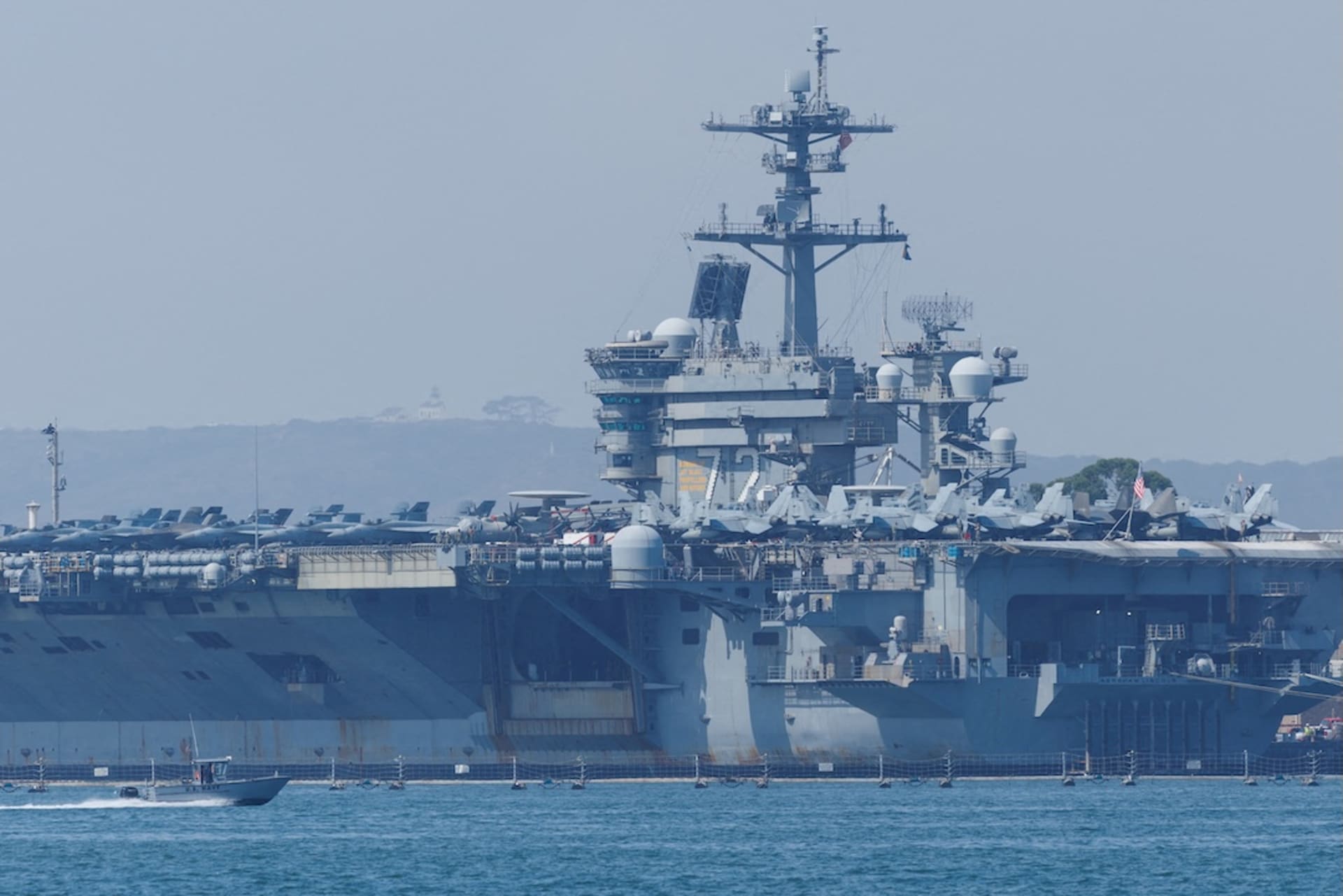
Two Iranian military provocations against U.S. assets in the Middle East yesterday underscored high tensions ahead of negotiations planned for Friday. An Iranian drone “aggressively approached” a U.S. aircraft carrier in the Arabian sea, prompting a fighter jet from the carrier to shoot it down, a U.S. Central Command (CENTCOM) spokesperson said. Hours later, the U.S. Navy escorted a U.S.-flagged tanker to safety after it was approached by two Iranian gunboats that threatened to board the vessel.
The military incidents. Iran’s top officials did not immediately comment on the maritime incidents. The country’s semi-official Tasnim news agency reported that communications with a drone over international waters had been lost, though the reason remained unclear. The incidents could mean Iranian hardliners are resistant to talks, the Wall Street Journal reported. The CENTCOM spokesperson said that Iran’s aggression increases “risks of collision, miscalculation, and regional destabilization.”
What’s on deck in talks. Officials from the United States and Israel as well as Turkey and Saudi Arabia held separate high-level meetings yesterday in Jerusalem and Riyadh that discussed the regional stakes of the upcoming U.S.-Iran talks. Iran has pushed for the negotiations to be moved from their planned location in Istanbul to Oman, Axios reported. Last week, U.S. officials demanded Tehran end uranium enrichment and dispose of its stockpiles, limit its ballistic missiles, and end support for proxy groups, according to the New York Times. In recent days, Tehran has reportedly pushed for narrow talks focused on nuclear issues.
Regional input. Turkey and the United Arab Emirates are among those urging Iran and the United States to negotiate rather than risk military conflict, a point Turkish President Recep Tayyip Erdoğan stressed during a meeting with Saudi Crown Prince Mohammed bin Salman yesterday. Also yesterday, U.S. envoy Steve Witkoff met with Israeli Prime Minister Benjamin Netanyahu, who said Iran could not be trusted to uphold its promises.
“[There is an] organic connection between the repressiveness of the clerical system and Tehran’s aggressive approach to the region. Both are part of what makes the Islamic Republic the Islamic Republic. U.S. diplomacy and goodwill are not going to overcome the ontology of the Iranian regime.”
—CFR expert Steven A. Cook, Foreign Policy
Across the Globe
Ukraine talks. The second round of negotiations between Russia, Ukraine, and the United States over a potential peace settlement began today in Abu Dhabi. It followed a large-scale Russian attack yesterday on Ukraine’s energy grid. The Abu Dhabi talks are expected to focus on outstanding disputes over territory and Western security guarantees for Ukraine.
U.S. mineral deal in DRC. A group of investors that includes U.S. firm Orion and the U.S. Development Finance Corporation reached a preliminary deal to buy a multibillion-dollar stake in copper and cobalt mining assets in the Democratic Republic of Congo (DRC), their seller Glencore announced yesterday. U.S. Deputy Secretary of State Christopher Landau said the purchase reflected the principles of a recent U.S.-DRC agreement on peace and mineral development. If completed, it would be the largest U.S. investment in the country in a decade.
U.S.-Africa trade pact. U.S. President Donald Trump signed a yearlong extension of the African Growth and Opportunity Act (AGOA), which gives many African imports duty-free access to the United States, U.S. Trade Representative Jamieson Greer said yesterday. For months, African governments have urged the Trump administration to renew the policy, even as the administration publicly floated allowing it to lapse. Greer said the administration would work with Congress on unspecified changes to “modernize” AGOA.
Colombia’s Petro in DC. The two countries are working together on counternarcotic efforts and sanctions, Trump said after meeting with Colombian President Gustavo Petro at the White House yesterday. Trump called Petro “terrific,” a sharp reversal in rhetoric from his threats to attack Colombia last month. Ahead of the meeting, Colombia extradited a high-profile drug trafficker to the United States and agreed to accept U.S. deportation flights. The two presidents also discussed the possibility of exporting Venezuelan gas via Colombia, Petro told a local radio station.
Syrian forces in Kurdish area. Syrian military forces deployed yesterday to the previously Kurdish-controlled city of Qamishli, in keeping with an agreement reached Friday to integrate Kurdish fighters into the Syrian government. After the two sides engaged in deadly clashes last month, a U.S. envoy called their integration deal a “historic milestone in Syria’s journey toward national reconciliation.”
Saudi-Turkish energy cooperation. The two countries agreed to a broad partnership to install wind and solar energy in Turkey, including an initial $2 billion of investments in solar power plants, Turkey’s energy and natural resources minister said on social media yesterday. The solar plants are expected to sell renewable energy at the lowest price in Turkey, he added.
Moon mission delay. NASA announced yesterday it is delaying its expected launch date of the Artemis II mission to put astronauts on the moon from February until at least March after detecting issues, including liquid hydrogen leakage, in a test this week. Such challenges are often anticipated and the reason why NASA conducts launch rehearsals, NASA Administrator Jared Isaacman wrote on social media. The mission aims to return humans to the moon for the first time since 1972.
France’s U.S. tech crackdown. French authorities raided the offices of tech platform X yesterday and summoned owner Elon Musk for questioning, as part of an initial probe into the alleged spread of sexualized images of children on the platform, among other violations. Musk called the raid a “political attack.” France also announced last week it would phase in government use of French software over U.S. video conferencing tools like Microsoft Teams and Zoom, with a government minister saying the country “cannot risk exposing our scientific exchanges, sensitive data, and strategic innovations to non-European actors.”
What’s Next
- Today, German Chancellor Friedrich Merz begins a trip through the Gulf in Saudi Arabia.
- Today, U.S. Secretary of State Marco Rubio hosts a meeting on critical minerals in Washington, DC.
- Today, Spain hosts a summit on the responsible use of AI by militaries.
- Tomorrow, the New START nuclear arms control treaty between the United States and Russia expires.