China in Latin America: September 2025
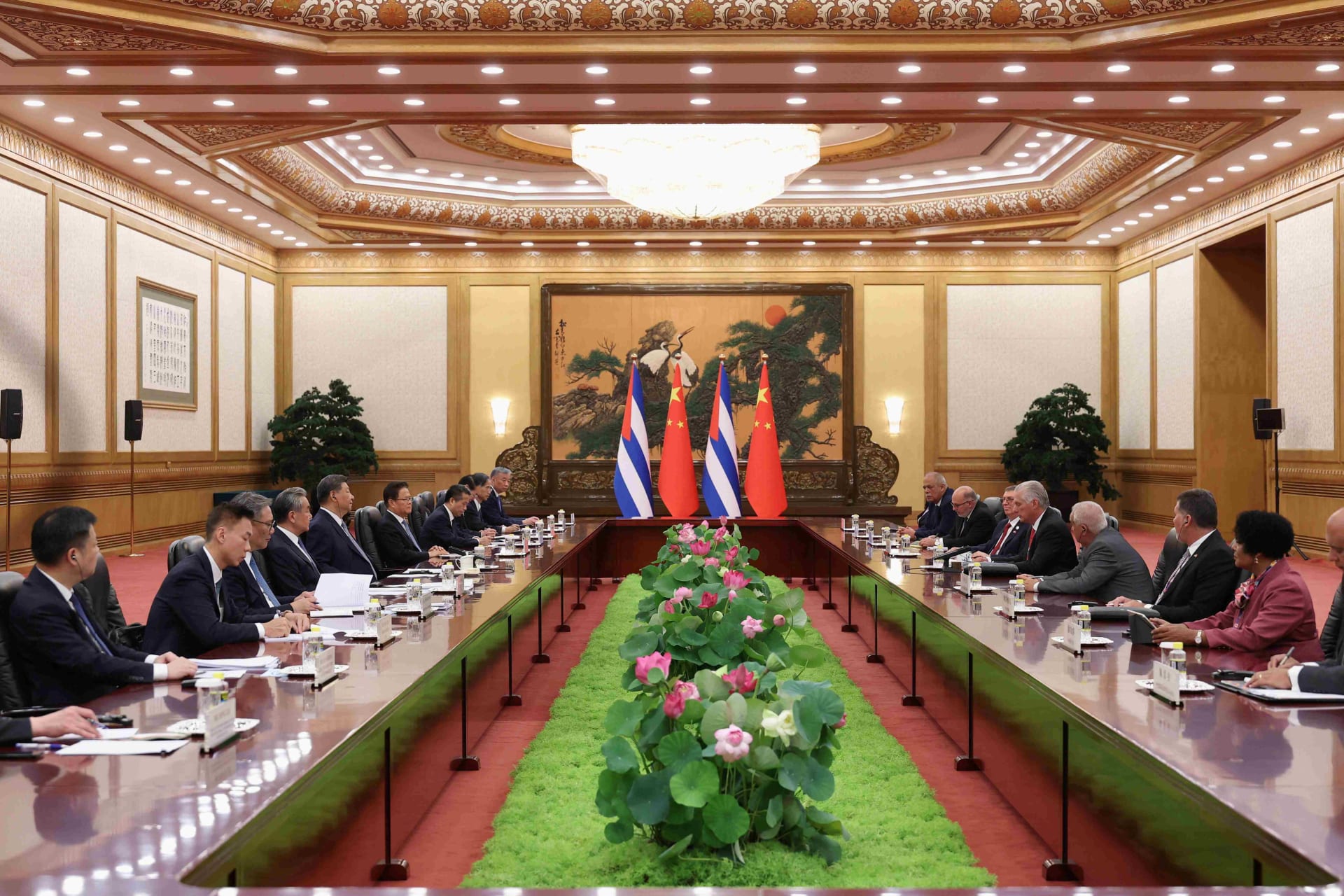
In September, tensions escalated between Mexico and China over proposed tariff hikes. China denounced U.S. strikes in the Caribbean as a threat to regional security. Cuban President Miguel Díaz-Canel met with Chinese President Xi Jinping in Beijing.
Mexico’s Tariffs: In September, China launched a trade barrier investigation in response to Mexico’s plans to raise tariffs on nearly 1,500 goods including autos, electronics, toys, and textiles.
Mexico’s tariff hikes would affect countries, including China, with which it does not have a trade agreement. The proposal was formally submitted to Congress on September 8 as part of the 2026 federal budget.
Mexican Economy Minister Marcelo Ebrard said the new tariffs will apply to sectors where Mexico’s trade deficit with China is growing, according to El Economista. He later said the measures are not aimed at any specific country, a statement that Mexican President Claudia Sheinbaum affirmed.
The Chinese government urged Mexico to “think twice” and “exercise extreme caution” before taking any trade actions. A spokesperson for the Ministry of Commerce warned that tariff hikes by Mexico “would be seen as appeasement and compromise to unilateral bullying,” and that China will take necessary measures to safeguard its interests.
Sheinbaum proposed a high-level bilateral working group to discuss the tariffs and said Mexico wants to maintain a “very good relationship” with China. She denied that the levies are a coercive measure.
Trade: Chinese companies upped their soybean purchases from South American growers amid trade tensions with the United States. China bought at least 20 cargoes of soybeans—over 1.3 million tons—from Argentina, spurred in part by a temporary break in Argentina’s export taxes. Argentina’s soy exports reached a six-year high driven by strong Chinese demand, while leaving local processers with a limited supply.
China began an antidumping investigation into pecan imports from the United States and Mexico. The investigation is expected to conclude by September 2026, with a possible six-month extension.
A study published by the China-Brazil Business Council found that Chinese imports supported 5.2 million jobs in Brazil in 2022, more than double the number of jobs supported by exports to China.
China launched its first direct break-bulk shipping service to Peru’s Port of Chancay, which will transport irregular and oversized goods.
China’s General Administration of Customs approved imports of Brazilian sorghum, following an August visit by a Chinese delegation to meet with sorghum producers in Brazil.
Peru sent its first pecan shipment to China.
Diplomacy: Cuban President Miguel Díaz-Canel was among the twenty-six heads of state attending China’s military parade to commemorate the eightieth anniversary of the end of World War II in the Pacific. Venezuela sent a lower-ranking delegation headed by Jorge Rodríguez, the president of the country’s national assembly.
During Díaz-Canel’s visit to Beijing—his first since 2022—he signed eleven bilateral cooperation agreements in areas including agriculture, artificial intelligence, and infrastructure.
Venezuelan President Nicolás Maduro called China “the world’s leading military power” and congratulated Chinese President Xi Jinping on the World War II commemoration. Maduro inaugurated a monument in Venezuela’s capital, Caracas, to honor China’s victory over Japan in 1945.
Díaz-Canel, Cuban Foreign Minister Bruno Rodríguez, and Nicaraguan President Daniel Ortega expressed their countries’ support for China’s newly announced Global Governance Initiative, which seeks to reform international institutions and amplify the voices of developing countries.
Venezuelan Foreign Minister Yván Gil met with Chinese Ambassador Lan Hu on September 17. Gil said Venezuela received “a message of support and solidarity” toward its efforts to preserve peace in the Caribbean.
The Chinese government said the United States’ actions in the Caribbean “threaten regional peace and security” and violate international law. Lin Jian, a spokesman for the Chinese Foreign Ministry, said China “opposes external interference in Venezuela’s internal affairs under any pretext.”
The United States announced it would restrict visas for Central American citizens intentionally acting on behalf of the Chinese Community Party. The Chinese Embassy in Washington, DC, accused the United States of “deliberately sowing discord” between China and Caribbean and Latin American countries.
Peruvian Finance Minister Raúl Pérez-Reyes said Peru can maintain a good relationship with both the United States and China and that his country manages a foreign policy “based on active neutrality.”
China announced its support for Brazil’s $125 billion Tropical Forest Forever Facility. The fund is designed to pay countries for preserving their tropical forests, offering up to $4 per hectare.
Brazil’s Environment Minister Marina Silva suggested that other metrics besides greenhouse gas emissions would perhaps be needed to evaluate China’s contribution to climate efforts, pointing to the country’s adoption of renewable-energy technology.
China held the sixth China-Latin America High-Level Defense Forum in Beijing, hosting eighteen nations from the region. Chinese Defense Minister Dong Jun called for closer and more resilient ties between China and Caribbean and Latin American countries.
China and the Dominican Republic signed an agreement that includes a $40 million contribution to Dominican emergency response and natural disaster management projects. China will also provide 450 scholarships to Dominican officials across fields including agriculture, public health, renewable energy, and transportation.
Dong met with his Cuban counterpart Álvaro López Miera in Beijing on September 16, pledging to take military relations to “a new level.”
Federico Tong Hurtado, president of the Peruvian Institute for Sport, received a Chinese delegation led by Gao Zhidan, director of the General Administration of Sport of China and president of China’s Olympic committee. Tong Hurtado presented a joint action plan to deepen the two countries’ sports cooperation.
China donated eight generator sets to Cuba of 1.8 megawatts each to boost capacity at a power plant in Matanzas.
The Chinese Foreign Ministry recognized Chilean influencer Nicolás Figueroa Curáz for his content creation and cultural contributions to Chile.
Infrastructure: China Railway Construction Corporation won a $470 million contract to build a twenty-six-kilometer electric railway in Chile. The Santiago-Batuco line will cover eight stations and serve an expected thirty-five million passengers per year.
The first train for the Bogotá, Colombia, metro arrived from China. Once complete, the metro system will have a total of thirty trains with six cars each. Five trains are expected to arrive before the end of the year.
A new floating facility to produce crude oil arrived in Venezuela’s Lake Maracaibo. The rig is part of a $1 billion project operated by China Concord Resources Corp, which is working to boost output at two oil fields in western Venezuela.
Bloomberg reported that China Southern Power is in talks for a controlling stake in Chilean power-transmission company Transelec. A potential deal—which would need approval from Chilean regulators—could be valued at over $4 billion.
Chinese state-owned company CRRC Zhuzhou Locomotive won a contract to build fifteen passenger trains for the Mexico-Pachuca route. The Chinese company presented an offer 69 percent lower than its only competitor. The first train will be delivered no later than September 2026.
Nicaragua granted over eighty-five thousand hectares of mining concessions to three Chinese companies: Zhong Fu Development, Three Gold Coins Company, and Northern Mining Company.
Cuba’s MedSol will transfer technology to Chinese company Hubei C&C to produce aspirin for the Cuban market. In the first phase of the agreement, Hubei C&C will produce one hundred million aspirin tablets. According to Julio Alfonso Rubí, the director general of Cuba’s National Center for Scientific Research, the move is only the first step to produce more medicines with Cuban technology in China.
Chinese battery maker CATL opened a regional office in Chile.
China Eastern Airlines will launch a new flight route between Shanghai, China, and Buenos Aires, Argentina. With just one transit stop in New Zealand, the flight will cut travel time between the two cities by up to five hours. It is China’s first air route to Latin America with a stopover in the Southern Hemisphere rather than in the United States or Europe.
Chinese Ambassador Wang Wei said China supports Argentina’s “economic and financial stabilization” through its currency swap. Argentine Undersecretary for Foreign Policy Juan Manuel Navarro thanked “China’s confidence in Argentina’s economic plan.”
Ecuador’s attorney general presented charges against former President Lenin Moreno, his wife, his daughter, his two brothers, and other associates for receiving $76 million in bribes from the Chinese company Sinohydro. Sinohydro built Ecuador’s Coca Codo Sinclair hydroelectric plant, one of the largest in the country. Moreno denounced the bribery charges as “a farce” and “political persecution.”
The U.S. Department of Justice announced the seizure of more than three hundred thousand kilograms of methamphetamine precursor chemicals en route to Mexico from China. The seizure was the largest of methamphetamine precursors in U.S. history, according to U.S. Attorney for the District of Columbia Jeanine Ferris Pirro. The chemicals were bound for Mexico’s Sinaloa Cartel.
Argentina’s former Finance Secretary, now Foreign Minister, Pablo Quirno said a Chinese bank deliberately pushed down the peso’s value on September 1.
Cuba is negotiating the restructuring of its banking, financial, and corporate debts with China.