Syria’s Transitional Election
By experts and staff
- Published
- CFR Editors
Welcome to the Daily News Brief, CFR’s flagship morning newsletter summarizing the top global news and analysis of the day.
Subscribe to the Daily News Brief to receive it every weekday morning.
Top of the Agenda
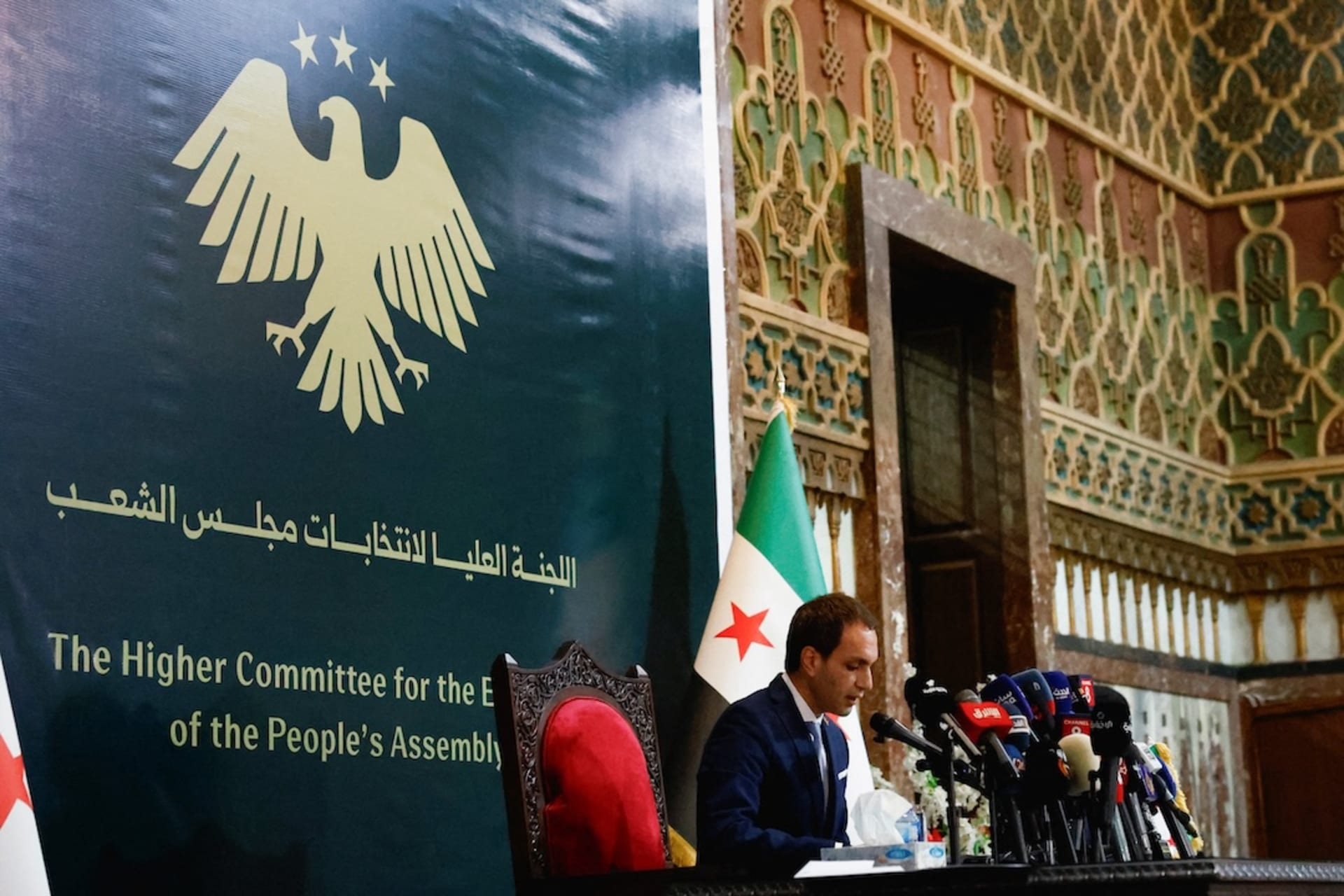
The results are in for Syria’s first parliamentary election since the fall of Bashar al-Assad. The election determined about half of Syria’s new legislature. Interim President Ahmed al-Sharaa is due to appoint some remaining members, while others will be chosen in future elections that were delayed due to logistical challenges. Many Syrians remain displaced after more than thirteen years of war. The vote marked a step forward in the country’s transition from the Assad dictatorship and a sign of the transitional government’s many unresolved challenges. Elections were delayed in Kurdish-held territory in northeast Syria, where militia fighters clashed with government forces in recent days.
The details. The indirect vote yielded 119 lawmakers that will be part of a 210-person parliament, the electoral committee said. Seats largely went to men from the Sunni Muslim majority, with few women or religious minorities elected. Sharaa is due to appoint 70 lawmakers in the coming days, while 21 will be chosen in postponed elections. Around 5 percent of the newly-elected lawmakers are women, down from a range of 6–13 percent in the decades prior to Assad’s fall. A spokesperson for Syria’s electoral committee said that poor results for women and Christians were “among the most significant shortcomings” of the vote but expressed hope that Sharaa would address these shortcomings through his own appointments.
Clashes in the northeast. The Syrian government and the Kurdish-led Syrian Democratic Force (SDF) reached a truce in part of Aleppo following armed clashes, state media reported today. Each side blamed the other for the fighting that cast doubt on a U.S.-brokered March deal to integrate the SDF into Syrian state institutions. A U.S. envoy met with SDF officials yesterday. The United States partnered with the SDF to fight the Islamic State group during Syria’s civil war but is currently withdrawing its forces.
“Syria faces grave problems, including a collapsed economy, the prospect of renewed internal conflict, and disruptive meddling by outside powers. The caretaker government will not be able to address any of these issues if its own hold over the country remains contested.” —the International Crisis Group’s Jerome Drevon, Foreign Affairs
Across the Globe
China’s clean tech exports. The country’s clean tech exports reached a record $20 billion in August, according to a report from consultancy Ember. While the United States has pressed countries to buy more U.S. fossil fuels this year, China’s green tech exports have surged. From January to July 2025, China exported $120 billion in green technologies while the United States exported $80 billion worth of oil and gas, Bloomberg reported.
Trump’s latest industrial policies. The United States will impose 25 percent tariffs on imports of medium and heavy trucks beginning November 1, President Donald Trump wrote on social media yesterday. The White House also announced the U.S. government is taking a 10 percent stake in Canadian mining company Trilogy Metals, Inc., which aims to mine in northwest Alaska.
ICC conviction over Darfur. The International Criminal Court (ICC) ruled yesterday that Sudanese militia leader Ali Kushayb, one of the leaders of the government-backed Janjaweed militia, was guilty of twenty-seven counts of war crimes and crimes against humanity. It is the court’s first conviction related to the 2003-2020 conflict in Darfur and its first for gender-based persecution. Some of the Janjaweed later helped form the militia Rapid Support Forces (RSF), which is currently battling Sudan’s government in an ongoing civil war.
Madagascar’s new PM. Madagascar’s President Andry Rajoelina appointed a military general as the country’s new prime minister following widespread youth-led antigovernment protests. Rajoelina came to power in a coup in 2009 before later winning elected office. Some demonstrators have called for Rajoelina’s removal and vowed to continue protesting.
Paraguay sanctions relief. The United States lifted sanctions on former Paraguayan President Horacio Cartes that were imposed in 2023. At the time, Washington accused Cartes of obstructing a probe of transnational organized crime in order to protect himself. A State Department spokesperson said yesterday that the sanctions “were no longer required to incentivize changes in behavior.” Since Trump’s election, Paraguay has closely aligned with his administration’s priorities, moving its Israeli embassy to Jerusalem and agreeing to accept third-country deportees.
Trump-Lula call. Trump yesterday held his first call with Brazilian President Luiz Inácio Lula da Silva since the United States imposed 50 percent tariffs on Brazilian goods in July. Both described the call as positive, and Trump said the leaders would soon meet in person. Bilateral relations had soured because of the tariffs and U.S. sanctions on judges who tried former Brazilian President Jair Bolsonaro for a coup attempt, but Trump did not mention Bolsonaro in his readout.
Egyptian UNESCO nominee. The executive board of the UN Educational, Scientific and Cultural Organization (UNESCO) yesterday nominated former Egyptian tourism and antiquities minister Khaled el-Anani to be its next director. He is expected to be confirmed next month and would be its first director from the Arab world. He has overseen projects including the National Museum of Egyptian Civilization in Cairo and the renovation of a historic synagogue in Alexandria. El-Anani vowed to try to re-engage Washington following the Trump administration’s recent move to withdraw from the organization.
Physics prize. Researchers John Clarke, Michel Devoret and John Martinis won this year’s Nobel Prize in Physics for discoveries in the field of quantum mechanics. They conducted experiments that showed phenomena in the small-scale quantum world can be replicated in larger systems. “Quantum mechanics is the foundation of all digital technology,” the prize chairman said.
What’s Next
Today, global shipping industry conference FIATA begins in Hanoi.
Today, Canadian Prime Minister Mark Carney meets with Trump in Washington.
Tomorrow, United Kingdom Prime Minister Keir Starmer begins a trip to India.
- Tomorrow, the annual Draconid meteor shower is expected to peak in the night sky.