Trump Removes National Security Advisor
By experts and staff
- Published
- CFR Editors
Welcome to the Daily News Brief, CFR’s flagship morning newsletter summarizing the top global news and analysis of the day.
Subscribe to the Daily News Brief to receive it every weekday morning.
Top of the Agenda
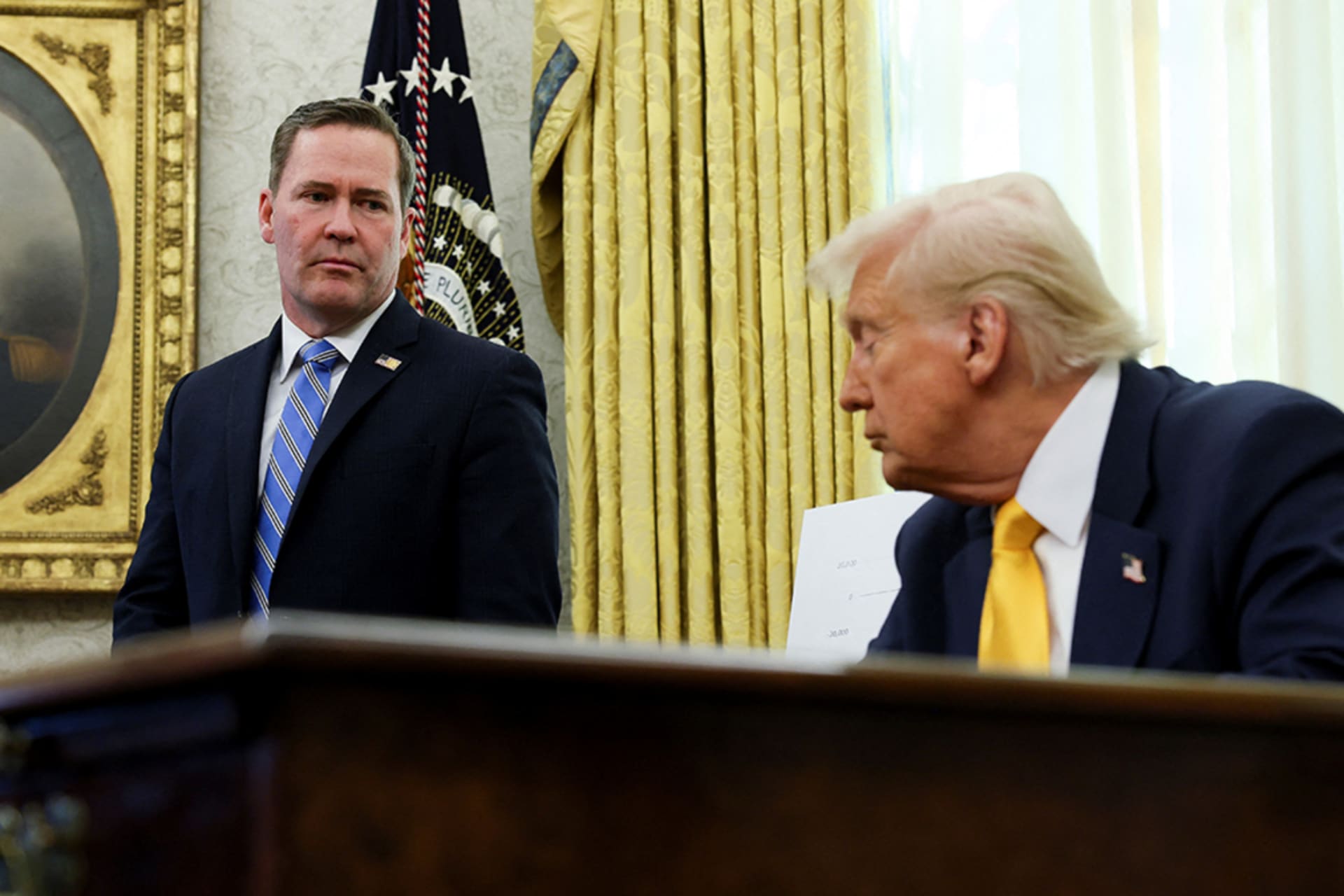
Trump removed National Security Advisor Michael Waltz yesterday and nominated him to be U.S. ambassador to the United Nations. It was the first senior leadership change of Trump’s second administration. Waltz had come under criticism in recent weeks after adding a journalist to a Signal group discussing U.S. plans to bomb Yemen. Trump praised Waltz for having “worked hard” and said that Secretary of State Marco Rubio will serve as interim national security advisor. The shake-up comes as the United States tries to move forward with sensitive negotiations with Iran, Russia, and Ukraine.
The details.
- Trump did not announce the reason for Waltz’s departure. Beyond the Signal episode, unnamed sources told news outlets that some in the White House viewed Waltz as too hawkish.
- Waltz’s deputy Alex Wong is also departing, multiple news outlets reported.
- Trump dismissed several of Waltz’s aides in April after far-right conspiracy theorist Laura Loomer visited the White House and criticized them as harmful to Trump’s agenda.
- Waltz’s 102-day tenure outlasted that of Trump’s first national security advisor during his previous term, Michael Flynn, who was ousted after less than thirty days.
Looking ahead.
- It was not immediately clear how Rubio would divide his time between the four positions he now holds, which also include that of interim administrator of the U.S. Agency for International Development and interim archivist. There is little precedent for one person simultaneously holding senior roles; Henry Kissinger served both as national security adviser and secretary of state in the 1970s.
- Waltz’s potential UN ambassadorship requires Senate confirmation, during which lawmakers could question him again about the Signal chat. Ahead of that process, Vice President JD Vance voiced confidence in Waltz and denied that he was fired over the Signal incident, saying that Trump simply “decided it’s better for Mike to be in this new role.”
“I think that all presidents get the foreign policy team and decision-making process that they want. And it’s pretty clear that Donald Trump’s takeaway from Trump 1.0 is that he did not want senior leaders on his team acting as guardrails or constraints. He wanted people who would enable him to enact what he sees as fundamental to reorienting American foreign policy.”
—CFR expert James M. Lindsay, The President’s Inbox
Across the Globe
U.S.-Iran talks postponed. Nuclear talks originally planned for this weekend have been postponed, host Oman said. Iran’s foreign minister cited “logistical and technical reasons.” The delay came after Washington announced new sanctions Wednesday against traders of Iranian petroleum and petrochemical products. Yesterday, Trump wrote on social media that buyers of Iranian oil would face secondary sanctions, but no official announcement immediately followed.
EU trade offer to Trump. The European Union (EU) is considering a commitment to buying more than $56 billion worth of U.S. goods in exchange for reduced tariffs, the bloc’s trade negotiator Maroš Šefčovič told the Financial Times. He said if that commitment is made, the EU would consider U.S. tariffs of 10 percent “very high.” The bloc is due to be hit by a 20 percent levy once Trump’s ninety-day pause on so-called reciprocal tariffs ends.
UN weighs major restructuring. The United Nations is considering consolidating departments and shifting jobs away from more expensive cities amid funding struggles, a memo seen by Reuters said. The document “is the result of an exercise to generate ideas,” the spokesperson for Secretary-General António Guterres said. Under one suggestion, functions for food support, refugees, aid to children, and the World Health Organization would operate under a single entity.
Seoul’s leadership vacuum. South Korea’s acting prime minister and his would-be replacement both resigned yesterday. The former acting leader Han Duck-soo stepped down as he plans to run in the upcoming election, while former Finance Minister Choi Sang-mok did so because he faced an impeachment accusation. Former Education Minister Lee Ju-ho is now serving as acting president.
Ruling on U.S. deportations. A U.S. federal judge yesterday ruled it was illegal for the Trump administration to invoke the 1798 Alien Enemies Act to expel Venezuelan migrants without a hearing. Trump had said in a proclamation that the Venezuelan gang Tren de Aragua was carrying out an invasion of the United States, but the judge wrote that Trump did not present evidence of such an invasion. The ruling applies to migrants being held in southeastern Texas.
Germany labels AfD extremist. Germany’s domestic intelligence agency labeled the far-right Alternative for Germany (AfD) party an extremist group, easing permission for government surveillance of their actions. The label had already applied to a youth unit within the party. The national-level designation could also lead to the party’s ban. The AfD came in second place in Germany’s recent federal elections and its leaders called the extremism label “targeted interference” in Germany’s democratic process.
ICJ order on Guyana vote. The International Court of Justice ordered Venezuela to halt its plans to carry out May 25 regional elections in the Guyana-controlled territory of Essequibo, which Venezuela also claims. Venezuela’s government did not immediately comment. In late 2023, Venezuela threatened to annex the area by force. Mediation by neighboring countries deescalated tensions at the time, but they have since risen.
U.S. mediation on DRC conflict. Washington aims to facilitate the signing of a peace deal between the Democratic Republic of Congo (DRC) and Rwanda—which is accused of backing the M23 rebel group in the DRC—at the White House in about two months, Trump’s senior advisor for Africa told Reuters. The peace accord would be accompanied by deals opening the door to increased Western investment in both countries’ minerals sectors, he said. The DRC and Rwanda are due to submit separate drafts of a peace deal today.
What’s Next
Tomorrow, 25 percent U.S. tariffs on imported car parts take effect.
- Tomorrow, Singapore and Australia hold elections.
- On Sunday, the Asian Development Bank begins its annual meeting in Milan.
- On Sunday, Romania holds the first round of a presidential election redo after the original vote last year was annulled.