U.S.-Iran Peace Talks Hit an Impasse. What Comes Next?
The failure of peace talks leaves the United States with difficult decisions to make.

By experts and staff
- Published
Experts
![]() By James M. LindsayMary and David Boies Distinguished Senior Fellow in U.S. Foreign Policy
By James M. LindsayMary and David Boies Distinguished Senior Fellow in U.S. Foreign Policy

The peace talks between the United States and Iran ended early Sunday morning in Islamabad, Pakistan, without a deal to end the now seven-week old Iran war. Each side blamed the other for the failure to secure a breakthrough. Both capitals, but especially Washington, now face difficult decisions.
The Islamabad Talks
That the talks happened at all was an accomplishment. President Donald Trump had insisted that Iran re-open the Strait of Hormuz as the price for U.S. participation. The speaker of Iran’s Parliament, Mohammad-Bagher Ghalibaf, demanded that Israel halt its attacks on Lebanon and that Washington release Iran’s frozen assets. Neither side got its wish. The Strait of Hormuz remained closed, Israel continued to strike Lebanon, and U.S. officials denied that any Iranian assets had been released. The negotiations proceeded anyways.
The meeting was the first face-to-face negotiation between the two countries in more than a decade and the highest-level meeting between U.S. and Iranian officials since the Islamic Republic’s founding in 1979. Vice President JD Vance led the U.S. delegation, which also included special envoy Steve Witkoff and Trump’s son-in-law Jared Kushner. Ghalibaf and Foreign Minister Abbas Araqchi led the Iranian delegation.
The sticking point, at least from the U.S. perspective, is that Iran refuses to terminate its nuclear program, relinquish the nearly one thousand pounds of enriched uranium it has accumulated, and re-open the Strait of Hormuz to all naval traffic without the payment of tolls. It is unsurprising that Tehran rebuffed the first two demands. It has long insisted on its sovereign right to enrich uranium.
An open question is whether either side was interested in reaching an agreement or believed that a deal could be struck in less than a day over issues that have divided the two capitals for decades. Vance told reporters after the talks ended that the U.S. officials “made very clear what our red lines are … and they have not chosen to accept our terms.” That wording suggests that he had gone to Islamabad hoping to accept Iran’s surrender and not walk back U.S. demands.
Oil for All, or Oil for None
Trump responded to the failure to reach a deal by taking to Truth Social to declare that the United States would stop “every vessel in International Waters that has paid a toll to Iran.”
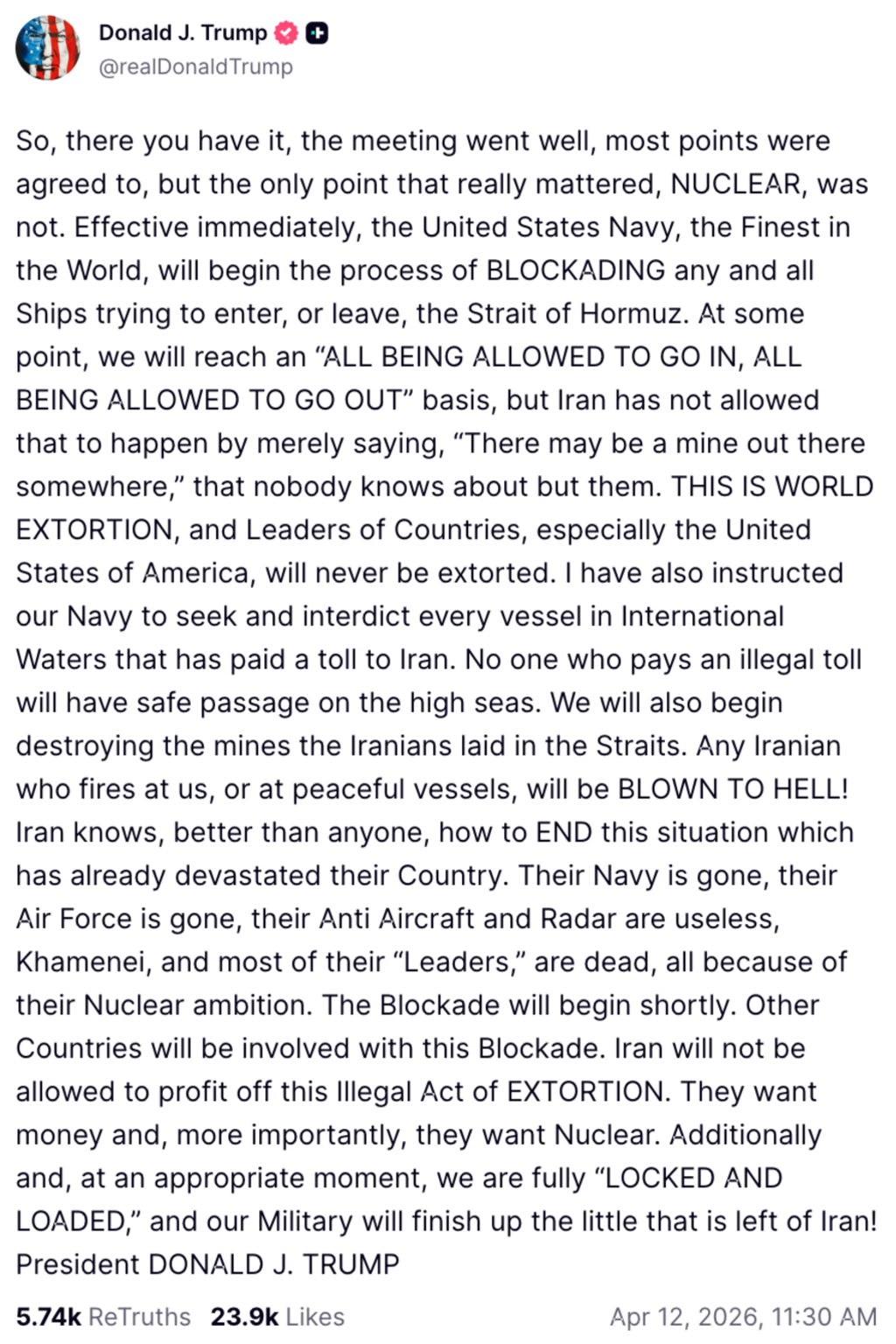
Trump subsequently told Fox News that he expected “numerous” countries to help with the blockade. He stopped short, however, of saying who would participate or when they would join the effort. No countries immediately signed up for the operation. British Prime Minister Keir Starmer explicitly ruled out Britain’s participation.
Since Operation Epic Fury began, only ships that have paid “tolls” to Iran have been able to pass through the Strait. Iran is unlikely to stop that practice or let ships departing from Gulf Arab ports transit the strait freely. As a result, Trump’s decision to impose a blockade effectively creates a situation of “open for all, or open for none” in the Gulf. Trump’s calculation seems to be that the loss of oil revenue will force Tehran back to the negotiating table if not to its knees.
But the economic pain arising from the closure of the Gulf will cut both ways. Global oil prices rose on the news of the blockade. They will rise higher the longer the blockade lasts and possibly send the global economy into a tailspin.
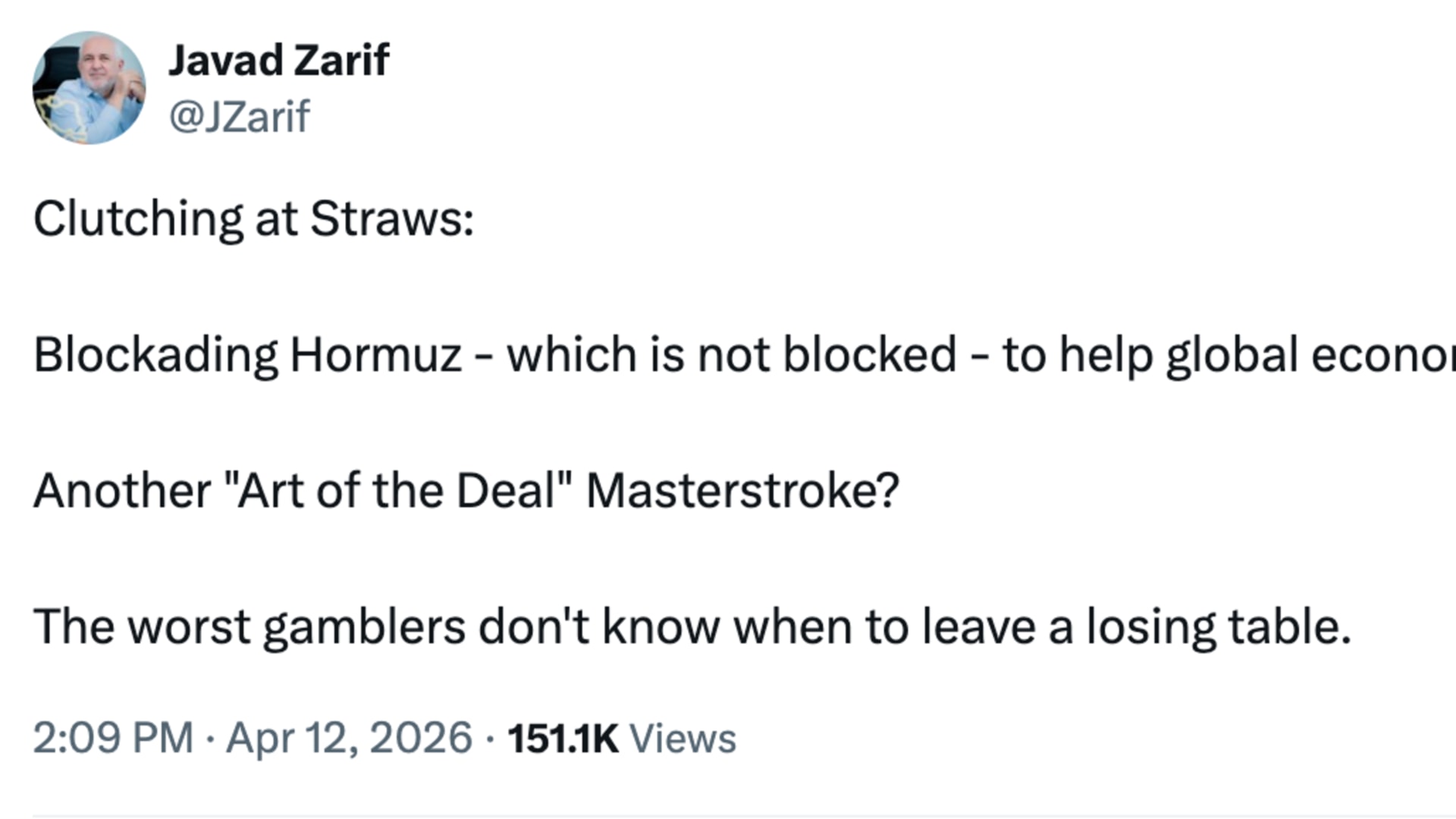
Tehran may calculate that international pressure will force Washington to end its blockade before Iran feels any bite. Iran’s bravado certainly did not dim in the face of Trump’s announcement. Former Iranian Foreign Minister Mohammad Javad Zarif mocked Trump in a tweet for “clutching at straws.”
If it lasts, the blockade could also present Washington with difficult choices. Will the U.S. Navy stop a Chinese-flagged or Russian-flagged vessel, or a vessel bound for a friendly country like India or Japan, transiting the strait with Iranian oil? What if they refuse to comply?
Earlier this month, the Trump administration let a Russian-flagged vessel break its blockade of Cuba. That decision had little consequence given that few countries are trying to come to Havana’s aid. But many countries want Gulf oil. Allowing certain ships to pass while stopping others will create diplomatic headaches for the Trump administration and encourage ships to swap the flags they sail under to avoid being stopped by the U.S. Navy.
What Next?
In any event, Trump’s blockade is unlikely to force Iran’s hand quickly. Economic pressure takes time to hit home. The ceasefire, however, ends in just eight days. Will either side want to renew the fighting?
Iran likely will not. The ceasefire gives it time to regroup. A sizeable portion of Iran’s missile forces survived the five weeks of bombing. Iran is now digging out weapons stored at underground sites that have been blocked under rubble. Iran also appears to be getting help from China to rebuild its air defenses. The more time Tehran gets, the more it can do to position itself for a resumption of fighting.
The onus to resume fighting instead likely falls on Trump. Israel and Gulf Arab states have been urging him to “finish the job.” The Pentagon has presented Trump with a range of military options, including the resumption of full-scale bombing. However, his dilemma remains the same as it was before the ceasefire went into effect: how to translate the degradation of Iran’s military assets into political concessions. Small strikes are not likely to change Tehran’s calculations, while a massive bombing campaign risks a broader and longer war that Trump looks to be trying to avoid.
Recognition of that dilemma might lead the White House to reexamine its diplomatic options. Pakistan and others are pushing to resume the talks. But abandoning the blockade after only just announcing it could create substantial diplomatic and political costs for Trump and may convince Tehran that intransigence is its winning strategy.
So, Trump has big decisions to make. None of his options are appealing. Whatever choice he makes will have consequences that ripple across the globe.
Oscar Berry assisted in the preparation of this article.