A New Ebola Outbreak Spreads Through Conflict and a Weak U.S. Response
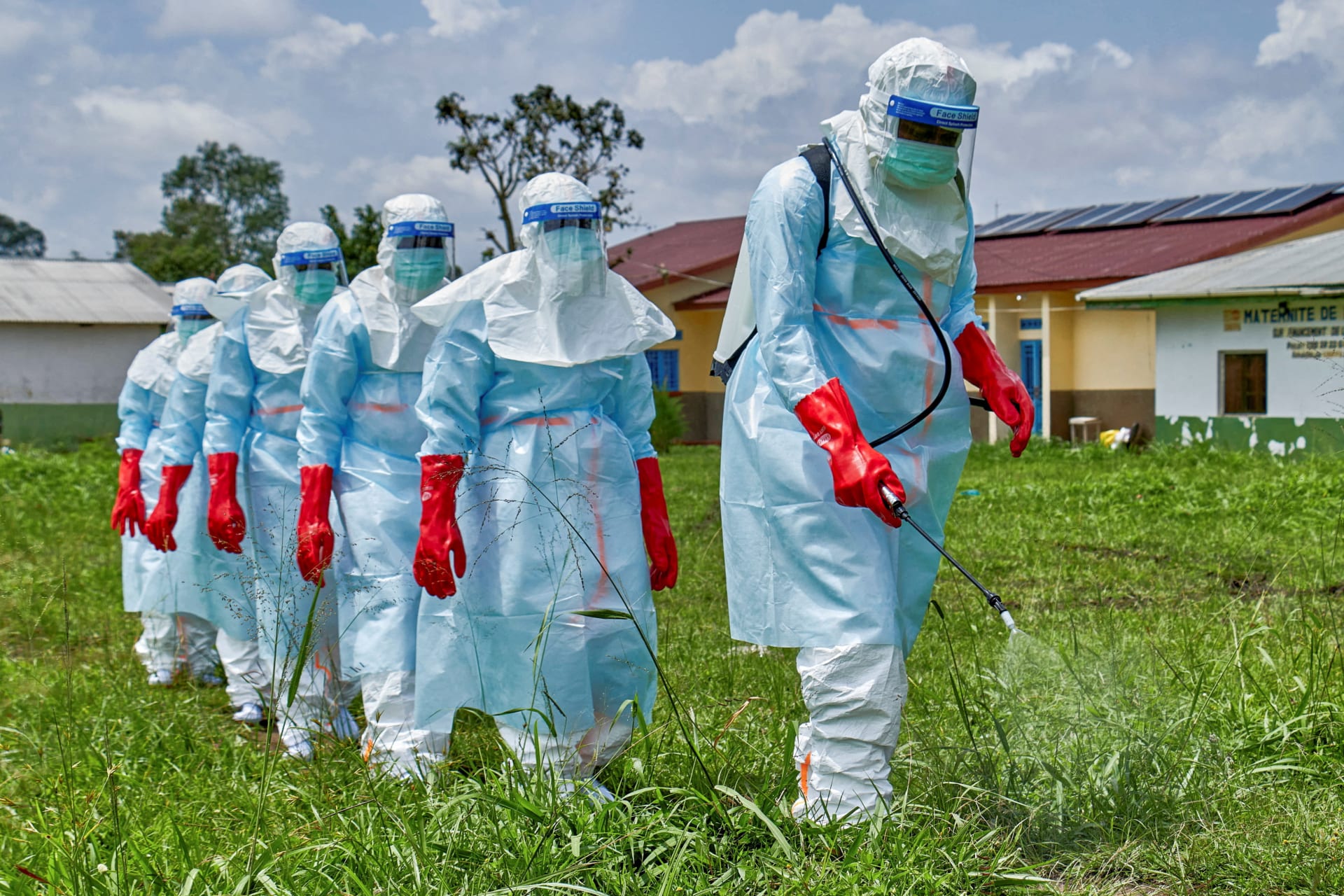
The outbreak of a rare strain of Ebola that went undetected for several weeks in the Democratic Republic of Congo—and which has now spread to Uganda—is raising concerns about regional and global authorities’ ability to effectively respond.
By experts and staff
- Published
 Michelle GavinCFR ExpertRalph Bunche Senior Fellow for Africa Policy Studies
Michelle Gavin is the Ralph Bunche senior fellow for Africa policy studies at the Council on Foreign Relations.
The World Health Organization (WHO) declared on May 17 that an outbreak of a rare strain of Ebola, known as the Bundibugyo virus, in the Democratic Republic of Congo (DRC) and Uganda constituted a public health emergency of international concern. While Ebola is significantly less transmissible than many airborne viruses, there is currently no vaccine or specific treatment for the Bundibugyo strain.
WHO Director-General Tedros Adhanom Ghebreyesus said on May 22 that the risk level in the DRC was “very high at the national level, high at the regional level, and low at [the] global level.” There have been 82 confirmed cases and 7 deaths in the DRC, along with almost 750 suspected cases and 177 suspected deaths, he said, calling the situation “deeply worrisome.” He noted the situation in neighboring Uganda is “stable.” The WHO has so far allocated $3.9 million from its Contingency Fund for Emergencies to support response efforts.
The last major Ebola epidemic—the largest and deadliest in history—swept through West Africa from 2014 to 2016, killing more than eleven thousand people and infecting nearly thirty thousand others, with most cases concentrated in Guinea, Liberia, and Sierra Leone.
As officials race to contain the outbreak, the Council on Foreign Relations turned to Michelle Gavin to explain the scale of the crisis, what’s driving it, and how prepared the region and the world are to respond.
What is the scale of the outbreak so far?
As of May 22, nearly 750 suspected cases have been reported in the DRC, largely in northeastern Ituri province, but also in North and South Kivu. Two confirmed cases were reported in Uganda. While the Ugandan numbers are small and there are no reports of transmission in the country, the fact that the infected individuals were in Kampala—the capital and the most densely populated city—is worrying. Health officials have repeatedly stressed that the virus has been circulating for weeks, and authorities are still working to determine the full scope of the outbreak.
How prepared are health systems in the region compared to the 2014–2016 outbreak in West Africa?
Central Africa has extensive experience dealing with Ebola. Both Uganda and the DRC have faced multiple localized outbreaks in the past decade and have successfully contained and ended them. Medical professionals on the ground are familiar with these situations and have real expertise in responding.
But politics play a role in infectious disease response, as was evident during the COVID-19 pandemic. The DRC is no different, and public confidence in governing authorities is particularly fragile right now, as President Félix Tshisekedi flirts with a third term in office; large swaths of eastern territory remain under the control of M23, a Rwandan-backed Congolese insurgent group; and murky security-for-minerals deals fuel uncertainty and suspicion.
On social media, conspiracy theories abound, suggesting the outbreak is a distraction, a hoax, a money-making scheme, or a pretext for some other nefarious agenda. The profound mistrust of authorities and of outsiders that permeates Congolese society after generations of exploitation creates a particularly difficult backdrop for this Ebola response.
All of this is unfolding in the context of profound insecurity. Eastern Congo has been plagued by conflict for decades, and scores of armed groups operate in the region, as do foreign military forces from Burundi, Rwanda, and Uganda. Nearly one million people in Ituri, where the outbreak is worst, are displaced. Transportation and communications infrastructure is poor. It is not an environment in which it is easy to quickly establish new facilities, distribute health-care supplies, or even obtain accurate, timely information about what is happening in different communities.
In recent years, Western countries including the United States have cut their foreign aid budgets. How does that impact the world’s ability to respond to the current Ebola outbreak?
There is no question that foreign aid cuts have weakened the region’s capacity to respond. The now-defunct U.S. Agency for International Development funded the people who actually had on-the-ground networks and knowledge. Since its closure in 2025, community health workers have lost their jobs and moved into other work to survive, and stocks of personal protective equipment have been depleted. More significantly, the United States’ eyes and ears on the ground—and its knowledge of how to get things done locally—have disappeared.
Another problem is the Trump administration’s decision to withdraw from the WHO and bar U.S. government officials from coordinating with the agency. An Ebola outbreak is the worst possible moment for self-imposed constraints on communication, cooperation, and coordination.
What would a successful international response look like at this point?
The only way to get ahead of the outbreak is through rigorous contact tracing; isolating and caring for those infected while protecting health-care workers; and public education delivered by known, trusted voices, particularly around burial practices.
There is no vaccine for the particular strain of Ebola that is currently circulating, but urgent work is underway to test the effectiveness of existing vaccines and accelerate the development of new ones. However, given that transmission has been occurring for weeks, conditions on the ground are extremely challenging, and the global health community has been thrown into disarray by former leaders such as the United States, the numbers are likely to get worse before they get better.
This work represents the views and opinions solely of the author. The Council on Foreign Relations is an independent, nonpartisan membership organization, think tank, and publisher, and takes no institutional positions on matters of policy.
Colophon
Data Visualization
- Allison Krugman
- Will Merrow
- Austin Steinhart