A Turning Point in Ukraine
CFR President Michael Froman analyzes the mounting costs of the Russia-Ukraine stalemate—and whether this moment represents the best opportunity for peace since the war broke out in 2022.
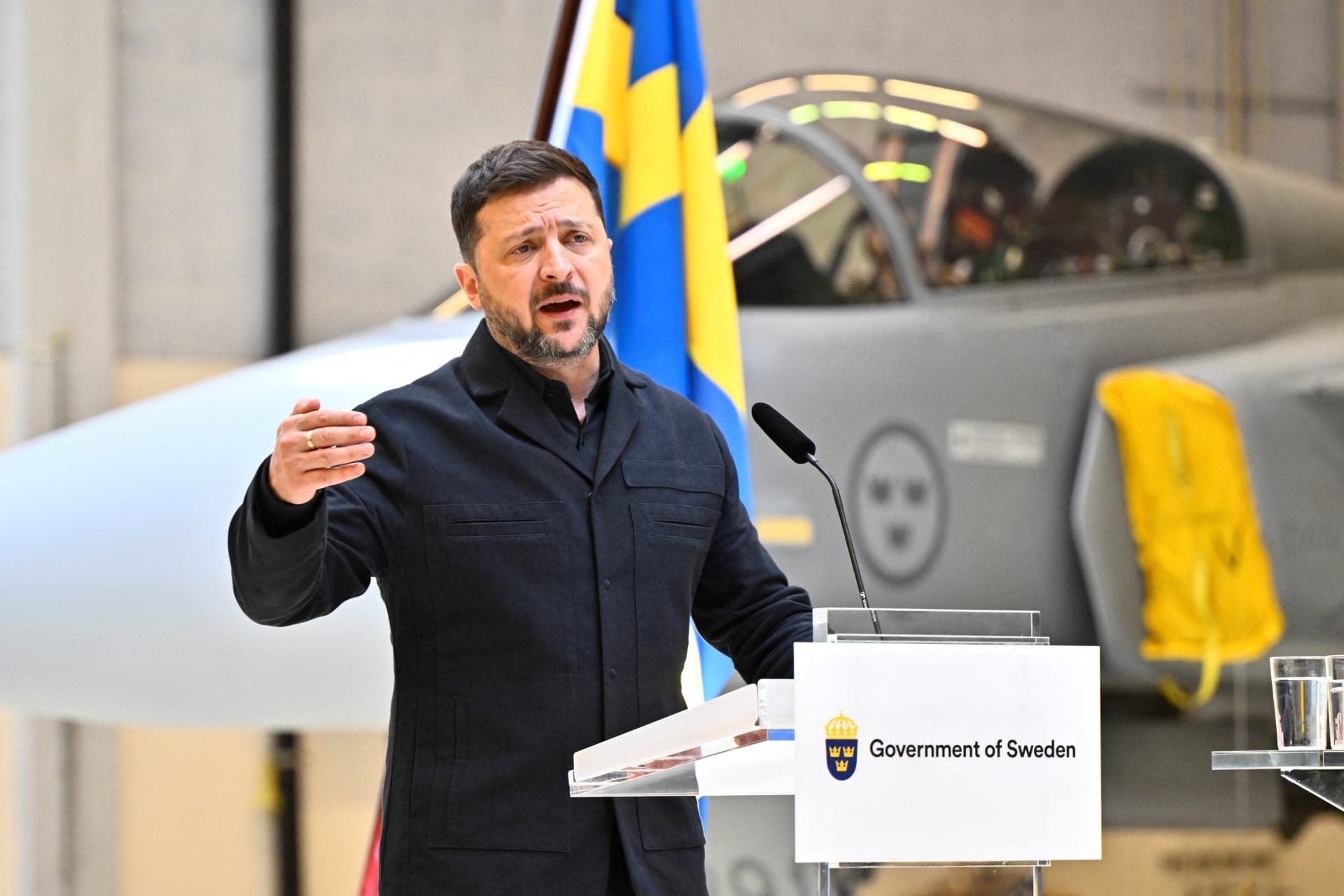

This week, the U.S. House of Representatives acted contrary to the wishes of its leadership and President Donald Trump to pass legislation providing support for Ukraine.
And yesterday, Ukrainian President Volodymyr Zelenskyy published an open letter to Russian President Vladimir Putin calling for a meeting between the two leaders and a full ceasefire during subsequent peace negotiations.
“We see that the United States is fully focused on the issue of Iran, and it would be wrong to simply wait until the war in Europe returns to the center of its attention. Ukraine proposes ending this war through direct engagement between us—and you.”
Zelenskyy’s letter and the new aid bill come at an inflection point in the war, not because Ukraine and Russia have stopped striking one another but because for the first time, as the Royal United Services Institute’s Jack Watling writes in the pages of Foreign Affairs, a ceasefire is “now a realistic possibility.”
On the ground, the front line—which spans nearly eight hundred miles—is largely frozen. But frozen lines do not necessarily make for a frozen conflict.
Russia is paying more for less ground than at any point in the history of the war. Its monthly casualty rates, now above thirty thousand, have reportedly exceeded its recruitment rates every month since December 2025. In January 2026 alone, Western intelligence officials assessed that Russia sustained roughly nine thousand more battlefield casualties than it could replace. Yet, according to the Institute for the Study of War (ISW), Russia’s rate of advance is collapsing: Russian forces gained 9.76 square kilometers per day in the first four months of 2025, but only 4.6 over the same period this year—less than half of last year’s pace. On a net basis, thanks to Ukrainian counterattacks in the Zaporizhzhia and Dnipro in the south and along the Kharkiv-Luhansk axis in the northeast, Russia may end 2026 having gained little to no new territory whatsoever.
Data released by ISW reveal that the Russian military’s diminishing marginal return on manpower is a direct result of new and improved Ukrainian materiel and tactics, particularly with respect to drones—which have turned the 15-to-25-kilometer band on either side of the front line into a “kill zone” that neither side can mass forces within. Ukraine has actually achieved numerical drone superiority (at the tactical level), now fielding 1.3 strike drones for every Russian one, and the effects show up across ISW’s battlefield data. And the pace of Ukrainian drone strikes against Russian targets has roughly doubled year-over-year.
As the war of attrition grinds on at the front, the deep-strike campaign is escalating on both sides. For the first time since the war began, Ukraine is prosecuting a sustained campaign against targets more than 1,000 kilometers behind Russian lines—an ability unlocked by new domestically produced long-range strike drones and cruise missiles. Take this week’s St. Petersburg International Economic Forum, better known as “Putin’s Davos,” as a case in point. On Wednesday, groups of international businesspeople who had gathered in St. Petersburg for a discussion of Russia’s economic potential were met with clouds of dark, billowing smoke shrouding the port city—the result of long-range Ukrainian drones striking an oil terminal and military targets, but perhaps more important, a reminder of Ukraine’s expanded strike capabilities and a willingness to exercise that capacity ahead of the exhibitions most important to Putin.
Just last month, the Ukrainians also struck targets in Moscow ahead of the Kremlin’s annual Victory Day parade—which paled in comparison to last year’s showcase. And since March, Ukraine has dramatically expanded the tempo and reach of these attacks, damaging Russian oil export and refining assets in addition to defense industrial base targets outside major Russian cities.
Russia, meanwhile, is pressing its one enduring comparative advantage—sheer industrial mass—into massed drone-and-missile strikes against Ukrainian cities, which now arrive weekly in barrages of hundreds of drones and dozens of missiles. On Tuesday, Russia unleashed its largest aerial assault against Kyiv in months, killing more than twenty people and wounding more than one hundred. Ukrainian forces have proved remarkably adept at neutralizing the drone component of these strikes, but their capacity to thwart the ballistic missile threat is rapidly diminishing. Ukraine relies entirely on foreign-produced ballistic missile interceptors—above all the U.S.-made Patriot system, supplemented by the Franco-Italian SAMP/T—and its stocks of both are dwindling.
The United States, which produces only 60 to 65 anti-ballistic interceptors per month and expended nearly half its Patriot stockpile in seven weeks of the Iran war. And we no longer donate these munitions to Ukraine. Instead, new deliveries depend on European allies purchasing U.S. systems on Kyiv’s behalf. The largest such order, a $3.7 billion German-financed purchase of Patriot interceptors signed in April, won’t begin deliveries until 2028 at the earliest. Europe’s capacity to surge production of SAMP/T interceptors is likewise challenged.
As a result of these structural constraints, Ukrainian cities may soon have no effective defense against Russia’s most advanced missiles. This raises the tragic and ironic prospect of mass civilian casualties and severe damage to critical infrastructure, including the energy grid, just as Ukraine might be turning the tide at the front line and through its deep strikes.
Then there is the economic piece of the puzzle.
Putin has configured the entire Russian economy around the war, allocating nearly 40 percent of the federal budget (approximately $238 billion) to defense and security this year. But that still isn’t enough. According to a recently leaked warning from the Russian finance ministry, war spending is on track to overshoot the budget by at least $28 billion in 2026, and potentially double that in the ministry’s “negative scenario.” This overshoot prompted Russian Finance Minister Anton Siluanov to ask the cabinet to freeze trillions of rubles in civilian spending through 2028.
Russia’s deficit hit 5.9 trillion rubles (roughly $83 billion, or 2.5 percent of GDP) in the first four months of the year, its largest since the full-scale invasion, while the economy ministry slashed its 2026 growth forecast to just 0.4 percent. The Iran war’s oil price spike has offered some relief but sanctions, subsidies to domestic refiners, as well as Ukraine’s mounting strikes on Russian refineries and export terminals, are eating into its revenue flows. Even members of Russia’s parliament have begun saying aloud that tanks and shells “don’t have any consumer value.”
Kyiv may take satisfaction in Moscow’s money problems, as Zelenskyy did in his open letter to Putin this week, but it has headaches of its own. Ukraine’s economy is both lopsided and weak. Defense and security consume 27 percent of GDP. Growth stalled in the first quarter, inflation is running at 8.6 percent a year, defense producers face chronic working capital shortages, and the state railway—the logistical backbone of the war effort—missed a $45 million coupon payment in January and is on the brink of insolvency.
The country survives on foreign aid and loans, which finance nearly half of all government spending. Indeed, when Hungary held up the European Union’s €90 billion support package last winter, Kyiv came close to having the central bank print money to fund the war, as it did in 2022. Money from that aid package is now flowing, with the first tranches arriving this month, but it is a stopgap, linked to future Russian reparations and still dwarfed by the resources Russia is marshaling. Closer to home, the U.S. House of Representatives this week passed additional sanctions on Russia and authorized $1.8 billion in security and reconstruction aid and $8 billion in loans following a 226–195 vote. It still faces a vote in the U.S. Senate and the possibility or likelihood of Trump’s veto, so additional sanctions and finance are anything but assured. That said, it is another signal that the American public and their representatives in Congress don’t want to abandon Ukraine at this critical time.
But the long-term outlook on the Ukrainian economy remains bleak. Nearly six million Ukrainians remain refugees abroad and another 3.7 million are displaced within the country. How many of the former cohort will return is uncertain. Deaths now outpace births nearly three to one as young men are killed or maimed at the front. Birth rates hit what one Ukrainian official called an “anti-record.” The IMF projects that Ukraine’s public debt will exceed 122 percent of GDP by the end of this year, more than double its prewar level, with no clear answer for how a shrunken Ukraine will repay its creditors once the fighting stops.
So, where do we go from here?
An optimist would conclude that Ukraine’s deep-strike campaign, its newfound effectiveness at the front, and the mounting financial strain on the Kremlin will soften Putin’s negotiating posture. A pessimist would conclude that those very same headwinds will prompt Putin to double down his prosecution of the war.
Negotiations are difficult when one side or the other believe that time is on their side. Some in Europe are now arguing that this is the wrong time to press for peace negotiations, just as Ukraine is gaining an upper hand. The better argument might be that the costs of stalemate now might be sufficiently high on both sides that the current situation presents the best possible opportunity for peace that the region has seen in this long conflict.
Let me know what you think about the state of the war in Ukraine and what this column should cover next by replying to [email protected].