ASEAN’s Future—and Asia’s
By experts and staff
- Published
- Stewart M. PatrickJames H. Binger Senior Fellow in Global Governance and Director of the International Institutions and Global Governance Program
It’s telling that President Obama’s first foreign trip after winning reelection takes him to Asia, the historical hinge of the twenty-first century. The president will visit three Southeast Asian nations: He’ll mark one hundred and eighty years of diplomatic relations with Thailand, a staunch U.S. ally in the region. He’ll become the first sitting U.S. president to visit Myanmar, a nation emerging from five decades of military rule. And he’ll attend the East Asia Summit in Cambodia, reaffirming the presence of the United States as a Pacific power and a geopolitical counterweight to China.
At a symbolic level, the president’s visit is intended to reinforce America’s strategic “rebalancing” (née “pivot”) toward East Asia, after a decade of U.S. distraction and overextension in the broader Middle East. The White House recognizes that East Asia will remain the dynamic core of global growth for the foreseeable future—and that the United States must be present and active to encourage its economic openness and strategic stability, at a time when China’s neighbors are increasingly wary of its ultimate intentions.
Critical to the success of U.S. objectives in Asia will be the emergence of the Association of Southeast Asian Nations (ASEAN) as a more coherent and robust regional organization.That is the thesis of a new working paper by CFR fellow Joshua Kurlantzick, “ASEAN’s Future and Asian Integration.” To be sure, “coherent” and “robust” are two words not generally associated with ASEAN. Since its founding in 1967, ASEAN has been synonymous with vapid communiqués and lowest-common-denominator policy positions. The “ASEAN way” has included a commitment to consensus-based decisionmaking, accompanied by extreme reluctance to intervene—or even to comment on—internal political conditions in member states. The result has been a body repeatedly hamstrung by internal divisions and unable to respond in any coordinated manner to regional crises.
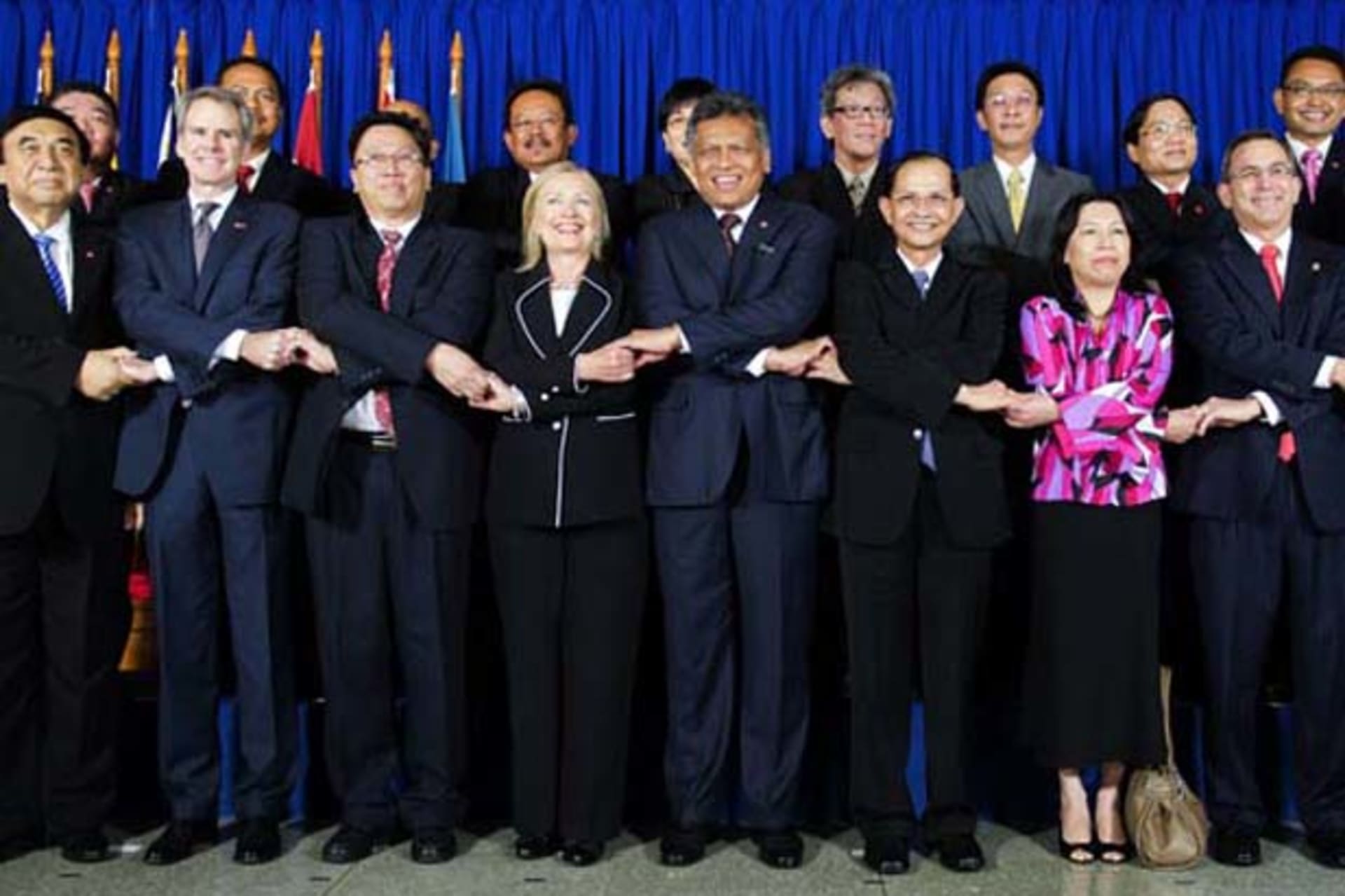
After ignoring the regional body during the 2000s, the United States has begun taking the organization seriously, appointing the first U.S. ambassador to ASEAN and signing ASEAN’s Treaty of Amity and Cooperation. During the administration of George W. Bush, regional officials often complained that the United States was AWOL. The Obama administration has reversed that impression, embracing the Transpacific Partnership (TPP), launching a U.S.-Indonesian Comprehensive Partnership, expanding defense links and naval exercises with Vietnam and the Philippines in the South China Sea, initiating a diplomatic dialogue with the nations of the Mekong River basin, and moving briskly to normalize U.S. relations with Myanmar.
President Obama should use this trip to deepen U.S. ties with ASEAN. Despite its obvious institutional flaws, Kurlantzick observes, “Over the past two decades, ASEAN has been the leader of East Asian trade, economic, and security integration.” To begin with, ASEAN’s more economically liberal nations have generated “a kind of regional free-trade arms race,” by signaling their willingness to pursue free trade agreements (FTAs) with non-ASEAN members. Likewise, ASEAN has accelerated the region’s financial integration, sponsoring with China, Japan and Korea the Chiang Mai Initiative in the wake of the Asian financial crisis. Finally, the annual ASEAN Regional Forum (ARF), although lacking formal mechanisms for conflict resolution, has provided an important venue to increase dialogue and confidence-building.
What is less clear is whether ASEAN, as currently structured, can address today’s emerging security, political, and economic challenges. The past year has witnessed extraordinary divisions not only between ASEAN and China, but also within ASEAN itself, over China’s sweeping claims in the South China Sea. Neither has ASEAN developed the will and capacity to handle an entire slew of non-traditional security threats, encompassing “drug trafficking, human trafficking, pandemic disease outbreaks, [and] terrorism,” nor shown any willingness to criticize human rights abuses among its member states. (Contrary to the assertions of ASEAN leaders, the body’s soft, speak-no-evil approach had zero impact on Myanmar’s recent political reforms, which were entirely internally generated).
ASEAN—a bloc comprising six hundred million inhabitants and some of the world’s most dynamic economies (responsible for 3 percent of global GDP)—has the potential to serve as an anchor of regional stability and prosperity in East Asia. But living up to this potential, Kurlantzick argues, will require ASEAN to face up to six major challenges:
The coming decade may be ASEAN’s time to shine—in part because of increased U.S. engagement. President Obama’s upcoming trip offers the United States a welcome opportunity to throw its weight behind ASEAN’s emergence as a more dynamic regional player, so that it can play a catalytic role in Asian integration.