The U.S.-Led Middle East Order Is Over. The Mecca Agreement Proves It.
A defense pact between Pakistan, Saudi Arabia, and Turkey shows how far U.S. influence in the Middle East has eroded—and how regional powers are now shaping their own security order.
By experts and staff
- Published
 Steven A. CookCFR ExpertEni Enrico Mattei Senior Fellow for Middle East and Africa Studies
Steven Cook is an expert on Arab and Turkish politics as well as U.S.-Middle East policy. He is the author of The End of Ambition: America’s Past, Present, and Future in the Middle East.
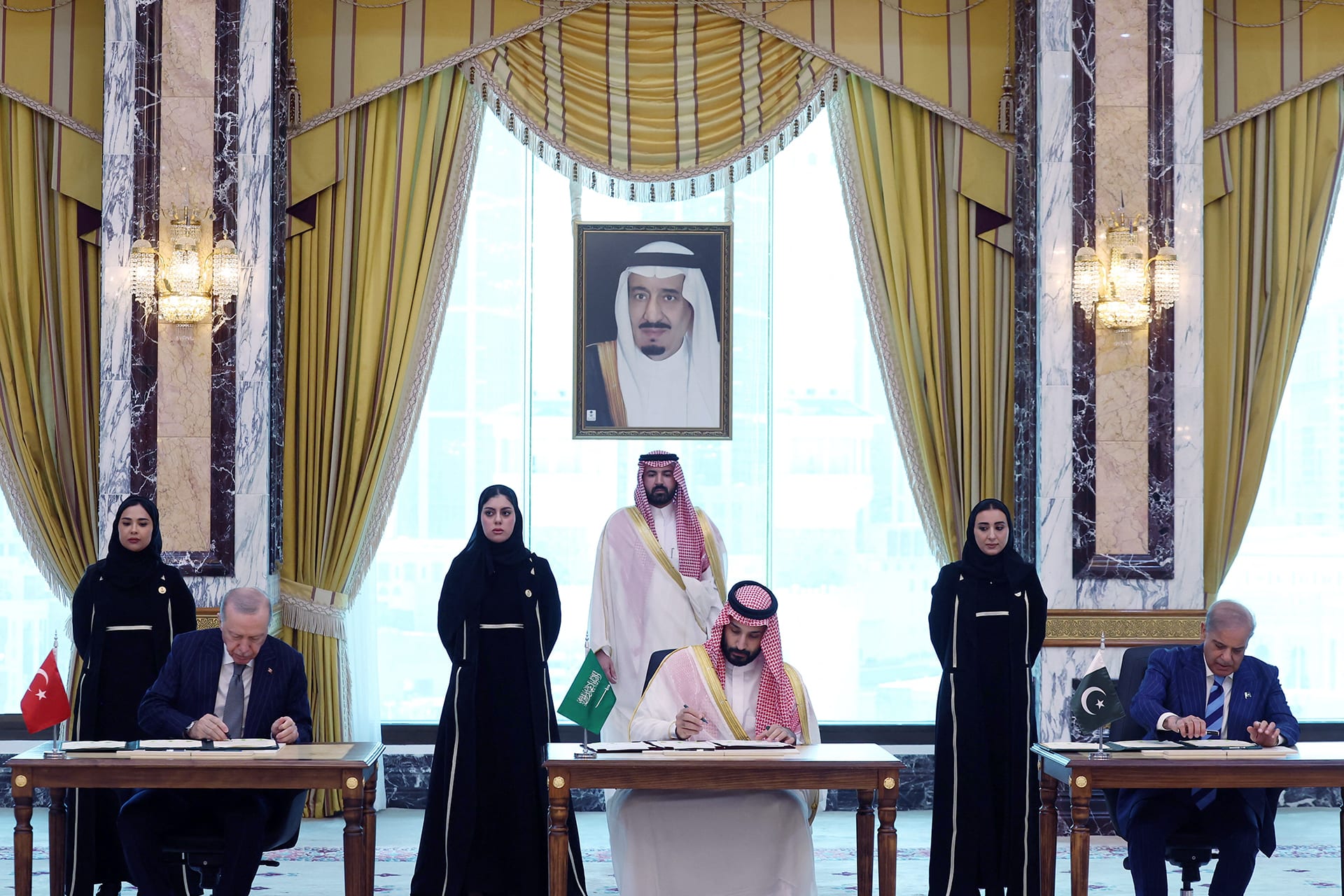
Pakistan, Saudi Arabia, and Turkey signed the Mecca Joint Defense Agreement on August 7. The parties have not released an official text, but reports indicate that the three countries have in essence agreed to a NATO Article 5-like clause—an attack on one signatory would be considered an attack on all of them. That security guarantee is significant as it enjoins Saudi Arabia and Turkey to come to Pakistan’s defense in the event of a war in South Asia, and presumably Saudi and Pakistani forces would join the fight should Israel and Turkey come to blows in Syria or the Eastern Mediterranean.
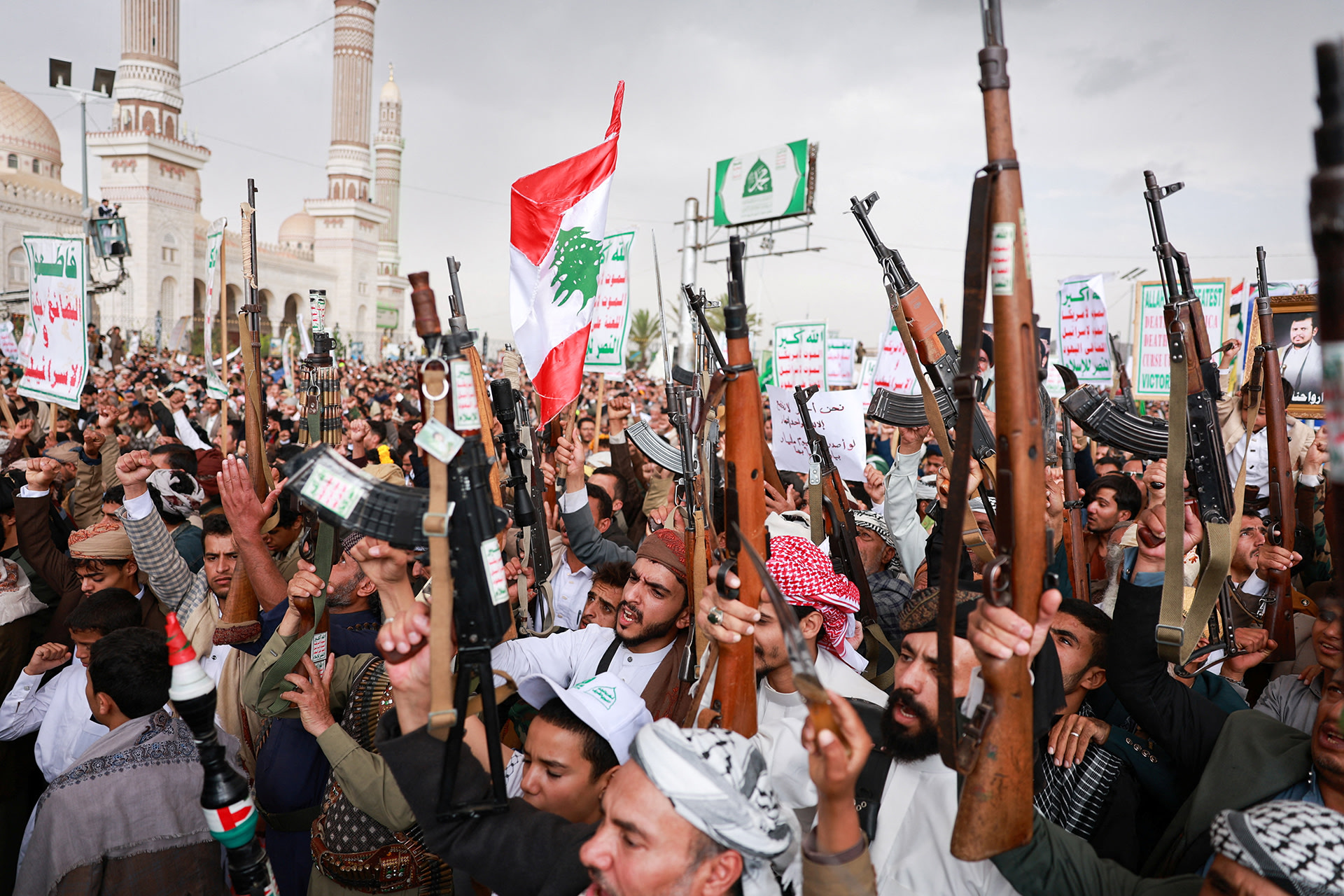
These commitments were tested only forty-eight hours after the signing ceremony when Ansar Allah (or the Houthis) fired on a Saudi Aramco oil refinery in the southwestern city of Jazan. Although Saudi Arabia has been under consistent fire from the Houthis since July 13, Saudi leaders did not call on their new partners for help. Perhaps this is because they do not believe the Houthi threat is grave. But what is more likely is that, despite the bold announcement of a new security pact, Saudi leaders did not believe that Turkish and Pakistani leaders were eager to join the fight on the Arabian Peninsula.
This does not diminish the Mecca Agreement because its importance does not lie in its security guarantees. Rather, it reflects a change underway in the Middle East’s regional order—one that reduces the United States’ decades long leadership role.
Since the 1970s, the United States has nurtured and led a regional order that has included Bahrain, Egypt, Jordan, Morocco, Qatar, Saudi Arabia, Turkey, the United Arab Emirates (UAE), and (de facto) Israel. Other countries, such as Oman and Kuwait, also played unique roles in this regional architecture. These relationships made it relatively easier and less expensive for Washington to pursue its core interests in the Middle East—preventing threats to the free flow of oil, helping to ensure Israeli security, and blocking any country or combination of countries from challenging American primacy in the region.
The United States was generally successful in achieving these goals, even accounting for some notable setbacks like the Arab oil embargo in 1973 and the Iranian Revolution in 1979, which toppled a friendly authoritarian. After the brief disruption of the global oil market and the deep recession it caused in the 1970s, oil was never effectively weaponized again, Israel’s safety was largely assured, and the United States remained the guarantor of regional security. All of this would have been harder—and cost significantly more resources—without the help of Washington’s regional partners.
The high-water mark of this regional order was perhaps thirty-five years ago, when the United States assembled a coalition to defend Saudi Arabia and restore Kuwait’s sovereignty after Iraq’s invasion and occupation of Kuwait. More recently, the order has been under stress due to the U.S. invasion of Iraq in 2003, U.S. support for protesters during the so-called Arab Spring, the United States’ unwillingness to take significant action to overthrow the regime of Syrian President Bashar al-Assad, Washington’s tepid-at-best support for Saudi Arabia’s intervention in Yemen’s civil war, President Donald Trump’s unwillingness to come to Saudi Arabia’s direct defense after Iran attacked oil facilities in the Kingdom in 2019, and Israel’s campaign in the Gaza Strip after the October 7, 2023, attacks. All have placed pressure on this regional order.
After inconclusive wars in Afghanistan and Iraq, the debate within the U.S. policy community—to which Middle Eastern leaders pay close attention—centered on the questions of withdrawal and retrenchment from the region. The idea that the Middle East was no longer important coincided with the notion that ensuring the flow of energy resources from the region was rapidly becoming a thing of the past. One version of this argument noted the significant increase in domestic oil and gas production, prompting some to suggest that a United States that no longer relied on Middle Eastern energy resources could walk away from the region. Another line of reasoning posited, rather simplistically, that protecting the region’s oil fields was unnecessary as the transition to alternative energy resources proceeded. The first argument conveniently ignored the fact that the energy markets are global and threats to it in one part of the world would still affect U.S. consumers. The second claim vastly underplayed the difficulty of decarbonizing the energy system and society more broadly.
Adding to the dissonance of the 2010s was the unpredictability of the United States, which came in two related varieties. Reflecting the political polarization of the United States, significant and abrupt shifts became a theme of U.S. policy in the region. In 2015, President Barack Obama agreed to the Joint Comprehensive Plan of Action (JCPOA) with Iran. His successor, Donald Trump, abrogated the nuclear agreement three years later after initially exploring ways to get back into the JCPOA. The United States promoted democracy in the region, then did not, before trying again after the Arab uprisings, and finally giving up on it. A values-forward approach to the region then followed, but this was abandoned when President Joe Biden discovered he needed Egypt’s help in Gaza in 2021 and Saudi Arabia’s flexibility on oil production in 2022. Regional leaders could once count on continuity in U.S. foreign policy, but over the last few decades they have been forced to contend with policy based on “anything but what the previous President did,” regardless of its wisdom.
Trump’s style of diplomacy, which relies on what his gut tells him and keeping his options open, has compounded U.S. unpredictability. As a result, in the ongoing conflict with Iran, the United States has toggled between force, threats of force, and negotiation. Washington’s regional partners often have no advance warning of Trump’s twists and turns and have paid a high price in the form of Iran’s willingness to target them in response to U.S. actions. Trump’s apparent impulsiveness has now left some in the region to wonder whether they will be left in the lurch to face an empowered Iran on their own.
There were moments when it seemed that old, U.S.-led order could be strengthened and developed. The Abraham Accords, the 2020 normalization agreements between Israel and Bahrain, Morocco, and the UAE, suggested a way forward. That agreement produced a “minilateral” of the United States, India, Israel, and the UAE that in turn spurred the idea for the India–Middle East–Europe Economic Corridor (IMEC) combined with the (unrealized) Israel-Saudi Arabia normalization. Altogether, this held out the prospect for institutionalizing much of what the United States had been encouraging its regional partners to do over the previous four decades. Hamas’s attack on Israel, Saudi-Emirati tensions over Israel, Sudan, and Yemen, and the war between the United States, Israel, and Iran fractured the region, however.
Fast forward to today, and the Saudis, who have clearly become concerned about the reliability of the United States, are now looking for other options—i.e., the Mecca Agreement. It is not important that the Turks and Pakistanis are unable to bring the kind of military power to bear that the United States possesses. The Saudis and their new security partners are seeking a new order that allows them, not Washington, to shape the region.
For Pakistan and Turkey—both U.S. partners who nevertheless chafe at the exercise of the United States’ power in their parts of the world—the Mecca Agreement enhances their influence in the Gulf at the expense of their own adversaries: India and Israel, respectively. Turkish President Recep Tayyip Erdoğan also has an ideological commitment to this new security pact, given the long-standing Turkish Islamist interest in a “Muslim NATO.” The Saudis and Turks have also gone further, proposing a redirection of the rail link that is part of IMEC. Instead of running from Jordan to Israel and then linking to Europe via Cyprus and Greece, goods would bypass Israel and continue from Saudi Arabia through Jordan and north to Syria and finally Turkey before being transshipped to the Europeans.
The U.S.-aligned regional order could now become a Middle East with two blocs: the countries that remained committed to the Abraham Accords and its alternative, the Mecca Agreement. Previously, regional rivalries and disputes were contained because leaders prioritized their relations with the United States, which was the tie that bound the regional order. Now, with the Pakistanis, Saudis, and Turks moving forward with a vision that competes directly with the Abraham Accords, that no longer seems to be the case.
This is a major change, and it is hard to overstate its significance. After five decades, it is no longer possible to talk about a U.S.-led order in the Middle East.
This work represents the views solely of the author(s). The Council on Foreign Relations is an independent, nonpartisan membership organization, think tank, and publisher, and takes no institutional positions on matters of policy.