China in Europe: February 2026
In February 2026, German Chancellor Friedrich Merz made his first official visit to China, and Chinese Foreign Minister Wang Yi used stops in Hungary and at the Munich Security Conference to argue that China and Europe are “partners, not rivals.”
By experts and staff
- Published
- Turner RuggiResearch Associate, U.S. Foreign Policy
Merz in China
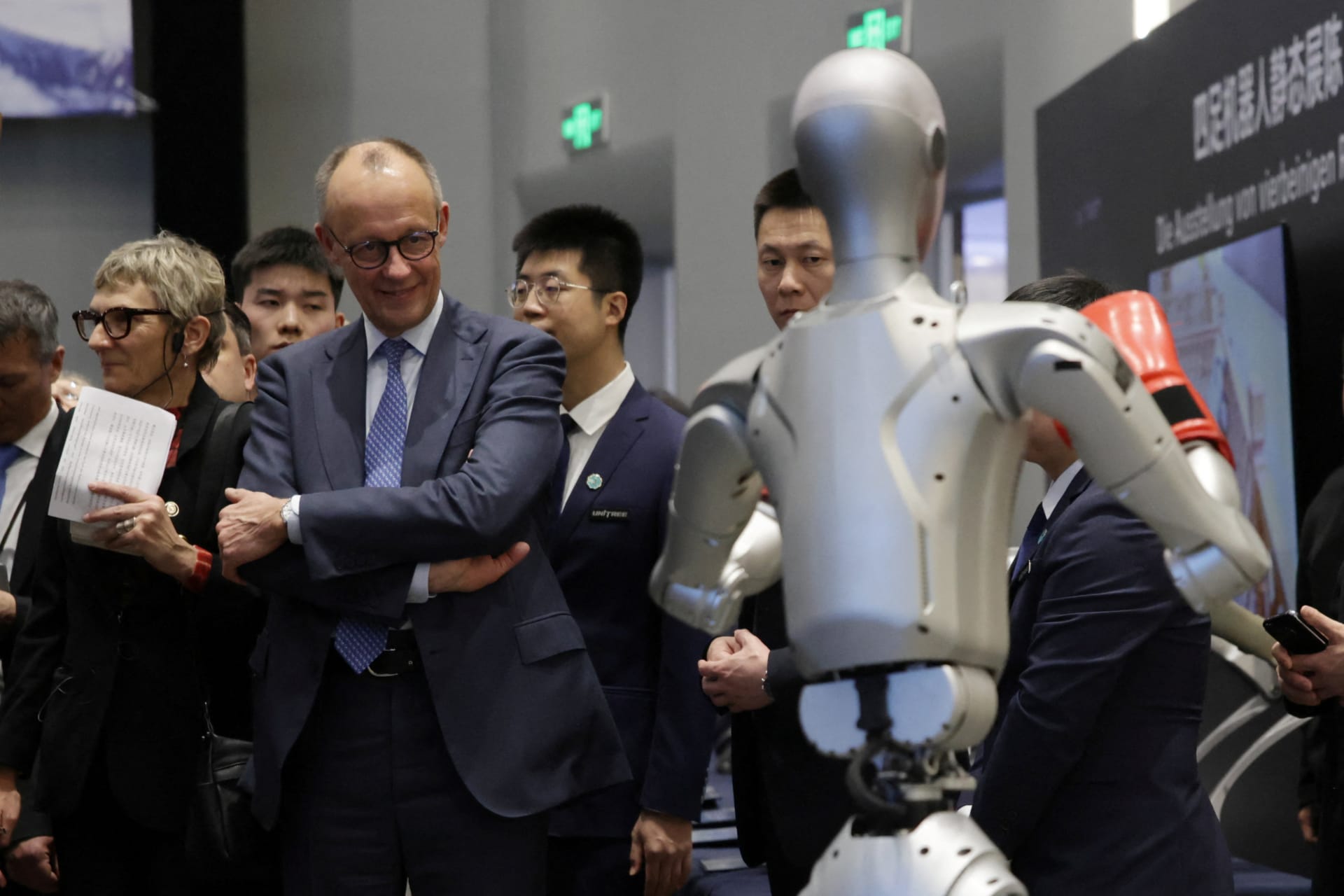
German Chancellor Friedrich Merz visited China from February 25 to 26 for his first official trip to the country. The German leader was joined by thirty top executives from firms such as Volkswagen, BMW, Mercedes-Benz, Siemens, Bayer, and Adidas. The German delegation met with Chinese business leaders, as well as Chinese President Xi Jinping and Premier Li Qiang. Merz notably did not refer to China as a “systemic rival,” a term which had upset Chinese officials when used by the previous chancellor, Olaf Scholz. Merz also visited robotics manufacturer Unitree and was shown a demonstration that included a self-driving Mercedes-Benz. Although the meeting was viewed as a step forward in China-Germany relations, tensions were evident: Merz openly addressed the “difficult issues” in the relationship, “relating to competition—China has high capacities, some of which are now also posing a problem for Europe because they far exceed market demand.” The German chancellor said he would launch regular government-to-government consultations with China in 2027 to address economic concerns. Germany’s trade deficit with China hit a record €90 billion in 2025, and German firms have accused Chinese companies of enjoying unfair advantages, including an artificially lowered exchange rate and state subsidies. Xi and Merz discussed Taiwan, as the German leader said any reunification with Taiwan should be done peacefully. On Ukraine, Merz added that “we know that signals from Beijing are taken very seriously in Moscow” in his plea for China to make more effort toward a ceasefire. A spokesperson for China’s foreign ministry called Merz’s visit “fruitful” and said that “practical cooperation is the biggest highlight in China-Germany relations.”
Munich Security Conference
On February 14, Chinese Foreign Minister Wang Yi delivered a keynote speech at the sixty-second Munich Security Conference in which he declared that “China and the EU are partners, not rivals.” When asked about China-Europe relations, Wang said, “Are there differences and disagreements between China and Europe? Of course there are. . . . Differences are not a reason to be adversaries, and divergences are even less a basis for confrontation,” and added that “China and Europe should all the more join hands to practice multilateralism, uphold the authority of the United Nations, oppose unilateralism and bullying, and resist bloc confrontation.” On the sidelines of the conference, Wang held meetings with German Foreign Minister Johann Wadephul, French Foreign Minister Jean-Noël Barrot, British Foreign Secretary Yvette Cooper, Austrian Foreign Minister Beate Meinl-Reisinger, and Serbian President Aleksandar Vučić.
Wang in Hungary
Before Wang’s trip to Munich, the Chinese foreign minister visited Budapest, Hungary, for his first European stop of 2026, where he met with Prime Minister Viktor Orbán and Foreign Minister Péter Szijjártó. Wang outlined five areas for deepening China-Hungary cooperation, including consolidating mutual trust, expanding mutually beneficial cooperation, enhancing people-to-people exchanges, promoting sound China-EU relations, and strengthening global governance. Wang praised Hungary as a “stellar example of a new type of international relations” and urged its leaders to create a “more favorable business environment” for Chinese enterprises. Szijjártó said Chinese companies made the most investments in Hungary in 2025 and that Hungary was the top European destination for Chinese investment. Orbán told Wang that investment from Chinese enterprises “has ranked first for years in a row” and highlighted the imminent opening of the Budapest-Belgrade Railway. The two sides also discussed the Ukraine crisis, with Szijjártó affirming that both countries are members of the Friends of Peace group.
Chinese Spies Caught
In Greece, a fifty-four-year-old air force colonel, identified as Christos Flessas, was arrested on February 5 at a military base near Athens on suspicion of providing classified and top-secret information to China, and has since confessed. The investigation began after a tip-off from the CIA to Greece’s National Intelligence Service. Greek authorities found a “special machine with software” supplied by China to photograph classified documents. The colonel was allegedly recruited by a Chinese official to send information related to NATO projects in exchange for payments. Meanwhile, in France, the Paris prosecutor’s office announced the arrest of four individuals (including two Chinese nationals) for possession of sensitive military data. The individuals installed a satellite dish on a rented Airbnb apartment to intercept “exchanges between military entities,” according to the Agence France-Presse. The investigation focused on whether they had been “handing over information to a foreign power” against France’s national interests.
Dairy Tariffs
China reduced tariffs on EU dairy products in February, suggesting China-EU trade tensions had softened. On EU dairy imports worth over $500 million, the tariffs range from 7.4 percent to 11.7 percent, effective for five years from February 13, replacing the 21.9–42.7 percent range previously introduced in December 2025. The dairy tariffs are widely viewed as part of China’s retaliatory response to the EU’s duties on Chinese electric vehicles. The EU exports approximately thirty thousand tons of cheese and one hundred thousand tons of cream to China per year.
WTO Dispute
On February 12, the European Commission requested the establishment of a World Trade Organization (WTO) panel to rule on Chinese practices that it says curb the intellectual property rights of EU companies. The dispute concerns patents that protect technologies essential for manufacturing goods that meet international standards, such as fifth-generation cellular network technology (5G) for mobile phones and Wi-Fi. The commission argues that Chinese courts have unilaterally set binding global royalty rates for non-Chinese patents, unfairly pressuring European high-tech companies to lower their royalty rates worldwide. Later in February, the EU trade Commissioner Maroš Šefčovič called for a reassessment of the WTO’s “most favored nation” rule, arguing it has been abused by China and led to concerning trade imbalances. The rule requires that WTO members receive the lowest tariff granted to one partner in the WTO to all other members. Under Šefčovič’s proposal, the low tariff rate would be linked to reciprocal market access. The European trade commissioner said, “There must be a clear link between [most favored nation] and the actual level of market openness.” The issue is expected to emerge at the next WTO ministerial conference, set to take place in Cameroon in March.