Dispatch from Munich: The Future of Transatlantic Relations
CFR President Michael Froman reflects on this year’s Munich Security Conference.
Over the last three days, I joined heads of state, foreign ministers, military officers, intelligence officials, businesspeople, journalists, and foreign policy scholars in Bavaria for the 62nd Munich Security Conference (MSC). Rather than wait until Friday, I thought I’d share some early impressions.
Security is the operative word at this confab. There are special entrances and exits to conference halls for the considerable number of participants who carry firearms. Balaclava-clad snipers man the local rooftops. Police helicopters regularly circle overhead, and one is occasionally cut off—or brushed aside—by hulking security guards who surround key leaders like Ukrainian President Volodymyr Zelenskyy in the modern equivalent of a Roman phalanx, working its way through the narrow hallways of the Hotel Bayerischer Hof.
I have yet to find another venue where generals from The Gambia, lawyers from The Hague, and CEOs from Silicon Valley sit shoulder to shoulder, sipping espressos and sometimes a pint of München Hofbräu, without batting an eye. Indeed, when I went to watch the Representative Alexandria Ocasio-Cortez make her MSC debut, the seats in front of me were packed with young German military officers, glasses of wine in hand, eager to hear from the congresswoman. I even witnessed a prominent European minister and an African businessman smoking old-school billiard tobacco pipes between meetings. It reminded me of poking my head into my father’s smelly study when I was a kid.
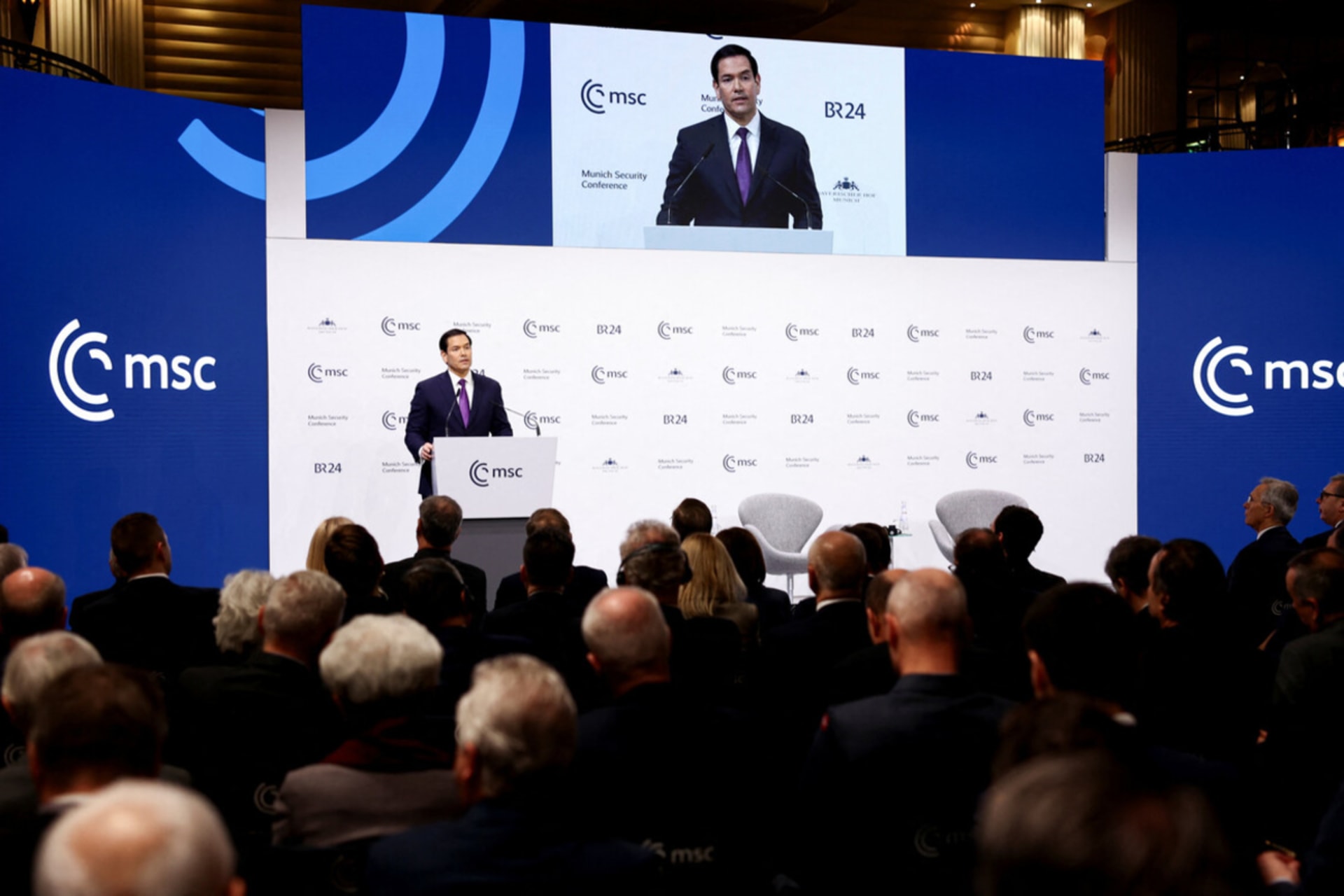
The tight security and colorful cast of characters somewhat belie the wonkish programming: roundtables, town halls, tabletop exercises, and policy speeches. But the start of this year’s conference was profoundly tense. Thousands of attendees, many of them avowed transatlanticists, waited with bated breath inside the crammed halls of the Hotel Bayerischer Hof for U.S. Secretary of State Marco Rubio to deliver his address. Would it emphasize a recalibration but reaffirmation of NATO or another step toward a transatlantic divorce?
Many of my European friends fretted that Rubio would deliver a fiery polemic like JD Vance last year and permanently rupture the transatlantic alliance. Then, on Valentine’s Day, the clouds parted, and Rubio delivered a bouquet of flowers, albeit with a few thorns, instead. By the next day, those same friends were asking themselves whether Europe would be lulled back into a sense of complacency by Rubio’s lack of venom.
That Rubio’s speech was met with a robust standing ovation from European and world leaders was noteworthy, given his reference to some of the same concerns the administration has expressed about the state of European civilization. One German business leader described his address as a redux of Vance’s controversial remarks at last year’s MSC, only written in the tone of a Hallmark card.
Rubio did not pull his punches. He made clear that the United States expects Europe to take principal responsibility for the conventional defense of the continent sooner rather than later. He further lambasted the “broken status quo,” the “pursuit of a world without borders,” and the “dogmatic vision of free and unfettered trade” that caused “deindustrialization” and “stripped our nations of their wealth.”
So why the big sigh of relief?
What comforted worried attendees was the undertone of the secretary’s remarks. Rubio cast the Trump administration’s myriad frustrations with Europe as tough love—as exercising the United States’ duty of care toward an ally it was bound to and could never give up on. As Rubio proclaimed, “our destiny is and will always be intertwined with yours, because we know that the fate of Europe will never be irrelevant to our own.” He added, “in a time of headlines heralding the end of the transatlantic era, let it be known and clear to all that this is neither our goal nor our wish—because for us Americans, our home may be in the Western Hemisphere, but we will always be a child of Europe.” Message: “we care deeply.”
That language is reminiscent of rhetoric used by every administration since WWII. In other words, the family would stay together—but require expensive therapy, for which Europe must foot the bill.
Rubio’s colleague, U.S. Under Secretary of War for Policy Elbridge Colby, revealed in his remarks at the conference, that—having experienced the “near-death” experience of NATO, Europe was finally moving from a world in which it depended blindly on the collective security provisions of NATO’s Article V to a world defined by the individual responsibility of Article III. That is, the obligation of each NATO member state to “maintain and develop their individual and collective capacity to resist armed attack.” Hence the Trump administration’s call for “allies who can defend themselves so that no adversary will ever be tempted to test our collective strength.”
Whether Europe will actually undertake the reforms that both it and the United States proclaim are urgently needed is another question. If I had a euro for every time European leaders vowed to complete the European project and achieve strategic autonomy, well, I could buy a lot of Bavarian pretzels.
But at least the Europeans were singing the right tune this weekend, and with renewed vigor. On the main stage, French President Emmanuel Macron declared that “Europe has to learn to become a geopolitical power,” and German Chancellor Friedrich Merz stated an end to Europe’s “vacation from history.”
European Commission President Ursula von der Leyen, UK Prime Minister Keir Starmer, Macron, Merz, and others are increasingly championing a shared vision for a strong Europe capable of defending itself; an economically and technologically vibrant Europe capable of competing globally; and an independent Europe, free from hegemonic designs of Russia, China, and even the United States, and able to build distinct relationships with other powers, such as India.
In Munich, these ambitions were accompanied by striking proposals: a joint French-British-German nuclear deterrent for Europe; a “two-speed” European Commission designed to circumvent bureaucratic inertia and the politics of consensus; a revitalized European defense industrial base equipped with precision deep-strike capabilities and next-generation fighter aircraft; a bloc-wide capital markets union; sovereign cloud and AI capabilities; and more.
But most of these proposals are not new, and the political and structural barriers to achieving these goals cannot be understated.
We should also remember that Europe is not out of the woods with respect to the Trump administration’s grievances. Trump has yet to announce any withdrawal of U.S. forces from the continent, but that is assumed to be coming. A diplomatic storm is brewing over Europe’s stringent regulatory approach toward American technology companies. Domestic elections in France and Germany could attract unwanted attention—or intervention—from the president. And differences remain on both sides of the Atlantic on questions of free speech, migration, and trade.
There is no surefire method, besides time, to rebuild transatlantic trust after President Trump threatened to violate the sovereignty of the Kingdom of Denmark in his pursuit of Greenland. I was grateful that, unlike in Davos, Greenland did not suck up all the oxygen in Munich, but I cannot overstate the degree to which this episode continues to loom large in the perceptions of Europeans as to whether the United States is a reliable partner, even after Rubio’s speech.
Then, there is Ukraine.
At the conference, Western intelligence and military officials revealed their latest estimate of Russian casualties: 65,000 over the course of December and January. That’s about 1,000 per day. The Russians are not winning the conflict, which has now lasted longer than the Great Patriotic War and resulted only in Russian control of an incremental 12 percent of Ukraine since the full-scale invasion. Russia stands little chance of winning the war and achieving their maximalist territorial, political, and military objectives.
The trouble, however, is that Ukraine and its Western allies have no coherent strategy for winning the war either. In practice, our current strategy is to hope that Putin will eventually give up his imperialist ambitions and seek a reasonable settlement. The casualty count means Putin might finally have to start conscripting men from Moscow and St. Petersburg. The Russian economy continues to deteriorate. Perhaps these factors will lead to a change in the politics back home, but given Russian history, we should probably not underestimate Russians’ tolerance for pain.
The United States wants to negotiate peace now—or, in the words of U.S. Ambassador to NATO Matthew Whitaker, to fight until negotiations are impossible—which raises the question what happens then. Thus far, the current administration is unwilling to provide Ukraine with the material support required to change the correlation of forces on the ground and force Putin’s hand.
The Europeans would like to take a more aggressive approach to supporting Ukraine, but they lack the capabilities themselves to do so. European leaders, including Macron, also proclaimed at MSC that they must play an integral role in securing any eventual peace in Ukraine, including with respect to security guarantees. But, as Zelenskyy made clear, Russia has little respect for Europe. So, Europe might not be in the room where it happens but ultimately have to pay for and secure whatever is negotiated there.
Finally, there is the China question, which was the source of much debate. Will Europe derisk from the United States by pursuing more robust ties with Beijing, particularly on trade and technology? European leaders, including Merz and Macron, have certainly feinted in this direction, with the former set to lead Germany’s largest-ever delegation—including a record number of German CEOs—to the Middle Kingdom next week. But I am dubious that the right response to being wary of the United States is to ignore the facts underlying the challenge China poses to Europe’s manufacturing and, with China’s active support of Russia’s war against Ukraine, Europe’s security.
Interestingly, for the second year in a row, Chinese Foreign Minister Wang Yi squandered a golden opportunity to outmaneuver the United States in Munich. Instead of deepening transatlantic fissures by laying out a concrete framework for cooperation with Europe and positioning China as the more “stable” superpower, Wang’s mainstage appearance will be remembered for his fiery rebuke of Japan’s new prime minister. Japan, Wang said, “has lingering ambitions for invasion and colonialism of Taiwan, and the ghosts of militarism are still haunting the country.” It felt like a reprise of wolf warrior diplomacy.
To end on an optimistic note, I found myself in several discussions about what concretely could be done over the next year to make progress on this array of challenges. One issue came up repeatedly: cooperation between the United States, Europe, and others in pursuing innovative ways to reduce dependence on China for critical minerals. See CFR’s recent report on this issue.
President Obama had a sign on the Resolute Desk in the Oval Office which read, “Hard Things Are Hard.” Making progress on any number of these hard issues—from reforming Europe to securing Ukraine to reducing dependence on China—could create some much needed confidence and momentum in Europe. Let’s hope we have progress to report on by next year’s visit to Munich.
Let me know what you think about the Munich Security Conference and what this column should cover next by replying to [email protected].