Energy Security: Back to the Future
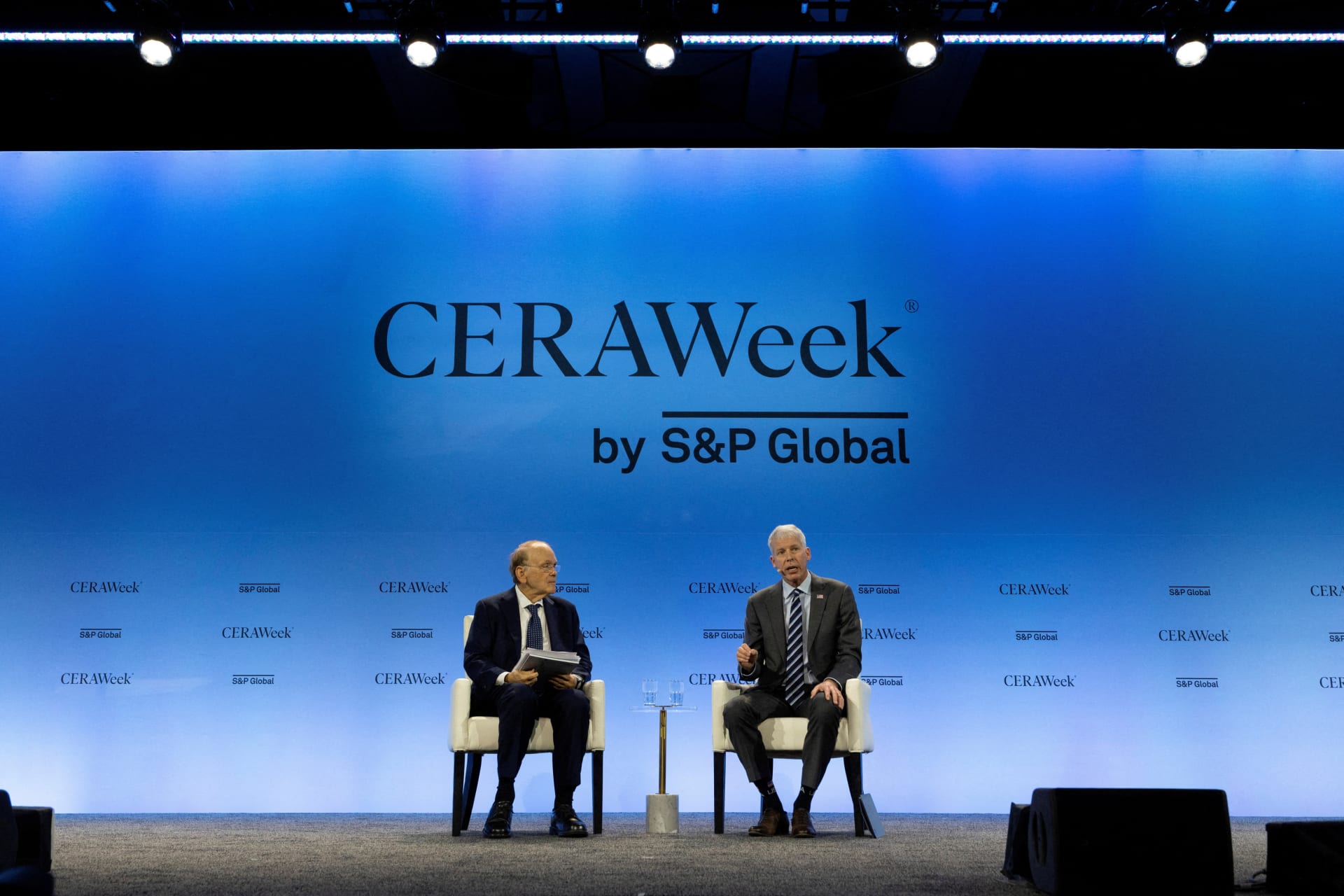

Every year, CERAWeek gathers the most influential leaders across the energy sector from industry, government, academia, and nongovernmental organizations. This year, unsurprisingly, the dramatic impact of geopolitical instability coursing through energy markets infused the zeitgeist of the entire week among its eleven thousand participants. As CERAWeek founder Daniel Yergin explained many years ago in his Pulitzer Prize–winning classic The Prize, energy and security issues have long been tightly intertwined. Conference-goers and main-stage speakers alike parsed and re-parsed the countless variables emerging from the war in Iran and the post–Nicolás Maduro leadership in Venezuela. Navigating global unpredictability at a time of exploding energy demand is the name of the game.
Facing such volatility, U.S. officials drove home the Trump administration’s “energy pragmatism” approach, while attempting to assuage market concerns regarding the largest oil shock in history. Secretary of Energy Chris Wright maintained that it is now more important than ever to focus on reliability and affordability in energy supply. That focus on reliability—as well as the dominance agenda underlined by U.S. Interior Secretary Doug Burgum—highlighted the growing importance in the global energy stack of nuclear and natural gas. Wright described natural gas as “America’s superpower”—the United States is the world’s largest exporter—and nuclear as critical to American energy preeminence, with emerging small modular reactor and fusion technologies as strategic priorities. Marking a major pivot in European attitudes, German Federal Minister for Economic Affairs and Energy Katherina Reiche plainly stated that Germany’s phaseout of nuclear energy in the past fifteen years was a “huge mistake” and that the “only way to secure [energy] supply is gas.”
Reiche added that “we concentrated on climate protection, we underestimated affordability. That was a mistake, and that we’re going to correct.” The expanded role of nuclear and natural gas ascendancy in the energy dialogue overshadowed past years’ emphasis on climate and efforts to achieve net zero emissions by 2050. Renewables remained an important part of the conversation on how to meet escalating power demand but have lost their primacy of place in U.S. policy. Epitomizing that change was Burgum’s on-stage signing of an agreement with TotalEnergies to cancel $1 billion in federal offshore wind leases and redirect those investments into U.S. oil and natural gas.
Casting further uncertainty over the role of renewables was anxiety over Chinese dominance in the supply chain for the critical minerals underpinning battery and other clean technologies. Beijing has shown a willingness to weaponize its control already, stoking concerns that the shift from hydrocarbons to renewables would expose vital energy supplies to possible cutoffs or coercion. The search for alternatives to—and relief from—Chinese domination is full on. Burgum, just back from Caracas, argued that Venezuela’s “potential [for critical minerals] is huge.” Efforts to expand and diversify sources of the wide array of critical minerals essential to the energy transition will likely gain further momentum, along with concerted efforts to escape the daunting problems caused by Beijing’s domination of downstream processing capabilities.
Demand-side concerns also came to the fore against the backdrop of increases in energy demand fueled by artificial intelligence (AI), prompting dialogue on electricity capacity and grid reliability. Constellation CEO Joseph Dominguez maintained that the war raging in the Middle East threw agreements to build data centers in the region into question. Corporations could respond by relocating projects from volatile regions to the United States. That would further intensify pressures to build out power generation domestically, which would surely require an all-of-the-above strategy in terms of the technologies deployed to meet the need.
So while today’s harsh realities reminded CERAWeek participants just how inextricably our energy future is linked to geopolitics, the geology of hydrocarbons and vulnerability of transportation routes ensure that there will be no easy solutions. Increasing energy security vulnerabilities at a time of burgeoning energy demand globally, driven not only by AI but also the rapidly growing needs of emerging economies, will clearly drive investment and policy decisions more powerfully than did the climate concerns of just a few years ago, especially in the United States. The silver lining could be that a more pragmatic approach to implementing clean energy solutions, including through smarter demand management and the expansion of nuclear energy, could mitigate climate effects more effectively than past climate orthodoxies that proved both hard to sell to cost-conscious stakeholders and vulnerable to reversal and political backlash.