“The Euro Crisis Is Dead! Long Live the Euro Crisis!”
By experts and staff
- Published
 Benn SteilCFR ExpertSenior Fellow and Director of International Economics
- Dinah WalkerAnalyst, Geoeconomics
You’ve got to hand it to Mario Draghi. Never in the history of central banking has one man accomplished so much with so few words and even less action.
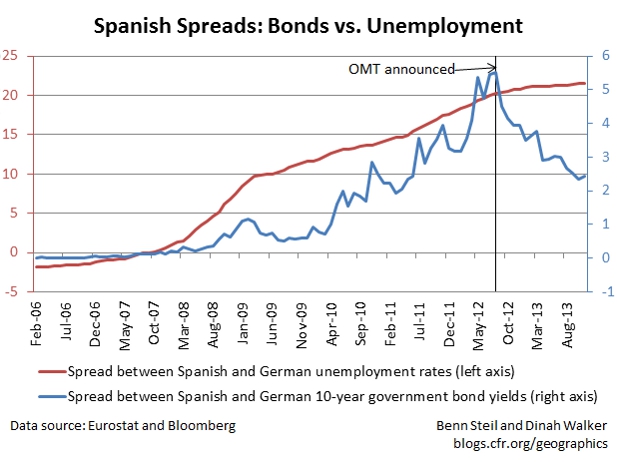
Since having announced the creation of the Outright Monetary Transaction (OMT) program in August 2012, Draghi has had the pleasure of sitting back and watching yield spreads between Spanish and German government bonds fall relentlessly without having to buy a single bond. Italian spreads have done the same.
If only it were this easy to repeat the trick for unemployment, the spread for which has widened steadily over this period—as shown in the graphic above.
Not surprisingly, Spaniards are unimpressed with the eurozone’s contribution to the country’s well-being. According to a recent Pew survey, only 37% of Spaniards think the Spanish economy has been strengthened by European economic integration. The corresponding figure in Italy and Greece is a mere 11%.
Here’s the rub. Draghi himself seems to believe that such economic integration is an important element in the eurozone’s long-term survival—central bank action is not enough. This is why OMT assistance is actually conditional on the country being on an EU-approved reform program. “There are clear limits to what monetary policy can and should aim to achieve,” he told an audience in Munich last February. “We cannot solve deep-rooted problems in the structure of Europe’s economies.”
The euro crisis is not over.
Read about Benn’s latest award-winning book, The Battle of Bretton Woods: John Maynard Keynes, Harry Dexter White, and the Making of a New World Order, which the Financial Times has called “a triumph of economic and diplomatic history.”