Gauging the Impact of Massive U.S.-Israeli Strikes on Iran
CFR experts assess the brewing conflict between the United States, Israel, and Iran, following the launch of a joint U.S.-Israeli military operation on February 28.
By experts and staff
- Updated
 Ray TakeyhCFR ExpertHasib J. Sabbagh Senior Fellow for Middle East Studies
 Elliott AbramsCFR ExpertSenior Fellow for Middle Eastern Studies
 Steven A. CookCFR ExpertEni Enrico Mattei Senior Fellow for Middle East and Africa Studies
 Linda RobinsonCFR ExpertSenior Fellow for Women and Foreign Policy
 Max BootCFR ExpertJeane J. Kirkpatrick Senior Fellow for National Security Studies
 Elisa EwersCFR ExpertSenior Fellow for Middle East Studies
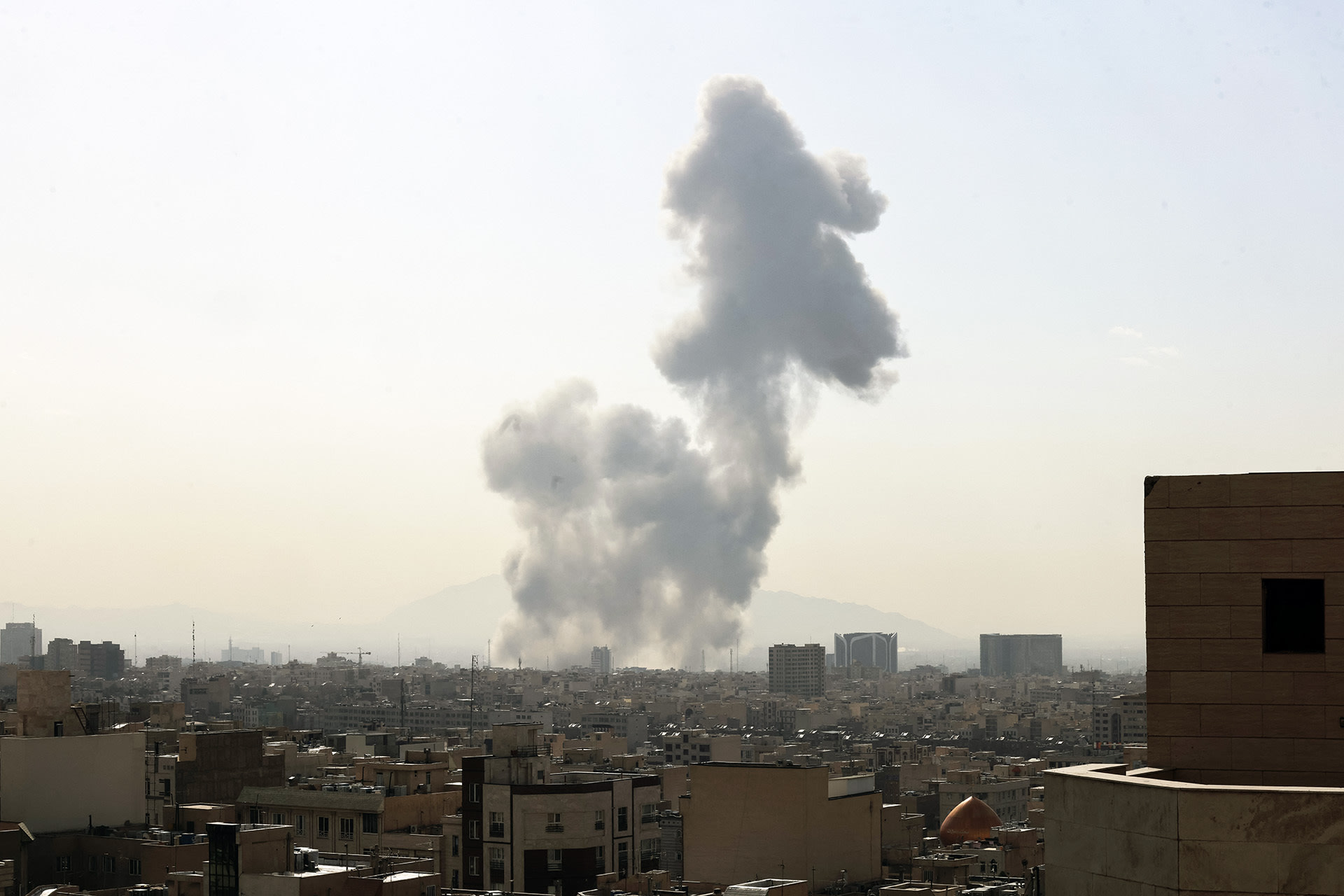
The United States and Israel launched a major assault on Iran on February 28 with the stated aim of toppling the regime in Tehran. President Donald Trump said that the U.S.-led operation would seek to eliminate Iran’s nuclear and missile programs, destroy the country’s navy, and change its leadership. Addressing the Iranian public in an early morning video that announced the strikes, Trump said that the country “will be yours to take. This will be probably your only chance for generations.”
Trump confirmed that Iranian Supreme Leader Ayatollah Ali Khamenei had been killed in the assault late on Saturday afternoon, and he alleged that much of Iran’s senior leadership was also dead. Israeli security officials had indicated earlier in the day that the ayatollah had been killed after his secure compound was bombed and shared the news of several other senior leaders’ deaths. Iranian media had maintained that Khamenei was alive and “steadfast and firm in commanding the field,” but they later acknowledged that he and members of his family had been killed.
“Iran considers it its legitimate duty and right to avenge the perpetrators and masterminds of this historic crime,” Iran‘s President Masoud Pezeshkian said about the ayatollah’s death.
Iran retaliated against the initial assault quickly, firing missiles at Israel and U.S. military bases in multiple Gulf states. The governments in Bahrain, Kuwait, Jordan, Qatar, and the United Arab Emirates all said they have been targeted. Iran’s Revolutionary Guard Corps vowed revenge for the killing of the regime’s longtime leader and launched another wave of strikes across the region on Sunday.
To better understand the potential fallout, CFR experts provided their assessments of the brewing conflict shortly after the U.S. and Israel launched the attack.
The Attack on Iran Will Not Kill the Islamic Republic
Ray Takeyh is Hasib J. Sabbagh senior fellow for Middle East studies at the Council on Foreign Relations.
Bombing a regime into extinction is rarely an effective strategy.
The United States and Israel have launched another wave of attack on Iran. The scale of this assault and who remains alive in the Iranian leadership are yet to be determined. But the Islamic Republic is an ideological system with a multi-layered elite and base of support. That support may have shrunk in the past few years, but it still provides the regime with a cadre prepared to use force to maintain power. The suppression of the recent uprising demonstrated that defeat abroad does not translate to weakness at home. The theocracy will likely survive the latest bombing—battered and bruised, but standing.
It is time to say farewell to arms control. The fact is that the Iranians were engaged in serious negotiations with U.S. officials. News accounts indicate that Iranian Foreign Minister Abbas Araghchi had tabled proposals that called for the suspension of uranium enrichment for several years before allowing it to then resume at low levels. Perhaps more could have been extracted from Iran if diplomacy had more time than a mere two weeks and two sessions. The Iranian side was trying to be imaginative in addressing U.S. concerns. All this has now ended, as the Trump administration opted for military attacks while the talks were unfolding. It would not be unreasonable for Iranian officials to assume that diplomacy was a mere ruse before the bombs fell.
Iran’s clerical leaders had to respond. Reports indicate they have targeted U.S. bases in the region, as well as Israel. It will take some time to assess the full scope of their attacks and whether there were any U.S. casualties. Should American soldiers die, then the administration will face significant pressure to strike Iran again as punishment for its conduct.
An escalatory cycle can only end if cool heads prevail, and there is little evidence today that there are cool heads in either capital.
Iran Strikes Highlight Exceptional U.S.-Israeli Coordination
Elliott Abrams is senior fellow for Middle Eastern studies at the Council on Foreign Relations. He previously served as a special representative for Iran and Venezuela in the first Trump administration.
Israelis are spending another day in bomb shelters to protect themselves from Iranian attacks, but this time is different.
First, the Iranian salvos follow a carefully planned, simultaneous U.S.-Israeli operation. Israeli sources have said that the date of the attack was agreed upon two weeks ago. The ongoing and exceptionally close cooperation between the U.S. military and the Israeli Defense Forces—and between President Donald Trump and Prime Minister Benjamin Netanyahu—has reached a new high. The safest assumption is that the joint Trump-Netanyahu decision to attack Iran was made during Netanyahu’s visit to Washington two weeks ago.
Second, the objective is not to merely degrade the Iranian nuclear weapons sites or hit its missile launchers, but force regime change. Trump was clear about that in his first statement. This marks a profound change in stated Israeli and U.S. goals: while the fall of the regime has long been wished for, it has never been the objective of a joint military campaign, nor has any U.S. president so directly called upon Iranians to rise up. Iran is the greatest security threat to Israel, so this change in U.S. objectives will be warmly welcomed.
Third, this is a campaign, not a one-off strike. No end date has been set, so Israel can likely count on U.S. involvement until hostilities cease.
For Netanyahu, the joint campaign is another display of his close relationship with Trump, and it will strengthen the Israeli leader politically. This is an election year in Israel, and a successful joint operation against Iran will help Netanyahu maintain the sense, for many Israeli voters, that he is uniquely positioned to deal with Israel’s enemies.
Israel is being hit with everything Iran can throw at it, including waves of missiles and drones, and there will be damage and casualties. Israelis know that their much-vaunted and highly effective air defenses are not impenetrable. Given Iran’s strikes on U.S. military targets based in neighboring Gulf countries, Israelis will assume that no targets in their country are off-limits, including purely civilian sites such as office buildings or hospitals. They know the coming week will be extremely difficult, and already their country is isolated by the closure of its air space and airports.
In a deeper sense, however, Israel is not alone. Not only is it in a close partnership with the United States, but also with several of their Arab neighbors—including Bahrain, Kuwait, Qatar, and the United Arab Emirates—who are also under attack by Iran. Together, these countries share a common adversary and will have much to discuss through in diplomatic, intelligence, and military channels about Iran’s attacks and its postwar future. Israelis will wonder today whether, after decades hearing the Iranian regime shout “Death to Israel,” a new era is coming in the Middle East.
Iran’s Arab Neighbors, Targeted in Reprisals, Brace for Iranian Instability
Steven A. Cook is Eni Enrico Mattei senior fellow for Middle East and Africa studies at the Council on Foreign Relations.
Unlike the U.S. strikes on Iran’s nuclear facilities in June 2025, President Donald Trump’s Operation Epic Fury seeks to topple the Islamic Republic. It is a risky strategy given the enormous challenges of trying to engineer regime change from thousands of miles away. The president clearly hopes that the large numbers of Iranians who have been in revolt against their government for some time will take matters into their own hands and bring an end to clerical rule.
The uncertainty of both military operations and regime change has left governments in the region on edge. Ahead of U.S. military operations, Gulf states made clear they would not participate in any attack on Iran, though they are likely providing technical assistance to the United States given their responsibilities as U.S. Central Command partners.
As is often the case, regional governments’ positions are more nuanced than their public pronouncements would suggest. The leadership of Saudi Arabia and the United Arab Emirates (UAE) do not want to get dragged into a conflict and are concerned that potential chaos in Iran will affect the trillion-dollar bets they are making on their domestic transformations. Yet they are hardly supporters of the Iranian regime. After the Iranians retaliated this morning with attacks on Bahrain, Jordan, Kuwait, Qatar, and the UAE—which all host U.S. military personnel—the Saudis condemned Iran and offered to put their “capabilities at the disposal in support of any measures [the Arab states] may undertake.” The Emiratis intercepted Iranian ballistic missiles and have reserved the right to respond. No one in any leadership position in Abu Dhabi or Riyadh will lament the passing of the Iranian regime should the Islamic Republic fall.
Doha has had better relations with Iran than other Gulf states, but Qatar issued a strong condemnation of Iran’s retaliatory strikes on its territory. Relations between the two countries were already strained after Iran fired on Al Udeid Air Base (near Doha) last summer. Still, Qatar will continue to share a massive gas field with Iran and thus must manage the bilateral relationship. For its part, Oman’s government condemned the U.S. military operations. Its foreign minister, Badr bin Hamad al-Busaidi, was in the United States on the eve of military operations lobbying the Trump administration against an attack.
Uncertainty will be the watchword for Gulf leaders in the coming days, weeks, and months. Now that military action has begun, their greatest fear is likely the survival of the Iranian regime. They do not want a weakened, vengeful regime as a neighbor.
Regime Change Is Risky, and More Than the Ayatollah
Linda Robinson is senior fellow for women and foreign policy at the Council on Foreign Relations. She has testified before Congress on special operations, the Iraq war, and the Middle East.
Taking out Iranian Supreme Leader Ayatollah Ali Khamenei is not the same as regime change. The Islamic Revolutionary Guard Corps (IRGC) is the regime.
The risks of war are high if U.S. President Donald Trump holds fast to the goal of regime change, because there is very little likelihood of achieving it with air strikes alone. The unarmed Iranian people do not have the means to topple a sophisticated and deeply entrenched repressive military apparatus like the IGRC.
The risks increase exponentially if, in an effort to achieve that goal, U.S. ground forces are deployed to Iran. This is a scenario that U.S. military uniformed leadership has reportedly argued would incur very high casualties and likely risk failure.
So either the president has to climb down from the objective or risk a long, punishing, and possibly unsuccessful campaign.
The president may be tempted to deploy U.S. special forces that were successful in Venezuela because they were used in a direct action raid mission to capture and extract Nicolás Maduro. But if those forces were used to uproot the IRGC they would suffer massive casualties. That could lead to calls for larger and larger deployments. Once in, the risk of mission creep could grow—as occurred in Iraq after the 2003 invasion—as both political and military leaders would seek to achieve the declared objective.
The best-case scenario is that the president will choose to mitigate the risk by declaring victory if the Israeli removal of Khamenei is confirmed, and backtrack to focusing on a nuclear threat reduction deal as was being negotiated.
There are numerous other risks in the event that the United States does not seek a quick off-ramp. Most obviously, the IRGC network could conduct various types of attacks against U.S. personnel and regional bases and the reach could be quite beyond the region, including inside the United States.
If the president were to decide to rely more heavily on Israeli ground operations, that would pose risks as well, stoking the already strong concern among Arab states that do not want to see a prolonged war in the region.
Already, the optics of the United States and Israel jointly going to war in Iran are not sitting well with countries and the public in the region. Those governments and public are in fact quite concerned about the costs of war to their stability, lives, economy, and military capability. The risk of a setback to U.S. standing in the Middle East is high and potentially long-lasting.
Trump’s Ambitious War Aims Can’t Be Achieved With Air Power Alone
Max Boot is the Jeane J. Kirkpatrick senior fellow for national security studies at the Council on Foreign Relations.
It’s easy to start a war. It’s very hard to end one successfully.
That is a lesson that President George W. Bush learned in Iraq and Afghanistan—and previous presidents before him, in places ranging from Vietnam to Somalia. It is a lesson that President Donald Trump is likely to learn anew in Iran.
In lieu of a prime-time address or a speech to Congress—which is what past presidents have done before starting a war—Trump posted an eight-minute video at 2:30 a.m. Eastern on Saturday laying out his war aims. His goals include:
- “We are going to destroy their missiles and raze their missile industry to the ground.”
- “We are going to annihilate their navy.”
- “We are going to ensure that the region’s terrorist proxies can no longer destabilize the region or the world and attack our forces.”
- “We will ensure that Iran does not obtain a nuclear weapon.”
- “The members of the Islamic Revolutionary Guard, the armed forces, and all of the police… lay down your arms…. To the great, proud people of Iran…. take over your government.”
These are very ambitious objectives, and most of them cannot be achieved by air power alone. It is certainly possible to destroy most of Iran’s missiles, most of its navy, and most of its nuclear program with bombs and missiles. But what is to prevent Iran from rebuilding those capabilities the second that U.S. and Israeli bombs stop falling? Recall that Trump said that Iran’s nuclear program was “totally obliterated” last June, yet eight months later he is claiming the regime remains enough of a threat to justify U.S. military action (even though there is no evidence of Iran restarting enrichment).
Trump’s third objective—ensuring that Iran will no longer support “terrorist proxies”—is even harder to achieve. As long as Iran has the capability to export oil (and it does, despite U.S. sanctions) it will generate revenues sufficient to support Hezbollah, the Houthis, and other proxy groups.
The only thing that would make Iran stop supporting those organizations would be if the current clerical regime falls and is replaced by a liberal democracy. With his final war aim, Trump is signaling that he is pursuing regime change, but his approach is halfhearted. Ensuring the downfall of Iran’s government would require a ground invasion, which Trump has not ordered. Instead, he is hoping that U.S. air strikes—particularly if they killed Iranian Supreme Leader Ayatollah Ali Khamenei and other senior leaders—will galvanize another uprising. Perhaps security forces will lay down their arms this time, rather than slaughtering protesters as they did in January. Perhaps not.
But hope isn’t a strategy, and it’s not clear that Trump actually has a plan to achieve regime change. Keep in mind that the U.S. intelligence community assessed prior to the start of hostilities that, even if Khamenei is killed, his likely successors will be hardline leaders from the Islamic Revolutionary Guard Corps—the very people who oversee Iran’s terrorist networks along with its nuclear and missile programs.
So the odds of Trump achieving all, or even most, of his objectives are remote, while the risks of miscalculation—resulting in a lengthy, indecisive conflict—are high. There are good reasons why previous presidents were reluctant to become embroiled in a war with Iran. Trump has ignored all the caveats. Now he will have to deal with the fallout from the biggest gamble of his presidency.
Weakened Hezbollah Appears to Be Waiting After Iran Attacks
Elisa Ewers is senior fellow for Middle East Studies at the Council on Foreign Relations.
Until just a few years ago, Lebanon-based Hezbollah was Iran’s strongest, most lethal, and best-supplied proxy, with the most advanced command and control. For decades, in all the scenarios of potential U.S. military confrontation with Iran, Hezbollah’s potential role in a conflict was always a consideration because of two assumptions: first, that Hezbollah would activate; and second, that the group’s involvement posed a great risk to U.S. interests, Israel, and others in the region.
Those assumptions no longer hold.
Hezbollah, for many years both a political and militia force in Lebanon, is at its weakest point after Israeli attacks decimated its leadership and degraded its most advanced weaponry. Israel has continued to strike Hezbollah over recent months to ensure it does not rebuild. Just as importantly, the Lebanese government in Beirut sees these recent shifts as an opportunity to reassert sovereign authority over the whole state of Lebanon, which it has not had for decades.
Both these developments factor into Beirut’s response to the U.S. and Israeli attacks on Iran on February 28. Lebanon’s political leadership has unequivocally condemned Iran’s attacks on regional neighbors including Bahrain, Kuwait, Jordan, Qatar, Saudi Arabia, and the United Arab Emirates. It has also proclaimed that it does not need Hezbollah, or any other group, to defend Lebanese sovereignty or interests, which is consistent with its policies over the last six months to disarm Hezbollah in southern Lebanon.
For its part, Hezbollah’s statement today is also interesting in that it condemns the U.S. and Israeli attacks on Iran and calls for resistance, but falls short of announcing that Hezbollah will take a role in Iran’s retaliation or any direct conflict with the United States or Israel in the immediate term. For now, it seems that Hezbollah has determined it is not in its interest to inject itself into this war.
The Iranian regime is in a fight for its survival. It has decided to act swiftly against its neighbors in response to U.S. and Israeli day-one strikes. Iran may find a need to escalate further, making the cost greater for the United States and its partners. Much has changed in just the first ten hours, but one question in coming days and weeks will be whether Iran will look to Hezbollah to be a part of that escalatory response, including against U.S. targets and targets inside Israel. Whether Hezbollah heeds Iran’s call will be the interesting thing to watch.
This work represents the views and opinions solely of the authors. The Council on Foreign Relations is an independent, nonpartisan membership organization, think tank, and publisher, and takes no institutional positions on matters of policy.
Colophon
Data Visualization
- Will Merrow
- Austin Steinhart