The Bricker Amendment
In 1954, an unusual ally helped President Dwight D. Eisenhower defeat a constitutional amendment to curtail presidential authority to make international agreements.
By experts and staff
- Published
 James M. LindsayCFR ExpertMary and David Boies Distinguished Senior Fellow in U.S. Foreign Policy
We live in highly partisan times. Members of Congress regularly rally behind presidents of their own party on foreign policy even when they might doubt his decisions. Republicans have abandoned their longtime commitment to free trade to defend President Donald Trump’s tariffs. Democrats closed ranks to defeat Republican efforts to derail President Barack Obama’s 2015 Iran nuclear deal.
It’s tempting to think that the two parties have always squared off in this fashion over foreign policy. But they haven’t. At times in U.S. history, presidents have found fellow party members more a hindrance than a help in achieving their foreign policy goals. A few presidents have even been saved from a major foreign policy defeat by the opposition party.
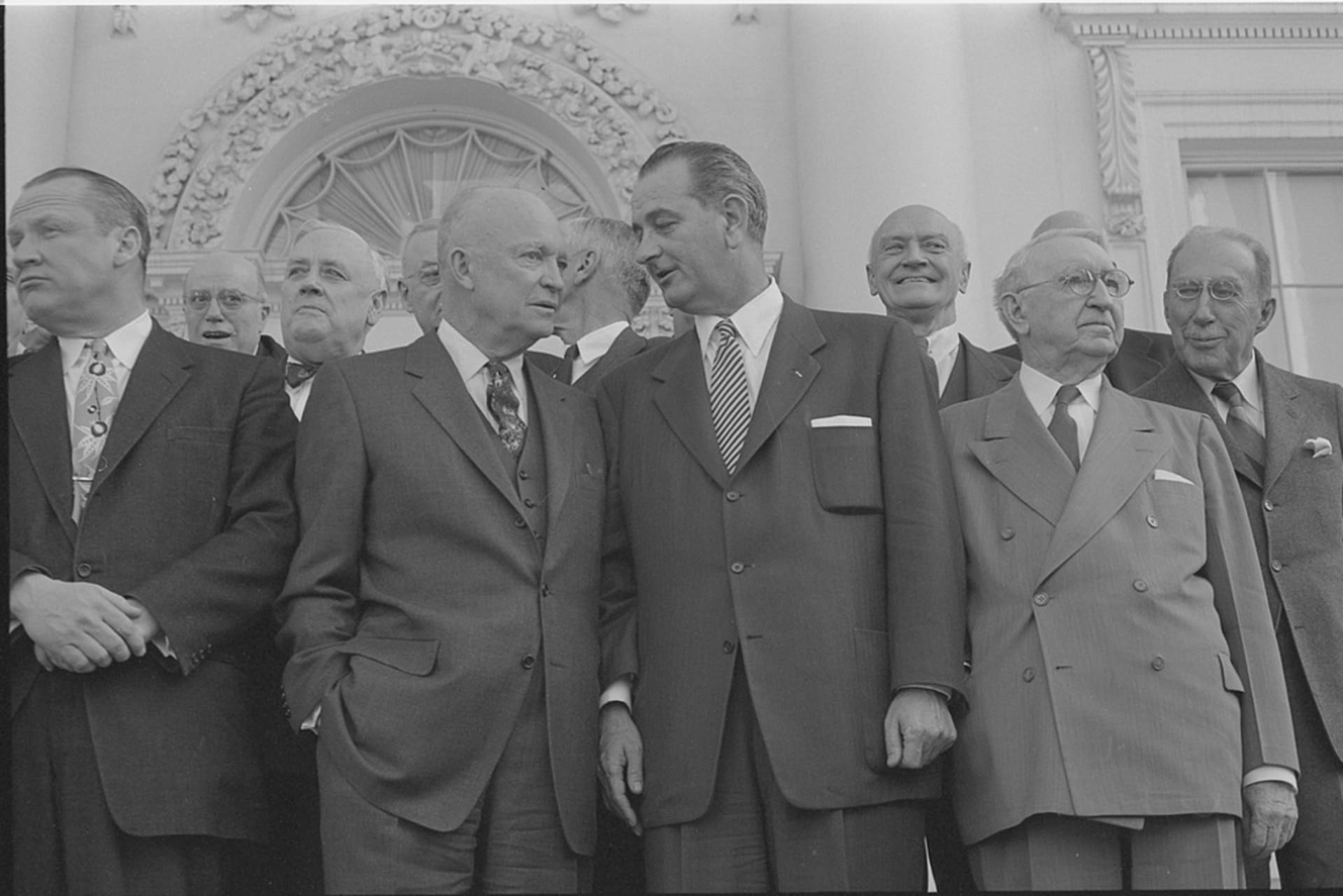
A case in point is President Dwight D. Eisenhower and the battle over the Bricker Amendment, an effort to amend the U.S. Constitution to make it harder for presidents to make international agreements. That effort came within one vote of succeeding in the Senate on this day in 1954. If not for the legislative wizardry of Democratic Senate Minority Leader Lyndon B. Johnson, U.S. foreign policy might have traveled a very different path over the past seven decades.
The Fear of Executive Agreements
The battle over the Bricker Amendment reflected two distinct concerns that arose after World War II. One was the fear of the growing use of executive agreements. These are arrangements struck with other countries on matters that, in theory at least, do not warrant treatment as treaties. The Constitution says nothing about executive agreements, let alone distinguish them from treaties. Their existence, however, is implied by Article I, Section 10 of the Constitution, which denies the states the power to “enter into any Agreement or Compact with another State, or with a foreign Power.” That choice of words suggests that the framers understood that treaties did not exhaust the full range of agreements that the U.S. government could make with other countries.
Whatever the framers had in mind as they deliberated in Philadelphia in the summer of 1787, executive agreements have been used since the earliest days of the republic. They remained less common than treaties during much of the nineteenth century. As the twentieth century opened, however, and the United States became more entwined with the world, presidents increasingly turned to them. Their use exploded with the onset of World War II. Between 1940 and 1949, FDR and Harry Truman signed eight times as many executive agreements as treaties. Their successors continued and expanded the practice.
Types of Executive Agreements
Most executive agreements are negotiated either as “treaty-based executive agreements” or as “congressional-executive agreements.” The former are struck pursuant to treaties that authorize presidential action. The latter are approved by Congress either before or after they are negotiated.
Some executive agreements, however, are concluded solely on the president’s own constitutional authority. The poster child in the early 1950s for such “sole executive agreements” was the Yalta agreement. President Franklin D. Roosevelt struck that deal with Joseph Stalin and Winston Churchill in February 1945 to structure the post-war peace. Republicans came to detest Yalta for supposedly allowing the Soviet Union to dominate Eastern Europe and Northeast Asia. The 1952 Republican Party platform vowed to repudiate it.
The Fear of Expanded Presidential Authority
Whatever the Yalta agreement’s substantive merits, the use of executive agreements alarmed senators on both sides of the aisle. They feared that executive agreements enabled the president to cut them out of treatymaking. No objective standard distinguishes agreements that need to be handled as treaties (or approved by Congress) from those that can be made under the president’s own constitutional authority. When Senator Guy Gillette, a Democrat from Iowa, asked the State Department in 1954 what differentiated a treaty from an executive agreement, he said he was told: “A treaty was something they had to send to the Senate to get approval by two thirds votes. An executive agreement was something they did not have to send to the Senate.” Not a terribly clarifying answer.
Two Supreme Court rulings only intensified Senate fears. In United States v. Belmont (1937) the court upheld an executive agreement FDR negotiated that overrode contrary New York State law. In United States v. Pink (1942), the Court ruled that executive agreements are interchangeable with treaties. Both decisions expanded executive authority by adding another constitutional arrow to the presidential quiver.
The Fear of Treaty Overreach
Most discussions of the battle over the Bricker Amendment focus on how it sought to rein in executive agreements. The more significant impetus behind the amendment, though, was the fear that treaties could be used to override the Constitution itself. That fear stemmed from the Supreme Court’s decision in Missouri v. Holland (1920). In the decade before that decision, the Court had struck down federal laws that regulated the hunting of migratory birds. The Court ruled that Congress had overstepped its authorities and invaded the powers reserved under the Tenth Amendment for the individual states. In the wake of the Court’s decisions, the Senate provided its advice and consent to a treaty with Canada requiring the United States to protect migratory birds. Congress then passed a law to implement the treaty. A Missouri game warden challenged the law. The Court upheld its constitutionality, concluding that the Constitution’s supremacy clause makes treaties the supreme law of the land.
The Court’s ruling in Missouri v. Holland sparked the fear that the president and the Senate acting together could rewrite the Constitution. No longer would both houses of Congress need to pass a constitutional amendment with two-thirds support and then secure the approval of three-fourths of the states. A president and two-thirds of the Senate could do it on their own. The fear of rogue treaty-making might have remained a theoretical problem discussed only in the pages of law review journals. Except for one thing. In the early 1950s, several global human rights treaties were being negotiated. Critics warned that these treaties, ostensibly intended to prevent genocide and protect human rights, were in fact a ruse for subverting the Constitution. Adopting them would override the Bill of Rights, undermine federalism, and ultimately lead to one-world government. At the core of this fearmongering was a particularly dark concern: These treaties would compel the United States to end segregation.
Enter John Bricker
John Bricker was a former governor and the junior Republican senator from Ohio. He had been the Republican vice-presidential candidate in 1944. An archconservative, he detested FDR’s New Deal and feared the rise of one world government. One observer described him as so self-impressed that he walked “as if someone was carrying a full-length mirror in front of him.” He devoted his energies to reversing the damage he thought FDR and the Supreme Court had done to traditional American constitutionalism.
On September 14, 1951, Bricker introduced the first of what became many versions of his amendment. He tinkered with his language, and by February 1952, fifty-nine senators had joined him as co-sponsors. The Senate Judiciary Committee held hearings on the Bricker Amendment and ultimately approved it. However, the Democratic-controlled Senate declined to hold a floor vote, killing it for that session of Congress. But support for Bricker’s proposal remained strong in Republican circles, and it became a plank in the party’s 1952 election platform.
That election gave Republicans control of the Senate. The battle over the Bricker Amendment resumed almost immediately. On January 7, 1953, Bricker and sixty-three cosponsors introduced a new version of his bill. That number of sponsors was significant; the Union had forty-eight states in 1954, so sixty-four votes were needed to pass a constitutional amendment if all senators voted. The threshold for passage would be lower if some senators didn’t vote. If the Senate blessed the Bricker Amendment, which was officially known as S.J. Res. 1, the House would likely follow suit. Ratification by the states seemed almost certain.
Developed in close consultation with the leadership of the American Bar Association, S.J. Res. 1 stipulated that:
- No treaty provision that conflicted with an enumerated constitutional power would be binding;
- No treaty could override or abridge the rights of citizens of the United States;
- No treaty could alter domestic law unless Congress specifically passed legislation enacting it; and
- Executive agreements, and all other international agreements, would be subject to the same constraints the amendment imposed on treaties.
The Bricker Amendment, then, proposed to restrict the president’s power to strike international agreements while increasing Congress’s—not just the Senate’s—say. Opponents rightly noted that these changes would kneecap the president’s ability to negotiate. No country could be sure that Congress would pass any required implementing legislation, or if it did so, that it would not unilaterally rescind its approval at a later date.
None of these reservations dented public enthusiasm for the Bricker Amendment. The American Medical Association, the American Legion, the Daughters of the American Revolution, and the Veterans of Foreign Wars were just some of the civil society groups that joined the ABA in standing behind S.J. Res. 1. The Vigilant Women for the Bricker Amendment even gathered more than half a million signatures in support of Bricker’s handiwork.
Eisenhower’s Problem
The support for the Bricker Amendment inside and outside of Washington posed a problem for Eisenhower. He took office just thirteen days after Bricker introduced S.J. Res. 1. He opposed the amendment because it would curtail presidential power at precisely the moment he believed the United States needed strong presidential leadership overseas.
But Eisenhower couldn’t count on his party’s support, even though Republicans controlled the Senate. Forty-five of the Senate’s forty-eight Republicans had cosponsored the Bricker Amendment. That broad support was partly of Eisenhower’s own making. In seeking the Republican presidential nomination, he had avoided criticizing Bricker and other archconservatives in the party. To his lasting discredit, Eisenhower had even refused to defend his mentor George C. Marshall against scurrilous attacks by Senator Joseph McCarthy. Making matters worse, Eisenhower said before taking office that Congress had exclusive authority to decide whether and how to amend the Constitution. He was in no position to tell Senator Bricker and his supporters to stand down.
Eisenhower’s secretary of state, John Foster Dulles, and his attorney general, Herbert Brownell, had no such qualms. Both men testified at length against the proposed amendment. But Dulles’s statements before taking office alarmed Bricker and his allies. Dulles had declared that treaties: can take powers from the states and give them to the Federal Government or to some international body, and they can cut across the rights given the people by their constitutional bill of rights. That was precisely what the Bricker Amendment’s proponents feared. Dulles told senators after becoming secretary of state that the Eisenhower administration was “committed to the exercise of the treaty power only within traditional limits.” Unsurprisingly, most senators doubted Dulles’s promise of self-restraint.
LBJ to the Rescue
Eisenhower fought behind the scenes throughout the first half of 1953 to kill the Bricker Amendment. He made little progress. In June, the Senate Judiciary Committee approved a new version of Bricker’s proposal. That forced Ike’s hand. He announced his “unalterable opposition” to the amendment. He made his opposition public because Johnson had privately communicated that the Bricker Amendment could be defeated if Eisenhower stood against it.
The Senate minority leader had no political reason to help Eisenhower. Ike’s fight with archconservative Senate Republicans might even advance Johnson’s short-term ambition to become Senate majority leader and his longer-term ambition to sit in the Oval Office himself. But Johnson agreed that the Bricker Amendment would upend the traditional constitutional structure and make it impossible for the United States to lead abroad. Not an ideal outcome for a man who hoped one day to be president.
The future thirty-sixth president, however, had political problems of his own to deal with. To start, his most important financial backers enthusiastically supported the Bricker Amendment. Beyond that, many Democratic senators, and particularly southern Democrats, faced considerable constituent pressure to vote for the Bricker Amendment, precisely because it was presented as saving the United States from desegregation, socialism, and one-world government.
So LBJ had to find a way to derail the amendment without being seen as opposing it—while preventing Republicans from claiming credit for abandoning a bad idea. That looked to many like trying to draw a square circle. But Johnson had a well-earned reputation as a “master of the Senate.” He devised a devilishly complex plan that rested on a tried-and tested legislative tactic: kill a bill under the guise of “improving” it.
The Vote
The Senate opened what became a month-long debate on the Bricker Amendment on January 27, 1954. Two days earlier, Eisenhower had written to Senate Majority Leader William Knowland of California reiterating his opposition to the Bricker Amendment:
Adoption of the amendment in its present form by the Senate would be notice to our friends as well as our enemies abroad that our country intends to withdraw from its leadership in world affairs. The inevitable reaction would be of major proportions. It would impair our hopes and plans for peace and for the successful achievement of the important international matters now under discussion.
The debate over the amendment dominated the nation’s newspapers as supporters and opponents traded charges and countercharges. S.J. Res. 1 finally came to a vote on February 26. It quickly became clear that it was in trouble. Republican senators offered, and the Senate accepted, several amendments that softened the legislation in a bid to make it acceptable to Eisenhower. Bricker then introduced a motion to restore much of his original bill. That motion was defeated 50 to 42, meaning that Bricker’s proposal not only did not get the constitutionally required two-third votes, it did not even garner majority support. Bricker’s motion failed in part because the White House had persuaded three of the original Republican Bricker Amendment cosponsors to vote no. But the more important change came on the Democratic side of the aisle. Thanks in good part to Johnson’s persuasion, thirteen of the nineteen original Democratic cosponsors also voted against Bricker’s motion.
Even though Eisenhower had indicated he could live with the substantially weakened version of the Bricker Amendment, the legislative wrangling didn’t end there. That wouldn’t have served Johnson’s interests. He was intent on making sure that Republicans didn’t get the credit for saving Eisenhower.
The Master of the Senate at Work
So Johnson played his next card. A month earlier, he had convinced Senator Walter George of Georgia, the ranking Democrat on the Senate Foreign Relations Committee and a Bricker Amendment supporter, to propose substitute amendment. While the George Amendment constrained presidential authority less than the original Bricker Amendment did, it was significantly tougher than the watered-down version of the Bricker Amendment now before the Senate. For that reason, Eisenhower opposed it and Bricker supported it. But the George Amendment had two virtues in Johnson’s eyes: It enabled vulnerable Democrats to vote for a bill that would bar treaties from overriding the Constitution, and it wasn’t a Republican bill. Senator George called for a vote on his proposal. After several hours of debate, the Senate voted 61 to 30 for the George Amendment.
But that vote only decided that the George Amendment would supplant the now watered-down version of the Bricker Amendment. The vote had not decided whether the George Amendment would be submitted to the forty eight states for ratification. Johnson now had to reduce support for the George Amendment on final passage by at least one vote. That would deny it the necessary two-thirds support. To that end, he had pledges from three Democratic senators to change their votes if needed.
As the Senate turned to the question of final passage, it appeared that Johnson had miscalculated. Majority Leader Knowland surprised everyone. Although he had just voted against the George Amendment, he announced that he would vote to send it to the states for ratification. He urged his colleagues to follow suit “because of the very real need for some steps to be taken to curb…the gradual encroachment by the Executive on the legislative power of the Congress.” Two Republican senators followed Knowland’s lead, while another Republican senator flipped in the other direction. The three Democratic senators who had promised Johnson they would switch their votes did just that.
That left the vote at 60 to 30. If that margin held, the George Amendment would pass. As Democrats stalled the conclusion of the vote, frantic LBJ aides searched for Senator Harley Kilgore. The Democrat from West Virginia had voted against the George Amendment and then headed back to his office. When he returned to the Senate floor, still groggy from a possible alcohol-induced nap, he voted no. The presiding officer banged the gavel, concluding the vote. The George Amendment had fallen one vote short of passage. It, like the Bricker Amendment, was dead.
The Aftermath
Bricker’s push to restrict presidential authority to make international agreements sputtered out after his epic 1954 defeat. Some of that reflected Washington’s tendency to move onto the next hot button issue. But it also reflected how events diminished the issue’s political relevance. Three months after the Bricker Amendment’s defeat, the Supreme Court ruled in Brown v. Board of Education (1954) that “separate-but-equal” schooling was unconstitutional. Suddenly segregationists had a new (and lamentable) legislative battle to fight. Then the Court ruled in Reid v. Covert (1957) that international agreements cannot overrule the Bill of Rights. Not surprisingly, the Bricker Amendment was soon forgotten.
Except by Eisenhower. “If it’s true that when you die the things that bothered you the most are engraved on your skull,” he told an aide, “I am sure that I’ll have there the mud and dirt of France during the invasion and the name of Senator Bricker.” He achieved victory in the latter instance only with the help of Democratic senators and the legislative wizardry of Lyndon Johnson, who showed why even legislation that enjoys strong support can falter on Capitol Hill.
The United States celebrates its 250th anniversary in 2026. To mark that milestone, I am resurfacing essays I have written over the years about major events in U.S. foreign policy. A version of this essay was published on February 26, 2022.
Oscar Berry assisted in the preparation of this post.