Macron’s Agenda Meets Trump’s at the G7 Summit
Repercussions from the Iran war and the growing economic challenge posed by China are expected to dominate the annual meeting of the Group of Seven (G7) economies in France, but the attendance of President Donald Trump adds uncertainty to the summit’s outcome.

Heidi Crebo-Rediker specializes in international political economy, U.S. economic competitiveness, economic security, and international finance.
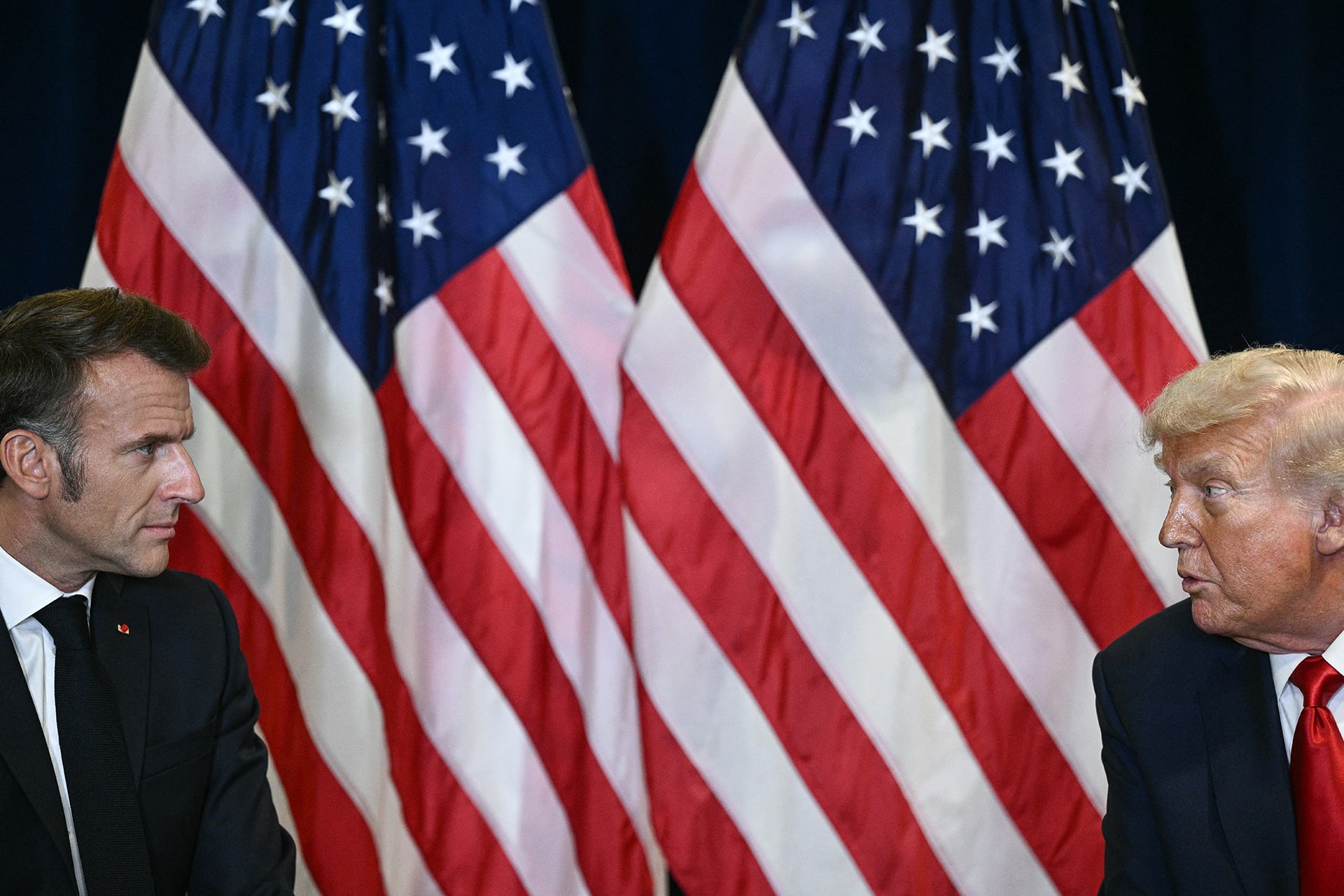
President Trump’s decision to attend next week’s G7 summit in Évian-les-Bains, France, is noteworthy. Given his disdain for multilateralism and his frequent frustration with many of the other attendees, U.S. participation was not guaranteed. Regardless of global tensions or policy differences, leader-to-leader engagement at summits has value. Yet Trump will arrive immediately after celebrating his birthday on June 14 with a UFC championship event on the White House lawn and may be in a fighting mood himself, ready to use the G7 stage to berate allies for what he views as inadequate support following Iran’s closure of the Strait of Hormuz.
Against this backdrop, French President Emmanuel Macron’s challenge may be less about advancing his personal initiatives than managing the summit itself. France could find itself confronting two sets of competing summit agendas: the one it planned and the one that geopolitical events—and Trump—have created. The task facing the French president will be to prevent these dueling agendas from overwhelming the broader purpose of the gathering while preserving what remains of G7 cohesion.
That cohesion, as well as the G7’s usefulness as an organizational forum, has been challenged at other times over its fifty years of existence. It has survived many political transitions and still provides the primary platform for advanced economies to coordinate global policy. It should be preserved. Macron next week will seek to keep the flame alive as he passes the torch to the United States, which assumes the G7 presidency in 2027.
The Trump factor
No amount of preparation by government ministers and leader-level representatives—known as sherpas—will be able to account for Trump’s unpredictability. Despite uncertainties around U.S. willingness to engage at the summit, France began its G7 presidency with a solid agenda. Macron framed the presidency around the idea that advanced economies should continue to work together to reduce instability and build more resilient forms of international cooperation, particularly in response to China’s growing economic influence.
The June 15–17 summit is designed to focus leaders on a carefully constructed set of priorities carried over from past G7 meetings: addressing macroeconomic imbalances, strengthening economic security and critical mineral supply chains, and reforming international development partnerships. Reuters reported that President Macron will chair a video call with representatives from China, the G7, and other countries to jointly address different perspectives on global imbalances and shared responsibility. Macron’s G7 agenda also includes advancing cooperation on some aspects of artificial intelligence (AI). The latter has been a particular priority for France as it seeks to position itself as Europe’s leading AI hub. Macron underscored that ambition by inviting OpenAI CEO Sam Altman to participate in summit discussions.
Despite French efforts to keep to the agenda, leaders will arrive in Évian confronting a geopolitical and economic environment very different from the one France envisioned when it assumed the presidency and crafted its policy priorities. The U.S. and Israeli attack on Iran in late February and Tehran’s subsequent retaliation and closure of the Strait of Hormuz have unleashed a wave of energy, supply chain, and commodity shocks that are wreaking havoc on the global economy. Rising transportation costs, concerns about fertilizer supplies and food security, and renewed inflationary pressures are likely to dominate both formal discussions and private conversations among leaders.
Iran, however, is only part of the story. Trump is expected to arrive with his own America First economic and security agenda. That agenda will likely feature more transactional approaches to development partnerships, greater commercial opportunities for U.S. firms abroad, expanded deployment of U.S. technology platforms and AI systems, stronger efforts to reduce dependence on Chinese-controlled supply chains, and increased fossil fuel production to buoy U.S. economic and strategic strength.
Franco-American mood swing?
In some areas, Trump’s priorities overlap with French objectives. Both countries support strengthening economic security and reducing strategic vulnerabilities in critical supply chains. The growing prominence of AI on the summit agenda also creates opportunities for cooperation, especially given demand for access to U.S. autonomous cybersecurity and software-engineering capability.
But in most areas beyond the formal agenda, significant differences among G7 members remain and are likely to surface as part of side conversations throughout the summit. Support for Ukraine, trade, digital sovereignty, regulation, and climate policy are just a few of the issues where diminished trust in the United States—and an ever-growing desire among allies to reduce their strategic dependencies on Washington—will push the other six members to coordinate more closely among themselves.
Évian may ultimately be remembered less for what France hoped to accomplish than for whether leaders can prevent mounting geopolitical tensions from overwhelming the meeting itself. In that sense, success may depend less on progress across the formal agenda than on the ability of seven increasingly divergent partners to continue moving, however imperfectly, in the same direction.
This work represents the views and opinions solely of the author. The Council on Foreign Relations is an independent, nonpartisan membership organization, think tank, and publisher, and takes no institutional positions on matters of policy.