Obama’s UN Address: An Enlightened Man in an Unreasonable World
By experts and staff
- Published
- Stewart M. PatrickJames H. Binger Senior Fellow in Global Governance and Director of the International Institutions and Global Governance Program
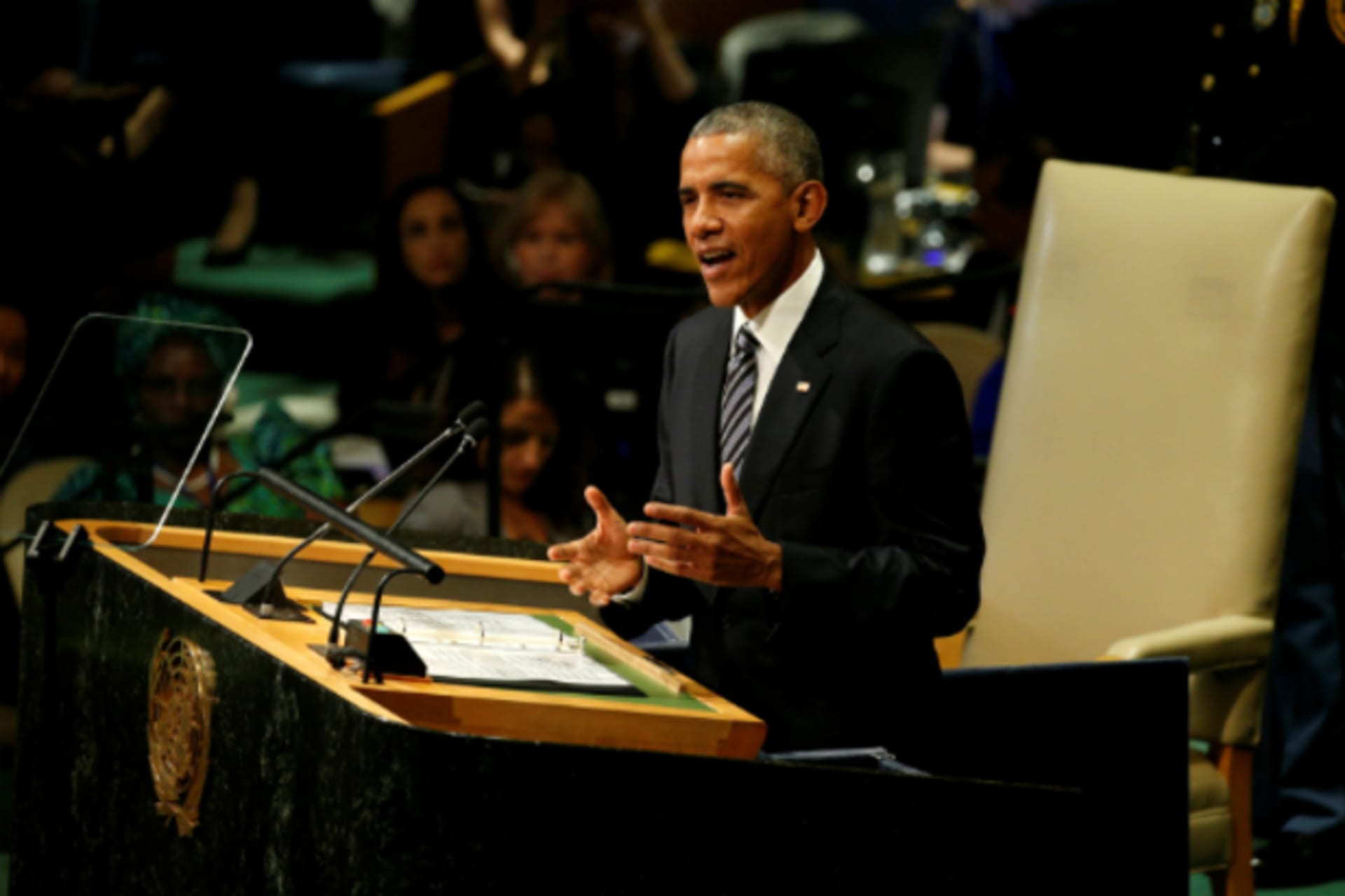
President Barack Obama used his eighth and final address to the UN General Assembly to share his noble vision of a world order in which equality, liberty, and unity trump injustice, oppression, and division. Part sermon, part pep-talk, the speech exuded an unflinching faith in liberal ideals and a progressive optimism that humanity can surmount any economic, political, and ecological challenges it faces. All that is required, the president suggested, is that leaders and citizens listen to the better angels of their nature. The big-picture speech contained little guidance about how to resolve intractable problems, from mass migration to North Korea’s nukes. But it was an eloquent effort, delivered by a reasonable man living in unreasonable times. Its biggest flaw was in ignoring the practical difficulties and inherent trade-offs of applying such high-minded ideals to a fallen world.
The president began by identifying “the paradox that defines our world today.” By all measures, global integration has made the world more prosperous and less violent than ever before. Since the end of the Cold War, extreme poverty has declined dramatically, the information revolution has expanded access to knowledge, and individual freedom has spread to more countries. Equally impressive, “Our international order has been so successful that we now take it as a given that great powers no longer fight world wars.” And yet around the globe, people are more anxious about their future and uncertain about their fates. They have lost trust in institutions and are divided into rival communities.
The root of this angst, Obama suggested, is a battle of “competing visions.” The first outlook believes that continued global integration will generate human progress. This hopeful outlook “recognize[s] our common humanity” and the imperative of working together to achieve shared goals. The second is a dark, backward-looking worldview that would exploit, oppress, and divide the Earth’s inhabitants. The world must move forward, Obama declared. But it also needs “a course correction.” He identified four big priorities:
What the president’s speech lacked was sufficient acknowledgment of how difficult it is to realize such noble goals in an often crooked world—or when liberal aspirations clash with more pedestrian but pressing interests. Consider this passage, shortly after discussing the struggle for human liberty and dignity in the Middle East. “So those of us who believe in democracy, we need to speak out forcefully.” And yet Obama’s own administration, like many before, has applied democracy promotion selectively—promoting it in Myanmar, for example, while cozying up to authoritarians like President Abdel Fattah el-Sisi of Egypt, when the logic of geopolitics prevails.
At other points, the president’s high-mindedness verged on naiveté. Most jarring was his observation about the ongoing wars in the Middle East—including in Syria, where the United States has remained on the sidelines as more than 400,000 have died in a bloody sectarian war. “Across the region’s conflicts,” Obama declared, “we have to insist that all parties recognize a common humanity and that nations end proxy wars that fuel disorder.” It is not hard to imagine how Bashar al-Assad or Vladimir Putin would react to such wishful thinking.
A hallmark of Obama foreign policy—and a recurrent theme of his UN addresses—has been the tension between idealism and realism. This year, the president veered strongly toward idealism, turning the UN lectern into a bully pulpit—with an emphasis on “pulpit.” Toward the end of his speech, he almost seemed to concede as much: “Time and again, human beings have believed that they finally arrived at a period of enlightenment, only to repeat, then, cycles of conflict and suffering,” he noted. “Perhaps that’s our fate.”