Psychology and the Oil Market
By experts and staff
- Published
 Benn SteilCFR ExpertSenior Fellow and Director of International Economics
- Dinah WalkerAnalyst, Geoeconomics
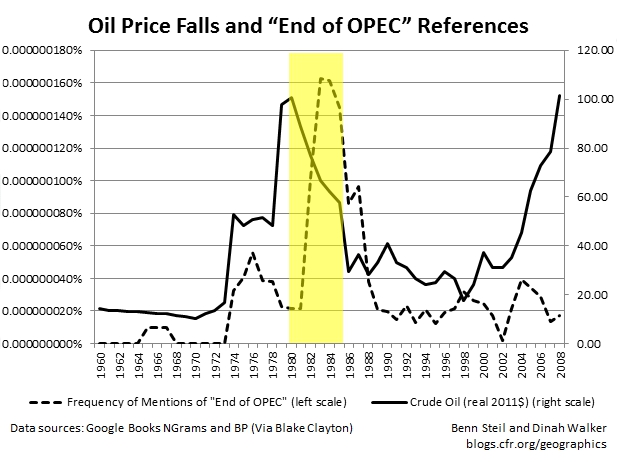
In his recent book, Market Madness: A Century of Oil Panics, Crises, and Crashes, our colleague Blake Clayton explains the role of market psychology in contributing to the wild price swings that have characterized the oil market over the past hundred years. Using data from Google Books NGrams, he shows that whenever oil prices climb for an extended period comments about “running out of oil” and “running out of gasoline” proliferate. These beliefs have repeatedly proven unfounded.
We decided to run a similar experiment for downturns in the oil market, such as the one we’ve been living through over the past eight months.
Google Books NGrams data, unfortunately, only go through the end of 2008 – so we can’t use it to look at the past eight months. But, as the graphic above shows, we can use it to look at the end of the last major oil price spike in 1980. And indeed, references to the “end of OPEC” soar with the plunge in oil prices immediately following the price-spike peak.
Googling the phrase “end of OPEC” today, not surprisingly, also shows many prominent-source recent uses of the phrase: for example, “The End of OPEC as We Have Known It is Here“ (Brookings), “Citi: Oil Could Plunge to $20, and This Might Be ‘the End of OPEC’” (Bloomberg), “End of OPEC is closer to reality“ (CNN), and “The End of OPEC” (Foreign Policy). Given Clayton’s findings of misguided fears of “running out of oil” during price surges, this suggests that we may be in the midst of a short-lived era of unfounded optimism on copious supply.
Read about Benn’s latest award-winning book, The Battle of Bretton Woods: John Maynard Keynes, Harry Dexter White, and the Making of a New World Order, which the Financial Times has called “a triumph of economic and diplomatic history.”