Trump Should Take the U.S. Military’s Warning on Iran Seriously
The U.S. military appears to be surfacing their concerns about the risks involved in sustaining a lengthy conflict with Iran. The White House should listen, as a conflict could trigger several cascading consequences.
By experts and staff
- Published
 Max BootCFR ExpertJeane J. Kirkpatrick Senior Fellow for National Security Studies
Max Boot is the Jeane J. Kirkpatrick senior fellow for national security studies at the Council on Foreign Relations.
President Donald Trump likely feels that the U.S. military is invincible after the success of various operations he has ordered during his time in office, including the killing of Iranian general Qasem Soleimani in 2020, the bombing of the Iranian nuclear program in June 2025, and the abduction of Venezuelan leader Nicolás Maduro in January. But those were all “one and done” strikes. The military operation that Trump has threatened against Iran is potentially much larger and lengthier—and thus much riskier.
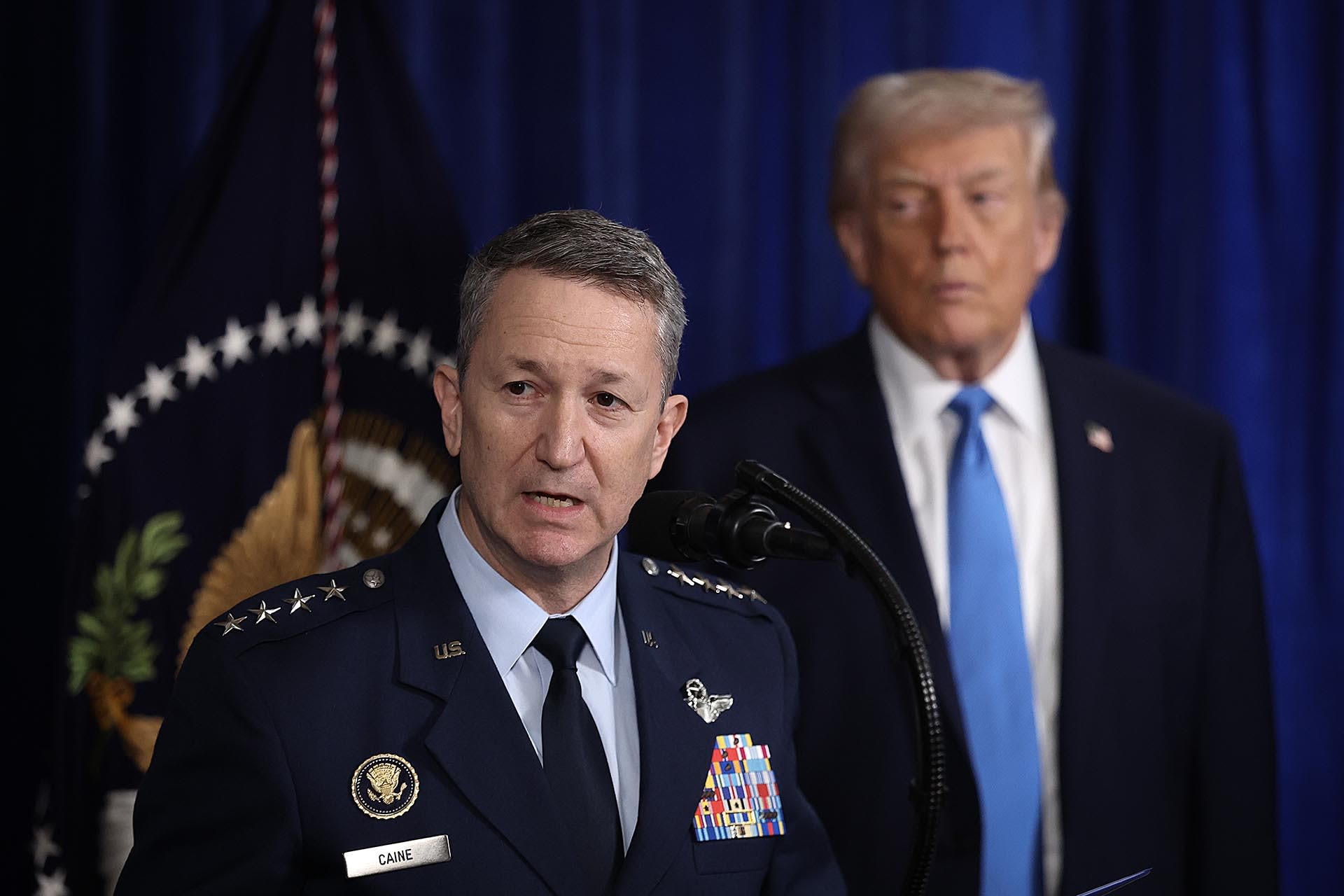
Various news outlets have published articles in recent days reporting that General Dan Caine, the chairman of the Joint Chiefs of Staff, is concerned about the risks of strikes on Iran. This looks very much like a concerted messaging campaign by the U.S. military to surface their concerns before Trump orders them into action. In response, Trump took to Truth Social to denounce “the Fake News Media” for stating that Caine “is against us going to War with Iran,” calling that “100% incorrect.” But, in fact, all of these news stories state that Caine has not expressed either support or opposition to the strikes; he is merely raising concerns about how a military campaign would unfold, as he is legally obligated to do in his role as the president’s senior military adviser.
And there are risks aplenty. The United States and Israel, working with Arab allies, were successfully able to shoot down almost all of the ballistic missiles and drones that Iran fired at Israel during the Twelve Day War in June. But while Iran’s longer-range missile forces were decimated during that conflict, there is evidence of Iran building its inventory back up. Moreover, Iran still has larger numbers of short-range and anti-ship missiles. Those missiles could be used to target U.S. bases in the region and oil infrastructure belonging to U.S. allies such as Saudi Arabia and United Arab Emirates.
The ultimate nightmare would be if Iran were able to temporarily close the Strait of Hormuz, one of the world’s most important commercial arteries (about 20 percent of global oil consumption flows through the strait), thereby spiking global oil prices. Iran refrained from such action in June because U.S. and Israeli strikes were concentrated on its nuclear facilities and missile forces; Iran launched only one small, symbolic strike against a U.S. air base in Qatar. However, if the Iranian leadership feels that Trump is attempting to bring down the entire regime, their response might be much more damaging. Little wonder that the Saudis, Emiratis and other allies have expressed opposition to renewed U.S. strikes against Iran.
There is then the concern that Trump’s intervention in Iran could lead to a dangerous run on U.S. munitions stockpiles. This could prove to be a lengthy affair, with Iran choosing to absorb U.S. bomb and missile strikes without giving in to Trump’s demands to end their nuclear and missile programs along with aid to proxy forces across the region.
The model here is the Trump administration’s war against the Houthis in Yemen between March and May of 2025. In the first month alone, the U.S. spent roughly $1 billion on operations there. This included expending two thousand bombs and missiles while having seven drones shot down, and two F/A-18 Super Hornets lost in accidents while operating from an aircraft carrier. Trump eventually decided to end the U.S. attacks with a face-saving agreement: The Houthis agreed not to target U.S. shipping but made no such agreement about shipping linked to Israel. Houthi attacks on Israel continued until the end of the Gaza War. These attacks against both U.S. and Israeli targets could start again if the United States launches a war against the Houthis’ Iranian patrons.
Guided munitions, including air defense interceptors, that are in short supply in the U.S. arsenal—and potentially needed for other contingencies—are in particular danger of being used up in a drawn-out, inconclusive conflict with Iran. A series of Center for Strategic and International Studies wargames in 2023 concluded that [PDF], in the event of a war with China over Taiwan, “the United States would likely run out of some munitions—such as long-range, precision-guided munitions—in less than one week.” The United States would face similar shortfalls in a conflict with Russia.
Such shortages have not been adequately rectified in the years since because of a lack of U.S. manufacturing capacity, and they could be greatly and quickly exacerbated by a U.S. conflict with Iran. The Financial Times reports that Israeli intelligence has concluded that the U.S. forces in the Middle East could only sustain four to five days of intense aerial attacks on Iran or a week of lower-intensity strikes. Of course, the United States could always bring more weapons and munitions from elsewhere in the world, but that could exacerbate critical vulnerabilities for U.S. allies—such as Taiwan, South Korea, or the Baltic states—which are at risk of aggression from China, North Korea, or Russia, respectively.
The longer that U.S. forces remain in the Middle East battling Iran, the greater the strain on already overstretched forces. To prepare for action against Tehran, the U.S. Navy rushed the USS Gerald R. Ford battle group back to the Middle East from the Caribbean, where the ships had deployed as part of the operation to capture Maduro. Carrier deployments in peacetime normally run about six months, but the Ford has been at sea for eight months already and could be deployed for as many as eleven months or longer, breaking a Navy record for a continuous ship deployment. Such lengthy deployments exact a major strain on both sailors and the machinery they operate, leading to morale falling while accident and breakdown rates spike.
These are all risks that the U.S. military is acutely aware of, and they are magnified because of the likely lack of support from any allies—aside from Israel—for U.S. operations against Iran. The United States could still successfully strike targets in Iran, but it is far from clear that such attacks would bring major concessions from the regime. The president would be well advised to take these considerable risks and costs into account before starting a war without an obvious exit strategy.
This work represents the views and opinions solely of the author. The Council on Foreign Relations is an independent, nonpartisan membership organization, think tank, and publisher, and takes no institutional positions on matters of policy.