Taiwan’s Political Polarization Is Playing Into China’s Hands
Divisions in Taiwan over how to approach China and how closely the island should align with the United States risk undermining important investments in defense and resilience.

David Sacks is a fellow for Asia studies at the Council on Foreign Relations.
Taiwan has made impressive strides in enhancing its resilience to Chinese military and economic coercion, but an increasingly polarized political environment threatens to stall and even reverse such progress. This is the picture that emerged after a week of meetings in Taipei with current and former officials, scholars, and journalists.
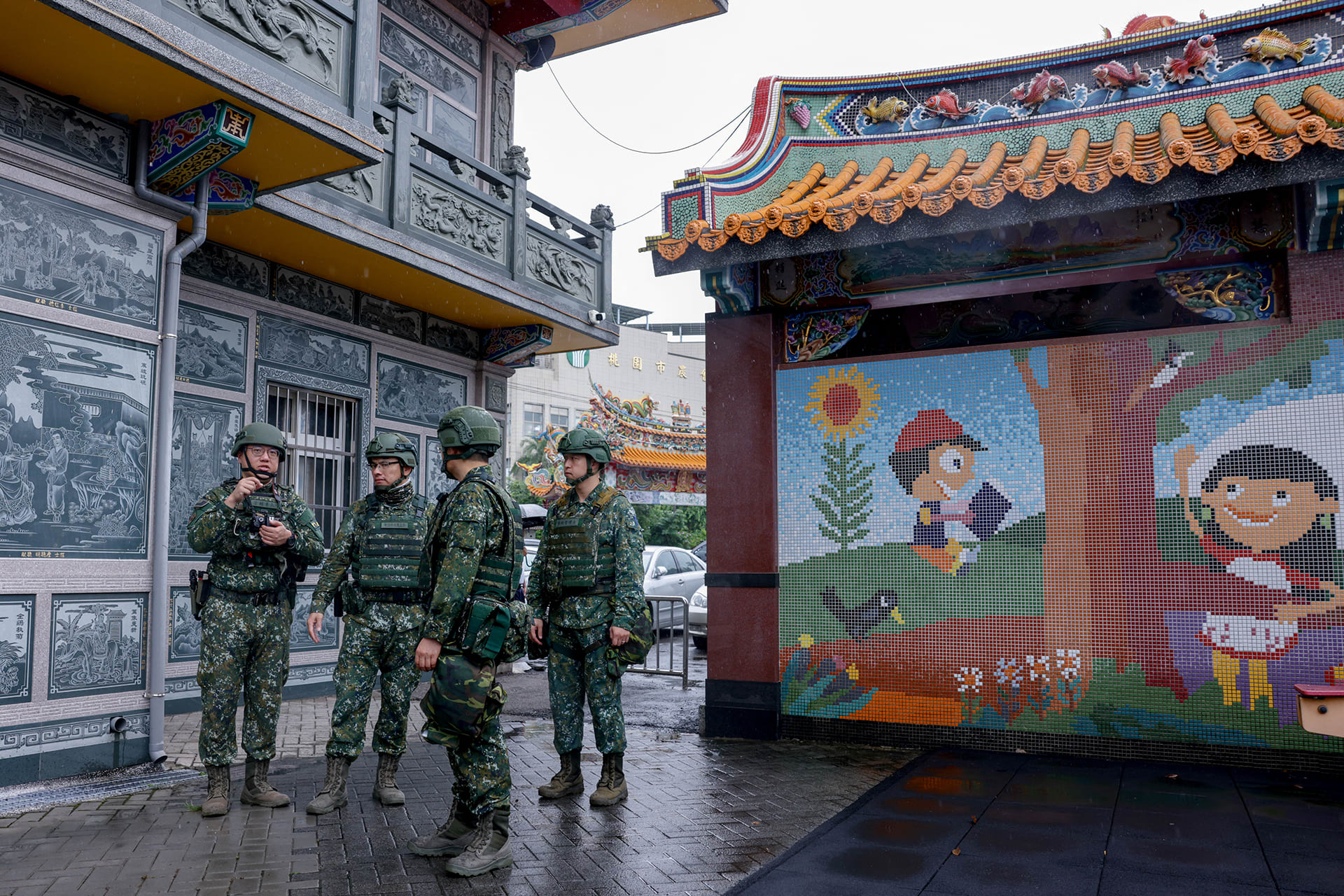
Since taking office nearly two years ago, Taiwanese President Lai Ching-te has emphasized resilience as a key component of deterrence. Early in his presidency, Lai established a Whole-of-Society Defense Resilience Committee, which convenes quarterly and includes representatives from government agencies, industry, and civil society groups. Military exercises now regularly take place in Taiwan’s cities, involve the mobilization of reservists, and simulate responding to strikes on critical infrastructure. Last week, the tabletop component of Taiwan’s annual Han Kuang military exercise similarly practiced urban resilience and the mobilization of local governments to aid in responding to a contingency.
The importance of resilience is one of the primary lessons Taiwan learned from the war in Ukraine. As the deputy secretary-general of Taiwan’s national security council, Lin Fei-fan, noted in Foreign Affairs, “Ukraine’s resistance has shown that modern deterrence hinges on a society’s capacity to absorb shocks and continue resisting under fire.” The unfolding war against Iran has further solidified this conviction regarding the significance of resilience. While analysts in Taiwan note the impressiveness of U.S. firepower and military tactical successes, they are equally impressed by Iran’s ability to weather weeks of sustained bombardment and to continue launching counterattacks, including those that deny free passage through the Strait of Hormuz.
Taiwan, however, still has significant shortcomings when it comes to resilience. It depends almost entirely on imported fuels to meet its energy needs, a vulnerability that the Iran war has magnified. Taiwan also relies on fourteen international undersea cables to connect to the world, which are vulnerable to disruption, and currently lacks a low-orbit satellite constellation. It does not have a significant indigenous defense industry, which would be needed to produce weapons during a contingency. While Taiwan has begun to overhaul its military reserves, much more needs to be done to make them a valuable fighting force. Taiwan’s government recognizes these vulnerabilities and is working to mitigate them by developing low-orbit satellite providers, taking steps to restart its nuclear power reactors, and encouraging the development of a domestic drone industry.
Aside from progress made in building defense resilience, Taiwan is also buoyed by its newfound status as a technological superpower. As the producer of the world’s most advanced chips, Taiwan’s hardware underpins all investments related to artificial intelligence (AI). Put simply, without Taiwan’s chips, progress in AI is not possible. As a principal beneficiary of the boom in AI-related investments, Taiwan’s economy grew by 8.7 percent in 2025 and is projected to grow by 7.7 percent in 2026.
There is optimism in Taiwan that economic ties with the United States will deepen in the coming years, further solidifying its relationship with its principal security guarantor and in turn bolstering deterrence. In the past decade, Taiwan has gone from being America’s tenth-largest trading partner to its fourth-largest. The United States and Taiwan have already reached an Agreement on Reciprocal Trade and, given the complementarity of the two economies, Taipei is confident that it is best placed among U.S. partners to fulfill its investment commitments.
But growing political polarization in Taiwan threatens to undo much of this progress and ultimately undermine the island’s security. Lai’s proposed $40 billion special defense budget remains stalled in the legislature, which is controlled by a coalition of the Chinese Nationalist Party (KMT) and the Taiwan People’s Party (TPP). That money is needed to procure critical capabilities from the United States and send a demand signal to Taiwanese companies that will spur them to increase manufacturing capacity for missiles and drones. Just as important, passing the special defense budget would send a message to the Trump administration that Taiwan is taking its defense seriously and is worthy of additional U.S. support.
There are differing views within the opposition KMT and TPP on what to include and what to leave out of the special defense budget. The prevailing opposition view, though, seems to center on funding the $11 billion arms package announced by the Trump administration in 2025 and punting on the rest. At its core, this impasse over the special budget reflects deep divisions on how to approach China. For those who oppose the budget, such spending could provoke China and leave Taiwan exposed at a moment when the United States is an increasingly unreliable partner. For those who support it, large investments in defense are needed to maintain deterrence and preserve Taiwan’s relationship with its most important partner: the United States.
China, for its part, is unsurprisingly attempting to influence this debate. Chinese leader Xi Jinping met with KMT Chair Cheng Li-wun in Beijing to strengthen voices in Taiwan calling for cross-Strait rapprochement and greater distance between the United States and Taiwan. Beijing’s approach also entails meting out punishments to the Lai administration, the most recent of which is successfully pressuring countries to not grant overflight rights to Lai’s plane, forcing him to cancel a visit to Eswatini, Taiwan’s lone diplomatic partner in Africa. For the remaining two years of Lai’s term, China can be expected to impose harsher penalties on Taiwan for taking steps to boost deterrence and build relations with the United States and other partners, while dangling benefits should Taiwan reverse course.
A sustainable path for Taiwan would be to stand firm on the position that Beijing’s massive military modernization, which continues to prioritize preparing for a conflict over Taiwan, requires that Taipei invest in its own defense to maintain some semblance of balance. By investing in resilience and defense, Taiwan would eliminate coercion and a blockade or invasion as viable options for Beijing, leaving dialogue as the only path forward. Whether Taiwan’s political parties can agree on such an approach, though, is increasingly in doubt.
This work represents the views and opinions solely of the author. The Council on Foreign Relations is an independent, nonpartisan membership organization, think tank, and publisher, and takes no institutional positions on matters of policy.