The Middle East’s New Center of Gravity

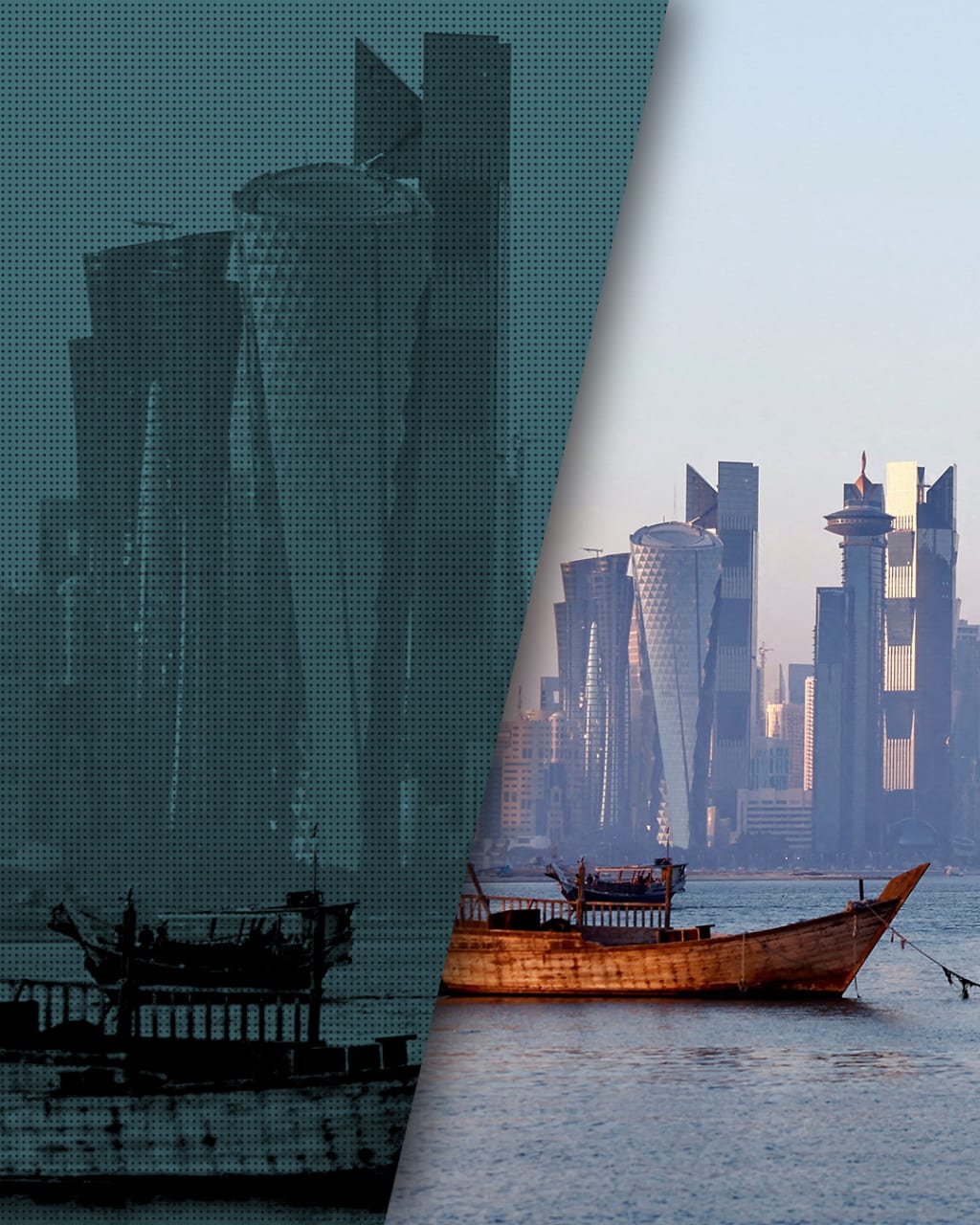
The post–World War II order has come to an end—and the new global architecture taking shape will reflect the outcomes of conflicts, diplomatic initiatives, and economic policies still in progress. In the Middle East, the pronounced shift in the distribution of power will certainly contribute to a new global order. This dynamic began well before Hamas’s attacks on Israel on October 7, 2023, yet the ensuing war in Gaza has accelerated those trends and created impetus for additional change.
[Video: https://vimeo.com/1192642041/03b5c48639]
Over the last decade, the regional center of gravity has shifted from Egypt, Iraq, and Syria, to the Gulf’s powerhouses: Qatar, Saudi Arabia, and the United Arab Emirates (UAE). The combination of their vast wealth, strategic location, and economic development plans, along with years of turmoil that have engulfed Baghdad, Cairo, and Damascus, have rendered Doha, Riyadh, and Abu Dhabi centers of power in the region. Any U.S. president entering the Oval Office since 2017 would have concluded that the United States’ most influential and capable partners are in the Gulf. In the main, that is likely to remain the case even after the war the United States and Israel launched against Iran in February 2026—in large part because other countries in the region are comparatively weak, confronting their own political and economic challenges.
The growing power of the Gulf states has less to do with military might and more to do with a specific model of economic development that integrates those countries more tightly in the global economy. Although they remain critical players in hydrocarbons, they have also sought to become centers of advanced technology, logistics, entertainment, and tourism. Investment from and in the West has been an important element in those sectors’ development. By making themselves partners of, for example, Google, Anthropic, and Microsoft, the Gulf states are both burnishing their prestige and reinforcing their importance to Washington. Saudi Arabia and the UAE, in particular, calculated that they did not need a security guarantee if they were part of the American high-tech development ecosystem. Now that Iran has specifically targeted tech infrastructure in Bahrain and the UAE, that view appears to be changing. Already, the Emiratis have signaled that they intend to tighten their security relationship with the United States.
The 2020 Abraham Accords also reflect the changing power dynamics in the region. By normalizing ties with Israel, the signatories—Bahrain, Morocco, and the UAE—necessarily relegated the Palestinian issue to secondary status. By dispensing with the idea normalization can occur without progress on the Palestinian problem, Bahraini, Emirati, and Moroccan leaders calculated that they would benefit diplomatically and economically, as well as bolster their national security. Normalization has indeed redounded to the benefit of all the signatories of the Abraham Accords, which have remained durable even during the worst fighting in the Gaza Strip. By moving forward with Israel—a globally important player in cyber-technology, artificial intelligence, health, and security technology—Bahrain, Morocco, and the UAE have advanced their own development goals. That advancement expands regional integration and contributes to the regional power shift toward the Gulf that is already well underway.
Then came the October 7 attacks. Several days after Hamas’s Operation Al Aqsa Flood, Israeli Prime Minister Benjamin Netanyahu vowed to change the Middle East. One by one, Israel targeted Hamas, Hezbollah, and Iran. The overall weakening of the so-called Axis of Resistance has made Israel more secure, but perhaps only temporarily. Those tactical achievements have yet to be converted into strategic gains. Hamas remains armed in Gaza, even though the territory it controls has been more than halved; the Lebanese government has not disarmed Hezbollah, even as it has taken steps to undermine its state within a state; and Iran remained a potent and capable adversary, even after Israel’s strikes during the Twelve-Day War of June 2025.
The incompleteness of Israel’s military gains over almost three years of continuous combat on at least four fronts was obvious in the 2026 war. Although the conflict’s outcome remains unclear, there are several scenarios that will have a direct bearing on the distribution of power in the region: if the Iranian regime falls or is so diminished that it cannot project power, the power shift underway in the Middle East will continue and even accelerate. If the regime survives and retains even limited control over the Strait of Hormuz, it will amount to a strategic defeat for the United States, Israel, and, by association, the Gulf states. They will be forced to live with a militarily weaker but nevertheless emboldened Tehran that will remain a threat to their physical security and prosperity.
Undoubtedly, the Middle East is undergoing considerable change. The shift from the old centers of regional power is likely durable, but the uncertain nature of war does not necessarily mean that the power and prestige of Qatar, Saudi Arabia, and the UAE will go unchallenged. One of the unintended consequences of the 2026 war is that it could give Tehran greater influence over commerce and security in the Middle East. That would run counter to the United States’ long-held core interests in the free flow of energy resources, helping to ensure Israeli security and maintaining American predominance in the region. President Donald Trump has hinted that those interests are not as important as they once were, suggesting that more change in the regional distribution of power could be in the offing. As the Iran war makes clear, Americans are divided over whether defending those interests is worth the costs. In the long run, then, Washington could well reduce its posture in the Middle East.
More from the Future of American Strategy >>