Trump, Ukraine, and the NATO Summit: A Love Story
CFR President Michael Froman analyzes the wins from this year’s summit in Ankara.

As Machiavelli wrote in The Prince, “Upon this a question arises: whether it be better to be loved than feared or feared than loved? It may be answered that one should wish to be both, but, because it is difficult to unite them in one person, it is much safer to be feared than loved, when, of the two, either must be dispensed with.”
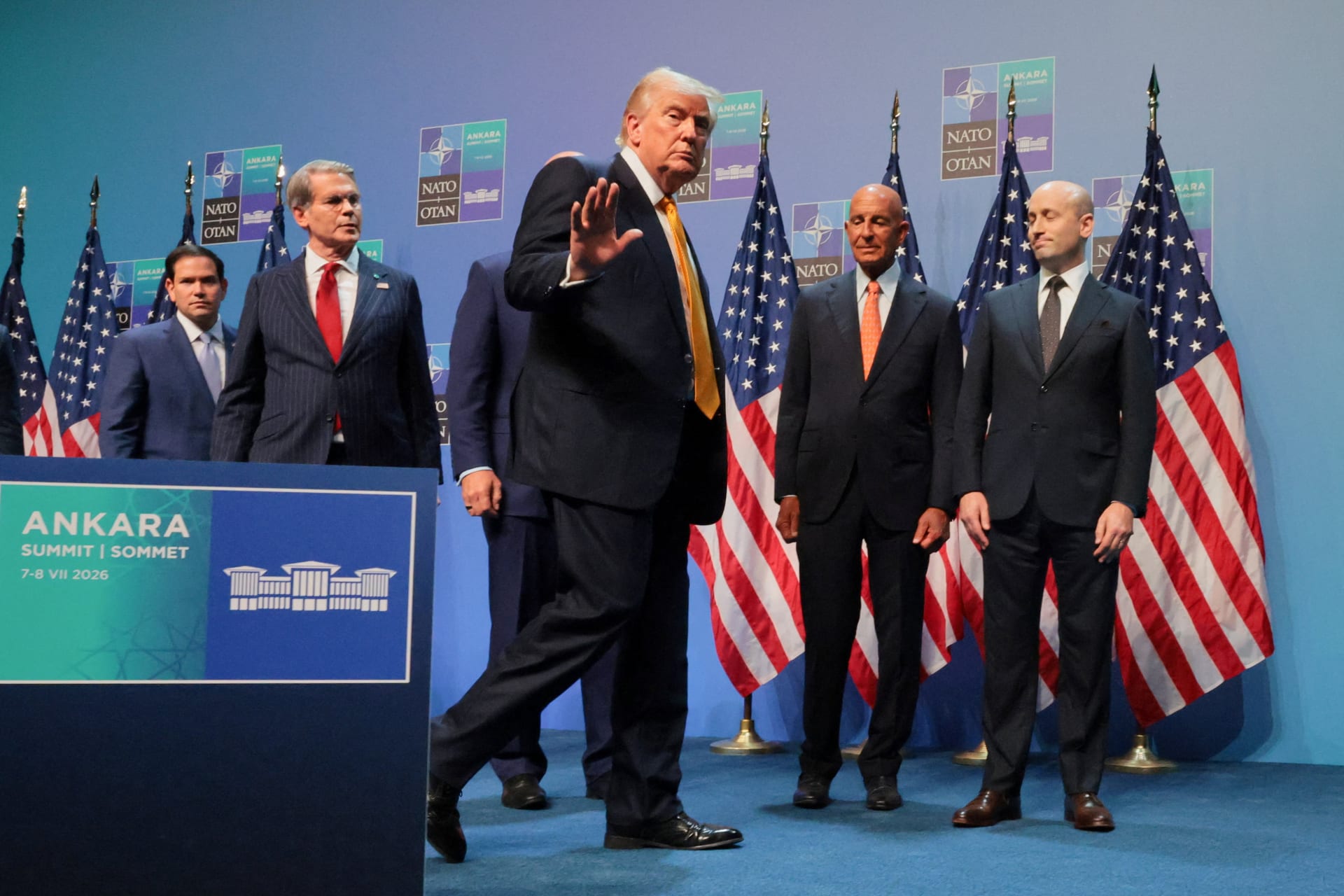
This complex dynamic of fear and love was on full display in Ankara, Turkey, where thirty-two NATO heads of state and key partners just gathered for the alliance’s thirty-sixth summit.
After leaving the closed door leaders’ dialogue, President Donald Trump pronounced, “There was a lot of love in that room, a lot of unity.” Most NATO leaders had been biting their nails, worrying about whether there would be a blow up with Trump at the summit over their reluctance to support U.S. efforts against Iran. An expression of love was certainly not high in the prediction markets.
Going in, fear was certainly thought to be the safer bet. Trump recently criticized NATO as a “paper tiger” that “wasn’t there for us” in the war in Iran. He has threatened multiple times to withdraw all U.S. troops stationed in Europe. And, most notably at Davos but again at the Ankara summit, he said the United States should control Greenland, an autonomous territory of NATO member state Denmark.
Rather than harp on the negative, Trump preferred to accentuate the positive, calling the NATO leaders smart, showering NATO Secretary General Mark Rutte with bouquets of compliments, and taking a victory lap for securing a significantly greater commitment of resources by other NATO countries for defense.
When French President Emmanuel Macron, German Chancellor Friedrich Merz, European Commission President Ursula von der Leyen, and other NATO leaders vowed earlier this year to pursue “strategic autonomy” for Europe, the move could have been seen as a rebuff of the president. But in many ways, it was an embrace of an idea he has long championed: a strong Europe, able to defend itself and fight, if necessary, without the United States.
Our European allies have a long history of flirting with the concept of autonomy without making the necessary investments to achieve it, but this time may be different. The European Commission’s ReArm Europe initiative, which is designed to unlock more than €800 billion in defense spending, as well as its €150 billion SAFE defense loan program, demonstrate a seriousness of purpose toward balancing and hedging against the United States. At the same time, members agreed to new spending commitments last year, a goal of 3.5 percent (+1.5 percent on related infrastructure spending) by 2035. And spending is far outpacing that ten-year timeline. Germany (which amended its constitution to finance defense spending), Poland, and the Baltic states are leading the way, with Germany set to hit 3.5 percent by 2029, the Baltic states near or already spending 3.5 percent, and Poland on track for 5 percent. These figures would likely be materially lower were it not for Trump instilling fear. Of course, Russian President Vladimir Putin’s full-scale invasion of Ukraine had something to do with it as well.
NATO’s spending boom is taking shape under the auspices of what the Trump administration calls “NATO 3.0,” a Pentagon-coined vision in which Europe assumes primary responsibility for its own conventional defense, freeing the United States to concentrate on priorities elsewhere while serving as Europe’s primary arms supplier and the provider of NATO’s nuclear deterrent. To that end, the Trump administration has already withdrawn 5,000 troops stationed in Germany, mused about cutting the United States’ contribution to the NATO Force Model by one-third to one-half, and launched a six-month review of its roughly eighty-thousand-troop presence in Europe–even as reports suggest it may offset any conventional drawdown with an expanded nuclear footprint on the continent. This could be a difficult adjustment for Europe, but Rutte promised to “breathe life” into the concept.
Meanwhile, NATO allies announced more than $50 billion in new procurements—among them European purchases of Northrop Grumman surveillance drones. Given the pressure of European taxpayers to spend their increased defense dollars in Europe, there is likely to be more co-production of U.S. weapon systems on European soil. A draft agreement between Lockheed Martin and Rheinmetall to produce ATACMS missiles in Germany, the first manufacture of that weapon outside the United States, is one such example. So was Trump’s announcement that Ukraine will be granted licenses to produce Patriot missile interceptors—a permission so far only afforded to Japan and Germany—although it is quite unclear exactly what that means and whether it makes sense to erect a Patriot missile factory in a territory under constant threat of Russia’s bombing, instead of on the soil of a nearby NATO ally, such as Poland, which Russia would be more reluctant to attack.
Ukraine was in many respects the big winner in Ankara. In addition to the Patriot announcement, the fact that it, more than Greenland, Venezuela, or Iran, was the centerpiece of the summit was noteworthy. NATO allies excluding the United States pledged €70 billion in assistance for Ukraine and affirmed their commitments to “sustaining at least equivalent levels in 2027.”
Moreover, the country appears to be back on the U.S. president’s good side. What a difference a year makes. Compare and contrast the Oval Office confrontation in February 2025 with the Ankara lovefest earlier this week, when Trump had nothing but compliments for Ukrainian President Volodymyr Zelenskyy. Over the last year, Ukraine has done a remarkable job in changing both the situation on the ground and, very importantly, the narrative. Now, they are perceived as not only holding on, but winning: making (modest) territorial strides against Russian positions, damaging Crimea, striking oil facilities across Russia, and lighting up the skies of St. Petersburg and even Moscow. Trump likes a winner. Last year, it appeared he thought that would inevitably be Putin. Now? Zelenskyy’s a good hedge.
The alliance is not out of the woods, but few would have predicted that, in a twelve-month span that saw Trump roll out the red carpet for Putin and Denmark deploy troops to Nuuk, Greenland as a response to U.S. territorial ambitions, there would be such public expressions of good feelings—love, even—between the president and our transatlantic allies (with the exception of Spain, perhaps). That is the paradox of Trump’s relationship with and impact on NATO. He might be a tough pill to swallow, but he might also be just what the doctor ordered. The question is whether the side effects, including a loss of trust in the United States as Europe’s fundamental security partner, will outweigh the material benefits over time.
When the United States invaded Iraq in 2003, there were skeptics in Europe, but some European nations followed the U.S. lead and deployed troops there in part because of the role the United States historically played in guaranteeing their security. One of the potential implications of NATO 3.0 and strategic autonomy is that the United States might no longer be able to count on Europe’s support for operations outside the European theater. Witness Iran and the Strait of Hormuz. The United States might find itself less burdened in Europe but more burdened elsewhere.
Let me know what you think about the Ankara NATO summit and what this column should cover next by replying to [email protected].
This work represents the views and opinions solely of the author. The Council on Foreign Relations is an independent, nonpartisan membership organization, think tank, and publisher, and takes no institutional positions on matters of policy.